

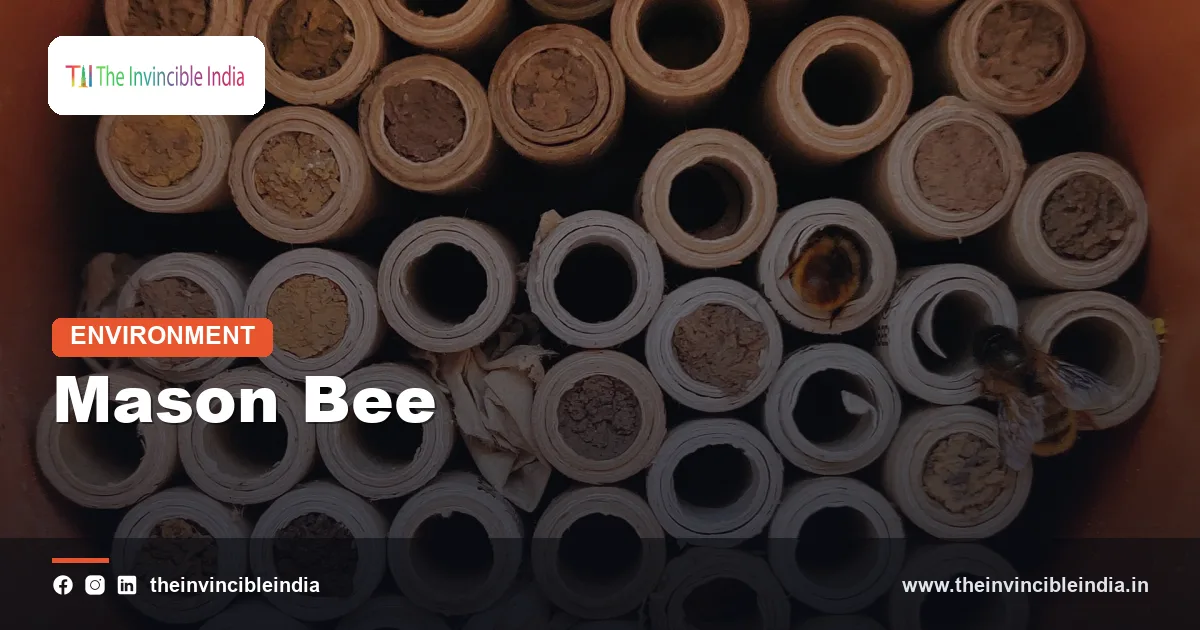
A mason bee is a small, solitary bee of the family Megachilidae that builds its nest cells in hollow stems, old beetle-borer holes and crevices and seals each cell with mud or similar hardened material. Unlike the honey bee, a mason bee does not live in a colony with a queen: every adult female builds, stocks and closes her own nest, which makes the mason bee one of the quiet, hardworking pollinators of Indian gardens, farms and hillsides.
Mason bees are gentle, rarely sting and are efficient at transferring pollen between flowers, yet most people in India notice only their mud-capped nests on walls, bamboo, pipes and window frames. This article explains what a mason bee is, which bees are called by this name in India, how the nests are built, how the life cycle works, and why these insects deserve protection.
Quick Facts
| Attribute | Details |
|---|---|
| Common name | Mason bee (solitary mud-nesting bee) |
| Scientific name / group | Mainly the genera Osmia, Chalicodoma and related genera; order Hymenoptera |
| Family | Megachilidae (the mason, leafcutter and resin bees) |
| Size | Roughly 6 to 20 mm in body length, depending on the species |
| Habitat in India | Gardens, farmland edges, forest margins, old walls, bamboo and Himalayan hillsides |
| Diet | Adults feed on nectar; larvae feed on a stored mixture of pollen and nectar |
| Life cycle | Complete metamorphosis: egg, larva, pupa and adult, usually one generation a year |
| Role | Pollinator of wild plants, fruit trees, vegetables and pulses |
Key Takeaways
- A mason bee is a solitary bee in the family Megachilidae in which each female builds and provisions her own nest without a queen or workers.
- Mason bees seal their nest cells with mud, clay or chewed plant material, which is the origin of the name “mason”.
- A female mason bee carries pollen dry on a brush of hairs under her abdomen, so much of it drops onto flowers and makes her an efficient pollinator.
- Mason bees are non-aggressive, and males have no sting at all, so the insects are safe around homes and gardens.
- Mason bees are threatened mainly by pesticide use, loss of flowering plants and the disappearance of nesting sites such as dead stems and old wood.
- Providing hollow stems, bamboo pieces and a source of damp clay is a simple way to support mason bees in an Indian garden.
What is a mason bee?
A mason bee is a solitary, mud-using bee that belongs to the family Megachilidae, a large family that also includes the leafcutter bees and resin bees. The word “mason” refers to the habit of building partitions and caps of mud, much as a human mason builds walls with mortar.
The family Megachilidae is recognised by several features. Its members have long mouthparts suited to deep flowers, and the females have a pollen-carrying brush, called a scopa, on the underside of the abdomen rather than on the hind legs. Many species also fold their wings flat over the back when at rest. A mason bee is usually stout, dark or metallic in colour, and often has a hairy body in shades of grey, brown, black, blue or green.
The term “mason bee” is a common name, not a single scientific species. It is applied to different groups in different parts of the world. In Europe and North America it usually means species of the genus Osmia, while in the tropics and subtropics it is often used for larger mud-nesting species of Chalicodoma and related genera.
Which bees in India are called mason bees?
In India, the name mason bee covers several Megachilidae, chiefly species of Chalicodoma in the plains and species of Osmia and related genera in the cooler Himalayan zone. Because the group is large and still being studied, the exact list of species varies between regional surveys.
The larger Chalicodoma bees build compact nests of mud mixed with small pebbles on walls, rock faces, tree trunks and the undersides of ledges. These nests dry as hard as cement and can last for years. Smaller mason bees, including Osmia and some related genera, use pre-existing tubes and rarely build exposed mud nests.
It is easy to confuse these insects with wasps. Many mud structures on Indian walls, such as the tubular “organ-pipe” nests and the round pots, are in fact built by mud-dauber wasps and potter wasps, which stock their cells with paralysed insects or spiders. A mason bee, by contrast, stocks its cells with pollen and nectar. The two groups can be told apart by looking at the insect: a bee is hairy and carries pollen, while a wasp is smooth with a narrow waist.
How does a mason bee build its nest?
A mason bee builds its nest by finding a ready-made cavity or a sheltered surface, collecting mud or clay, and dividing the space into a row of small cells separated by mud walls. Each cell holds one egg and its food supply.
The steps are as follows.
- Choosing a site: The female inspects hollow plant stems, bamboo, drilled holes in wood, gaps in masonry and abandoned insect burrows. The tube must be dry, sheltered and of the right width for her body size.
- Collecting mud: She gathers damp clay or mud from the ground, rolls it into a small pellet with her jaws and carries it back to the nest.
- Building the cell: She lines the back of the tube, then stocks it with pollen and nectar before laying an egg on top of the food.
- Making a partition: She seals the cell with a mud wall and starts the next cell in front of it.
- Closing the nest: When the tube is nearly full, she leaves an empty vestibule space and closes the entrance with a thicker mud plug.
A single nest may contain around half a dozen to a dozen cells in a tube, though the number depends on the species and the length of the cavity. The female does not return to guard or feed her young after the nest is sealed.
What does a mason bee eat and how does it carry pollen?
An adult mason bee drinks nectar for its own energy, while the larvae eat a stored ball of pollen mixed with nectar that the mother collects from flowers. The mother makes many trips to build up this food supply, visiting a wide range of flowers.
The pollen-carrying method is the main reason mason bees are valued as pollinators. A female carries pollen loosely in the scopa under her abdomen. Because the pollen is dry and not packed tightly, much of it is rubbed off on the stigma of each flower she lands on. A honey bee, by comparison, moistens its pollen with nectar and packs it into baskets on the hind legs, which keeps it largely out of circulation for pollination.
Mason bees visit a broad range of plants, including wild flowers, mustard, lucerne, legumes, fruit blossoms, sunflower and many garden ornamentals. Some species gather pollen from many plant families, while others specialise in a narrow set of plants. Adult females are active during the warm part of the day, and they need flowers within a short flight of the nest, often only a few hundred metres.
What is the life cycle of a mason bee?
The mason bee life cycle has four stages: egg, larva, pupa and adult, and most species complete one generation in a year. The adult stage is short, often only a few weeks, while the immature stages take up most of the year inside the sealed nest.
| Stage | What happens |
|---|---|
| Egg | The female lays one egg on the pollen-and-nectar mass in each cell. |
| Larva | The grub-like larva eats the stored food and grows through several stages inside the cell. |
| Cocoon and pupa | After the food is finished, the larva spins a silk cocoon and changes into a pupa. |
| Adult in cocoon | In many temperate species, the adult forms inside the cocoon and waits through the cold or dry season. |
| Emergence | The adult chews through the mud plug when the weather warms or the rains arrive. |
In many mason bees the eggs that become females are laid at the back of the tube, where the first and largest food supplies are stored, and the eggs that become males are placed nearer the entrance. The males therefore emerge first, a pattern called protandry. After mating, each female looks for a new nest site and begins the cycle again.
How is a mason bee different from a honey bee?
A mason bee differs from a honey bee mainly in social behaviour: the mason bee is solitary and has no hive, while the honey bee lives in a large colony with a queen, workers and drones. The two groups also differ in how they nest and how they carry pollen.
| Feature | Mason bee | Honey bee |
|---|---|---|
| Social structure | Solitary; each female nests alone | Colony with queen, workers and drones |
| Nest material | Mud, clay or plant material in tubes and cavities | Wax combs in a cavity or open comb |
| Honey production | None for human use | Stores honey in large quantities |
| Pollen carrying | Dry, on the abdomen scopa | Moist pellets on the hind legs |
| Temperament | Docile; males cannot sting | Defends the hive and may sting in numbers |
| Family | Megachilidae | Apidae (genus Apis) |
India has four widely known honey bee species of the genus Apis: the rock bee Apis dorsata, the Indian hive bee Apis cerana, the little bee Apis florea and the introduced European honey bee Apis mellifera. The mason bee is not related to the honey-making habit of these species and offers no honey, but it complements them as a pollinator.
Does a mason bee sting?
A mason bee rarely stings: the males have no sting, and the females use theirs only if they are squeezed, trapped or handled roughly. The sting is generally mild compared with that of a honey bee or a wasp.
Because a mason bee has no colony and no stored honey to protect, it has little reason to be defensive. A female spends her time collecting pollen and mud, and she tends to ignore people near her nest. Children and gardeners can safely watch a nest from close range. The sensible precautions are to avoid blocking the nest entrance, to avoid grabbing the insect and to avoid disturbing the cells.
People who are allergic to insect venom should still be careful, since any stinging insect can cause a reaction in a sensitive person. For most households, a mason bee nest on a wall or in a bamboo pole poses almost no risk.
Why is the mason bee important for crops and gardens?
The mason bee is important because it pollinates a wide range of wild plants, fruit trees, vegetables and pulses, helping flowers set fruit and seed. Pollination by bees contributes to the yield and quality of many Indian crops, and solitary bees add resilience beyond what honey bees alone provide.
Crops that benefit from bee visits in India include mustard, sunflower, lucerne, cucurbits such as ash gourd, pulses, citrus, mango, apple in the hills, and many vegetable seed crops. Wild solitary bees also pollinate native plants, which sustains the food supply of birds and mammals that eat the fruit and seeds.
In parts of Japan, Europe and North America, certain Osmia species are managed on purpose for orchard pollination, because they work in cool and cloudy weather when honey bees stay in the hive. In India, systematic management of mason bees is less common, and wild populations do most of the work. Protecting the habitat of these wild bees is therefore the practical route to benefit from them.
What threatens the mason bee?
The mason bee is threatened mainly by pesticide exposure, loss of flowering plants, destruction of nesting sites and a changing climate. These pressures affect most wild bees, not only mason bees.
- Pesticides: Insecticides sprayed on flowering crops, especially systemic types such as neonicotinoids, can poison foraging bees and contaminate pollen fed to larvae.
- Loss of flowers: Monoculture farming, herbicide use and the clearing of field edges remove the varied blossoms that a bee needs across a season.
- Loss of nesting sites: Tidy gardens, the removal of dead stems and old wood, and the sealing of wall gaps leave fewer places to nest.
- Natural enemies: Parasitic wasps, cuckoo bees that lay eggs in the host nest, mites and fungi can destroy a large share of the cells.
- Climate change: Shifts in the timing of flowering and emergence can leave bees active when few flowers are available.
Because mason bees do not store honey and are scattered individually, their declines are harder to notice than those of colony bees. Surveys of solitary bees in India remain limited, so the exact status of many species is still being worked out.
How can people support mason bees in India?
People can support mason bees by providing safe nesting tubes, a patch of damp clay, a continuous supply of flowers and a garden free from harmful sprays. These measures cost little and work in a balcony, a school ground or a farm boundary.
- Offer nesting tubes: Bundles of hollow bamboo or reed pieces, cut so that one end is closed by a node, can be tied together and fixed under a sheltered eave. The openings should face away from heavy rain and the tubes should be cleaned or replaced regularly.
- Leave dead stems and old wood: Cut stems and wooden posts with small holes are natural nesting sites and should not be cleared out all at once.
- Keep a source of mud: A shallow patch of bare, damp clay soil allows females to collect building material.
- Plant a succession of flowers: Native flowering plants that bloom in different months keep pollen available across the active season.
- Avoid pesticides: Spraying should be avoided when plants are in flower, and non-chemical pest control is preferable.
Even a small bee hotel placed in a safe, sunny and sheltered spot is often occupied within a season if flowers are nearby. Tubes that are too narrow, too damp or mouldy should be replaced, since poor-quality nests encourage mites and fungi.
Bottom Line
The mason bee is a solitary, mud-using pollinator of the family Megachilidae that works quietly in Indian gardens, fields and hills. It is gentle, effective at moving pollen and easy to support with simple nesting tubes, damp clay and a pesticide-free flowering garden.
Frequently Asked Questions
What is a mason bee?
A mason bee is a solitary bee of the family Megachilidae that builds nest cells in hollow stems and holes and seals them with mud. Each female builds and stocks her own nest, with no queen and no workers. The name refers to the use of mud as a building material.
Does a mason bee make honey?
No, a mason bee does not make honey for human use. Females collect pollen and nectar only to feed their own larvae in small, separate cells. The bee is valued for pollination and not for honey or wax.
Is a mason bee dangerous to humans?
No, a mason bee is not dangerous to most people, because it is docile and rarely stings. Males have no sting, and females use theirs only when handled or squeezed. The sting is mild, though people with insect-venom allergy should still be careful.
How do I tell a mason bee nest from a wasp nest?
A mason bee nest is usually a mud-sealed row of cells in a tube or a hard mud mass stocked with pollen, while a wasp nest is stocked with paralysed insects or spiders. Mud-dauber and potter wasps also build mud structures on Indian walls. The insect itself helps: a bee is hairy and carries pollen, whereas a wasp is smooth and narrow-waisted.
Where do mason bees live in India?
Mason bees live in gardens, farmland edges, forest margins, old walls and hillsides across India, wherever flowers and nesting cavities are available. Larger mud-nesting species are common on walls and rocks in the plains. Smaller tube-nesting species occur in cooler hill regions as well.
How long does a mason bee live?
An adult mason bee lives for only a few weeks, but the full life cycle from egg to adult usually takes about a year. Most of that time is spent as a larva, pupa and sleeping adult inside the sealed nest. The adult emerges when the weather or the rains suit flowering plants.
{“@context”:”https://schema.org”,”@graph”:[{“@type”:”FAQPage”,”mainEntity”:[{“@type”:”Question”,”name”:”What is a mason bee?”,”acceptedAnswer”:{“@type”:”Answer”,”text”:”A mason bee is a solitary bee of the family Megachilidae that builds nest cells in hollow stems and holes and seals them with mud. Each female builds and stocks her own nest, with no queen and no workers. The name refers to the use of mud as a building material.”}},{“@type”:”Question”,”name”:”Does a mason bee make honey?”,”acceptedAnswer”:{“@type”:”Answer”,”text”:”No, a mason bee does not make honey for human use. Females collect pollen and nectar only to feed their own larvae in small, separate cells. The bee is valued for pollination and not for honey or wax.”}},{“@type”:”Question”,”name”:”Is a mason bee dangerous to humans?”,”acceptedAnswer”:{“@type”:”Answer”,”text”:”No, a mason bee is not dangerous to most people, because it is docile and rarely stings. Males have no sting, and females use theirs only when handled or squeezed. The sting is mild, though people with insect-venom allergy should still be careful.”}},{“@type”:”Question”,”name”:”How do I tell a mason bee nest from a wasp nest?”,”acceptedAnswer”:{“@type”:”Answer”,”text”:”A mason bee nest is usually a mud-sealed row of cells in a tube or a hard mud mass stocked with pollen, while a wasp nest is stocked with paralysed insects or spiders. Mud-dauber and potter wasps also build mud structures on Indian walls. The insect itself helps: a bee is hairy and carries pollen, whereas a wasp is smooth and narrow-waisted.”}},{“@type”:”Question”,”name”:”Where do mason bees live in India?”,”acceptedAnswer”:{“@type”:”Answer”,”text”:”Mason bees live in gardens, farmland edges, forest margins, old walls and hillsides across India, wherever flowers and nesting cavities are available. Larger mud-nesting species are common on walls and rocks in the plains. Smaller tube-nesting species occur in cooler hill regions as well.”}},{“@type”:”Question”,”name”:”How long does a mason bee live?”,”acceptedAnswer”:{“@type”:”Answer”,”text”:”An adult mason bee lives for only a few weeks, but the full life cycle from egg to adult usually takes about a year. Most of that time is spent as a larva, pupa and sleeping adult inside the sealed nest. The adult emerges when the weather or the rains suit flowering plants.”}}]}]}


