

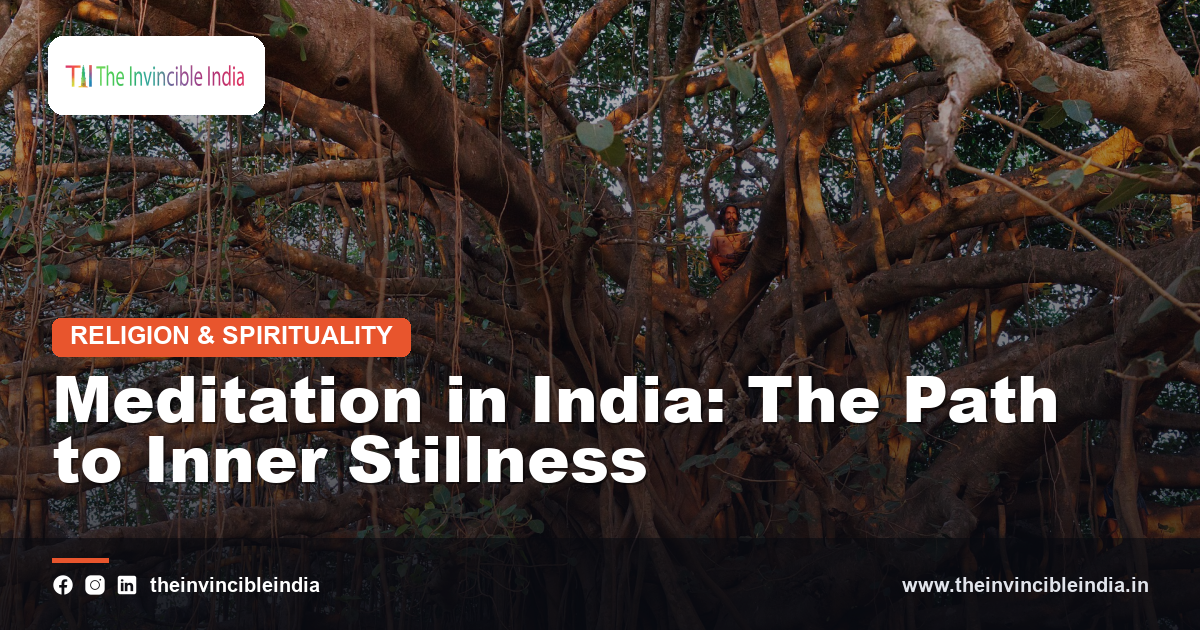
Meditation has its deepest and most ancient roots in India, where the great spiritual traditions developed, over thousands of years, profound techniques for stilling the mind, deepening awareness and attaining inner peace and self-realisation. From the sages of the Vedic age to the Buddha and the masters of yoga, India gave the world a rich heritage of meditative practice, aimed at calming the restless mind, transcending ordinary consciousness and reaching the deepest truths of the self and reality. Today, meditation born of these Indian traditions has spread across the world, valued for its spiritual depth and its benefits for well-being. This guide explores the roots, traditions, types, benefits and global spread of meditation, one of India’s great gifts to spiritual humanity.
Quick Facts
| Detail | Information |
|---|---|
| Origin | Ancient roots in the spiritual traditions of India |
| Sanskrit term | Dhyana, meaning meditation |
| Traditions | Central to yoga, Hinduism, Buddhism and Jainism |
| Goal | Stilling the mind, inner peace and self-realisation |
| Types | Many, from concentration to mindfulness to mantra |
| Global spread | Now practised around the world |
The Ancient Home of Meditation
India is the ancient home of meditation, the land where the practice was most deeply developed and from which its great traditions flowed to the world. For thousands of years, the sages, yogis and spiritual masters of India explored the inner world of the mind and consciousness, developing sophisticated techniques for stilling the restless mind and attaining higher states of awareness and peace. Meditation lies at the heart of the spiritual traditions of India, from the ancient Vedic sages to the masters of yoga and the Buddha. As the ancient home of meditation, where the practice reached extraordinary depth and refinement, India has given the world one of its most precious spiritual gifts, a heritage of inner discipline now valued across the globe.
Ancient Roots
The roots of meditation in India reach back into deep antiquity, to the sages of the Vedic age and the profound explorations of consciousness recorded in the ancient texts. The Upanishads, the philosophical texts of the Vedic tradition, reflect deep meditative insight into the nature of the self and reality, and the practice of meditation was central to the spiritual life of the ancient sages. From these ancient roots, meditation developed into a highly refined discipline across the Indian traditions. This great antiquity, reaching back to the earliest spiritual explorations of India, gives meditation in India a heritage of thousands of years, making it one of the most ancient and deeply developed spiritual practices in the world.
Meditation and Yoga
Meditation is at the heart of yoga, the great Indian discipline of spiritual practice, and the two are deeply connected. In the classical system of yoga, meditation is a central and culminating practice, the discipline through which the mind is stilled and higher states of consciousness attained, building on the foundations of ethical living, physical discipline and control of the breath. The classical text on yoga sets out a path in which meditation leads towards the deepest spiritual realisation. This close connection between meditation and yoga reflects the Indian understanding of meditation as a discipline of the whole being, and the tradition of yoga has been one of the great vehicles for the development and transmission of meditative practice.
The Yoga of Patanjali
A foundational text for the tradition of meditation and yoga is the classical treatise on yoga attributed to the sage Patanjali, which sets out a systematic path of spiritual discipline culminating in meditation and the highest realisation. This influential work describes a graded path, including ethical foundations, physical and breathing disciplines, the withdrawal of the senses, concentration, meditation and, finally, the deepest state of absorption. It provides a profound and systematic framework for the practice of meditation as part of the spiritual path. The classical yoga of Patanjali is one of the great foundations of the Indian meditative tradition, offering a clear and profound map of the inner journey from ethical living to the deepest states of meditation and realisation.
The Goal of Meditation
The goal of meditation in the Indian traditions goes far beyond mere relaxation, aiming at the stilling of the restless mind, the deepening of awareness, and ultimately the highest spiritual realisation. Through meditation, the practitioner seeks to calm the constant activity of the mind, to gain insight into the nature of the self and reality, and to attain inner peace, higher states of consciousness and, ultimately, liberation. Meditation is thus a spiritual discipline directed towards the deepest goals of the spiritual life. This profound understanding of the goal of meditation, as a path to self-realisation and liberation rather than merely a technique for relaxation, is characteristic of the Indian traditions and gives their meditative practices their depth and seriousness.
Concentration Meditation
One of the fundamental forms of meditation developed in India is concentration meditation, in which the mind is focused single-pointedly on a chosen object, such as the breath, a sacred word, an image or a point of focus. By concentrating the mind on a single object and gently returning to it whenever it wanders, the practitioner develops focus, calm and stability of mind, quieting the restless flow of thoughts. Concentration is a foundational practice in many meditative traditions, often the basis on which deeper meditation is built. This practice of focusing the mind single-pointedly, developing concentration and calm, is one of the essential techniques of the Indian meditative tradition and a foundation of many of its methods.
Mindfulness and Awareness
Another great form of meditation developed in India, especially in the Buddhist tradition, is the practice of mindfulness and awareness, in which the practitioner observes the present moment, the breath, the body, the sensations, thoughts and feelings, with clear, non-judgemental awareness. Rather than focusing on a single object to the exclusion of all else, mindfulness cultivates an open, attentive awareness of experience as it arises and passes, developing insight into the nature of the mind and reality. This practice of mindful awareness, deeply developed in the Buddhist meditative tradition, is one of the great contributions of Indian spirituality, and in modern times it has spread widely around the world, valued both as a spiritual practice and for its benefits to well-being.
Mantra Meditation
A distinctive and widely practised form of meditation in India is mantra meditation, in which a sacred word, sound or phrase, a mantra, is repeated, silently or aloud, as the focus of the practice. The repetition of the mantra focuses and calms the mind, and the sacred sound is believed to carry spiritual power and to attune the practitioner to the divine. Mantra meditation is deeply rooted in the Indian traditions, in which sacred sound has always been held to have great power, and it is one of the most popular and accessible forms of meditation. This practice of meditating through the repetition of a sacred mantra is one of the characteristic and beloved techniques of the Indian meditative tradition.
Meditation in Buddhism
Meditation is absolutely central to Buddhism, which arose in India and developed profound meditative techniques as the very heart of its path to liberation. The Buddha attained enlightenment through meditation, and the practice is essential to the Buddhist way, including techniques of calm and concentration and, above all, the practice of insight or mindfulness meditation aimed at seeing the true nature of reality and attaining the ending of suffering. Buddhist meditation, developed over centuries, is one of the great meditative traditions of the world. Born in India and spread across Asia and beyond, Buddhist meditation, especially the practice of mindfulness, has had an immense influence and is among the most widely practised meditative traditions today.
Meditation in Jainism
Meditation also holds an important place in Jainism, the ancient Indian religion of non-violence, as a means of purifying the soul and advancing towards liberation. Jain meditation is directed towards self-discipline, the purification of the mind and soul from the effects of karma, and the realisation of the true nature of the self, and it is an important part of the Jain spiritual path, especially for ascetics. The Jain tradition has its own profound meditative practices, aimed at detachment, self-realisation and liberation. This meditative tradition of Jainism adds another dimension to the rich heritage of meditation in India, reflecting the shared emphasis of the Indian traditions on inner discipline and the meditative path to spiritual liberation.
States of Deep Meditation
The Indian traditions describe profound states of deep meditation that lie beyond ordinary consciousness, the highest attainments of the meditative path. In the classical yoga tradition, the deepest state of meditation is a state of complete absorption, in which the ordinary sense of separateness dissolves and the practitioner attains the highest realisation. Other traditions describe similar profound states of deep meditative absorption and spiritual insight. These states, attained through long and dedicated practice, represent the summit of the meditative path and the deepest spiritual experiences it offers. The description of these profound states of deep meditation, and the map of the path towards them, is one of the remarkable achievements of the Indian meditative traditions and reflects the great depth of their inner exploration.
The Benefits of Meditation
While the ultimate goal of meditation in the Indian traditions is spiritual, the practice also brings many benefits for the mind and well-being, which have contributed to its worldwide popularity. Meditation is widely recognised to promote calm, reduce stress and anxiety, improve focus and clarity of mind, and foster emotional balance and a sense of peace. These benefits, increasingly studied and valued in the modern world, have made meditation attractive to many people seeking well-being, quite apart from its spiritual dimension. This combination of profound spiritual purpose and practical benefits for the mind and well-being is one of the reasons for the enduring value and the modern global popularity of meditation, which offers gifts to both the seeker and the person seeking peace of mind.
The Role of the Teacher
In the Indian traditions, meditation has traditionally been learned under the guidance of a teacher or guru, who transmits the practice and guides the student on the inner journey. The subtle art of meditation, and especially the navigation of the deeper states and experiences it brings, has been held to require the guidance of an experienced teacher who has walked the path, and the relationship between teacher and student has been central to the transmission of meditative traditions. This emphasis on learning meditation under proper guidance reflects the depth and subtlety of the practice in the Indian traditions. The role of the teacher in guiding the student on the meditative path is an important feature of the way these profound practices have been transmitted across the generations.
Meditation Goes Global
In modern times, meditation born of the Indian traditions has spread across the world, becoming one of India’s most influential gifts to global culture. Through the teaching of Indian masters, the spread of yoga and Buddhism, and the growing interest in Indian spirituality, meditative practices from India have been embraced by millions of people around the world, valued both for their spiritual depth and for their benefits to well-being. Meditation is now practised globally, in spiritual, secular and therapeutic settings alike, and its techniques have entered the mainstream of health and wellness. This global spread of meditation, carrying an ancient Indian heritage to the whole world, is a remarkable testament to the enduring value and universal appeal of the Indian meditative traditions.
Meditation Today
Today meditation flourishes both as a living spiritual practice in the traditions of India and as a global practice embraced by millions around the world. In India, it continues to be practised as part of the spiritual paths of the great traditions, from yoga to Buddhism to Jainism, aimed at inner peace and self-realisation. Around the world, meditation is practised for spiritual growth and for well-being, its ancient Indian techniques valued in an age of stress and distraction. Ancient yet ever relevant, profound yet practical, meditation remains one of India’s greatest gifts to humanity, an inner discipline of stillness and awareness that continues to offer peace, insight and the path to self-realisation to seekers everywhere.
Sources & Further Reading
- Ministry of Culture and Ministry of AYUSH, Government of India, on meditation and yoga (indiaculture.gov.in).
- The Yoga Sutras of Patanjali, a classical text on meditation and yoga.
Frequently Asked Questions
What is the origin of meditation?
Meditation has its deepest and most ancient roots in India, where the great spiritual traditions developed, over thousands of years, profound techniques for stilling the mind and attaining inner peace and self-realisation, from the Vedic sages to the Buddha and the masters of yoga.
What is the goal of meditation in Indian traditions?
In the Indian traditions, the goal of meditation goes beyond relaxation, aiming at the stilling of the restless mind, the deepening of awareness, insight into the nature of the self and reality, and ultimately the highest spiritual realisation and liberation.
What are the main types of meditation?
The main types of meditation developed in India include concentration meditation, focusing the mind on a single object; mindfulness or insight meditation, cultivating open awareness of the present moment; and mantra meditation, repeating a sacred word or sound.
How is meditation related to yoga?
Meditation is at the heart of yoga, the great Indian discipline of spiritual practice. In the classical system, meditation is a central and culminating practice, building on ethical living, physical discipline and control of the breath towards the deepest realisation.
What are the benefits of meditation?
While the ultimate goal of meditation is spiritual, the practice also promotes calm, reduces stress and anxiety, improves focus and clarity of mind, and fosters emotional balance and peace, benefits that have contributed to its worldwide popularity.


