

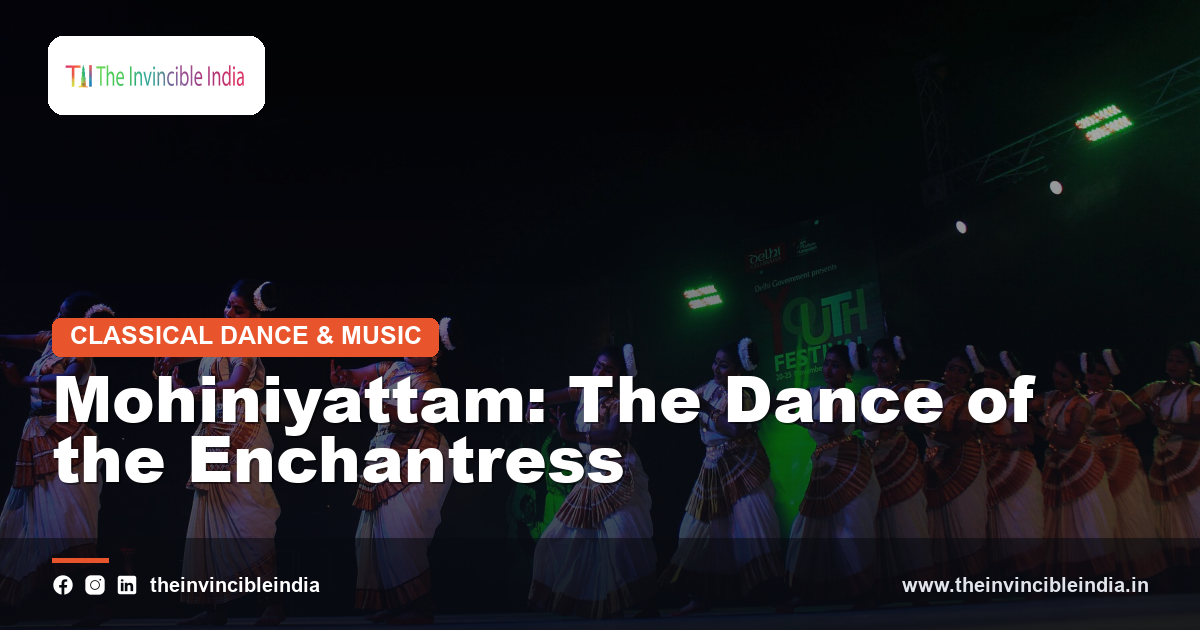
Mohiniyattam is one of the eight classical dance forms of India and, with Kathakali, one of the two classical dances of Kerala. Its name means the dance of Mohini, the enchantress, a female form taken by the god Vishnu, and the dance embodies feminine grace, tenderness and charm. Marked by gentle, swaying movements likened to swaying palms and rolling waves, and performed in a distinctive white-and-gold costume, Mohiniyattam is the most lyrical and graceful of the classical forms, belonging to the soft, delicate style known as lasya. This guide traces its history, technique, music, costume and revival, and its place among the treasures of Indian classical dance.
Quick Facts
| Detail | Information |
|---|---|
| Type | One of India’s eight classical dance forms |
| Origin | Kerala, South India |
| Meaning | The dance of Mohini, the enchantress form of Vishnu |
| Style | Lasya, the gentle and graceful feminine style |
| Costume | White or off-white sari with a gold border (kasavu) |
| Revival | Reinvigorated in the twentieth century at the Kerala Kalamandalam |
The Dance of the Enchantress
Mohiniyattam takes its name and spirit from Mohini, the enchantress, a beautiful female form assumed by the god Vishnu in Hindu mythology. The dance embodies the grace, charm and allure associated with this figure, and it is the most gently feminine of the classical forms. Every element of the dance, from its soft, swaying movements to its serene expression and its elegant white costume, expresses this quality of enchanting loveliness. Belonging to the lasya style, the delicate and graceful mode of dance, Mohiniyattam is a study in tenderness and refinement, a flowing, lyrical art that seeks to charm and move the viewer through beauty rather than force.
A Classical Dance of Kerala
Mohiniyattam is one of the two classical dances of Kerala, alongside the dramatic Kathakali, and the two form a striking contrast: Kathakali is bold, theatrical and traditionally performed by men, while Mohiniyattam is gentle, lyrical and traditionally performed by women. Together they express the range of Kerala’s rich performing-arts heritage, drawing on the region’s music, mythology and cultural traditions. Mohiniyattam shares with the wider culture of Kerala its language, its devotional themes and its distinctive musical tradition, and it is deeply rooted in the artistic life of the region. It stands as one of Kerala’s most graceful contributions to the classical dance of India.
Historical Development
Mohiniyattam developed in Kerala over the centuries, drawing on the region’s temple and performance traditions and on the wider grammar of Indian classical dance set out in the ancient treatises. It took recognisable shape as a distinct classical form in the era of the princely states of Kerala, when it was nurtured under royal patronage. Like several classical dances, it passed through a period of decline before being revived and reshaped in the twentieth century. Its history thus combines deep roots in Kerala’s devotional and courtly culture with a modern renaissance that restored it to the concert stage and secured its place among the great classical arts of India.
Royal Patronage
Mohiniyattam owes much of its development to the patronage of the rulers of Travancore, in southern Kerala, who supported the arts and helped shape the classical traditions of the region. The most celebrated of these patrons was the nineteenth-century ruler and composer Swathi Thirunal, a great supporter of music and dance whose compositions enriched the repertoire of Mohiniyattam and other arts. Under such royal support, the dance was cultivated and refined, gaining in sophistication and gaining a body of fine musical compositions to accompany it. This courtly patronage was crucial in nurturing Mohiniyattam and preparing the ground for its later flowering as a recognised classical form.
The Twentieth-Century Revival
After a period of decline, Mohiniyattam was revived in the early twentieth century, above all through the efforts of the great Malayalam poet Vallathol Narayana Menon, who founded the Kerala Kalamandalam in the 1930s and made the teaching of Mohiniyattam a central part of its work. The institution trained dancers, systematised the technique and repertoire, and restored the dance to respect and prominence. Devoted teachers, including celebrated women dancers who came to be regarded as mothers of the modern form, refined and expanded the tradition. This revival rescued Mohiniyattam from obscurity and re-established it as a living classical art, taught and performed with pride.
The Lasya Style
Mohiniyattam is the classical embodiment of lasya, the gentle, graceful and lyrical style of dance, as distinct from the vigorous, energetic style known as tandava. Everything about the dance expresses this soft, feminine quality: the slow, swaying movements, the gentle rhythms, the tender expression and the flowing grace of the whole. There is no forceful stamping or sharp, angular movement; instead the body moves in smooth, circular, undulating patterns. This makes Mohiniyattam one of the most soothing and beautiful of the classical dances to watch, a flowing meditation in movement that seeks to evoke serenity, tenderness and charm rather than dramatic power.
Swaying Movements
The signature of Mohiniyattam is its gentle, swaying movement, in which the body sways softly from side to side in graceful, continuous curves, often compared to the swaying of palm trees in the breeze or the gentle rolling of waves along the Kerala coast. The knees bend and the torso and hips move in smooth, flowing arcs, while the footwork is soft and the whole dance seems to glide. This undulating, wave-like quality is central to the beauty of the form and to its enchanting effect. Achieving it with the required grace and control, so that the movement seems effortless, is one of the great skills of the trained Mohiniyattam dancer.
Expression and Abhinaya
While Mohiniyattam is celebrated for its graceful movement, expression, or abhinaya, is equally central to the art. Through subtle facial expression, gentle gesture and the language of the eyes, the dancer interprets devotional and romantic poetry, conveying tender emotions of love, longing and devotion. The expressive pieces allow the dancer to explore the many shades of feeling with delicacy and nuance, drawing the audience into the mood of the song. This refined, understated expressiveness, in keeping with the gentle spirit of the form, is a hallmark of Mohiniyattam, and the finest dancers move their audiences through the smallest and most delicate of gestures.
The Distinctive White Costume
Mohiniyattam has one of the most elegant and recognisable costumes in Indian dance: a white or off-white sari with a rich gold border, in the classic kasavu style of Kerala. This simple yet beautiful attire, so different from the bright colours of many other classical costumes, perfectly suits the dance’s mood of serene grace and purity. The dancer’s hair is gathered into a bun to one side and adorned with flowers, and she wears traditional gold jewellery and the customary make-up that makes expressions read clearly. The white-and-gold costume has become an emblem of Mohiniyattam and adds greatly to its image of enchanting loveliness.
Music and Song
Mohiniyattam is accompanied by soft, melodious music in the classical tradition of Kerala and South India, well suited to the gentle mood of the dance. The songs, often composed in the blended language of Manipravalam and drawn from devotional and romantic poetry, are sung by a vocalist, while instruments including drums, the flute, the veena and cymbals provide rhythm and melody. The sopana style of temple singing has influenced its music, lending it a devotional character. The gentle, flowing music mirrors the swaying movement of the dance, and the close harmony of sound and movement is essential to the serene, enchanting atmosphere of a Mohiniyattam performance.
The Repertoire
The repertoire of Mohiniyattam includes both items of pure dance and expressive, interpretive pieces, arranged in a recital sequence that displays the range of the form. It typically opens with invocatory and pure-dance items that establish the rhythmic and graceful character of the dance, followed by expressive pieces in which the dancer interprets devotional and romantic songs through abhinaya. The compositions of royal patrons and later masters form part of this repertoire, and the recital moves between the beauty of pure movement and the tenderness of expression. This structured sequence gives a Mohiniyattam performance its shape and allows the dancer to reveal every facet of the graceful art.
Mothers of the Modern Form
The modern flowering of Mohiniyattam owes much to a number of devoted women dancers and teachers who, in the wake of the twentieth-century revival, refined the technique, enriched the repertoire and trained new generations. Working at the Kerala Kalamandalam and beyond, these artists shaped the classical form as it is danced today and are honoured as mothers of the modern tradition. Their dedication carried Mohiniyattam from its revival into a full and flourishing life, giving it a clear technique, a rich repertoire and a lineage of accomplished dancers. Their legacy lives on in the many performers who continue to cherish and develop the art.
Training and Discipline
Mastering Mohiniyattam requires years of dedicated training under a guru, through which the dancer develops the soft, controlled, swaying movements that define the style. Students learn to move with grace and fluidity, to hold the gentle postures of the dance, and to command the subtle expression that its interpretive pieces demand, all while absorbing the music and poetry that give the dance meaning. The training instils patience, control and a deep feeling for the lyrical spirit of the form. This long apprenticeship, rooted in the bond between teacher and student, has preserved the delicate art of Mohiniyattam and passes its beauty on to each new generation of dancers.
Mohiniyattam Today
Today Mohiniyattam is cherished as one of India’s classical dances, taught in academies in Kerala and beyond and performed on stages across India and the world. Its serene grace and lyrical beauty have won it admirers everywhere, and dancers continue to study and develop the tradition restored by the twentieth-century revival. Contemporary artists create new choreography while preserving the classical repertoire, and the dance remains rooted in the devotional and cultural life of Kerala. In its swaying movements, its tender expression and its enchanting white-clad grace, Mohiniyattam keeps alive one of the most beautiful and distinctive strands of India’s classical dance heritage.
Sources & Further Reading
- Sangeet Natak Akademi, national academy for music, dance and drama, on the classical dance forms of India (sangeetnatak.gov.in).
- Kerala Kalamandalam, deemed university for art and culture, on Mohiniyattam training and its revival (kalamandalam.org).
- Ministry of Culture, Government of India, on the performing-art traditions of Kerala (indiaculture.gov.in).
Frequently Asked Questions
What is Mohiniyattam?
Mohiniyattam is one of the eight classical dance forms of India and, with Kathakali, one of the two classical dances of Kerala. Its name means the dance of Mohini, the enchantress, and it is known for its gentle, swaying movements, lyrical grace and white-and-gold costume.
What does the name Mohiniyattam mean?
The name Mohiniyattam means the dance of Mohini, referring to the enchantress, a beautiful female form taken by the god Vishnu in Hindu mythology. The dance embodies the grace and charm associated with this figure.
What is the lasya style?
Lasya is the gentle, graceful and lyrical style of dance, as distinct from the vigorous tandava style. Mohiniyattam is the classical embodiment of lasya, expressed through its soft, swaying movements, gentle rhythms and tender expression.
What does a Mohiniyattam dancer wear?
A Mohiniyattam dancer wears a distinctive white or off-white sari with a rich gold border, in the classic kasavu style of Kerala, with the hair gathered into a side bun adorned with flowers, along with traditional gold jewellery.
Who revived Mohiniyattam in the twentieth century?
Mohiniyattam was revived in the early twentieth century, above all through the poet Vallathol Narayana Menon, who founded the Kerala Kalamandalam in the 1930s and made the teaching of the dance central to its work, aided by devoted women dancers and teachers.


