

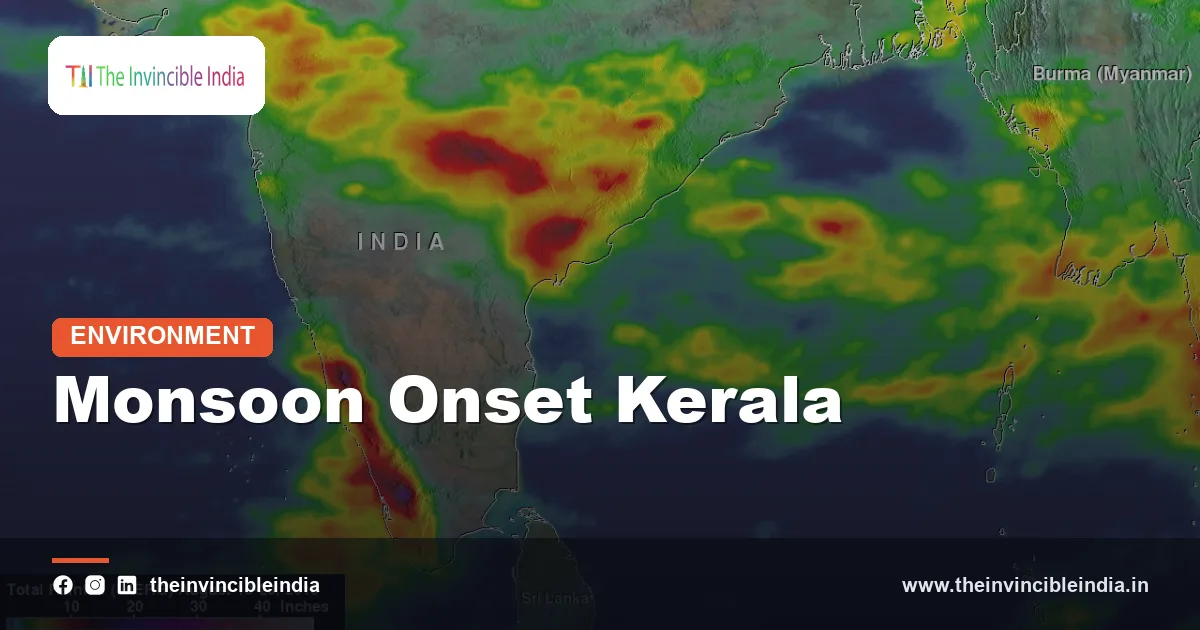
The monsoon onset over Kerala is the official arrival of the southwest monsoon on the Indian mainland, normally declared around 1 June by the India Meteorological Department (IMD) only after a set of rainfall, wind and cloud conditions is met. Because Kerala lies at the southwestern tip of the country, it is the first state to receive the monsoon, and the onset date starts the clock for the entire Indian rainy season. This explainer was last updated on 30 October 2026.
The monsoon onset is a technical declaration and not simply the first rain of the year. The IMD announces it when the monsoon current has become established over Kerala by objective criteria, which prevents a few stray showers from being mistaken for the real monsoon. Farmers, planners and forecasters across India watch the announcement closely, because the date helps shape sowing decisions and expectations for the whole season.
| Attribute | Details |
|---|---|
| Event | Arrival of the southwest monsoon over the Kerala coast |
| Normal date | About 1 June, with a variation of roughly a week either way |
| Declared by | India Meteorological Department (IMD), Ministry of Earth Sciences |
| Preceded by | Onset over the South Andaman Sea and Nicobar Islands, normally around the third week of May |
| Rainfall criterion | Widespread rain of at least 2.5 mm for two consecutive days at a majority of designated stations |
| Other criteria | Westerly winds of adequate depth and strength, and low outgoing longwave radiation indicating deep cloud |
| Local name | Edavappathi, the first monsoon rain of the Malayalam calendar |
| Next milestone | Monsoon reaches Mumbai around 10 to 11 June in a normal year |
Key Takeaways
- The monsoon onset over Kerala is normally declared around 1 June, with a variation of about one week either way.
- The IMD declares the monsoon onset over Kerala only when rainfall, wind and cloud criteria are all met, and not on the basis of a single heavy shower.
- The rainfall criterion requires at least 2.5 mm of rain on two consecutive days at 60 per cent of 14 designated stations in Kerala and neighbouring areas.
- The monsoon onset over Kerala marks the start of the four-month southwest monsoon season, which delivers roughly three-quarters of India’s annual rain.
- The onset date over Kerala is not a reliable predictor of total seasonal rainfall, because an early or late start does not guarantee a good or bad season.
- After the monsoon onset, the rain moves north along the west coast and across the country, and it normally covers all of India by about 8 July.
What Is the Monsoon Onset Over Kerala?
The monsoon onset over Kerala is the declaration that the southwest monsoon has set in over the state, signalling the start of the rainy season on the Indian mainland. Kerala is chosen as the marker because its coast and the Western Ghats are the first land that the moist southwesterly winds strike.
The monsoon does not appear suddenly out of nowhere. The Indian Ocean warms for weeks before, and the winds slowly change. The first sign is usually the monsoon’s arrival over the South Andaman Sea and the Nicobar Islands, normally around 20 May. A few days later, it normally reaches Kerala. In older sources, the sudden strengthening of the rain at this stage is called the “burst of the monsoon”, because the weather changes sharply over a few days.
Kerala has two rainy seasons. The first, the southwest monsoon, is called Edavappathi in Malayalam after the month of Edavam. The second, in October and November, is the northeast monsoon, locally known as Thulavarsham. The onset discussed here refers only to the first.
Why Does the Monsoon Arrive at Kerala First?
The monsoon arrives at Kerala first because the state sits on the southwestern edge of India, directly in the path of the southwesterly winds coming across the Arabian Sea from the equatorial Indian Ocean. The Western Ghats rise just inland, forcing the moist air upward into heavy rain.
The mechanism begins in the months before onset, when northern India heats strongly and a heat low forms. The Intertropical Convergence Zone (ITCZ), the belt of rising air near the equator, moves northward. South-east trade winds from the southern hemisphere cross the equator and curve into southwesterlies. Over the Arabian Sea a fast, low-level wind stream called the Somali Jet, also known as the Findlater Jet, carries large amounts of water vapour towards India. When these winds strengthen and deepen, the monsoon current reaches the coast of Kerala.
The geography of Kerala amplifies the effect. The long coastline faces the sea, and the Western Ghats act as a barrier that squeezes rain out of the air, a process called orographic lift.
How Does the IMD Decide When the Monsoon Has Set In?
The IMD decides that the monsoon has set in over Kerala by applying three objective criteria for rainfall, wind and cloudiness, all of which must be satisfied together. This rule-based approach was adopted to avoid subjective judgements and false starts.
- Rainfall: After 10 May, if at least 60 per cent of 14 designated stations in Kerala and the nearby islands and coast report rainfall of 2.5 mm or more for two consecutive days, the onset may be declared on the second day. The stations include Minicoy, Amini, Thiruvananthapuram, Kochi, Kozhikode, Kannur and Mangaluru.
- Wind field: The depth of the westerly winds should extend up to about 600 hectopascals (roughly 4 kilometres up), and the zonal wind speed over a defined box of the southeast Arabian Sea should be about 15 to 20 knots.
- Cloudiness: Satellite measurements of outgoing longwave radiation (OLR) should fall below a threshold, which indicates thick, deep clouds typical of monsoon convection.
All three conditions together signal that the monsoon current is not a passing system but a stable seasonal circulation. If rain falls before the criteria are met, the IMD does not declare onset. This is why a few days of early showers in Kerala may be described as pre-monsoon rain and not as the monsoon.
What Is the Normal Date and How Much Does It Vary?
The normal date for the monsoon onset over Kerala is 1 June, and the actual date has varied by roughly a week either way in most years, though the extremes have been wider. The IMD’s own statistics show an average variation of about seven days from the normal date.
In practice, recent years have included both early and late starts:
- 2023: Onset was declared on 8 June, a week later than normal.
- 2024: Onset came on 30 May, two days ahead of the normal date.
- 2025: Onset was declared on about 24 May, among the earliest in many years.
Over the long historical record, the earliest onset dates have fallen in mid-May, and the latest in mid-June. The IMD issues a forecast for the onset date every year in mid-May, with a stated model error of about four days. Because the forecast carries uncertainty, the announcement itself is still the final authority.
What Happens After the Monsoon Onset?
After the monsoon onset over Kerala, the monsoon advances northward along the west coast and eastward across India, normally reaching Mumbai around 10 to 11 June, Delhi around 27 June and covering the whole country by about 8 July. These are called normal dates, and the actual progress usually differs in any given year.
The IMD tracks the advance using a line called the northern limit of monsoon, which it plots on maps every day. Two currents advance in parallel: the Arabian Sea branch up the west coast and the Bay of Bengal branch across the north-east and eastern India. The two branches often make rapid progress over several days and then stall, sometimes for a week or more, when the winds weaken or when a low-pressure system fails to form.
The speed of advance matters. A fast advance can cover large areas at once, while a stalled monsoon leaves farmers waiting. In 2023, for instance, a cyclonic storm in the Arabian Sea in June slowed the monsoon’s progress along the west coast soon after onset.
What Is a Monsoon Onset Vortex?
A monsoon onset vortex is a low-pressure circulation that sometimes forms over the southeastern Arabian Sea shortly before the onset and can sharply accelerate it. It draws moisture and strengthens the westerly winds towards Kerala, or, in some cases, pulls the moisture away and stalls the monsoon.
When such a vortex intensifies into a cyclonic storm, it can draw the moisture away from the Kerala coast and steer it towards the northern Arabian Sea. This has happened in some years. The result is a patchy, weak start in which the onset has been declared but the rain over Kerala and the west coast remains scanty for days. The system is a reminder that the monsoon is a dynamic circulation, not a calendar event.
Does an Early or Late Onset Predict the Whole Season?
An early or late monsoon onset over Kerala does not reliably predict the rainfall for the entire season, because the total depends on the whole four-month period and on many other factors. Seasons with a late onset have still ended up normal, and early onsets have been followed by deficient rain.
The reasons are straightforward. After the onset, the rainfall depends on how often low-pressure systems form, on the Madden-Julian Oscillation, on the El Nino-Southern Oscillation (ENSO) and on the Indian Ocean Dipole. A strong start can be followed by a long break, while a slow start can be followed by a vigorous July.
The onset date does matter for specific activities. Farmers in Kerala and Karnataka use it to time paddy transplanting and other kharif sowing, and a delay of even a week can push back planting. Early rain, however, can be misleading, since farmers who sow after a few early showers risk crop loss if a dry spell follows. The IMD therefore advises sowing only after adequate soil moisture is established.
Why Does the Monsoon Onset Matter to India?
The monsoon onset matters because it signals the beginning of the rainy season that supplies most of India’s fresh water and drives agriculture, power demand, travel and the rural economy. A substantial part of Indian farming is rainfed, so the first rain governs when millions of farmers prepare their fields.
- Agriculture: Kharif crops such as rice, cotton, soybean, pulses and groundnut are sown with the monsoon.
- Heat relief: The onset ends the extreme pre-monsoon heat across the south and west, and electricity demand for cooling falls.
- Water supply: Rivers and reservoirs begin to fill, and groundwater recharge begins.
- Marine life and fishing: Seasonal fishing restrictions are in place along the coasts during the monsoon to protect breeding fish and keep boats out of rough seas.
- Tourism and culture: The monsoon is celebrated in Kerala through Ayurvedic rejuvenation tourism, backwater festivals and boat races that follow the rains.
- Markets and policy: Traders, economists and policymakers watch the onset for early signals about food prices and rural demand.
How Is Climate Change Affecting the Monsoon Onset?
Climate change is making the monsoon onset more variable, as warming oceans and shifting circulation patterns change how and when the monsoon winds strengthen. Scientists have noted an increase in cyclonic storms in the Arabian Sea, and these storms have interfered with the onset and advance in some years.
The Arabian Sea has warmed faster than in the past, and warm water provides more energy to onset vortices and pre-monsoon cyclones. Studies also suggest that heavy rain during the first weeks after onset has become more intense on the west coast, raising the risk of floods and landslides in the Western Ghats region, including Kerala.
The long-term trend in the average onset date is not clear, and researchers caution against reading too much into a few early or late years. What is clearer is that forecasters now put more effort into predicting the onset window, monitoring the Arabian Sea and warning coastal communities of extreme rain in the first days of the season.
Bottom Line
The monsoon onset over Kerala is the carefully defined start of India’s main rainy season, declared by the IMD only when rainfall, wind and cloud conditions all agree. It arrives around 1 June in a normal year, but its timing says little about the final seasonal total.
Frequently Asked Questions
When does the monsoon normally arrive in Kerala?
The monsoon normally arrives in Kerala around 1 June. The actual onset date varies by about a week either way in most years.
What is the monsoon onset?
The monsoon onset is the official declaration by the IMD that the southwest monsoon has set in over a region, first over Kerala. It is declared only after rainfall, wind and cloud criteria are met together.
What are the IMD criteria for declaring the monsoon onset over Kerala?
The IMD requires widespread rain of at least 2.5 mm for two consecutive days at 60 per cent of 14 designated stations after 10 May. It also requires westerly winds of sufficient depth and speed over the Arabian Sea and low outgoing longwave radiation showing deep cloud.
Why does the monsoon reach Kerala before the rest of India?
The monsoon reaches Kerala first because the state lies at the southwestern tip of India, where the southwesterly winds from the Arabian Sea first meet land. The Western Ghats then force the moist air upward, causing heavy rain.
Does an early monsoon onset mean a good monsoon season?
No, an early monsoon onset does not guarantee a good season, because seasonal rainfall depends on conditions through June to September. Factors such as El Nino, the Indian Ocean Dipole and the frequency of low-pressure systems matter more than the start date.
How long does the monsoon take to cover all of India after reaching Kerala?
The monsoon normally takes about five weeks to cover India after reaching Kerala. The normal date for covering the entire country is about 8 July, though the actual progress can be faster or slower.
{“@context”:”https://schema.org”,”@graph”:[{“@type”:”FAQPage”,”mainEntity”:[{“@type”:”Question”,”name”:”When does the monsoon normally arrive in Kerala?”,”acceptedAnswer”:{“@type”:”Answer”,”text”:”The monsoon normally arrives in Kerala around 1 June. The actual onset date varies by about a week either way in most years.”}},{“@type”:”Question”,”name”:”What is the monsoon onset?”,”acceptedAnswer”:{“@type”:”Answer”,”text”:”The monsoon onset is the official declaration by the IMD that the southwest monsoon has set in over a region, first over Kerala. It is declared only after rainfall, wind and cloud criteria are met together.”}},{“@type”:”Question”,”name”:”What are the IMD criteria for declaring the monsoon onset over Kerala?”,”acceptedAnswer”:{“@type”:”Answer”,”text”:”The IMD requires widespread rain of at least 2.5 mm for two consecutive days at 60 per cent of 14 designated stations after 10 May. It also requires westerly winds of sufficient depth and speed over the Arabian Sea and low outgoing longwave radiation showing deep cloud.”}},{“@type”:”Question”,”name”:”Why does the monsoon reach Kerala before the rest of India?”,”acceptedAnswer”:{“@type”:”Answer”,”text”:”The monsoon reaches Kerala first because the state lies at the southwestern tip of India, where the southwesterly winds from the Arabian Sea first meet land. The Western Ghats then force the moist air upward, causing heavy rain.”}},{“@type”:”Question”,”name”:”Does an early monsoon onset mean a good monsoon season?”,”acceptedAnswer”:{“@type”:”Answer”,”text”:”No, an early monsoon onset does not guarantee a good season, because seasonal rainfall depends on conditions through June to September. Factors such as El Nino, the Indian Ocean Dipole and the frequency of low-pressure systems matter more than the start date.”}},{“@type”:”Question”,”name”:”How long does the monsoon take to cover all of India after reaching Kerala?”,”acceptedAnswer”:{“@type”:”Answer”,”text”:”The monsoon normally takes about five weeks to cover India after reaching Kerala. The normal date for covering the entire country is about 8 July, though the actual progress can be faster or slower.”}}]}]}


