

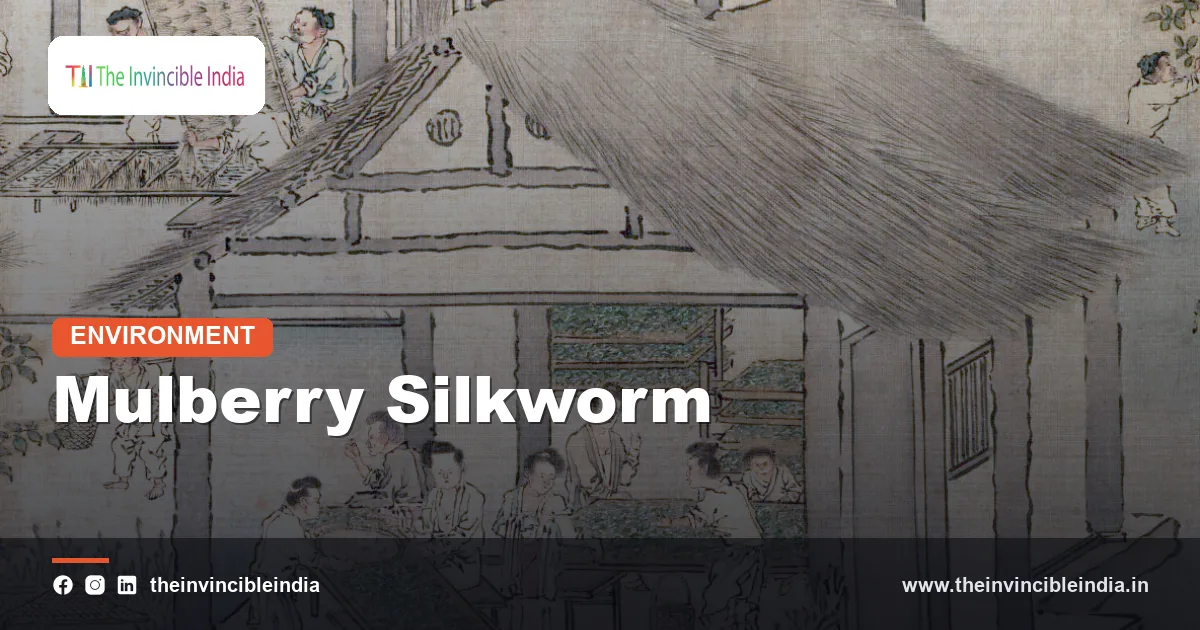
The mulberry silkworm is the caterpillar of the domesticated moth Bombyx mori, an insect reared by people for thousands of years because it spins a continuous silk cocoon that can be unwound into a single fine thread. In India, the mulberry silkworm supplies the largest share of the country’s raw silk, and the craft built around it, called sericulture, supports rural families in Karnataka, Andhra Pradesh, Tamil Nadu, West Bengal, Jammu and Kashmir and several other states.
Unlike almost every other insect an ordinary person will meet, the mulberry silkworm no longer exists in the wild. It has been shaped by human selection so thoroughly that the adult moth cannot fly and the caterpillar depends on a keeper to supply fresh leaves. This article explains what the mulberry silkworm is, how its life cycle works, how silk is obtained, and why this small caterpillar matters to Indian farming, textiles and science.
Quick Facts
| Common name | Mulberry silkworm, domesticated silkworm |
|---|---|
| Scientific name, order, family | Bombyx mori; order Lepidoptera; family Bombycidae |
| Size | Full-grown caterpillar about 6 to 8 cm long; adult moth wingspan roughly 4 to 5 cm |
| Habitat in India | Reared indoors in sericulture sheds; mulberry gardens in Karnataka, Andhra Pradesh, Tamil Nadu, West Bengal, Jammu and Kashmir and other states |
| Diet | Leaves of the mulberry tree (Morus species); adults do not feed |
| Life cycle | Egg, five larval stages (instars), pupa inside a cocoon, adult moth; about 40 to 50 days in warm conditions |
| Economic role | Source of mulberry silk, the main commercial silk of India; supports sericulture and the handloom and powerloom silk sector |
| Notable features | Fully domesticated; flightless adult; cocoon filament can be hundreds of metres long; wild relative is Bombyx mandarina |
| Governing body | Central Silk Board (CSB), a statutory body under the Ministry of Textiles, set up in 1949, headquartered in Bengaluru |
Key Takeaways
- The mulberry silkworm is the domesticated caterpillar of the moth Bombyx mori and is the source of mulberry silk, the most widely produced silk in India.
- The mulberry silkworm eats only mulberry leaves in practice, so sericulture always begins with growing mulberry plants, a stage called moriculture.
- A mulberry silkworm passes through five larval stages before spinning a cocoon made of a single continuous silk filament that is often well over a kilometre long.
- India is among the world’s top two silk producers and is the only country that produces all four commercial silks: mulberry, tasar, eri and muga.
- The adult Bombyx mori moth cannot fly, does not feed and lives only a few days, because domestication has removed the traits needed to survive in the wild.
- The Central Silk Board, founded in 1949 and based in Bengaluru, coordinates research, seed supply and development of the silk industry in India.
What is the mulberry silkworm?
The mulberry silkworm is the larval stage of Bombyx mori, a moth in the family Bombycidae, and it is the insect behind most of the world’s silk. The word “worm” is misleading, because the animal is a caterpillar, the feeding stage of a moth, and it has six true legs and several pairs of fleshy prolegs like other caterpillars.
A newly hatched caterpillar is a few millimetres long, dark and hairy. By the end of its growth it is creamy white, smooth, plump and several centimetres long, with a small curved horn on the rear end and a pair of spinning glands inside its head. These glands produce liquid silk that hardens on contact with air.
The adult moth is creamy white with faint brown lines on short wings. Its wings are too small, and its body too heavy, for flight. The mouthparts are reduced, so the moth does not eat. Its entire adult life is spent in finding a mate and laying eggs.
The wild ancestor of the domesticated silkworm is generally considered to be Bombyx mandarina, a moth found in parts of East Asia. The two can still interbreed, but the domesticated form differs in size, colour, temperament and, above all, in its dependence on humans.
Where did the mulberry silkworm come from?
The mulberry silkworm was domesticated in China, and traditional accounts place the beginning of silk production there roughly five thousand years ago. Archaeological finds of silk textiles and cocoon remains from Chinese Neolithic sites support the idea that silk was being produced very early in human history.
For a long time, China guarded the secrets of sericulture. Silk travelled westward along the trade routes later grouped under the name Silk Road, while the knowledge of how the thread was made spread much more slowly. Legends from several regions describe eggs or cocoons being carried across borders, and sericulture eventually reached Korea, Japan, India, Central Asia and Europe.
In India, silk was known from ancient times, and historical records mention several indigenous wild silks. The rearing of the domesticated mulberry silkworm became established in the south, especially in the old Mysore region, and in Bengal and Kashmir. Historical accounts credit rulers of Mysore in the eighteenth century with encouraging the industry, and Karnataka has remained the leading silk state in the modern period.
How does the mulberry silkworm life cycle work?
The mulberry silkworm has a complete life cycle with four stages: egg, larva, pupa and adult. In a warm, well-managed rearing house the whole cycle takes roughly six to seven weeks, although the exact timing depends on temperature, humidity, breed and food quality.
Egg stage
A female Bombyx mori lays several hundred tiny eggs, usually a little under five hundred, soon after mating. Eggs are about the size of a poppy seed. In commercial sericulture, eggs are produced by specialised seed farms, tested for disease and supplied as “disease-free layings” so that rearers do not have to produce their own.
Larval stage
The caterpillar hatches in about ten days under suitable conditions and begins to eat at once. It grows through five instars, which are periods separated by four moults. Before each moult the caterpillar stops feeding and rests for a short time, then sheds its skin. The larval stage lasts about three to four weeks and the animal increases its weight thousands of times.
Spinning and pupal stage
When it is ready to spin, the caterpillar stops eating, empties its gut and searches for a corner to attach itself. It then moves its head in a figure-of-eight pattern for two to three days, laying down the silk filament that forms the cocoon. Inside, it moults into a pupa, a non-feeding stage in which the body is rebuilt into that of a moth.
Adult stage
If left alone, the moth would soften one end of the cocoon with an enzyme and emerge after about ten to twelve days. The adult lives for only a few days. For silk production, however, most cocoons are processed before emergence, because a hole in the cocoon cuts the filament into short, less valuable lengths. Only the cocoons chosen for breeding are allowed to hatch.
What does the mulberry silkworm eat?
The mulberry silkworm feeds almost entirely on the leaves of the mulberry tree, belonging to the genus Morus. The quality of the leaf has a direct effect on the health of the caterpillar and the quality of the silk, so rearers pay close attention to it.
Mulberry is a perennial tree or shrub, and for sericulture it is kept pruned to a bush that gives plenty of tender leaves. The cultivation of mulberry for silkworm food is known as moriculture, and in many Indian districts it is a separate farm activity from rearing. Farmers can harvest leaves several times a year in suitable climates, which is why several silk crops can be raised annually in southern India.
- Young caterpillars are given tender, chopped leaves with a high water and protein content.
- Older caterpillars are given coarser, mature leaves or whole branches, and they eat so heavily that the sound of chewing can be heard in a full rearing shed.
- Leaves must be clean and free of pesticide residues, as even small traces can kill the caterpillars.
Some silkworms will accept other plants in laboratory trials, and scientists have developed artificial diets for research. Commercial silk, however, still depends on fresh mulberry leaves.
How is silk made from mulberry silkworm cocoons?
Silk is made by collecting the cocoons, killing or stifling the pupae inside, softening the gum that holds the thread together and then unwinding the filament in a process called reeling. The finished thread is called raw silk and can be twisted, dyed and woven into fabric.
The cocoon filament is made of two proteins. Fibroin forms the strong core of the thread, and sericin is the sticky gum that glues the filament in layers. A single cocoon can yield a continuous filament that is often more than a thousand metres long, but the filament is extremely thin, so several are combined while reeling.
- Rearers harvest the cocoons from the mountages, the frames on which the caterpillars spin.
- Cocoons are sorted for defects and then heated with steam or hot air to stifle the pupae, so that no moth cuts through the thread.
- Cocoons are cooked in hot water to soften the sericin.
- The loose end of the filament is found and several filaments are combined into a single raw silk thread and wound on reels.
- The raw silk is twisted, degummed (the sericin is removed to bring out the soft shine), dyed and woven.
Reeling may be done on small village units, charkha or cottage basins, or on semi-automatic and automatic machines. The remaining pupae and waste silk are used in other products, and silk waste is spun into a coarser yarn.
How important is the mulberry silkworm to India?
The mulberry silkworm is the backbone of Indian silk production, because mulberry silk makes up the large majority of India’s raw silk output. India is among the two largest silk-producing countries in the world, alongside China, and it is also one of the largest consumers of silk, driven by weddings, festivals and a long tradition of woven silk saris.
Sericulture is attractive as a rural occupation because it gives regular income from a small land holding and uses labour that is available within the family, including women. It is described as one of the more labour-intensive agro-based industries, and it supports a chain of mulberry growers, rearers, reelers, twisters, weavers and traders. Public estimates put the number of people dependent on sericulture across India in the millions, and the number varies with the source and the year.
| State or region | Relevance to mulberry sericulture |
|---|---|
| Karnataka | Leading mulberry silk state; Ramanagara has a large cocoon market, and Mysore silk is a well-known product |
| Andhra Pradesh and Telangana | Major mulberry-growing and cocoon-producing region; Dharmavaram silk is a regional weaving tradition |
| Tamil Nadu | Mulberry sericulture and a strong weaving base, including Kanchipuram silk saris |
| West Bengal | Old centre of silk rearing, especially in Malda and Murshidabad districts |
| Jammu and Kashmir | Temperate-zone sericulture using bivoltine silkworm races |
The Central Silk Board (CSB), set up in 1949 under the Ministry of Textiles, supports research, seed production and extension. Quality labelling through the Silk Mark is intended to help buyers recognise genuine natural silk.
What are the breeds and races of the mulberry silkworm?
Mulberry silkworms are classified mainly by voltinism, which is the number of generations the race produces in a year. The three main groups are univoltine, bivoltine and multivoltine, and each is suited to a different climate and produces silk of a different quality.
- Univoltine races produce one generation a year and are found mostly in cold temperate regions. Their eggs enter a resting stage called diapause.
- Bivoltine races produce two generations a year. They give long, fine filaments of high quality but are more sensitive to heat and disease.
- Multivoltine races produce many generations a year, are hardy in tropical heat and are common among traditional rearers in southern India. The silk is generally coarser and the yield per cocoon lower.
Much Indian research has gone into crossing tough multivoltine races with productive bivoltine races, to produce hybrids that suit tropical conditions and still deliver good silk. Cocoons also vary in colour and shape, and they can be white, yellow or greenish, oval or peanut-shaped, depending on the race.
What diseases and pests affect the mulberry silkworm?
The mulberry silkworm is vulnerable to several diseases, because generations of domestication have lowered its resistance. The main ones are pebrine, flacherie, grasserie and muscardine, and they can wipe out a rearing batch within days if hygiene is poor.
- Pebrine is caused by a microsporidian parasite, Nosema bombycis, which is passed through the eggs. Louis Pasteur’s work on pebrine in the 1860s helped save the French silk industry and became an early example of disease control in animals.
- Flacherie is a bacterial or viral gut disease, often linked with poor leaf quality, heat and humidity.
- Grasserie is a viral disease, also called nuclear polyhedrosis, which makes the skin fragile and milky.
- Muscardine is a fungal disease in which the dead caterpillar becomes hard and covered with a powdery growth.
A parasitic fly known as the uzi fly, Exorista bombycis, lays eggs on the caterpillars in India, and its maggots feed inside the body and damage the cocoon. Ants, lizards, rats and birds are also a risk in open sheds. Good rearing practice includes disinfecting the room and equipment, using disease-free layings, keeping the right temperature and humidity, discarding sick larvae, and protecting windows with nets.
Why is the mulberry silkworm important to science?
The mulberry silkworm is important to science because it is one of the best-studied insects after the fruit fly, and it serves as a model organism for genetics, physiology and biotechnology. Its long record of domestication has produced hundreds of strains with differences in colour, cocoon shape, growth and disease resistance.
The silkworm genome was sequenced in the early 2000s, and it has helped researchers understand how silk proteins are made and how insects respond to hormones. Silk protein is also studied for medical uses, including surgical sutures, wound dressings and scaffolds for tissue growth. Silkworms and their pupae can also be used to make recombinant proteins, because their silk glands and bodies can be adapted to produce useful molecules.
Sericulture by-products are valued as well. Silkworm pupae are used as animal and fish feed in some regions, and mulberry leaves and fruits have their own uses as fodder and food. Silk waste and cocoon scraps are spun into lower-grade yarns.
How does mulberry silk compare with India’s other silks?
Mulberry silk is the finest and most uniform of India’s four commercial silks, while tasar, eri and muga come from semi-domesticated or wild-feeding species and have distinct textures. India is the only country to commercially produce all four, which is a distinctive feature of its textile heritage.
| Silk type | Silkworm | Main food plant | Typical regions | Character |
|---|---|---|---|---|
| Mulberry | Bombyx mori | Mulberry | Karnataka, Andhra Pradesh, Tamil Nadu, West Bengal, Jammu and Kashmir | Smooth, fine, white to cream, high lustre |
| Tasar | Antheraea mylitta | Arjun, asan and sal trees | Jharkhand, Chhattisgarh, Odisha | Coarser, natural copper-gold colour |
| Eri | Samia ricini | Castor | Assam and the north-east | Soft, thick, woolly, warm |
| Muga | Antheraea assamensis | Som and soalu trees | Assam | Golden, glossy, durable |
Because mulberry silkworms are reared indoors on cultivated leaves, mulberry silk can be produced in larger, more predictable quantities than the wild or semi-wild silks, and it is the main fibre of the great silk-weaving centres of southern India.
Bottom Line
The mulberry silkworm is a completely domesticated moth caterpillar that turns mulberry leaves into one of the world’s oldest luxury fibres. In India it supports a large rural industry, from mulberry gardens and rearing houses to reeling units and weaving towns, and it remains central to the country’s silk identity.
Frequently Asked Questions
What is a mulberry silkworm?
A mulberry silkworm is the caterpillar of the domesticated moth Bombyx mori, reared for the silk in its cocoon. It feeds on mulberry leaves and spins a continuous thread that can be unwound and woven into fabric. It is not found in the wild and depends on human care.
Why is it called the mulberry silkworm?
It is called the mulberry silkworm because it eats the leaves of the mulberry tree and yields mulberry silk. The name also separates it from other silk-producing species such as the eri, muga and tasar silkworms, which feed on different plants.
How long does a mulberry silkworm live?
A mulberry silkworm lives for about six to seven weeks from egg to adult under warm rearing conditions. Most of that time is spent as a caterpillar and pupa. The adult moth survives only a few days and does not eat.
Which Indian state produces the most mulberry silk?
Karnataka is the leading producer of mulberry silk in India. Andhra Pradesh, Tamil Nadu, West Bengal and Jammu and Kashmir also contribute large shares. Rearing is concentrated in districts that have good mulberry cultivation and nearby cocoon markets.
Is the mulberry silkworm killed to make silk?
In conventional production the pupa inside the cocoon is killed by heat before the moth can emerge, because a hole would break the long filament. Some alternative methods allow the moth to emerge first and then spin the broken filaments, giving a different, less lustrous yarn. The eri silkmoth is the species usually associated with this gentler approach.
Can the mulberry silkworm fly or survive in the wild?
The adult moth of the mulberry silkworm cannot fly, and the caterpillar cannot survive for long without human care. Domestication over thousands of years has reduced its flight ability, camouflage and resistance to disease. It relies on keepers for fresh leaves, shelter and protection from predators.
{“@context”:”https://schema.org”,”@graph”:[{“@type”:”FAQPage”,”mainEntity”:[{“@type”:”Question”,”name”:”What is a mulberry silkworm?”,”acceptedAnswer”:{“@type”:”Answer”,”text”:”A mulberry silkworm is the caterpillar of the domesticated moth Bombyx mori, reared for the silk in its cocoon. It feeds on mulberry leaves and spins a continuous thread that can be unwound and woven into fabric. It is not found in the wild and depends on human care.”}},{“@type”:”Question”,”name”:”Why is it called the mulberry silkworm?”,”acceptedAnswer”:{“@type”:”Answer”,”text”:”It is called the mulberry silkworm because it eats the leaves of the mulberry tree and yields mulberry silk. The name also separates it from other silk-producing species such as the eri, muga and tasar silkworms, which feed on different plants.”}},{“@type”:”Question”,”name”:”How long does a mulberry silkworm live?”,”acceptedAnswer”:{“@type”:”Answer”,”text”:”A mulberry silkworm lives for about six to seven weeks from egg to adult under warm rearing conditions. Most of that time is spent as a caterpillar and pupa. The adult moth survives only a few days and does not eat.”}},{“@type”:”Question”,”name”:”Which Indian state produces the most mulberry silk?”,”acceptedAnswer”:{“@type”:”Answer”,”text”:”Karnataka is the leading producer of mulberry silk in India. Andhra Pradesh, Tamil Nadu, West Bengal and Jammu and Kashmir also contribute large shares. Rearing is concentrated in districts that have good mulberry cultivation and nearby cocoon markets.”}},{“@type”:”Question”,”name”:”Is the mulberry silkworm killed to make silk?”,”acceptedAnswer”:{“@type”:”Answer”,”text”:”In conventional production the pupa inside the cocoon is killed by heat before the moth can emerge, because a hole would break the long filament. Some alternative methods allow the moth to emerge first and then spin the broken filaments, giving a different, less lustrous yarn. The eri silkmoth is the species usually associated with this gentler approach.”}},{“@type”:”Question”,”name”:”Can the mulberry silkworm fly or survive in the wild?”,”acceptedAnswer”:{“@type”:”Answer”,”text”:”The adult moth of the mulberry silkworm cannot fly, and the caterpillar cannot survive for long without human care. Domestication over thousands of years has reduced its flight ability, camouflage and resistance to disease. It relies on keepers for fresh leaves, shelter and protection from predators.”}}]}]}


