

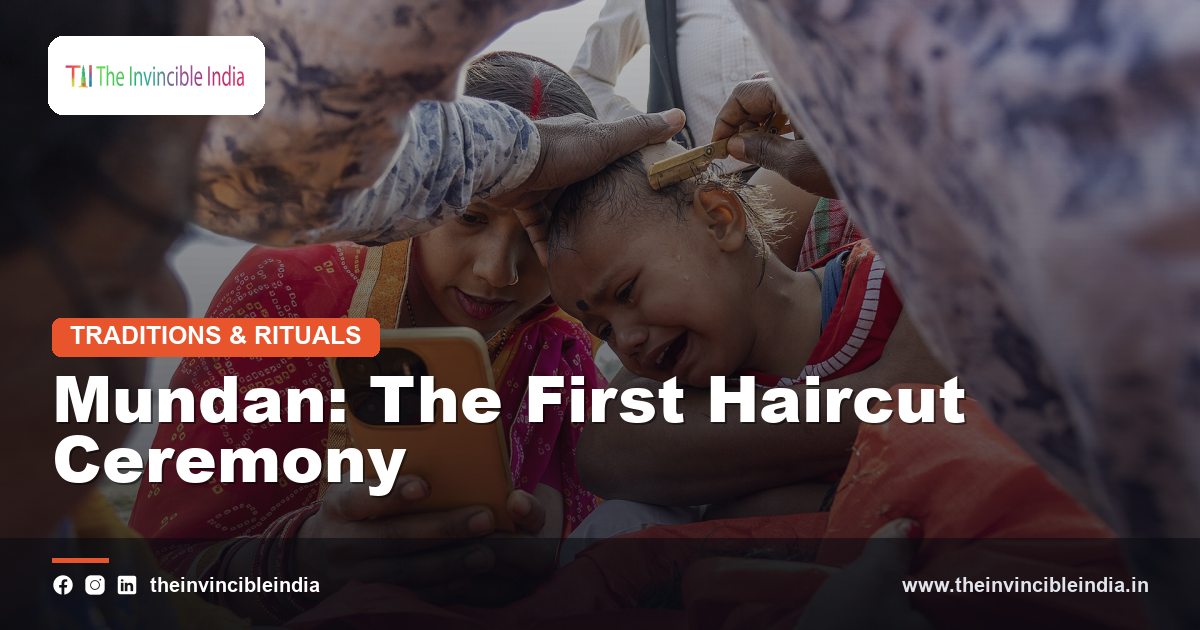
Mundan, also known as Chudakarana, is one of the Hindu samskaras, or life-cycle rituals, and marks a child’s first haircut, typically performed within the first few years of life. During the ceremony, a priest or family elder shaves the child’s head, an act regarded as marking a fresh, auspicious start. The ritual is usually accompanied by prayers, offerings and a small family gathering, often performed at a temple or at home under a priest’s guidance. Much like the samskaras observed around Indian wedding traditions, Mundan reflects the structured sequence of rites that mark significant transitions across a Hindu life. This guide explores its meaning, timing and continuing practice.
Quick Facts
| Detail | Information |
|---|---|
| Also Known As | Chudakarana, Mundan Sanskar |
| Type of Observance | Hindu life-cycle samskara (sanskar) |
| General Timing | Typically within the first or third year of a child’s life |
| Key Practices | Head shaving, prayers, small family gathering |
| Performed By | Family priest or temple purohit |
| Region of Prominence | Observed across Hindu communities throughout India |
Meaning and Significance
Mundan is observed as one of the earliest of the Hindu samskaras, the sequence of rites of passage understood to mark significant stages across a person’s life. The ceremony centres on shaving a young child’s head for the first time, an act carried out with the involvement of family members and, in most cases, a priest who guides the accompanying prayers. It is regarded less as a routine grooming practice than as a considered ritual, intended to mark the child’s passage out of infancy.
Families often treat the day as a modest but meaningful occasion, gathering relatives for a small ceremony rather than observing it privately. This blend of ritual purpose and family celebration has helped Mundan remain a familiar practice across many Hindu households, even as approaches to its exact conduct vary from family to family.
Position Among the Hindu Samskaras
Within the traditional framework of Hindu samskaras, which are understood to guide an individual from before birth through to the final rites, Mundan is counted among the ceremonies associated with early childhood. It follows the naming ceremony and typically precedes the rituals connected with a child’s formal education, situating it within a broader sequence intended to mark gradual development.
This placement reflects a wider cultural understanding in which important life stages are marked by specific rites rather than passing unmarked, giving structure and shared meaning to a family’s experience of a child’s early years. Mundan’s position underscores its role as a rite specifically concerned with a child’s physical and symbolic transition out of infancy.
Origins and Symbolism of Tonsure
The custom of shaving a child’s head is traditionally understood to symbolise the removal of impurities said to be carried over from the period before birth, offering the child a clean and auspicious start to conscious life. Hair, in many Indian traditions, is treated as significant in ritual contexts, and its ceremonial removal is one of several practices in which hair plays a symbolic role.
Beyond this symbolic dimension, the custom is also associated with practical beliefs regarding a child’s healthy growth, with some families holding that the first haircut supports stronger subsequent hair growth. Whatever the specific reasoning offered within a family, the ritual is consistently treated as significant rather than incidental.
Ideal Timing and Age
Mundan is most commonly performed within a child’s first year or during the third year, according to family custom and regional practice, with the exact timing typically decided in consultation with a priest or family elder. Some traditions hold that performing the ceremony in odd-numbered years is considered more auspicious, though practices vary considerably across communities.
The choice of age is generally guided by a combination of astrological considerations and family convention rather than any single fixed rule, allowing flexibility in how and when the rite is observed. This variability illustrates the broader pattern seen across Hindu samskaras, where core rituals are retained while specific details are adapted to individual family circumstances.
Choosing an Auspicious Day
Selecting a suitable date for Mundan typically involves consulting a Hindu calendar or a family priest, who considers the child’s birth details alongside broader astrological factors to recommend a favourable day. Certain days of the week and specific lunar phases are commonly regarded as more suitable than others for the ceremony.
This practice of aligning significant family rituals with an auspicious date reflects a wider convention observed across many Hindu ceremonies, in which timing is treated as an important element of a rite’s overall conduct. Families often plan the ceremony well in advance once a suitable date has been identified, coordinating with relatives and, where relevant, travel to a temple.
The Ritual Process
The Mundan ceremony typically begins with prayers invoking blessings for the child, followed by the ceremonial shaving of the head, usually performed by a barber under the supervision of the presiding priest or a senior family member. The child’s first lock of hair is often collected and, in some family traditions, offered at a temple or immersed in a river.
Following the shaving, the child may be bathed and dressed in new clothes, with the priest concluding the proceedings with further prayers for health and long life. This sequence of preparation, ritual act and closing prayer is a structure common to many Hindu samskaras, giving Mundan a recognisable ritual rhythm despite variation in specific detail.
Role of the Priest and Family
A priest typically presides over the Mundan ceremony, reciting Vedic or regional prayers appropriate to the rite and guiding the family through each stage of the proceedings. The priest’s presence is regarded as lending the ceremony its formal religious character, distinguishing it from an ordinary haircut.
Family members, particularly parents and grandparents, play an active role throughout, from making preparatory arrangements to participating directly in blessing the child once the ritual is complete. This shared involvement of priest and family reflects the broader pattern in Hindu samskaras, where religious rite and family occasion are closely interwoven rather than treated as separate events.
Significance of the First Haircut
The first haircut carries particular emotional and ritual weight for families, often regarded as a milestone comparable to other early childhood observances such as a first solid meal or first steps. It is frequently documented with photographs and remembered as one of the notable events of a child’s earliest years.
Beyond its ritual meaning, the occasion offers an opportunity for extended family to gather and celebrate together, reinforcing social bonds around a shared milestone. This combination of personal sentiment and ritual observance helps explain why Mundan continues to be marked with care by many families, even where broader religious practice has otherwise become less elaborate.
Offerings and Prayers
Offerings made during Mundan typically include flowers, fruit and other simple items presented to a deity as part of the accompanying prayers, reflecting the devotional character of the ceremony. In many families, a portion of the shaved hair is itself treated as an offering, particularly when the ceremony is performed at a temple.
Prayers recited during the ritual generally invoke blessings for the child’s health, long life and future wellbeing, continuing a pattern common to many Hindu life-cycle rites in which spoken blessing accompanies ritual action. These offerings and prayers together give the ceremony its devotional core.
Popular Pilgrimage Sites for Mundan
Certain temples across India are particularly associated with Mundan ceremonies, drawing families from considerable distances specifically to perform the rite at these locations. Such temples are often chosen for their long-standing reputation as auspicious sites for this particular samskara.
Performing Mundan at a well-known pilgrimage site is regarded by many families as adding to the ceremony’s spiritual significance, combining the rite itself with the broader merit traditionally associated with temple pilgrimage. This practice has helped sustain a steady flow of families visiting these temples specifically for the ceremony.
Tirupati and Mundan Tradition
Among the temples associated with Mundan, the Tirumala Venkateswara Temple at Tirupati is particularly well known, with large numbers of devotees offering their children’s hair there as part of the ceremony. The practice of hair offering at Tirupati is a long-standing devotional custom observed by pilgrims from across India.
Families who choose Tirupati for Mundan often combine the ceremony with a broader pilgrimage visit, treating the occasion as both a life-cycle rite and an act of devotion. This association has made Tirupati one of the most recognised settings for the Mundan ceremony among Hindu families nationally.
Regional Variations Across India
While the core elements of Mundan, head shaving and accompanying prayer, are broadly consistent, specific customs surrounding the ceremony vary across India’s different regions and communities. Differences can include the particular prayers recited, the involvement of extended family, and the treatment of the shaved hair afterward.
These regional variations reflect the broader pattern seen across Hindu samskaras, in which a shared ritual framework accommodates considerable local adaptation. Such diversity in practice has not diminished the ceremony’s recognisability as a distinct life-cycle rite.
Mundan in South India
In South Indian states, Mundan is commonly performed at temples, often as part of a family pilgrimage, with particular attention given to selecting a temple associated with the family’s chosen deity. The ceremony is frequently combined with other temple rituals conducted during the same visit.
Local customs in the south often place strong emphasis on the auspicious selection of both date and temple, reflecting the broader regional tradition of combining life-cycle rites with pilgrimage. This pattern gives Mundan in South India a strong association with temple culture specifically.
Mundan in North India
In North Indian households, Mundan is frequently conducted at home or at a family’s traditional place of worship, with a priest invited to preside over the ceremony in a more domestic setting. Family gatherings and a modest feast often follow the ritual itself.
This home-centred approach reflects a slightly different regional emphasis compared to the temple-focused observance common in parts of South India, though the underlying purpose and structure of the ceremony remain consistent across both traditions.
Modern Adaptations and Urban Practice
In contemporary urban settings, Mundan continues to be observed, though families increasingly balance traditional ritual elements with practical considerations such as time, travel and the involvement of extended family living in different cities. Some families opt for smaller, simplified ceremonies conducted at home rather than elaborate temple visits.
Despite such adaptations, the essential elements of the ceremony, prayer, ritual shaving and family blessing, are generally retained even in abbreviated modern observances. This continuity amid changing lifestyles reflects the broader resilience of Hindu samskaras.
Mundan Today
Mundan remains a widely observed samskara among Hindu families today, continuing to mark a child’s transition out of infancy through a combination of ritual shaving, prayer and family celebration. Its practice persists across both rural and urban settings, and among Hindu communities living outside India as well.
The ceremony’s enduring popularity reflects the broader continuity of Hindu life-cycle rituals, which continue to provide families with a meaningful way of marking significant early milestones, blending established ritual practice with each family’s own preferences.
Sources & Further Reading
- Ministry of Culture, Government of India (indiaculture.gov.in).
- Indira Gandhi National Centre for the Arts (ignca.gov.in).
Frequently Asked Questions
What is Mundan?
Mundan is a Hindu samskara marking a child’s first haircut, typically performed within the first few years of life with prayers and family celebration.
Why is a child's head shaved in Mundan?
The shaving is traditionally understood to remove impurities associated with the period before birth and mark a fresh, auspicious start for the child.
At what age is Mundan performed?
It is most commonly performed within the first year or during the third year of a child’s life, according to family and regional custom.
Why is Tirupati associated with Mundan?
The Tirumala Venkateswara Temple at Tirupati is a well-known site where large numbers of families offer their child’s hair as part of the ceremony.
Is Mundan performed differently across India?
Yes, while the core ritual is consistent, specific customs such as temple versus home observance vary between North and South India and other regions.


