

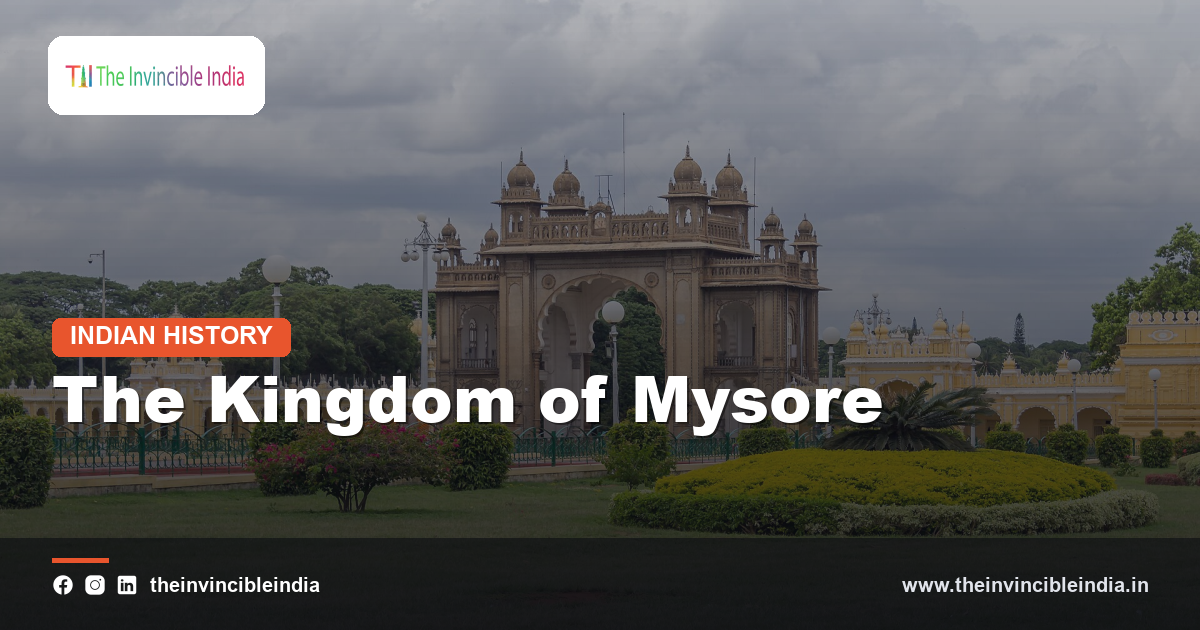
The Kingdom of Mysore rose from modest beginnings as a small principality under the overlordship of the Vijayanagara Empire to become one of the most notable powers of South India, celebrated across different eras for the long rule of the Wadiyar dynasty and for the dramatic ascent of Hyder Ali and his son Tipu Sultan. As the authority of the Maratha Empire and other regional powers ebbed and flowed across the subcontinent, Mysore built a formidable army, resisted the expanding reach of British power for a time, and later flourished as a princely state renowned for its splendid palace, its royal Dasara festival, and its patronage of art, music and craft. This guide explores the rise, rulers and enduring legacy of the Kingdom of Mysore.
Quick Facts
| Detail | Information |
|---|---|
| Region | Karnataka, South India |
| Capital | Mysore (Srirangapatna under Tipu Sultan) |
| Ruling dynasty | The Wadiyar dynasty |
| Notable rulers | Hyder Ali and Tipu Sultan |
| Famous landmark | The Mysore Palace |
| Legacy | A celebrated centre of art, music and the Dasara festival |
A Kingdom of the South
The Kingdom of Mysore stands as one of the most notable South Indian states of the medieval and early modern periods, a realm whose history spans humble beginnings as a small principality to a period of formidable military power and eventually a long era as a celebrated princely state. Its story is closely tied to the fortunes of the Wadiyar dynasty as well as to the remarkable rise of Hyder Ali and Tipu Sultan. This layered history defines the kingdom’s identity. This layered history of the Kingdom of Mysore, spanning dynastic continuity and dramatic upheaval alike, defines its identity as one of the most fascinating and closely studied states in the history of South India.
Origins under Vijayanagara Overlordship
The Kingdom of Mysore began its existence as a small principality governed by local chiefs who acknowledged the overlordship of the great Vijayanagara Empire, then the dominant power across much of South India. This subordinate status allowed the fledgling state to develop its own administration and local authority while remaining formally loyal to its imperial overlord. This early period established the foundations of local governance. This early period of Vijayanagara overlordship established the foundations of local governance and identity that would later allow Mysore to grow into an independent and eventually powerful kingdom of its own.
The Wadiyar Dynasty
The Wadiyar dynasty ruled the Kingdom of Mysore across a remarkably long span of history, providing a thread of dynastic continuity that persisted through periods of both subordination and independence, interruption and restoration. Members of this royal family are remembered for their patronage of religion, art and administration, qualities that shaped the character of Mysore across many generations of rule. This dynastic continuity is a defining feature. This long continuity of the Wadiyar dynasty across the history of Mysore is a defining feature of the kingdom’s story, distinguishing it from many other regional states whose ruling houses proved far less enduring.
Independence After Vijayanagara's Decline
As the great Vijayanagara Empire weakened and eventually fragmented, the local rulers of Mysore seized the opportunity to assert their own independence, transforming a once-subordinate principality into a sovereign kingdom in its own right. This assertion of independence allowed the Wadiyar rulers to expand their territory and influence across the surrounding region in the years that followed. This transition marks a pivotal moment for Mysore. This transition from subordinate principality to independent kingdom, achieved as Vijayanagara’s power declined, marks a pivotal moment in the history of Mysore, opening the path toward its later prominence in South Indian affairs.
The Rise of Hyder Ali
In the eighteenth century, a capable military commander named Hyder Ali rose from relatively modest origins within the Mysore administration to become the effective ruler of the kingdom, sidelining the Wadiyar dynasty from active power while retaining it in a ceremonial capacity. Hyder Ali built a strong and modernised army, expanded Mysore’s territory, and established the kingdom as a formidable regional power feared by its neighbours. This rise transformed Mysore’s fortunes. This dramatic rise of Hyder Ali transformed the fortunes of Mysore, turning what had been a modest regional kingdom into one of the most powerful and assertive states of South India during his lifetime.
Tipu Sultan, the Tiger of Mysore
Hyder Ali’s son, Tipu Sultan, succeeded his father as ruler of Mysore and continued the kingdom’s tradition of strong and assertive leadership, earning lasting fame as a determined opponent of expanding British power in South India. Remembered by the epithet the Tiger of Mysore, he combined administrative reform with military innovation, seeking to strengthen his kingdom’s ability to resist external domination. His reign remains a celebrated chapter in Indian resistance history. This reign of Tipu Sultan remains one of the most celebrated chapters in the history of Indian resistance to colonial expansion, and his memory continues to be honoured as a symbol of courage and independence.
Military Innovation and Mysorean Rockets
Under Hyder Ali and Tipu Sultan, the Kingdom of Mysore developed a notably modern and well-organised military, including the innovative use of iron-cased rockets that gave Mysorean forces a distinctive edge in several of their campaigns. This early rocketry, developed and refined within the kingdom’s own arsenals, attracted considerable attention and later influenced military experimentation elsewhere. This innovation reflects the kingdom’s military ambition. This military innovation of the Mysorean rockets reflects the ambition and technical resourcefulness of the Kingdom of Mysore under its most dynamic rulers, and it remains one of the most distinctive aspects of the kingdom’s military history.
Conflicts with the British
The Kingdom of Mysore under Hyder Ali and Tipu Sultan was engaged in a series of prolonged conflicts with the expanding British East India Company, contests that reflected the wider struggle for power and territory unfolding across South India during this period. These conflicts saw fortunes shift between the two sides across several campaigns, with Mysore proving a formidable and resourceful adversary throughout. These conflicts shaped the kingdom’s later history. These prolonged conflicts with British forces shaped much of the later history of the Kingdom of Mysore, culminating eventually in a decisive struggle that would determine the kingdom’s future direction.
The Fall of Srirangapatna
The island fortress city of Srirangapatna, which served as Tipu Sultan’s capital, became the site of the kingdom’s most dramatic and consequential confrontation with British forces, a struggle that ultimately ended in the fall of the city and the death of Tipu Sultan in its defence. This event marked the end of Mysore’s period as an independent power under its own assertive ruling dynasty of commanders. This fall reshaped the kingdom’s political future. This fall of Srirangapatna reshaped the political future of the Kingdom of Mysore, bringing to a close one of the most dramatic chapters in its history and opening the way for a new political arrangement in the region.
Restoration of the Wadiyar Dynasty
Following the fall of Tipu Sultan, the British authorities restored the Wadiyar dynasty to the throne of Mysore, reinstating the historic royal family in a position of authority under the broader framework of British paramountcy across India. This restoration returned continuity to the kingdom’s governance, allowing the ancient dynasty once again to preside over the affairs of the state, albeit within a new political arrangement. This restoration marked a significant turning point. This restoration of the Wadiyar dynasty marked a significant turning point in the history of Mysore, reconnecting the kingdom’s governance to its long dynastic tradition after decades of rule by Hyder Ali and Tipu Sultan.
Mysore as a Princely State
Under the restored Wadiyar dynasty, Mysore developed into one of the most notable and well-administered princely states of British India, known for progressive governance, infrastructure development and careful management of its resources and institutions. The rulers of this period are remembered for balancing tradition with reform, fostering a period of relative stability and prosperity within the framework of princely rule. This era enhanced the kingdom’s reputation. This era of Mysore as a princely state enhanced the kingdom’s reputation for good governance, and it laid foundations that would continue to influence the development of the region in the years that followed.
The Mysore Palace
The Mysore Palace stands today as one of the most magnificent royal residences in India, a grand structure combining Indo-Saracenic architectural elements with richly decorated interiors, courtyards and durbar halls reflecting the wealth and artistic patronage of the Wadiyar dynasty. Illuminated with thousands of lights during festive occasions, the palace remains a beloved symbol of Mysore’s royal heritage. This palace draws visitors from across the world. This grand Mysore Palace draws visitors from across India and the world, standing as one of the most recognisable and cherished landmarks associated with the royal history of the Kingdom of Mysore.
The Mysore Dasara Festival
The Kingdom of Mysore is closely associated with a grand royal celebration of the Dasara festival, a tradition of state ceremony and public festivity that continues to this day as one of the most celebrated cultural events in Karnataka. Rooted in the patronage of the Wadiyar dynasty, the festival combines religious observance with royal procession and public celebration on a magnificent scale. This festival remains a cherished tradition. This royal tradition of Mysore Dasara remains a cherished and widely celebrated tradition today, drawing large crowds and continuing to express the deep connection between the Wadiyar dynasty and the cultural life of the region.
Patronage of Art and Music
The rulers of Mysore, particularly during the princely era, were notable patrons of art, music and scholarship, supporting musicians, painters and scholars whose work enriched the cultural life of the court and the wider region. This patronage helped establish Mysore as an important centre of Karnatak music and traditional painting during this period. This cultural patronage enriches the kingdom’s legacy. This cultural patronage of art and music under the rulers of Mysore enriches the kingdom’s legacy considerably, and it remains an important part of the region’s continuing artistic and musical heritage today.
Crafts, Silk and Sandalwood
The Kingdom of Mysore fostered the development of distinctive regional crafts and industries, including the fine silk weaving and sandalwood carving for which the region remains renowned, supported in part by royal patronage and encouragement of skilled artisans. These traditional crafts contributed to the kingdom’s economy and cultural identity, becoming closely associated with the name of Mysore itself. These crafts remain celebrated hallmarks of the region. These traditional crafts of silk weaving and sandalwood carving, nurtured under the patronage of the Kingdom of Mysore, remain celebrated hallmarks of the region’s heritage, continuing to be practised and admired in Karnataka today.
Administration and Modernisation
During its later princely period, the Kingdom of Mysore became known for notable efforts at administrative modernisation, including developments in education, infrastructure and public institutions undertaken under the guidance of the Wadiyar rulers and their ministers. This reputation for progressive governance distinguished Mysore among the princely states of British India. This modernisation left a lasting institutional legacy. This modernisation effort undertaken during the princely era of Mysore left a lasting institutional legacy for the region, contributing to its continued development well into the modern history of Karnataka.
The Kingdom of Mysore Today
Today the Kingdom of Mysore is remembered as one of the most storied and culturally rich states in the history of South India, its legacy visible in the splendour of the Mysore Palace, the grandeur of the Dasara festival, and the enduring fame of Hyder Ali and Tipu Sultan as symbols of resistance and resolve. The Wadiyar dynasty’s long association with the region continues to be honoured with pride across Karnataka. Its heritage continues to be celebrated widely. As a kingdom remembered for the long rule of the Wadiyars, the dramatic era of Tipu Sultan, and a rich tradition of art and festival, the Kingdom of Mysore endures as a cherished chapter in the cultural heritage of India.
Sources & Further Reading
- Archaeological Survey of India, on the heritage of Srirangapatna (asi.nic.in).
- Ministry of Culture, Government of India (indiaculture.gov.in).
Frequently Asked Questions
What was the Kingdom of Mysore?
The Kingdom of Mysore was a South Indian state that began as a small principality under Vijayanagara overlordship and later grew into a powerful and independent kingdom, ruled for most of its history by the Wadiyar dynasty, with an interlude under Hyder Ali and Tipu Sultan.
Who was Tipu Sultan?
Tipu Sultan was the ruler of Mysore following his father Hyder Ali, remembered as the Tiger of Mysore for his determined military resistance to expanding British power, his administrative reforms, and his innovative use of rocket artillery.
What is the Mysore Palace known for?
The Mysore Palace is known for its grand Indo-Saracenic architecture, richly decorated interiors, and its dramatic illumination during festivals, standing today as one of the most celebrated royal residences and heritage landmarks in India.
What is Mysore Dasara?
Mysore Dasara is a grand royal festival tradition associated with the Wadiyar dynasty, combining religious observance with royal procession and public celebration, and it remains one of the most prominent cultural festivals of Karnataka today.
How did the Wadiyar dynasty return to power in Mysore?
After the fall of Tipu Sultan at Srirangapatna, British authorities restored the historic Wadiyar dynasty to the throne of Mysore, which then continued to rule the kingdom as a princely state under British paramountcy.


