


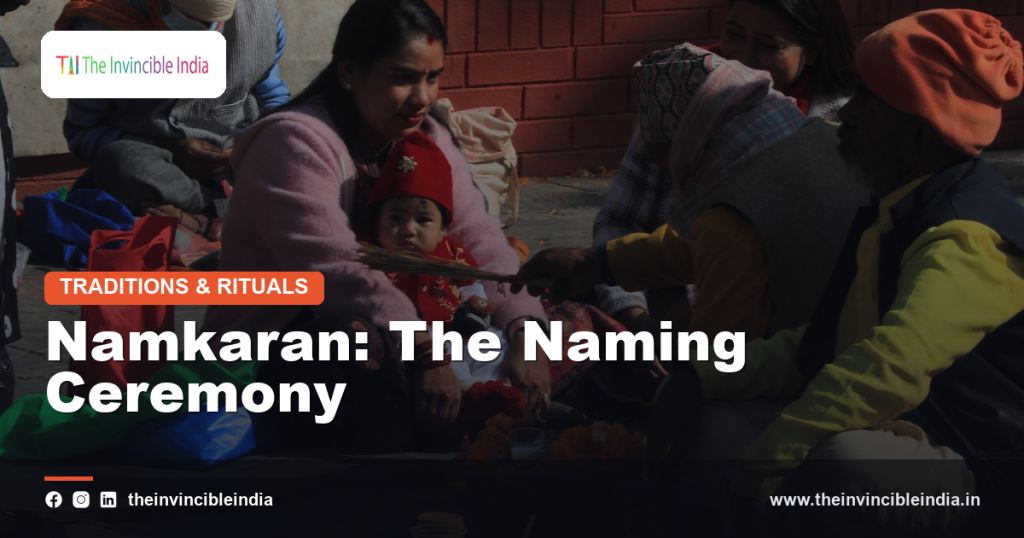
Namkaran, the formal naming of a newborn child, is one of the earliest and most cherished samskaras, or life-cycle rites, observed in Hindu tradition. Typically conducted within the first weeks after birth, the ceremony brings together family members to bless the child and formally announce the name chosen for them, often selected with reference to astrology, family custom or personal meaning. Much like the joy surrounding the celebration of a divine birth during Janmashtami, Namkaran is marked by warmth, ritual and communal celebration. This guide explores the ceremony’s meaning, rituals and continuing place in family life across India.
Quick Facts
| Detail | Information |
|---|---|
| Also Known As | Naamkaran, Naming Ceremony, Namakarana |
| Type of Observance | Hindu life-cycle rite (samskara) |
| Typical Timing | Within the first weeks after birth |
| Key Elements | Name selection, ritual blessing, family gathering |
| Basis for Naming | Astrology, family tradition, personal meaning |
| Presided Over By | Family priest or elders, depending on custom |
Meaning and Significance
Namkaran, derived from Sanskrit terms meaning the making of a name, refers to the traditional Hindu ceremony through which a newborn child is formally given their name. The occasion is treated as far more than a practical formality, understood instead as a moment of blessing in which family and community welcome the child by name for the first time.
The ceremony reflects a broader cultural understanding that a name carries meaning and intention, often chosen to reflect qualities the family hopes the child will embody. This blend of practical necessity and symbolic hope is part of what gives Namkaran its enduring emotional significance for families.
Namkaran as a Samskara
Within the traditional sequence of Hindu life-cycle rites, Namkaran generally follows shortly after birth-related rituals and precedes later ceremonies such as the first outing of the child or the introduction of solid food. It is counted among the samskaras performed in early infancy, a period during which several rites are traditionally observed in close succession.
As with other samskaras, the emphasis is on marking a significant transition, in this case the child’s formal entry into family and community identity through the giving of a name, with appropriate ritual and blessing.
Traditional Timing of the Ceremony
Namkaran is traditionally performed within a defined period after birth, commonly cited as around the eleventh or twelfth day, though practices vary across communities and families, with some conducting the ceremony later, within the first month. The timing is often chosen in consultation with a priest or family elder, taking account of both ritual custom and the family’s own circumstances.
This early timing reflects the ceremony’s function as one of the first formal acknowledgements of the child within family and social life, distinct from purely medical or administrative steps taken immediately after birth.
The Role of Astrology in Naming
In many Hindu families, the choice of name is guided by astrology, with a priest or astrologer consulted to determine the child’s birth chart and the auspicious syllable or letter associated with the position of the moon at the time of birth. Names beginning with this syllable are then considered particularly favourable.
While not universally followed, this astrological guidance remains a widely respected tradition, reflecting the broader role astrology continues to play in various life-cycle decisions across Indian culture, from naming to determining the timing of ceremonies and other significant family events.
Choosing a Name: Sources and Traditions
Beyond astrological guidance, names are often chosen with reference to family tradition, religious texts, the names of respected ancestors, or simply for their meaning and sound. Many families select names associated with deities, virtues or natural elements, believing that a meaningful name can shape or reflect the child’s character.
The involvement of grandparents and elders in this process is common, reflecting the value placed on continuity between generations. In many households, the final decision balances astrological recommendation with personal preference and family sentiment, illustrating how ritual guidance and individual choice coexist within the tradition.
The Ritual Structure of the Ceremony
The Namkaran ceremony typically involves a small ritual conducted at home or in a temple, often including prayers, the lighting of a lamp, and blessings invoked for the child’s health and future. In many households, a priest performs a short puja, after which the chosen name is formally whispered into the child’s ear.
The precise sequence and elaborateness of the ritual vary widely, from a brief family gathering to a more elaborate ceremony involving a wider circle of relatives, reflecting the flexibility with which this samskara is generally observed across different households.
The Role of the Priest and Family Elders
While some families conduct Namkaran informally among themselves, many engage a priest to perform the ritual, particularly when astrological consultation and formal mantra recitation are involved. The priest typically guides the family through the appropriate prayers and confirms the auspicious details relevant to the naming.
Grandparents and senior family members often play a prominent role as well, sometimes being given the honour of formally announcing or whispering the chosen name, a gesture that emphasises the ceremony’s function as a marker of family continuity across generations.
Whispering the Name: Symbolic Rites
A distinctive element of many Namkaran ceremonies is the whispering of the chosen name into the infant’s ear, often performed by the father, grandparent or officiating priest. This intimate gesture is treated as the ceremonial moment at which the name is formally bestowed, distinct from any later administrative registration.
The quiet, personal nature of this act stands in contrast to the more public elements of the ceremony, such as the family gathering or the feast that may follow, highlighting the ritual’s blend of intimate family sentiment and broader social celebration.
Regional Variations Across India
Namkaran customs vary across India, with differences in timing, ritual detail and surrounding celebrations shaped by regional and community tradition. In some regions, the ceremony is combined with other early infancy rites, while in others it stands as a distinct, separately celebrated occasion.
Differences can also be seen in the specific prayers recited, the food served at the accompanying gathering, and the manner in which the name is formally announced to relatives and neighbours, illustrating the broader diversity found within a shared underlying tradition.
Naming Traditions Among Different Communities
While Namkaran in its classical form is associated with Hindu tradition, naming ceremonies with broadly similar functions, welcoming and formally naming a newborn, are observed across many of India’s religious and regional communities, each following its own customs and religious framework.
This shared impulse to mark the naming of a child with ceremony and blessing, even where specific rituals differ considerably, reflects a common thread running through India’s diverse cultural landscape, in which the arrival of a new family member is treated as an occasion warranting formal recognition.
Gifts, Feasting and Celebration
Namkaran is often accompanied by a family gathering, with relatives and close friends invited to celebrate the new arrival and the formal announcement of the name. Gifts for the baby and, in many households, a festive meal are common features of the occasion.
This celebratory dimension complements the ceremony’s ritual core, transforming a religious rite into a broader social occasion that allows the extended family and community to share in the family’s joy, a pattern consistent with the communal character of many Hindu life-cycle observances.
The Significance of the Cradle Ceremony
In many households, Namkaran is accompanied by a related ritual in which the baby is placed in a decorated cradle for the first time, often to the accompaniment of a lullaby sung by women of the family. This cradle ceremony is sometimes treated as a distinct, closely associated observance rather than a strict part of Namkaran itself.
Together, the naming and cradling rituals mark two closely linked milestones in the infant’s earliest days, both centred on formally welcoming the child into the rhythms of family life through ritual and song.
Names and Their Cultural Meaning
Indian names frequently carry explicit meaning, often drawn from Sanskrit or regional languages, referencing virtues, natural phenomena, or the names and attributes of deities. This tradition of meaningful naming reflects a broader cultural view that a name is not merely a label but a small, ongoing expression of hope or identity.
Many families also choose names that honour a grandparent or ancestor, linking the child’s identity to family history. This layered approach to naming, combining meaning, sound and lineage, is part of what makes name selection such a carefully considered process in many households.
Documentation and the Modern Birth Certificate
Alongside the religious ceremony, formally registering a child’s name for official purposes, such as a birth certificate, has become a parallel and equally important step in contemporary life. Many families complete this administrative registration around the same period as the religious naming ceremony, though the two processes remain distinct in purpose and form.
This coexistence of ritual and administrative naming reflects the broader way in which traditional practices have adapted alongside modern institutional requirements, without one displacing the other in most households.
Namkaran Within the Wider Samskara System
Namkaran occupies an early position within the traditional sequence of Hindu samskaras, following rites associated with birth and preceding later ceremonies such as the first feeding of solid food, the first haircut, and eventually the Upanayana in some communities. Its early placement underscores the importance traditionally given to formally establishing a child’s identity soon after birth.
Viewed as part of this broader system, Namkaran reflects the same underlying philosophy found throughout the samskaras, that significant life transitions benefit from conscious ritual marking rather than being allowed to pass without formal acknowledgement.
Symbolic Foods and Customs Surrounding Namkaran
Alongside the naming ritual itself, many families mark Namkaran with symbolic foods and small customary acts, such as placing a few grains of rice or a drop of honey on the infant’s tongue, gestures believed to invoke sweetness and nourishment for the child’s life ahead. Such customs vary by community but share a common intent of blessing the child through simple, tangible acts rather than words alone.
A festive meal typically follows the ceremony, often featuring dishes considered auspicious within the family’s regional cuisine, shared among the gathered relatives. These accompanying customs, though secondary to the naming itself, add texture to the occasion and reflect the broader Indian tendency to embed ritual meaning into food and small symbolic gestures whenever a significant family milestone is observed.
Namkaran Today
In present-day India, Namkaran continues to be widely observed, though often in a simplified or more flexible form suited to contemporary family life. Many families combine the ceremony with hospital discharge celebrations or hold it soon after returning home, adapting timing to practical circumstances while retaining the core ritual elements.
Despite these adjustments, the ceremony’s essential purpose, formally and joyfully welcoming a child into the family through the giving of a name, remains a valued tradition, continuing to mark one of the earliest and most personal milestones in Indian family life.
Sources & Further Reading
- Ministry of Culture, Government of India (indiaculture.gov.in).
- Sahitya Akademi.
Frequently Asked Questions
What is the Namkaran ceremony?
Namkaran is the traditional Hindu ceremony in which a newborn child is formally given their name, usually performed within the first weeks after birth.
How is a child's name traditionally chosen?
Names are often chosen with reference to astrology, particularly the auspicious syllable linked to the child’s birth chart, alongside family tradition and personal meaning.
When is Namkaran usually performed?
It is commonly performed around the eleventh or twelfth day after birth, though exact timing varies by family and regional custom.
What happens during the ceremony?
The ceremony typically includes prayers, a short ritual conducted by a priest or family elder, and the whispering of the chosen name into the child’s ear.
Is Namkaran only a religious ritual, or also administrative?
Namkaran is a religious ceremony distinct from official birth registration, though many families complete both around a similar time.