


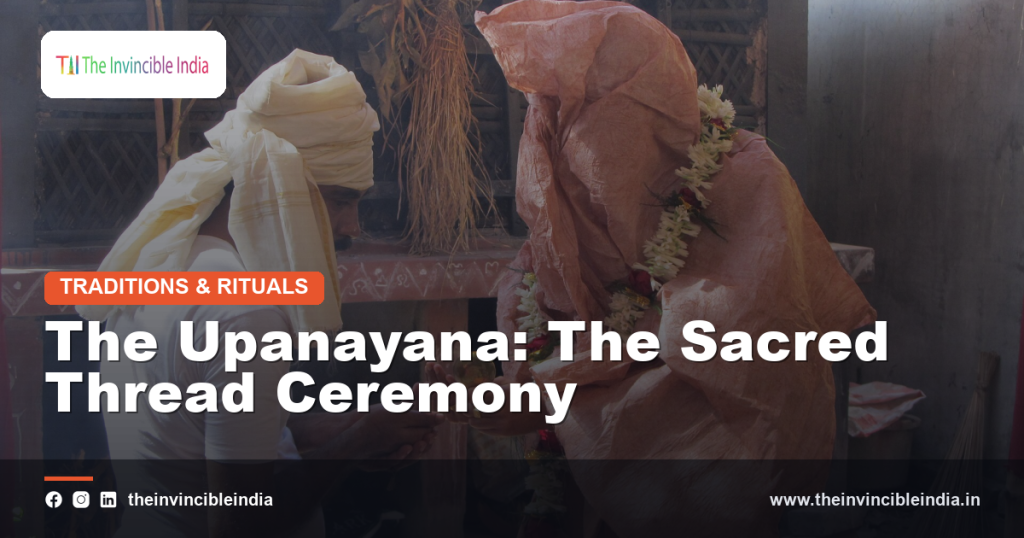
The Upanayana, popularly known as the sacred thread ceremony, is one of the traditional samskaras, or life-cycle rites, observed in Hindu practice to mark a child’s initiation into formal learning and religious life. Central to the ceremony is the yajnopavita, or sacred thread, which is worn across the body from that point onward as a mark of this new stage. Like other significant life-cycle observances such as the rituals surrounding Indian weddings, the Upanayana is marked by defined rites, presided over by a priest, and carries deep familial and community significance. This guide explains its meaning, rituals and continuing place in Hindu tradition.
Quick Facts
| Detail | Information |
|---|---|
| Also Known As | Sacred Thread Ceremony, Janeu, Yajnopavita Sanskar |
| Type of Observance | Hindu life-cycle rite (samskara) |
| Traditionally Performed For | Young boys, in some communities also girls |
| Key Object | The sacred thread (yajnopavita or janeu) |
| Presided Over By | A family priest (purohit) |
| Symbolises | Initiation into formal learning and religious duty |
Meaning and Significance
The Upanayana marks a significant transition in traditional Hindu life, formally recognising a child’s readiness to begin structured learning and religious observance. The word itself suggests being led near, referring to the child being brought close to a teacher or guru to begin formal instruction, historically in Vedic study and today often adapted to include broader religious and moral education.
The ceremony is regarded as one of the most important of the traditional samskaras, the sequence of life-cycle rites that mark key stages of an individual’s development. Its performance is often treated as a significant family occasion, bringing together relatives for a ritual that is at once deeply personal and rooted in long-standing communal custom.
Upanayana as a Samskara
In Hindu tradition, samskaras are a series of rites performed at various stages of life, from before birth through to the final rites after death, each intended to mark and sanctify a particular transition. The Upanayana is counted among the most significant of these, standing alongside ceremonies such as the naming rite and marriage as a defining moment in an individual’s religious life.
Unlike samskaras performed in infancy, the Upanayana involves the child as an active participant, reciting mantras and undertaking vows under the guidance of a priest. This active participation is part of what distinguishes it as a rite of initiation rather than simply an observance performed on the child’s behalf.
Origins in Vedic Tradition
The Upanayana has its roots in the ancient Vedic system of education, in which a young student, traditionally referred to as a brahmachari, would be formally initiated before beginning a period of study under a teacher, often residing at the teacher’s household. This period of disciplined learning, known as brahmacharya, was considered an essential foundation of a well-ordered life within traditional thought.
While the residential, teacher-centred model of education described in ancient texts is not the general practice today, the initiatory ceremony itself has persisted across many centuries, adapted to changing educational and social circumstances while retaining its core ritual structure.
The Symbolism of the Sacred Thread
The yajnopavita, or sacred thread, worn diagonally across the body from the left shoulder, is the most visible and enduring symbol of the Upanayana. Traditionally made of cotton and consisting of several strands, the thread is understood to represent a range of ideas depending on interpretation, including debts owed to teachers, ancestors and the divine, or the threefold discipline of thought, word and deed.
Once invested with the thread during the ceremony, the wearer is expected to keep it on at most times, replacing it periodically according to custom. The thread thus serves as a continuous, physical reminder of the commitments undertaken at the time of initiation.
Age and Timing of the Ceremony
Traditionally, the Upanayana was performed within a defined age range during childhood, generally before adolescence, though exact customs regarding age have varied across communities and historical periods. Auspicious timing is typically determined with reference to the family priest and, in many households, an astrologer, taking into account the child’s horoscope and the wider lunar calendar.
In contemporary practice, the age at which the ceremony is performed varies considerably between families and regions, with some conducting it in early childhood and others later, often coordinated with other family events such as a wedding in order to share the associated arrangements.
Preparatory Rituals
In the period leading up to the Upanayana, families typically undertake a series of preparatory rites, including invitations to relatives, preparation of ritual items, and smaller ceremonies intended to seek blessings for the occasion. A ceremonial haircut, or mundan, is performed for the child in many communities shortly before the main ritual.
These preparatory steps are treated as an integral part of the overall observance rather than mere logistics, reflecting the broader Hindu ritual pattern in which a major samskara is framed by smaller supporting rites performed in the days immediately before and after it.
The Role of the Guru and Gayatri Mantra Initiation
A central element of the Upanayana is the initiation of the child into the Gayatri mantra, one of the most revered verses in Hindu scripture, traditionally imparted by the officiating priest or a family elder acting in the role of guru. This moment is regarded as the spiritual heart of the ceremony, marking the beginning of the child’s formal engagement with sacred learning.
The relationship between teacher and student invoked during this rite draws on the ancient guru-shishya tradition, in which knowledge is transmitted through close personal guidance. Even in its modern, abbreviated form, the ceremony preserves this symbolic teacher-student bond as its defining feature.
Core Rites of the Ceremony
The Upanayana ceremony itself involves a sequence of ritual steps conducted around a sacred fire, including the invocation of deities, the recitation of Vedic verses, and the formal investiture of the sacred thread by the officiating priest. The child typically also receives a wooden staff and, in some traditions, a symbolic alms-seeking rite, echoing the austere lifestyle historically associated with Vedic students.
Family members participate through their presence and, at certain points, through blessings offered directly to the child. The combination of fire ritual, mantra recitation and symbolic objects gives the ceremony a rich, multi-layered structure typical of major Hindu life-cycle rites.
The Role of the Family Priest
A qualified priest, generally engaged by the family, presides over the Upanayana, guiding both the child and the assembled family through each stage of the ritual. The priest’s responsibilities include reciting the appropriate Vedic verses, conducting the fire ritual, and formally imparting the Gayatri mantra to the child.
Because the ceremony requires precise ritual knowledge, families typically rely on priests trained in the specific procedures associated with their community and regional tradition, underscoring the importance of specialised ritual expertise in sustaining the ceremony’s traditional form across generations.
Regional Variations in Practice
While the core elements of the Upanayana, the sacred thread, the fire ritual and the mantra initiation, are broadly shared, specific customs vary across regions and communities. Differences can be found in the exact sequence of rites, the number of strands in the thread, associated feasting customs, and the involvement of extended family in surrounding celebrations.
These regional variations reflect the broader diversity of Hindu ritual practice, in which a shared underlying framework accommodates considerable local adaptation, shaped by community tradition, family custom and the guidance of local priestly lineages.
Community and Family Traditions Associated with Upanayana
The Upanayana is typically treated as a significant family and community occasion, often marked by a gathering of relatives, a communal meal, and, in many families, a degree of celebration comparable to other major life-cycle events. Invitations, feasting and the exchange of gifts commonly accompany the core ritual.
For many families, the ceremony also serves as an occasion to reaffirm ties with the wider community and extended relatives, some of whom may travel considerable distances to attend. This social dimension complements the ceremony’s religious core, giving it a place in the broader rhythm of family life.
The Sacred Thread in Daily Life
Once invested, the sacred thread becomes part of the wearer’s daily life, traditionally worn at almost all times and adjusted in particular ways during specific rituals, such as being moved from one shoulder to the other during certain ceremonies. The thread is periodically replaced, often on designated occasions in the religious calendar.
For many wearers, the thread functions less as a conspicuous religious marker in daily interaction and more as a personal, private reminder of the commitments made at the time of the Upanayana, continuing to carry meaning long after the ceremony itself has concluded.
Women and the Sacred Thread Tradition
Historically, the Upanayana in its formal ritual sense has been more commonly associated with boys, though textual and historical evidence indicates that women’s participation in Vedic learning and related initiatory rites has varied across periods and communities. In recent times, a number of families and organisations have revived or introduced sacred thread ceremonies for girls as well.
These contemporary practices are generally understood as an extension of the ceremony’s underlying purpose, initiation into learning and religious life, to a wider group of participants, reflecting changing social attitudes while drawing on the same core ritual symbolism.
Symbolic and Educational Meaning for the Child
Beyond its ritual form, the Upanayana is traditionally understood as marking the beginning of a child’s more conscious engagement with learning, discipline and religious responsibility. The ceremony is often accompanied by guidance from elders on values such as respect for teachers, honesty and diligence, framed as lessons appropriate to this new stage of life.
For many families, the occasion becomes a moment to articulate hopes and expectations for the child’s future, blending ritual observance with a more general rite of encouragement, not unlike similar coming-of-age observances found in other cultural traditions.
The Ceremony Within the Wider Samskara System
The Upanayana is one of a sequence of samskaras that traditionally accompany an individual through life, including rites performed around birth, naming, first feeding of solid food, and eventually marriage and final rites. Its position, generally in childhood, marks the point at which formal religious and educational responsibility is understood to begin.
Viewed within this wider system, the Upanayana connects to a broader philosophy in which life is understood as a series of meaningful stages, each marked by ritual, rather than a continuous, undifferentiated process. This structured view of the life course underlies much of traditional Hindu practice.
Upanayana Today
In contemporary India, the Upanayana continues to be observed by many families, though its scale, timing and surrounding customs have adapted considerably to modern life. Ceremonies are often shortened, combined with other family functions, and are conducted with attention to the convenience of relatives travelling from different cities or countries.
Despite these adaptations, the essential elements of the ceremony, the sacred thread, the fire ritual and the mantra initiation, remain widely recognised and observed, underscoring the persistence of this ancient rite of passage within a rapidly changing social context.
Sources & Further Reading
- Ministry of Culture, Government of India (indiaculture.gov.in).
- Sangeet Natak Akademi (sangeetnatak.gov.in).
Frequently Asked Questions
What is the Upanayana ceremony?
The Upanayana is a traditional Hindu rite of passage that formally initiates a child into learning and religious life, marked by the investiture of the sacred thread.
What does the sacred thread represent?
The sacred thread, or yajnopavita, is understood to symbolise commitments such as discipline in thought, word and deed, and is worn as a lasting reminder of the initiation.
At what age is the Upanayana traditionally performed?
It is traditionally performed in childhood, generally before adolescence, though the exact age varies by family, community and regional custom.
What mantra is imparted during the ceremony?
The Gayatri mantra, one of the most revered verses in Hindu scripture, is traditionally imparted to the child by the officiating priest during the ceremony.
Is the Upanayana only performed for boys?
Historically it was more commonly performed for boys, though some families and communities today also conduct similar sacred thread ceremonies for girls.