

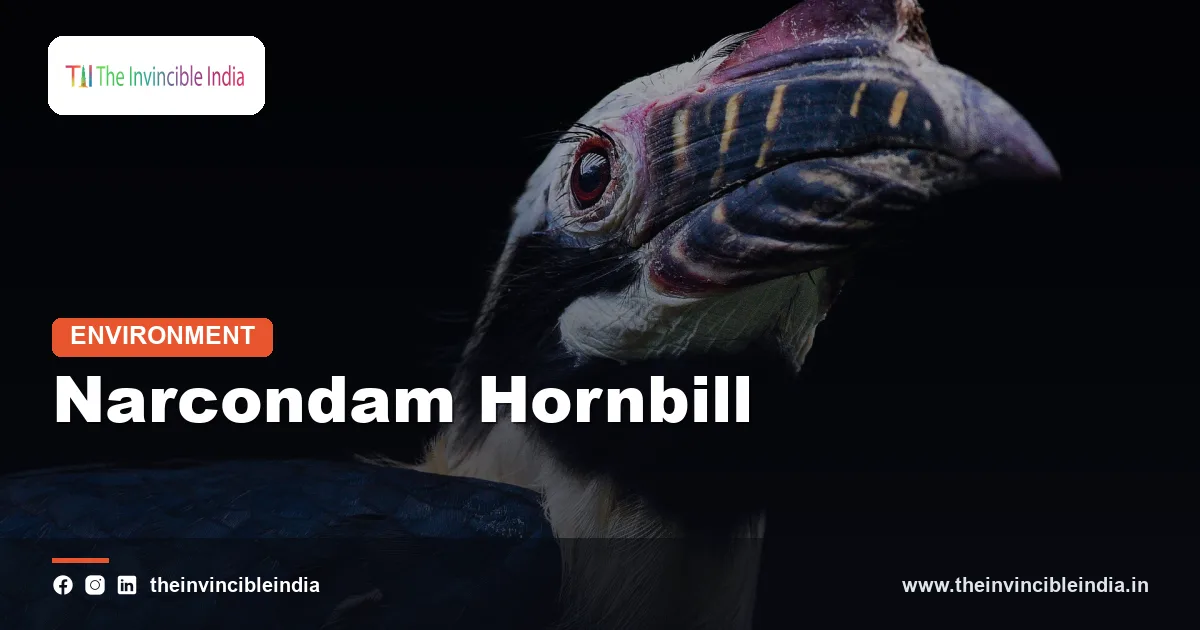
The Narcondam hornbill (Rhyticeros narcondami) is a medium-sized forest hornbill found nowhere in the world except on Narcondam Island, a tiny volcanic island of roughly 6.8 square kilometres in India’s Andaman Islands. It is one of the most range-restricted birds on earth, which makes the island’s forest the species’ only home.
The Narcondam hornbill is listed as Endangered by the International Union for Conservation of Nature (IUCN) because the entire species depends on one small island. Its population is small but has been described by surveys as relatively stable, and the main worry is the risk of sudden disturbance, including development proposals such as a planned radar station that has drawn public debate. Last reviewed: 17 October 2026.
| Attribute | Detail |
|---|---|
| Common name | Narcondam hornbill (also Narcondam wreathed hornbill) |
| Scientific name | Rhyticeros narcondami |
| Family | Bucerotidae (hornbills) |
| Only known range | Narcondam Island, Andaman Sea, Andaman and Nicobar Islands, India |
| Island area | Approximately 6.8 square kilometres; highest point about 710 metres |
| Described by | Allan Octavian Hume, in 1873 |
| IUCN status | Endangered |
| Protected area | Narcondam Island Wildlife Sanctuary, notified in 1977 |
| Main diet | Wild figs and other forest fruit |
Key Takeaways
- The Narcondam hornbill (Rhyticeros narcondami) is endemic to Narcondam Island in the Andaman Sea, meaning it occurs naturally nowhere else on earth.
- Narcondam Island covers only about 6.8 square kilometres, and the entire island has been protected as the Narcondam Island Wildlife Sanctuary since 1977.
- The Narcondam hornbill is classified as Endangered by the IUCN because its whole population lives within a single very small range, even though surveys suggest the population is not currently falling sharply.
- The Narcondam hornbill feeds mainly on figs and other fruits, which makes the bird a vital seed disperser for the forest of Narcondam Island.
- A proposal to build a radar and surveillance facility on Narcondam Island has caused debate between national security needs and the protection of the Narcondam hornbill’s only habitat.
- Threats to the Narcondam hornbill include invasive species, volcanic or cyclonic events, climate change and human disturbance.
What is the Narcondam hornbill?
The Narcondam hornbill is a medium-sized, forest-dwelling hornbill in the family Bucerotidae, belonging to the genus Rhyticeros, and it is a true island endemic confined to Narcondam. Hornbills are named for the large, curved bill that often carries a bony growth called a casque on top.
The species was first described scientifically by the British naturalist Allan Octavian Hume in 1873, after specimens were collected from the island. It is most closely related to the wreathed hornbill (Rhyticeros undulatus) of mainland Southeast Asia and is sometimes called the Narcondam wreathed hornbill. Over thousands of years of isolation on the island, the Narcondam hornbill became distinct in plumage, size and behaviour from its mainland relatives.
Because hornbills are large birds that depend on mature forest, the species also serves as an indicator of the condition of the island’s ecosystem.
Where is Narcondam Island?
Narcondam Island is a small, isolated volcanic island in the Andaman Sea, lying to the east of the main Andaman group and forming part of India’s Andaman and Nicobar Islands union territory. The island rises steeply from the sea and is covered with dense evergreen and semi-evergreen forest.
It is about 6.8 square kilometres in area and its summit, often called Mount Narcondam, rises to roughly 710 metres. The island is a dormant volcano, and geologists describe it as part of the volcanic arc that runs from Sumatra through the Andaman and Nicobar chain towards Myanmar. It lies well offshore, in the order of a hundred kilometres or more from the nearest large Andaman island, so it has little connection with other land.
Access is restricted and difficult. There is no natural harbour, landing by boat depends on sea conditions, and only a very small number of personnel are normally stationed on the island. The sanctuary was notified in 1977, and entry is controlled under wildlife law.
Why is the Narcondam hornbill found nowhere else?
The Narcondam hornbill is found nowhere else because its ancestors became isolated on a small oceanic island, where the population evolved separately from mainland hornbills. Such a pattern of isolated evolution is known as island endemism.
Narcondam is a volcanic island that has probably never been joined to the mainland, so any animal that lives there must have arrived by flying or floating across the sea. Large forest hornbills are generally poor at crossing open water, and it is believed that a small founding population arrived and then became cut off. With no interbreeding with mainland birds, the island population gradually diverged.
Island endemics tend to be vulnerable. Their range is tiny, their numbers are limited by the size of the island, and a single event can affect every individual. The Narcondam hornbill is one of the clearest examples of this pattern in Indian ornithology.
What does the Narcondam hornbill look like and eat?
The Narcondam hornbill is a mostly black bird with a long, pale tail and a yellowish bill, and the male is easily recognised by his rusty-orange or chestnut head and neck. The female is mostly black, with a dark head and neck, which makes the sexes easy to tell apart.
Adults are roughly 65 to 75 centimetres long. The bill is large, pale and slightly ridged, and the casque is small compared with larger Asian hornbills. In flight, the wings make a loud whooshing sound that carries across the forest, a feature common in large hornbills.
Diet
The Narcondam hornbill eats mainly fruit, especially wild figs (Ficus species), and it will occasionally take insects, small reptiles or other small animals. Hornbills swallow whole fruit, digest the pulp and later drop or regurgitate the seeds, often far from the parent tree. Fig trees fruit at different times through the year, which provides a steady supply of food for the birds.
How does the Narcondam hornbill breed?
The Narcondam hornbill breeds like other hornbills: the female enters a natural tree cavity, seals the entrance with a mixture of mud, droppings and fruit pulp, and lays her eggs inside while the male brings food through a narrow slit. This behaviour keeps the nest safe from predators.
Nesting normally takes place in the dry season and early monsoon months. The female usually lays a small clutch of one or two eggs and stays inside for weeks, moulting her flight feathers while the male feeds her and later the chick. When the chick is old enough, the female breaks out of the cavity, and in some hornbill species the chick re-seals the wall for a short time.
Because nest holes occur only in large, old trees, the birds depend on mature forest. Cavity availability may therefore limit how many pairs can breed on the island. This is a reason that logging, clearing or storm damage to big trees can have outsized effects on the species.
How many Narcondam hornbills are there?
Estimates of the Narcondam hornbill population vary between surveys, from a few hundred to roughly a couple of thousand birds, and the species is generally described as small but stable. Exact numbers are difficult to determine because the island is steep, forested and hard to reach.
Early counts in the 1990s suggested a few hundred birds. Later studies using systematic survey methods, such as distance sampling and point counts, suggested that the bird is common within the island and has a high density for a hornbill. Researchers from institutions such as the Wildlife Institute of India and independent ornithologists have carried out such work.
Different survey methods and years produce different numbers, so any single figure should be treated as an estimate. The more important fact for conservation is that every bird lives within less than seven square kilometres, so even a stable population is at risk from one disturbance.
Why does the Narcondam hornbill matter to the island’s forest?
The Narcondam hornbill matters to the island’s forest because it is the island’s main large fruit-eating bird and a key disperser of the seeds of figs and other trees. By carrying seeds across the island, the hornbill helps the forest renew itself and maintain its variety of trees.
Large-seeded and fleshy-fruited trees often rely on big birds, since small birds cannot swallow the fruit. On an island with few large frugivores, the loss of the hornbill could change which trees regenerate, with knock-on effects for insects, other birds and the soil. Ecologists describe this kind of relationship as a keystone interaction.
The hornbill also has cultural and scientific value. Narcondam is a rare example of an Indian island where a large part of the original vegetation remains intact, giving researchers a natural laboratory for studying island ecology.
What threats does the Narcondam hornbill face?
The main threats to the Narcondam hornbill are the risk of a catastrophic event on a very small island, the arrival of invasive species, human disturbance and the long-term effects of climate change. Because the whole species occupies one tiny area, even moderate pressures can be serious.
- Natural disasters: Cyclones, tsunamis, severe storms or a volcanic eruption could damage forest across the island and affect every nesting pair at once.
- Invasive species: Rats, feral animals and invasive ants can arrive in cargo or on boats. They may eat eggs, compete for food or alter the vegetation. Conservation managers stress that introduced animals of any kind must be kept off the island.
- Human disturbance: Poaching, unauthorised landings, fishing activity and construction can disturb nesting birds and open the forest to invasive species.
- Habitat modification: Clearing for infrastructure, new tracks or buildings would reduce the area of mature forest and the number of nest trees.
- Climate change: Stronger storms, changes in rainfall and sea-level rise may eventually change the island’s forest and fruiting patterns.
What is the controversy over the radar station on Narcondam Island?
The controversy concerns a proposal, associated with India’s defence establishment, to build a radar or surveillance facility on Narcondam Island, which conservationists argue could harm the Narcondam hornbill’s only habitat. Supporters of the proposal point to the strategic location of the Andaman Sea near busy shipping lanes.
The island lies within a protected wildlife sanctuary, so any non-forest activity requires scrutiny under India’s wildlife and forest laws, including review by environment authorities such as the Standing Committee of the National Board for Wildlife (NBWL). Reports from the late 2010s and early 2020s described discussions between defence and environment officials and objections from ornithologists and conservation groups.
The arguments
- Security case: The Andaman and Nicobar Islands sit close to the Strait of Malacca, one of the world’s busiest sea routes, and a radar on Narcondam could improve maritime awareness.
- Conservation case: Building roads, clearing land, adding staff and bringing supplies could increase the risk of invasive species, noise, light and loss of nest trees. In a species with one island, such effects cannot be offset elsewhere.
- Middle path: Some proposals discuss minimal clearing, strict biosecurity and monitoring. Critics respond that the fragile ecosystem leaves little margin for error.
The status of the proposal has changed over time, and readers should check recent official announcements for the latest position.
How is the Narcondam hornbill protected?
The Narcondam hornbill is protected mainly through the Narcondam Island Wildlife Sanctuary, notified in 1977, and through India’s Wildlife (Protection) Act, 1972, which gives strong protection to listed species. The species is also covered by international trade controls for hornbills.
The Andaman and Nicobar Forest Department manages the sanctuary, and access requires official permission. Scientific monitoring by agencies and research bodies helps track the population. The Narcondam hornbill is among the species given the highest level of protection in India’s wildlife law, though exact schedule placement should be checked against the current legal text.
Conservation experts recommend several measures: continued strict access control, biosecurity checks for any vessel or supplies reaching the island, regular population monitoring, protection of old trees used for nesting and early-warning planning for cyclones and other disasters. Some have also suggested establishing a second, safe population on another island as insurance, though such translocations are scientifically and ethically complex.
How does the Narcondam hornbill compare with other Indian hornbills?
The Narcondam hornbill is the most range-restricted of India’s hornbills, because it lives on a single small island, whereas other Indian species occupy large forest regions. India has about nine hornbill species, found mainly in the Western Ghats, the Himalayan foothills, the north-east and the islands.
| Species | Main Indian range | Range size |
|---|---|---|
| Narcondam hornbill | Narcondam Island, Andaman Islands | Single island of about 6.8 sq km |
| Great hornbill | Western Ghats, Himalayan foothills, north-east India | Wide forest belts |
| Malabar pied hornbill | Western Ghats and parts of the south | Regional, forest and plantation edges |
| Wreathed hornbill | North-east India | Hill forests, partly migratory |
| Rufous-necked hornbill | Eastern Himalaya, north-east India | Restricted and scattered |
| Indian grey hornbill | Widespread across much of India | Very wide, adapts to towns |
This comparison shows why scientists treat the Narcondam hornbill as a special conservation case. Its population is not large, and no neighbouring population can restock it if the island is affected.
Bottom Line
The Narcondam hornbill is a small, stable but extremely vulnerable island species, and its survival depends on keeping the 6.8 square kilometre island in good condition. Protecting the sanctuary, preventing invasive species and carefully assessing any development are the central tasks. The radar station debate illustrates the broader challenge of balancing national security and rare species conservation.
Frequently Asked Questions
Where is the Narcondam hornbill found?
The Narcondam hornbill is found only on Narcondam Island in the Andaman Sea, part of India’s Andaman and Nicobar Islands. It does not occur on any other island or on the mainland. The island is a small volcanic landmass of about 6.8 square kilometres.
Is the Narcondam hornbill endangered?
Yes, the Narcondam hornbill is classified as Endangered by the IUCN. The status reflects its extremely small range, since the entire species lives on one island. Surveys suggest the population itself is small but fairly stable.
How many Narcondam hornbills are left?
Estimates for the Narcondam hornbill range from a few hundred to roughly a couple of thousand birds, depending on the survey and method. The island is hard to survey, so exact numbers are uncertain. Most studies describe the population as stable.
What does the Narcondam hornbill eat?
The Narcondam hornbill eats mainly wild figs and other fruit, supplemented by occasional insects and small animals. By swallowing whole fruit and dropping the seeds, the bird spreads trees across the island. This makes it an important seed disperser for the forest.
Why is there a controversy about a radar station on Narcondam Island?
The controversy exists because a proposed radar or surveillance facility on Narcondam Island would be built inside the only habitat of the Narcondam hornbill. Supporters cite strategic and maritime security needs, while conservationists warn of habitat loss, disturbance and invasive species. The proposal’s status has changed over time, so recent official updates should be checked.
Can tourists visit Narcondam Island?
No, tourists are not generally allowed to visit Narcondam Island, because it is a protected wildlife sanctuary with controlled access. Entry is permitted only for authorised officials, researchers and security personnel with official permission. Landing is also difficult because of the steep coast and sea conditions.
{“@context”:”https://schema.org”,”@graph”:[{“@type”:”FAQPage”,”mainEntity”:[{“@type”:”Question”,”name”:”Where is the Narcondam hornbill found?”,”acceptedAnswer”:{“@type”:”Answer”,”text”:”The Narcondam hornbill is found only on Narcondam Island in the Andaman Sea, part of India’s Andaman and Nicobar Islands. It does not occur on any other island or on the mainland. The island is a small volcanic landmass of about 6.8 square kilometres.”}},{“@type”:”Question”,”name”:”Is the Narcondam hornbill endangered?”,”acceptedAnswer”:{“@type”:”Answer”,”text”:”Yes, the Narcondam hornbill is classified as Endangered by the IUCN. The status reflects its extremely small range, since the entire species lives on one island. Surveys suggest the population itself is small but fairly stable.”}},{“@type”:”Question”,”name”:”How many Narcondam hornbills are left?”,”acceptedAnswer”:{“@type”:”Answer”,”text”:”Estimates for the Narcondam hornbill range from a few hundred to roughly a couple of thousand birds, depending on the survey and method. The island is hard to survey, so exact numbers are uncertain. Most studies describe the population as stable.”}},{“@type”:”Question”,”name”:”What does the Narcondam hornbill eat?”,”acceptedAnswer”:{“@type”:”Answer”,”text”:”The Narcondam hornbill eats mainly wild figs and other fruit, supplemented by occasional insects and small animals. By swallowing whole fruit and dropping the seeds, the bird spreads trees across the island. This makes it an important seed disperser for the forest.”}},{“@type”:”Question”,”name”:”Why is there a controversy about a radar station on Narcondam Island?”,”acceptedAnswer”:{“@type”:”Answer”,”text”:”The controversy exists because a proposed radar or surveillance facility on Narcondam Island would be built inside the only habitat of the Narcondam hornbill. Supporters cite strategic and maritime security needs, while conservationists warn of habitat loss, disturbance and invasive species. The proposal’s status has changed over time, so recent official updates should be checked.”}},{“@type”:”Question”,”name”:”Can tourists visit Narcondam Island?”,”acceptedAnswer”:{“@type”:”Answer”,”text”:”No, tourists are not generally allowed to visit Narcondam Island, because it is a protected wildlife sanctuary with controlled access. Entry is permitted only for authorised officials, researchers and security personnel with official permission. Landing is also difficult because of the steep coast and sea conditions.”}}]}]}


