

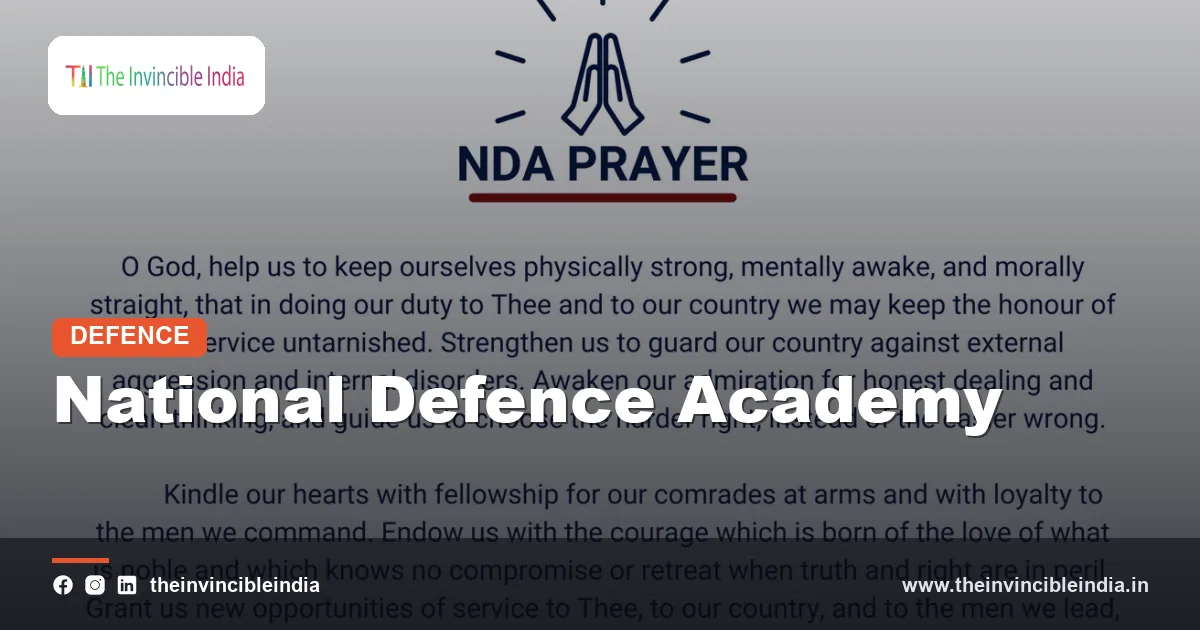
The National Defence Academy, widely known as the NDA, is the joint-services training institution where future officers of the Indian Army, Navy and Air Force begin their careers together. Located at Khadakwasla near Pune in Maharashtra and functioning since 1954, it is often described as the first academy of its kind in the world to train cadets of all three services under a single roof.
Admission to the National Defence Academy is highly competitive and takes place through a written examination conducted by the Union Public Service Commission, followed by a Services Selection Board interview. Cadets spend three years in a demanding mix of academics, drill, outdoor training and character-building before moving to their respective service academies. This article explains the history, selection, curriculum, traditions and notable people of the institution, along with the landmark 2021 decision to admit women.
| Fact | Detail |
|---|---|
| Location | Khadakwasla, near Pune, Maharashtra |
| Functioning since | 1954 (the Joint Services Wing at Dehradun shifted to Khadakwasla) |
| Services trained | Indian Army, Indian Navy and Indian Air Force |
| Motto | Seva Parmo Dharma (Service before Self) |
| Entry route | UPSC NDA and Naval Academy Examination, then SSB interview |
| Course duration | Three years (six terms) |
| Degree awarded | Bachelor’s degree, awarded through an affiliated university |
| Women admitted | From 2022, following a Supreme Court order in August 2021 |
History and Founding of the National Defence Academy
The idea of a joint training institution arose after independence in 1947. India had inherited its officer training from the British system, in which the Royal Military College at Sandhurst, Dartmouth and Cranwell trained the three services separately. The new country lost its main training institutions to partition, and planners decided to build a fresh academy that would train all three services together.
From Dehradun to Khadakwasla
A Joint Services Wing was set up in 1949 at Clement Town in Dehradun. The permanent campus was planned at Khadakwasla, on the shores of a lake near Pune. The foundation stone of the main building, the Sudan Block, was laid by Prime Minister Jawaharlal Nehru in October 1949. The Joint Services Wing moved to the new campus in 1954, and the institution then began functioning as the National Defence Academy.
The Sudan Block
The administrative and academic heart of the campus is the Sudan Block, a large landmark building. It is commonly said to be named in recognition of a contribution from Sudan towards the project, and it remains the most recognisable symbol of the academy.
Campus and Facilities at Khadakwasla
The campus lies on a sprawling area of several thousand acres, flanked by hills and the reservoir of Khadakwasla. It is a self-contained township, with academic buildings, residential blocks, mess facilities, hospitals, sports grounds and training areas.
Training infrastructure
- Academic blocks with classrooms, laboratories and a well-stocked library
- Parade grounds and drill squares for ceremonial training
- Swimming pools, boxing rings, gymnasiums and playing fields
- Equestrian facilities, including a riding school and stables
- Sailing and boating facilities on the lake
- Obstacle courses, firing ranges and fieldcraft areas in the surrounding terrain
- Simulators and aviation training facilities to introduce flying and navigation concepts
Cadet organisation
Cadets are organised into battalions and squadrons, each with its own identity, officers and traditions. Instructors from all three services serve at the academy, and the Commandant is a senior officer, who rotates among the three services in turn. This arrangement is intended to reflect the joint character of the institution.
Selection: The UPSC NDA Examination and SSB
Admission is through a two-stage process. The Union Public Service Commission conducts the National Defence Academy and Naval Academy Examination twice a year. Successful candidates are then called for a multi-day interview by the Services Selection Board.
Eligibility in outline
- Nationality: citizens of India, with certain categories of Nepalese and Bhutanese subjects also eligible under rules.
- Age: candidates must be within a prescribed band of roughly 16.5 to 19.5 years at the time of joining.
- Education: a pass in the Class 12 examination, or students who are appearing for it. The Army wing is open to candidates from any stream, whereas the Air Force and Naval wings require Physics and Mathematics.
- Fitness: candidates must meet physical and medical standards set for officers.
The written examination
The written paper has two parts: Mathematics and the General Ability Test, which includes English and general knowledge. The scores determine who is called for the next stage.
The Services Selection Board
The SSB assessment generally spans five days at a selection centre and tests intelligence, personality and officer-like qualities through psychological tests, group tasks, interviews and outdoor exercises. Candidates who clear it are medically examined, and the final merit list combines the written and SSB scores. The relative weight of each stage is notified by the commission and may be revised from time to time.
The Three-Year Training Programme
The course is structured over three years, divided into six terms. The syllabus is built on three interlinked pillars: academic, service and physical training, along with character development.
Academic training
Cadets follow a degree curriculum in Science, Computer Science or Arts and Humanities, depending on their stream. The degree is awarded through an affiliated university, which has long been Jawaharlal Nehru University. Naval cadets who follow the technical stream proceed to engineering education at the Indian Naval Academy.
Service and physical training
- Drill, weapons training, map reading and fieldcraft
- Swimming, boxing, obstacle courses and endurance events
- Horse riding, sailing and, for some cadets, introductory flying experience
- Leadership exercises, camping and treks in rugged terrain
- Service-specific classes for the Army, Navy and Air Force
Tone and discipline
The first term is known to be especially rigorous, aimed at transforming a civilian student into a cadet. Morning physical training, strict timetables and collective discipline are the norm. Cadets are also encouraged to take part in cultural and extracurricular activities, and the academy places emphasis on an all-round personality.
After the NDA: Pre-Commissioning Training
The three-year NDA course is not the end of officer training. After graduating, cadets move to their respective service academies for pre-commissioning training, which is specific to each service.
| Service | Next institution | Duration (general) |
|---|---|---|
| Army | Indian Military Academy, Dehradun | About one year |
| Navy | Indian Naval Academy, Ezhimala, Kerala | Around one year of specialised training |
| Air Force | Air Force Academy, Dundigal, near Hyderabad | About one year, including flying training |
Cadets are commissioned as officers only on completing this stage. Durations and arrangements may be revised by the services, so the figures above are indicative. Because they have trained together for three years, NDA graduates often carry strong bonds across the services, which helps in joint operations later in their careers.
The 2021 Supreme Court Order and Women at the NDA
For decades, the academy admitted only male candidates. Women could join the armed forces through other entry routes such as short service commissions, but the NDA entry was closed. That changed after a case brought before the Supreme Court of India.
The case and the order
A petition filed by advocate Kush Kalra challenged the exclusion of women from the NDA examination. In August 2021, a bench of the Supreme Court passed an interim order allowing eligible women to appear in the upcoming NDA exam, observing that restricting them was discriminatory. The court’s approach drew on its earlier decisions on permanent commissions for women officers in the Army and Navy.
Government response
The Union government subsequently told the Court that the armed forces had decided to admit women to the academy, and the Court asked for a phased and well-planned approach. The first women cadets joined the academy in 2022, marking a historic shift in a seven-decade-old institution.
Preparations
- Adaptation of residential and training infrastructure for women cadets
- Recruitment of women instructors and support staff
- Gradual increase in the number of vacancies, in coordination with the services
Traditions, Culture and Ceremonies
The academy’s traditions bind cadets to a common heritage. They are passed on across batches and give the institution a distinct character.
Antim Pag
The most celebrated tradition is the Antim Pag, meaning the “final step”. At the passing-out parade, graduating cadets march through the Sudan Block, and the ceremonial last step symbolises the completion of their training and their entry into the officer corps. The occasion is emotional for families and instructors, and it is held in the presence of a reviewing dignitary.
Other features
- The Passing Out Parade, held twice a year at the end of each term cycle
- Cadet identity through squadrons, which compete in sports, drill and academics
- Named halls and buildings that honour distinguished figures from military history, such as Habibullah Hall
- A strong culture of sports, adventure and community service
The motto, Seva Parmo Dharma, reminds cadets that service to the nation and fellow citizens takes precedence over personal interest.
Notable Alumni of the National Defence Academy
Thousands of officers have passed through the academy, and many have attained high rank or received national honours. Alumni include several chiefs of the Army, Navy and Air Force, as well as recipients of the highest gallantry awards.
- Lieutenant Manoj Kumar Pandey: posthumously awarded the Param Vir Chakra for his courage in the Kargil conflict of 1999.
- Second Lieutenant Arun Khetarpal: posthumously awarded the Param Vir Chakra for his role in the 1971 war with Pakistan.
- Wing Commander Rakesh Sharma: the first Indian to travel into space, in 1984, and a former Air Force pilot who began his training at the academy.
The academy has also trained cadets from friendly foreign countries, a facet of India’s military diplomacy. Alumni have also gone on to roles in civil life, such as politics, sports and administration, after serving in uniform.
Significance for India’s Armed Forces
The NDA is one of the primary sources of officers for the three services. Its importance goes beyond numbers, because it instils a culture of jointness in future leaders at the very start of their careers.
Why jointness matters
Modern warfare relies on coordination between land, sea and air forces. An Army officer who has lived, trained and played alongside Navy and Air Force counterparts is better prepared to understand their capabilities. This is one reason that the academy features in discussions on theatre commands and integrated planning, which have gained prominence since the creation of the post of Chief of Defence Staff.
Other entry routes
The NDA is not the only gateway to a commission. Officers also enter through the Combined Defence Services Examination, technical entry schemes, the Technical Graduate course, the Short Service Commission and, for some officers, through other schemes. The NDA is distinct because it takes candidates immediately after school and trains them for three years in a joint environment.
Conclusion
The National Defence Academy has served as the foundation stone of India’s military leadership for decades. From its beginnings at Khadakwasla in 1954 to the historic admission of women in 2022, it has adapted while holding to its core ideal of service before self. For young Indians who aspire to wear the uniform, it remains the most prominent route into the profession of arms.
Frequently Asked Questions
Where is the National Defence Academy located?
The National Defence Academy is located at Khadakwasla, near Pune in Maharashtra, on the banks of the Khadakwasla reservoir. It started functioning at this campus in 1954 after moving from its earlier Joint Services Wing at Dehradun.
How can one join the NDA?
Candidates must clear the UPSC National Defence Academy and Naval Academy Examination, held twice a year, and then qualify at a Services Selection Board interview and medical examination. Eligible candidates are young unmarried students who have passed or are appearing in Class 12.
How long is the NDA course?
The course lasts three years, spread over six terms. Cadets then go to the Indian Military Academy, the Indian Naval Academy or the Air Force Academy for about a year of service-specific training before being commissioned.
Are women allowed to join the NDA?
Yes. After an interim order of the Supreme Court in August 2021, eligible women were allowed to take the NDA examination, and the first women cadets joined the academy in 2022. Vacancies for women have been introduced in a phased manner.
What degree do NDA cadets receive?
Cadets complete a bachelor’s degree in Science, Computer Science or Arts, awarded through an affiliated university. Naval cadets in the technical stream proceed to engineering studies at the Indian Naval Academy.
What is the Antim Pag?
The Antim Pag, or final step, is the ceremonial last step taken by graduating cadets as they march through the Sudan Block at the passing-out parade. It symbolises the end of their training at the academy and their transition into the officer corps.


