

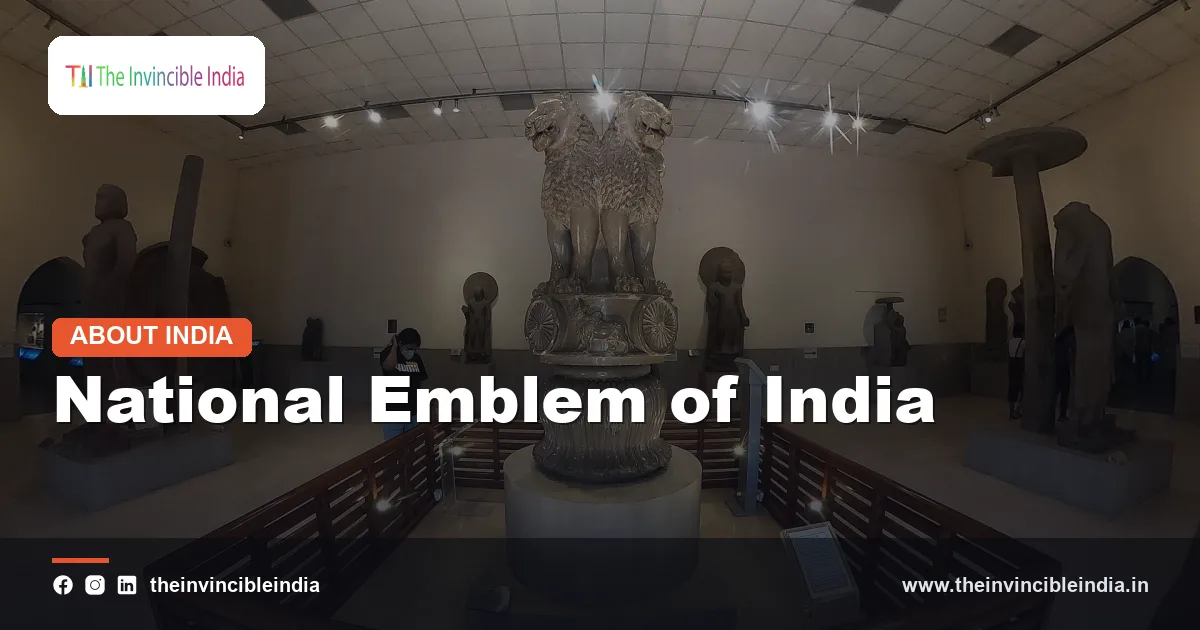
Look at an Indian passport, a rupee coin, a government letterhead or the gate of a ministry, and you will see a small, strong image of lions standing back to back above a wheel. This is the National Emblem of India, formally called the State Emblem of India. It is an adaptation of the Lion Capital of Ashoka at Sarnath, a masterpiece of Mauryan sculpture created around 250 BCE, and it was adopted by the Republic of India on 26 January 1950, the day the Constitution came into force.
The emblem is more than an official seal. It carries layers of meaning drawn from Buddhist and wider Indian tradition, from the first sermon at Sarnath to the idea of dharma as a guiding principle of government. Below it appear the words Satyameva Jayate, which mean “truth alone triumphs”. This article explains the origin of the emblem, its design, the symbolism of each element, its legal protection and the ways in which it differs from other national symbols such as the flag.
Quick Facts
| Item | Detail |
|---|---|
| Official name | State Emblem of India |
| Source | Lion Capital of Ashoka at Sarnath, c. 250 BCE (Mauryan period) |
| Adopted | 26 January 1950 |
| Material of the original | Polished Chunar sandstone |
| Lions | Four in the original, three visible in the emblem |
| Motto | Satyameva Jayate (Devanagari script), from the Mundaka Upanishad |
| Governing law | State Emblem of India (Prohibition of Improper Use) Act, 2005 |
| Original kept at | Sarnath Museum, Uttar Pradesh (Archaeological Survey of India) |
Origin: The Ashokan Pillar at Sarnath
The emblem traces back to Emperor Ashoka, the third ruler of the Mauryan dynasty, who reigned in the third century BCE. After his conversion to Buddhism, Ashoka set up a series of monolithic stone pillars across the subcontinent, inscribed with edicts that promoted ethical conduct, tolerance and welfare. Some were crowned with animal capitals of exquisite workmanship.
The pillar at Sarnath, near Varanasi, stands at a place of great importance in Buddhism. It was here, in the Deer Park at Isipatana, that the Buddha delivered his first sermon, an event known as Dhammachakkappavattana, or the turning of the wheel of dharma. The pillar bore an inscription warning against division in the monastic community, and its capital was the Lion Capital now taken as India’s emblem.
Rediscovery
The remains of the pillar and its capital were found during excavations at Sarnath in the early twentieth century, around 1905, under the direction of the archaeologist F. O. Oertel of the Archaeological Survey of India. The capital was in a remarkably good state, though the shaft was broken. It was placed in the Sarnath Museum, one of the earliest site museums in India, where it remains on display.
Design of the Lion Capital
The original capital was carved from a single block of Chunar sandstone, a buff-coloured stone quarried near Varanasi, and has the high lustre known as Mauryan polish. The sculpture has several parts, arranged one above the other.
Components of the original capital
- Inverted lotus base: a bell-shaped lotus at the bottom, a motif familiar in Persian and Indian art, symbolising purity and the sacred.
- Circular abacus (drum): a round platform bearing a frieze of four animals and four wheels in alternation.
- Four lions: four Asiatic lions, seated back to back, facing the four directions, forming the crown.
- Crowning wheel (now lost): a large wheel of dharma once stood above the lions, as indicated by fragments found at the site.
The lions show the vigour and naturalism of Mauryan sculpture, with strong muscle forms, a stylised mane and an expression of calm authority. The abacus is a carefully balanced frieze, and the whole structure is regarded as a high point of Indian stone art from antiquity.
What the National Emblem of India Looks Like
The State Emblem is not an exact copy. It is a two-dimensional adaptation that shows the capital as it would appear from the front. Because the lions are back to back, only three can be seen, while the fourth is hidden from view. The abacus is shown below, with a Dharma Chakra, or wheel of law, at the centre of its visible face. A bull appears on the right side of the wheel and a galloping horse on the left, with the outlines of other wheels at the extreme right and left edges.
The bell-shaped lotus is omitted. Below the abacus, in the Devanagari script, are the words Satyameva Jayate. The emblem is usually shown in a single colour, such as black, white, gold or the colour of the surface on which it is embossed or printed. It should be reproduced strictly according to the prescribed design and proportions.
What is visible and what is not
| Feature | In the original capital | In the State Emblem |
|---|---|---|
| Lions | Four | Three visible |
| Lotus base | Present | Omitted |
| Animals on abacus | Elephant, horse, bull, lion | Bull and horse shown at the front, the others implied |
| Wheel above lions | Originally present | Not shown |
| Motto | Absent | Satyameva Jayate below |
The Four Animals on the Abacus
Each of the four animals on the abacus faces one of the four directions and is separated by a wheel. They are the elephant, the horse, the bull and the lion. In Buddhist and wider Indian tradition they carry symbolic associations, though interpretations vary, and the following should be read as common traditional readings rather than fixed doctrine.
- Elephant: linked with the story of the conception of the Buddha, in which his mother, Queen Maya, dreamt of a white elephant. It also signifies strength, wisdom and stability.
- Bull: associated with the zodiac sign Taurus, under which the Buddha is traditionally said to have been born, and with patience, labour and fertility.
- Horse: linked with the horse Kanthaka, on which the prince Siddhartha left his palace in search of enlightenment. It symbolises energy and speed.
- Lion: a symbol of courage and royal authority and a title of the Buddha, who is sometimes called the lion of the Shakya clan.
Another reading holds that the animals represent the guardians of the four directions, or the natural world surrounding the dharma. In either case the message is of dynamic life in motion around a central principle.
The Ashoka Chakra and Dharma Chakra
At the centre of the abacus in the emblem is a wheel. It is a Dharma Chakra, a wheel of law, with twenty-four spokes. This wheel stands for the teaching of the Buddha and for the broader idea of dharma, which in Indian thought means righteousness, duty and the moral order that sustains society. The wheel’s motion represents continual progress and change, and its stress on law has made it a fitting symbol for a constitutional republic.
Wheel on the flag
The same Ashoka Chakra, drawn in navy blue and with twenty-four evenly spaced spokes, appears at the centre of the national flag of India, between the saffron and green bands. The Constituent Assembly adopted the flag on 22 July 1947. Both symbols come from the Sarnath pillar, which is why the wheel appears in each. The flag and the emblem are separate symbols with different rules of use, however.
The meaning of the twenty-four spokes is explained in several ways, including twenty-four hours of the day, virtues or stages of right conduct, and the unending movement of time. No single explanation is official, and all stress that the wheel stands for continuous movement forward.
Satyameva Jayate: The Motto
The words Satyameva Jayate come from the Mundaka Upanishad, one of the principal Upanishads of the Atharvaveda. In a famous verse, it declares that truth alone triumphs, not falsehood, and that the path of the gods is spread by truth. Because the Upanishads are central texts of Indian philosophy, the motto links the republic with one of its oldest traditions of thought.
The motto was popularised in the early twentieth century by Pandit Madan Mohan Malaviya, who urged its use during the national movement, including in a Congress session in 1918. When the new republic chose its emblem, the phrase was added to the base in Devanagari script. It is not part of the ancient Ashokan sculpture itself; it was chosen to give the state a moral foundation.
Meaning for governance
The phrase has served as a reminder to public servants that truth, honesty and accountability underpin lawful authority. It appears on coins, notes, official documents and government buildings alongside the emblem.
Adoption by the Republic of India
When India was becoming a republic, the Constituent Assembly and the government considered what symbol would suit an independent nation. The Sarnath capital was an obvious choice because of its historical, artistic and philosophical significance, and its association with Ashoka, who is remembered for promoting non-violence, tolerance and welfare. Artists from the school of art at Santiniketan, associated with Nandalal Bose, were involved in preparing the modern drawing, and Dinanath Bhargava is often credited with the design of the adaptation.
The emblem was adopted on 26 January 1950, when the Constitution took effect and India became a sovereign democratic republic. Before that, administrative documents had used colonial symbols. The change represented a break from the Crown crest and a reconnection with an Indian past that predated colonial rule.
Timeline
| Date | Event |
|---|---|
| c. 250 BCE | Lion Capital created during Ashoka’s reign |
| c. 1905 | Excavation of the capital at Sarnath |
| 1910 | Sarnath Museum established to house the finds |
| 22 July 1947 | National flag adopted by the Constituent Assembly |
| 26 January 1950 | State Emblem adopted |
| 2005 | State Emblem of India (Prohibition of Improper Use) Act enacted |
| 2007 | Rules for regulating use of the emblem framed |
Legal Protection: The State Emblem of India Act, 2005
Because the emblem represents the authority of the state, its use is regulated. An earlier law, the Emblems and Names (Prevention of Improper Use) Act, 1950, banned improper use of certain symbols and names. In 2005, Parliament passed the State Emblem of India (Prohibition of Improper Use) Act, which deals specifically with the emblem and was supported by rules framed in 2007.
Main provisions
- The Act prohibits the use of the emblem, or any imitation that is likely to mislead, for any trade, business, profession or in any title of a patent, trademark or design without the permission of the Central Government.
- Use by authorised persons and institutions, such as the President, the Vice President, Governors, Union ministers and offices of the Central Government, is regulated according to rules.
- Contravention is a punishable offence, with penalties of imprisonment, fine or both.
- The emblem must be reproduced strictly in line with the design and proportions notified by the government.
The Act and its rules also specify the occasions and kinds of documents on which the emblem may appear, such as official stationery, seals, passports, currency and public buildings. States have their own emblems, but they are also allowed to use the State Emblem of India in specified ways.
Where the Emblem Is Used
The emblem appears widely in everyday life, even where people do not notice it. It is the seal of the Government of India and is found on the cover of the Indian passport, on official correspondence, on coins and currency notes, on court and ministry buildings, and on documents issued by constitutional authorities. Embassies, high commissions and the offices of Governors also display it.
A large bronze version was installed on the roof of the central foyer of the new Parliament building in 2022. Its unveiling led to public discussion about the artistic rendering of the lions, which shows how closely citizens follow the representation of national symbols.
Emblem versus other national symbols
- The national flag is the tricolour with the Ashoka Chakra at its centre, adopted in 1947.
- The national anthem, Jana Gana Mana, was adopted on 24 January 1950, two days before the emblem.
- The national song, Vande Mataram, has equal honour with the anthem.
- The State Emblem is the official seal of the state, not a flag, and should not be used casually or commercially.
Symbolic Meaning of the Emblem
The four lions facing the four directions are commonly read as symbols of power, courage, pride and confidence. Their back-to-back arrangement suggests that authority should stand firm on all sides, and in the Buddhist tradition the lion’s roar stands for the proclamation of the dharma. The wheel at the base communicates that this power is checked by law and morality. The animals represent life, labour and energy, and the motto adds the philosophical standard against which governance is to be judged.
The emblem can therefore be read as a statement of the republic’s ideals: strength restrained by righteousness, progress grounded in truth, and unity amid diversity. Whether one follows the Buddhist reading or a broader civilisational one, the design says that the state exists to serve dharma and the people.
Conclusion
The National Emblem of India links a modern constitutional republic to one of the high points of ancient Indian art and thought. From the polished lions of Ashoka’s pillar to the printed seal on a passport, the same design announces the authority of the state and the values it aspires to uphold. Understanding its origin, symbolism and legal safeguards helps citizens use and respect it correctly. This content was last reviewed on 4 October 2026.
Frequently Asked Questions
When was the National Emblem of India adopted?
The State Emblem of India was adopted on 26 January 1950, the day the Constitution of India came into force. It is an adaptation of the Lion Capital of Ashoka at Sarnath, which dates to about 250 BCE.
Why are only three lions visible in the emblem?
The original capital has four lions seated back to back, facing the four directions. Since the emblem is a two-dimensional view from the front, only three are visible and the fourth is hidden behind them.
What does Satyameva Jayate mean and where is it from?
Satyameva Jayate means truth alone triumphs. It comes from the Mundaka Upanishad and appears in Devanagari script at the base of the emblem. It was popularised in the national movement by Madan Mohan Malaviya.
What animals appear on the abacus of the emblem?
The original abacus shows an elephant, a galloping horse, a bull and a lion, separated by wheels. In the emblem, the bull is seen on the right and the horse on the left of the central Dharma Chakra, while the other animals are not visible from the front.
Is there a law governing use of the National Emblem?
Yes. The State Emblem of India (Prohibition of Improper Use) Act, 2005, together with rules framed in 2007, restricts use of the emblem to authorised persons and purposes. Improper use, such as in business logos or trademarks without permission, is a punishable offence.
How is the emblem different from the national flag’s Ashoka Chakra?
Both come from the Sarnath pillar and show a twenty-four-spoke wheel. The emblem is the official seal of the state, showing lions, abacus, animals and motto, whereas the flag is a tricolour of saffron, white and green with the wheel in navy blue at the centre. Each has its own rules of use.
{“@context”:”https://schema.org”,”@graph”:[{“@type”:”FAQPage”,”mainEntity”:[{“@type”:”Question”,”name”:”When was the National Emblem of India adopted?”,”acceptedAnswer”:{“@type”:”Answer”,”text”:”The State Emblem of India was adopted on 26 January 1950, the day the Constitution of India came into force. It is an adaptation of the Lion Capital of Ashoka at Sarnath, which dates to about 250 BCE.”}},{“@type”:”Question”,”name”:”Why are only three lions visible in the emblem?”,”acceptedAnswer”:{“@type”:”Answer”,”text”:”The original capital has four lions seated back to back, facing the four directions. Since the emblem is a two-dimensional view from the front, only three are visible and the fourth is hidden behind them.”}},{“@type”:”Question”,”name”:”What does Satyameva Jayate mean and where is it from?”,”acceptedAnswer”:{“@type”:”Answer”,”text”:”Satyameva Jayate means truth alone triumphs. It comes from the Mundaka Upanishad and appears in Devanagari script at the base of the emblem. It was popularised in the national movement by Madan Mohan Malaviya.”}},{“@type”:”Question”,”name”:”What animals appear on the abacus of the emblem?”,”acceptedAnswer”:{“@type”:”Answer”,”text”:”The original abacus shows an elephant, a galloping horse, a bull and a lion, separated by wheels. In the emblem, the bull is seen on the right and the horse on the left of the central Dharma Chakra, while the other animals are not visible from the front.”}},{“@type”:”Question”,”name”:”Is there a law governing use of the National Emblem?”,”acceptedAnswer”:{“@type”:”Answer”,”text”:”Yes. The State Emblem of India (Prohibition of Improper Use) Act, 2005, together with rules framed in 2007, restricts use of the emblem to authorised persons and purposes. Improper use, such as in business logos or trademarks without permission, is a punishable offence.”}},{“@type”:”Question”,”name”:”How is the emblem different from the national flag’s Ashoka Chakra?”,”acceptedAnswer”:{“@type”:”Answer”,”text”:”Both come from the Sarnath pillar and show a twenty-four-spoke wheel. The emblem is the official seal of the state, showing lions, abacus, animals and motto, whereas the flag is a tricolour of saffron, white and green with the wheel in navy blue at the centre. Each has its own rules of use.”}}]}]}


