

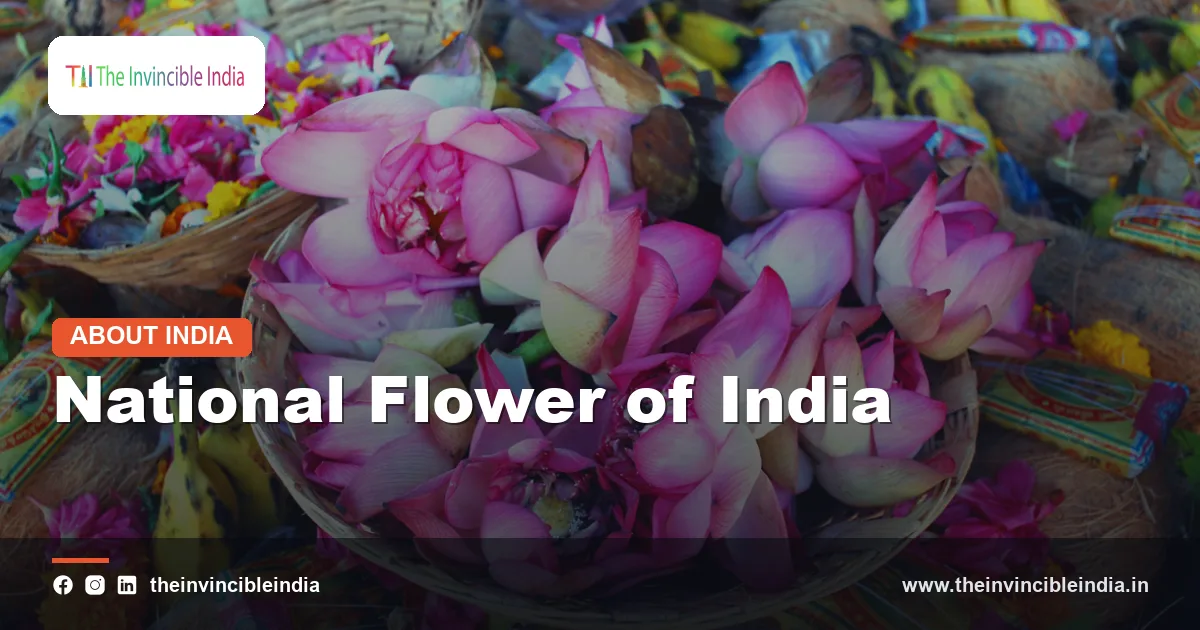
The national flower of India is the lotus, an aquatic flowering plant whose scientific name is Nelumbo nucifera, chosen for its beauty, its long history in Indian culture and its symbolism of purity and spiritual awakening. The lotus is also known as the sacred lotus or Indian lotus, and in Indian languages it goes by names such as kamal and padma.
The lotus grows rooted in the mud at the bottom of ponds and lakes, yet its leaves and flowers rise above the water looking clean and unstained. This quality has made it a central image in Hindu, Buddhist and Jain traditions and in Indian art. This article explains why the lotus is the national flower of India, how the plant is built and why its leaves repel dirt, what it symbolises, how it is used, and where it grows.
| National Flower of India at a Glance | |
|---|---|
| National flower | Lotus |
| Scientific name | Nelumbo nucifera |
| Plant family | Nelumbonaceae |
| Other names | Sacred lotus, Indian lotus; kamal, padma, pankaj, kamalini |
| Habitat | Freshwater ponds, lakes and slow-moving wetlands |
| Flower colours | Pink and white, with many cultivated varieties |
| Main symbolism | Purity, beauty, prosperity and spiritual awakening |
| Status | One of India’s national symbols, alongside the tiger, the peacock and the banyan |
Key Takeaways
- The lotus (Nelumbo nucifera) is the national flower of India and is counted among the country’s national symbols.
- The lotus grows from roots anchored in muddy water but produces clean leaves and flowers above the surface, which is why it stands for purity in Indian tradition.
- Lotus leaves have a micro-textured, waxy surface that sheds water and dirt, a property that scientists call the lotus effect.
- The lotus is closely associated with the Hindu goddess Lakshmi, with Buddhist and Jain iconography, and with the Padma awards, which take their name from the Sanskrit word for lotus.
- Almost every part of the lotus plant, including seeds, roots, leaves and petals, has traditional uses in food, medicine and ritual.
- The lotus is a freshwater aquatic plant that grows across the Indian plains and in many wetlands from Kashmir to Kerala.
What Is the National Flower of India?
The national flower of India is the lotus, a perennial aquatic plant recognised by the Government of India as one of the nation’s official symbols. It belongs to the same group of national symbols as the Tiger (national animal), the Indian Peacock (national bird), the Banyan (national tree) and the Mango (national fruit).
The lotus was chosen because it has been part of Indian civilisation for thousands of years, appearing in ancient texts, sculpture, temple architecture and folk traditions across the country. It is not tied to any single region, language or community, and it is respected by several religions. This broad cultural presence makes it a suitable emblem of the nation.
The lotus should not be confused with water lilies, which are plants of the genus Nymphaea. Both float on ponds and have showy flowers, but the lotus carries its leaves and flowers above the water on tall stalks, while water lilies have leaves that float flat on the surface.
What Does the Lotus Plant Look Like?
The lotus is a large, perennial water plant with big round leaves, tall stalks and showy flowers that can reach roughly 20 to 30 centimetres across. The leaves are often held well above the water on long stalks, and can be about half a metre or more in diameter. The leaf is circular and slightly cup-shaped, with veins radiating from the centre.
Key parts of the lotus include:
- Rhizome: A thick underwater stem that creeps through the mud and stores food. New leaves and flowers grow from it each season.
- Leaves: Large, round and bluish-green, usually standing above the water.
- Flower: A large bloom with many layered petals, usually pink or white, and a yellow centre that holds numerous stamens.
- Seed pod: After the petals fall, the flower leaves a flat-topped, cone-shaped structure with holes, each holding a hard seed.
Lotus flowers typically open in the morning and close towards evening, and each flower lasts for only a few days. A single plant can produce flowers throughout the warm season.
Why Does the Lotus Stay Clean in Muddy Water?
The lotus stays clean in muddy water because its leaves have a microscopic surface structure and a waxy coating that make water roll off in beads, carrying dirt particles away with it. This property is known as the lotus effect or the self-cleaning effect.
The surface of a lotus leaf is covered with tiny bumps, which are themselves coated with fine wax crystals. Because of this double-scale roughness, a water drop touches only the tips of the bumps and cannot spread. Dust and mud particles sit loosely on the tips, so when a droplet rolls over the leaf, it picks them up and removes them.
Scientists studied this effect closely in the late twentieth century and used it as inspiration for self-cleaning paints, coatings, fabrics and glass. This is an example of biomimicry, where human technology copies a natural design. The botanical feature also explains the poetic image used in Indian writing: the lotus living in mud without being soiled.
Why Is the Lotus a Symbol of Purity in India?
The lotus is a symbol of purity in India because it rises from muddy water without being stained, which is read as a picture of staying spiritually pure while living in the material world. The image appears in many traditions and is among the oldest metaphors in Indian thought.
A well-known verse in the Bhagavad Gita compares a person who acts without attachment to a lotus leaf that is untouched by water. In Sanskrit, one of the names for the lotus is pankaja, meaning “born of mud”, which captures both the humble origin and the pure bloom. The metaphor expresses the idea that beauty and goodness can emerge from difficult surroundings.
Other meanings attached to the lotus include prosperity, fertility, beauty, grace and the unfolding of consciousness. The opening of its petals is used as an image of the awakening of the mind.
What Is the Lotus’s Role in Hindu, Buddhist and Jain Traditions?
The lotus has a central role in Hindu, Buddhist and Jain traditions, where it appears as a seat, a symbol and a sacred offering. It is one of the few images shared by all three traditions, which is part of why it is regarded as a cultural emblem of the whole country.
In Hinduism
The goddess Lakshmi, associated with wealth and good fortune, is usually shown seated or standing on a lotus and holding lotus flowers. The god Brahma is described as born from a lotus that grows from the navel of Vishnu, who is therefore called Padmanabha. Goddess Saraswati is also often shown on a white lotus. Lotus flowers are offered in temples, and many deities have names or features linked to the lotus, such as lotus eyes and lotus feet.
In Buddhism
In Buddhist art, the Buddha is commonly depicted seated on a lotus throne, a sign of enlightenment rising above worldly attachment. The mantra “Om Mani Padme Hum” refers to the jewel in the lotus. Different colours and stages of the flower, from bud to full bloom, are used to represent stages of spiritual development.
In Jainism
In Jainism, the lotus is the emblem of Padmaprabha, the sixth Tirthankara. Lotus motifs also appear widely in Jain temple carvings and ceilings, where they are used as symbols of purity.
| Tradition | Lotus association |
|---|---|
| Hinduism | Seat of Lakshmi and Saraswati; Brahma born from a lotus; temple offerings |
| Buddhism | Lotus throne of the Buddha; the mantra Om Mani Padme Hum; symbol of enlightenment |
| Jainism | Emblem of the sixth Tirthankara Padmaprabha; common carved motif |
Where Does the Lotus Appear in Indian Art, Architecture and Awards?
The lotus appears throughout Indian art and architecture as a decorative and symbolic motif, in temple carvings, ceiling panels, pillars, coins, textiles and paintings, and it also gives its name to the Padma awards. Ancient Indian sculptures at Buddhist and Hindu sites often show lotus medallions and lotus-shaped pedestals.
Examples of the lotus in public life include:
- Padma awards: The Padma Vibhushan, Padma Bhushan and Padma Shri are among India’s highest civilian honours, instituted in 1954. The word “padma” is the Sanskrit name for the lotus, and the medals carry a lotus design.
- Architecture: Lotus-shaped domes, finials and carved ceilings appear in temples, mosques, forts and palaces across the country. The Lotus Temple in New Delhi, a Bahai house of worship completed in 1986, is a modern building shaped like a half-open lotus.
- Currency and heritage design: The lotus motif has appeared on coins, stamps and decorative arts over many periods.
- Literature and poetry: Poets in Sanskrit, Hindi, Bengali, Tamil and other languages compare eyes, faces and hands to the lotus.
What Are the Uses of the Lotus Plant?
The lotus plant has uses in food, traditional medicine, religious ritual and everyday life, since nearly every part of it is utilised. Its seeds, rhizomes, leaves, stalks, petals and stamens are all used in Indian households and traditional practice.
- Food: The rhizome, known as kamal kakdi or bhein, is sliced and cooked as a vegetable, fried or added to curries. The seeds, called kamal gatta or lotus seeds, are eaten raw, roasted or cooked. Large lotus leaves are used in some regions as plates or wrappers for food.
- Traditional medicine: In Ayurveda and other traditional systems, different parts of the lotus are described as cooling and calming agents. Such uses come from traditional practice, and they should not be treated as medical advice.
- Rituals: Lotus flowers and buds are offered in worship, and garlands and decorations are made from them.
- Craft and textiles: Fibres from lotus stalks have been used in some places to weave delicate fabrics.
- Ornamental use: The plant is widely grown in garden ponds and temple tanks for its flowers.
Lotus seeds should not be confused with makhana or fox nuts, which come from a different aquatic plant, Euryale ferox, although both are eaten as snacks.
Where Does the Lotus Grow in India?
The lotus grows in shallow, still or slow-moving freshwater across India, in ponds, lakes, tanks, oxbow lakes and marshes, from the plains of the north to the southern peninsula and the foothills of the Himalaya. It prefers warm, sunny conditions and water that is typically about half a metre to two metres deep.
Regions known for abundant lotus include the wetlands of West Bengal, Assam, Odisha, Bihar and Uttar Pradesh, the backwaters and ponds of Kerala, and lakes in Kashmir, where lotus blooms on Dal Lake are a summer attraction. The lotus has a very wide natural range that stretches from South Asia across Southeast Asia to northern Australia, and it has been cultivated in East Asia for centuries.
The plant depends on healthy wetlands. Drainage of ponds, pollution and the filling-in of lakes can reduce lotus habitat, which is one reason wetland conservation matters for this plant. Because lotus seeds are known to remain viable for a very long time, ponds that are restored sometimes regrow lotus from buried seed.
How Is the Lotus Different from Other National Symbols of India?
The lotus differs from the other national symbols of India in that it is a plant with a deep, continuous religious and artistic history, rather than an emblem created for the modern state. While the national flag and the State Emblem of India were formally adopted around the time of Independence and the founding of the Republic, the lotus was already a long-standing cultural icon.
| National symbol | Representative |
|---|---|
| National flower | Lotus (Nelumbo nucifera) |
| National animal | Tiger (Panthera tigris) |
| National bird | Indian Peacock (Pavo cristatus) |
| National tree | Banyan (Ficus benghalensis) |
| National fruit | Mango (Mangifera indica) |
| National aquatic animal | Ganges River Dolphin (Platanista gangetica) |
Together, these symbols reflect India’s natural diversity and cultural heritage. The lotus is especially notable because it unites the botanical, spiritual and artistic strands of that heritage in one image.
Bottom Line
The national flower of India is the lotus (Nelumbo nucifera), a freshwater plant admired for rising clean and bright out of muddy water. Its self-cleaning leaves, long presence in Hindu, Buddhist and Jain traditions, and connection to the Padma awards make it one of the most widely recognised symbols of Indian culture and identity.
Frequently Asked Questions
What is the national flower of India?
The national flower of India is the lotus, whose scientific name is Nelumbo nucifera. It is a freshwater aquatic plant that is one of India’s national symbols and is valued for its beauty and its association with purity in Indian culture.
Why is the lotus the national flower of India?
The lotus is the national flower of India because it has been part of Indian art, religion and literature for thousands of years and is respected across Hindu, Buddhist and Jain traditions. It is also a plant native to the subcontinent that symbolises purity, beauty and spiritual awakening, and it is not tied to any single region or community.
What is the scientific name of the lotus?
The scientific name of the lotus is Nelumbo nucifera. The plant belongs to the family Nelumbonaceae and is also called the sacred lotus or Indian lotus, and it is a different plant from the water lily, which belongs to the genus Nymphaea.
What does the lotus symbolise in Indian culture?
The lotus symbolises purity, beauty, prosperity and spiritual awakening in Indian culture. Because the plant grows in mud but blooms clean above the water, it represents the ability to remain pure while living in the material world. It is linked to the goddess Lakshmi, to the Buddha and to Jain iconography.
What is the lotus effect?
The lotus effect is the self-cleaning property of lotus leaves, whose micro-textured and waxy surface makes water roll off in droplets that carry dirt away. Scientists have used this natural design as inspiration for self-cleaning paints, glass and fabrics.
Where does the lotus grow in India?
The lotus grows in freshwater ponds, lakes, tanks and wetlands across India, from the Kashmir valley and the Gangetic plains to Assam, Odisha and Kerala. It prefers warm, sunny and shallow still water, and its habitat depends on healthy, unpolluted wetlands.
{“@context”:”https://schema.org”,”@graph”:[{“@type”:”FAQPage”,”mainEntity”:[{“@type”:”Question”,”name”:”What is the national flower of India?”,”acceptedAnswer”:{“@type”:”Answer”,”text”:”The national flower of India is the lotus, whose scientific name is Nelumbo nucifera. It is a freshwater aquatic plant that is one of India’s national symbols and is valued for its beauty and its association with purity in Indian culture.”}},{“@type”:”Question”,”name”:”Why is the lotus the national flower of India?”,”acceptedAnswer”:{“@type”:”Answer”,”text”:”The lotus is the national flower of India because it has been part of Indian art, religion and literature for thousands of years and is respected across Hindu, Buddhist and Jain traditions. It is also a plant native to the subcontinent that symbolises purity, beauty and spiritual awakening, and it is not tied to any single region or community.”}},{“@type”:”Question”,”name”:”What is the scientific name of the lotus?”,”acceptedAnswer”:{“@type”:”Answer”,”text”:”The scientific name of the lotus is Nelumbo nucifera. The plant belongs to the family Nelumbonaceae and is also called the sacred lotus or Indian lotus, and it is a different plant from the water lily, which belongs to the genus Nymphaea.”}},{“@type”:”Question”,”name”:”What does the lotus symbolise in Indian culture?”,”acceptedAnswer”:{“@type”:”Answer”,”text”:”The lotus symbolises purity, beauty, prosperity and spiritual awakening in Indian culture. Because the plant grows in mud but blooms clean above the water, it represents the ability to remain pure while living in the material world. It is linked to the goddess Lakshmi, to the Buddha and to Jain iconography.”}},{“@type”:”Question”,”name”:”What is the lotus effect?”,”acceptedAnswer”:{“@type”:”Answer”,”text”:”The lotus effect is the self-cleaning property of lotus leaves, whose micro-textured and waxy surface makes water roll off in droplets that carry dirt away. Scientists have used this natural design as inspiration for self-cleaning paints, glass and fabrics.”}},{“@type”:”Question”,”name”:”Where does the lotus grow in India?”,”acceptedAnswer”:{“@type”:”Answer”,”text”:”The lotus grows in freshwater ponds, lakes, tanks and wetlands across India, from the Kashmir valley and the Gangetic plains to Assam, Odisha and Kerala. It prefers warm, sunny and shallow still water, and its habitat depends on healthy, unpolluted wetlands.”}}]}]}


