

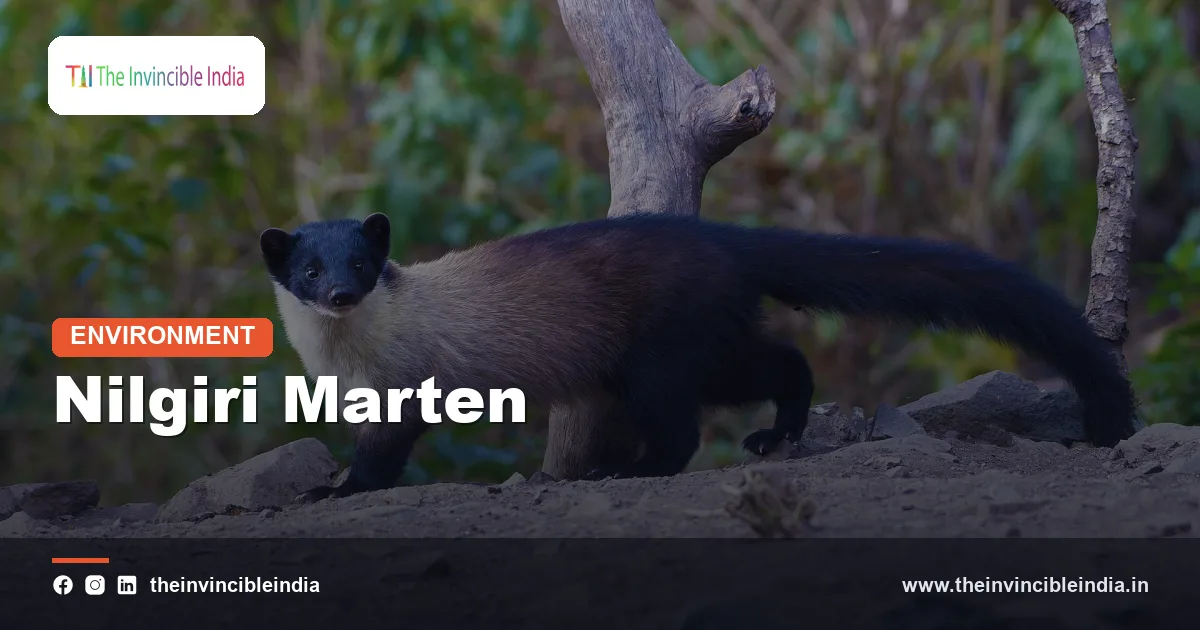
The Nilgiri marten (Martes gwatkinsii) is the only marten species found in peninsular India, a dark brown, long-tailed, tree-dwelling member of the weasel family that lives in the high-elevation shola forests and adjoining evergreen forests of the Western Ghats. It is endemic to southern India, meaning it occurs nowhere else in the world, and it is classified as Vulnerable on the IUCN Red List.
Nilgiri marten conservation matters because the species is rarely seen, poorly studied and tied to a fragile habitat that has been shrinking and fragmenting. Protecting the Nilgiri marten effectively means protecting the cloud forests, shola-grassland mosaics and wet evergreen forests of one of the world’s recognised biodiversity hotspots.
| Attribute | Details |
|---|---|
| Common name | Nilgiri marten (also called the Nilgiri martin) |
| Scientific name | Martes gwatkinsii (Horsfield, 1851) |
| Family | Mustelidae (weasels, martens, otters and badgers) |
| Range | Western Ghats of Kerala, Karnataka and Tamil Nadu, southern India (endemic) |
| Habitat | Montane shola forests, wet evergreen and semi-evergreen forests, adjoining plantations |
| Activity pattern | Mainly diurnal and arboreal |
| IUCN status | Vulnerable; population believed to be small and declining |
| Legal protection in India | Protected under the Wildlife (Protection) Act, 1972 (schedule placement is revised through amendments; consult current schedules) |
Key Takeaways
- The Nilgiri marten (Martes gwatkinsii) is the only marten species in peninsular India and is found only in the Western Ghats.
- The Nilgiri marten is classified as Vulnerable on the IUCN Red List because its population is small, scattered and thought to be declining.
- Unlike most small carnivores, the Nilgiri marten is largely diurnal and spends much of its time in trees, which makes it unusual among Indian mustelids.
- Habitat loss and fragmentation of shola and evergreen forests, caused by plantations, settlements and infrastructure, are considered the main threats to the Nilgiri marten.
- Reliable population estimates for the Nilgiri marten do not exist, and scientists describe the species as one of India’s least-studied carnivores.
- The Nilgiri marten occurs in several protected areas of the Western Ghats, a UNESCO World Heritage region since 2012 and a global biodiversity hotspot.
What is the Nilgiri marten?
The Nilgiri marten is a medium-sized, slender carnivore of the family Mustelidae, found only in the Western Ghats of southern India. It is the sole representative of the genus Martes in peninsular India; the other marten found in India, the yellow-throated marten (Martes flavigula), lives mainly in the Himalaya and north-eastern hills.
The species was described scientifically by the American naturalist Thomas Horsfield in 1851, from specimens in the Nilgiri hills, and the species name honours a Mr Gwatkin associated with the collection. Because of its secretive habits and limited range, the animal remained little known for more than a century.
The Nilgiri marten has a body of roughly 50-65 cm with a bushy tail of nearly equal length, and typically weighs about 1.5 to 2.5 kg, though measurements vary among sources. Its coat is dark chocolate brown, with a contrasting orange to yellow throat and chest patch that helps observers recognise it.
What does the Nilgiri marten look like?
The Nilgiri marten has a long, supple body, short legs, a pointed face with rounded ears, a long bushy tail and a dark brown coat contrasted by a yellowish-orange bib on the throat and upper chest. These features resemble those of the yellow-throated marten, although the Nilgiri marten has a darker body and a more restricted throat patch.
Its limbs end in sharp, semi-retractile claws suited to climbing, and its tail acts as a counterbalance when it moves along branches. Observers describe it as agile and quick, running along tree limbs and leaping between branches.
Distinguishing the species from similar animals in the field can be difficult. Other arboreal mammals in the same forests include the Indian giant squirrel, the Nilgiri langur, the brown palm civet and the Malabar civet, and the Nilgiri marten is sometimes mistaken for a civet or a mongoose in brief sightings.
Where does the Nilgiri marten live?
The Nilgiri marten lives in the Western Ghats, the mountain chain running along India’s south-western coast, where it has been recorded in the Nilgiris, the Anamalai hills, the Palani hills, the Cardamom hills and other high ranges of Kerala, Karnataka and Tamil Nadu. It favours montane shola forests, wet evergreen forests and nearby habitats at middle to high elevations.
Protected areas where the species has been reported include Mukurthi National Park, Silent Valley National Park, Eravikulam National Park, Periyar Tiger Reserve and other reserves in the Nilgiri Biosphere Reserve and Anamalai region. Records from the northern Western Ghats, such as parts of Karnataka’s Kodagu region, have also been described, although distribution details are still being refined.
Shola forests are patches of stunted evergreen forest lying in sheltered valleys, interspersed with open montane grasslands. This distinctive mosaic is restricted to the high ranges of the southern Western Ghats, and it provides the cool, moist conditions on which the marten and many other endemic species rely.
Key habitat types used by the Nilgiri marten
- Shola forests: high-altitude, stunted evergreen forests in valleys.
- Wet evergreen forests: tall, dense forests at lower to middle elevations.
- Forest edges and corridors: used when moving between forest fragments.
- Plantation margins: occasionally used where tea, coffee or cardamom estates adjoin natural forest.
How does the Nilgiri marten behave?
The Nilgiri marten is mostly diurnal and arboreal, meaning it is active during the day and spends much of its time in trees, though it also moves on the ground. This daytime activity is unusual, since most small carnivores in Indian forests are nocturnal.
It is usually seen alone or in pairs, travelling through the canopy or along fallen logs. Details of breeding, such as litter size, gestation and denning sites, are poorly documented. Related martens typically use tree hollows for dens, and it is likely, though not firmly established, that the Nilgiri marten does the same.
Like many forest mustelids, the species probably has a large home range for its body size and requires connected forest to move between feeding areas. Because it is elusive, most observations come from chance sightings, camera-trap images and the work of a small number of researchers.
What does the Nilgiri marten eat?
The Nilgiri marten is an omnivore that eats small vertebrates, insects, bird eggs, fruits and possibly nectar. Reports from the field describe it feeding on fruits, hunting small mammals, preying on nestlings and eggs, and visiting flowering trees for nectar or insects.
Studies of scats and direct observations indicate a varied diet that changes with season and local food supply. Fruiting trees of the shola and evergreen forests are likely to be important, which would make the marten a possible seed disperser as well as a predator.
Its diet puts it in competition with other small carnivores and arboreal mammals, including civets and the Indian giant squirrel, but little is known about how these species share resources. Predators of the marten itself are not well documented, although large cats, raptors and large snakes could pose risks in principle.
Why is the Nilgiri marten threatened?
The Nilgiri marten is threatened mainly by loss and fragmentation of its forest habitat, because the specialised forests it relies on have been cleared or broken up for plantations, agriculture, settlements, dams, roads and tourism infrastructure. The result is that populations may be small and isolated, which makes them vulnerable to local extinction.
Historically, large areas of Western Ghats forest were converted to tea, coffee, cardamom and rubber plantations, and montane grasslands and sholas were planted with exotic trees such as eucalyptus, wattle and pine. These exotic plantations offer far poorer habitat for native wildlife and can alter water flow and grassland ecology.
Other threats mentioned by researchers include roadkill on highways crossing forests, snaring or incidental trapping, hunting in some areas, disturbance from human activity and, over the longer term, climate change, which may push high-elevation species upslope into ever smaller areas. How serious each factor is for the Nilgiri marten is uncertain because systematic data are scarce.
Summary of threats
| Threat | How it affects the Nilgiri marten |
|---|---|
| Habitat loss | Reduces forest area available for feeding, denning and movement |
| Fragmentation | Isolates small populations and limits gene flow |
| Exotic plantations | Replace native shola and grassland with lower-quality habitat |
| Roads and infrastructure | Cause mortality and barriers to movement |
| Hunting and trapping | May affect local populations, often incidental |
| Climate change | May shrink suitable high-elevation habitat over time |
What is the conservation status and legal protection of the Nilgiri marten?
The Nilgiri marten is listed as Vulnerable on the IUCN Red List and is legally protected in India under the Wildlife (Protection) Act, 1972, which prohibits hunting and regulates trade in protected species. The schedule in which the species is placed has been adjusted through amendments over the years, including the major amendment of 2022, so the current schedule should be verified in the latest official text.
IUCN has noted that the total mature population is probably small and declining, but no precise number exists. The Vulnerable category reflects the combination of a restricted range, habitat decline and limited information, rather than a documented count.
Because most of the marten’s known range lies in or near protected areas, general forest and wildlife protection offers a baseline of safety. However, the animal’s presence outside reserves, in forest fragments and plantation landscapes, is less certain and less protected.
Which protected areas and programmes help the Nilgiri marten?
Protected areas such as national parks, wildlife sanctuaries, tiger reserves and biosphere reserves in the Western Ghats help the Nilgiri marten by safeguarding large tracts of its habitat. The Nilgiri Biosphere Reserve, established in 1986 as India’s first biosphere reserve, covers parts of Tamil Nadu, Kerala and Karnataka and includes shola forests used by many endemic species.
In 2012, UNESCO inscribed the Western Ghats as a World Heritage Site, recognising 39 component sites across seven sub-clusters in Kerala, Karnataka, Tamil Nadu and Maharashtra for their exceptional biodiversity and endemism. This status increases international attention to the region, although it does not by itself provide species-level protection.
Most targeted conservation of the Nilgiri marten comes through habitat protection, forest restoration, removal of invasive exotic trees in some areas and monitoring by forest departments and research institutions. A dedicated recovery programme for the species is not widely documented, so protection generally occurs as part of landscape-level efforts.
What research is needed to protect the Nilgiri marten?
Protecting the Nilgiri marten requires better information about its distribution, population size, ecology and genetics, because current knowledge is thin and conservation decisions rely heavily on assumptions. Camera-trap surveys, scat analysis, radio-tracking and genetic studies are standard tools for such research.
Priority questions include where the species still occurs, how many individuals are present in each forest block, how far animals move, what they eat across seasons and whether populations are connected. Genetic studies would also clarify how the Nilgiri marten is related to the yellow-throated marten, since some scientists have considered the two closely related and debated their taxonomic distinction.
Citizen science, such as verified photographs from visitors, forest staff and local communities, can supplement formal surveys when carefully documented. Such records help refine the species’ known range.
How can people help conserve the Nilgiri marten?
People can help conserve the Nilgiri marten by supporting forest protection, avoiding disturbance in shola habitats, reporting sightings through reliable channels and choosing responsible tourism and consumer products from the Western Ghats. Because the species depends on intact forest, protecting habitat is the most effective step.
- Visit protected areas responsibly, following rules on noise, litter, speed limits and off-trail movement.
- Support restoration of native shola and grassland and removal of invasive exotic species where authorised.
- Choose shade-grown or certified plantation products where available, which may offer better habitat for wildlife.
- Report credible sightings with photographs to forest departments or recognised research groups.
- Back local communities and organisations that work on forest conservation and human-wildlife coexistence.
Bottom Line
The Nilgiri marten is a rare, endemic, diurnal tree-dwelling carnivore of the Western Ghats, listed as Vulnerable and threatened chiefly by habitat loss and fragmentation. Much about its biology remains unknown, so careful research, continued forest protection and restoration of shola and evergreen habitat are the essential steps to secure its future.
Frequently Asked Questions
What is the Nilgiri marten?
The Nilgiri marten (Martes gwatkinsii) is a slender, dark brown carnivore of the weasel family that lives only in the Western Ghats of southern India. It is the only marten species found in peninsular India. It has a yellowish-orange throat patch and a long bushy tail.
Is the Nilgiri marten endangered?
The Nilgiri marten is classified as Vulnerable on the IUCN Red List, which is one step below Endangered. The listing reflects a small, declining population and a restricted range. Precise population numbers are not available because the species is rarely seen and poorly studied.
Where can the Nilgiri marten be found?
The Nilgiri marten is found in the Western Ghats of Kerala, Karnataka and Tamil Nadu, mainly in shola forests and wet evergreen forests. Areas where it has been recorded include the Nilgiris, the Anamalai and Palani hills and protected areas such as Mukurthi, Eravikulam, Silent Valley and Periyar. Its exact distribution is still being refined.
What does the Nilgiri marten eat?
The Nilgiri marten is an omnivore that eats small animals, insects, bird eggs, fruits and possibly nectar. Its diet appears to vary with season and the local availability of food. Research on its diet remains limited.
Is the Nilgiri marten active during the day?
Yes, the Nilgiri marten is mainly diurnal, which is unusual among small carnivores in Indian forests. It also spends much of its time in trees, using its sharp claws and long tail for climbing and balance. Even so, it is very hard to spot because of its shy nature and low numbers.
How is the Nilgiri marten protected in India?
The Nilgiri marten is protected under the Wildlife (Protection) Act, 1972, which bans hunting and regulates trade, and it occurs in several protected areas of the Western Ghats. The schedule placement has changed through amendments, so the current text of the Act should be checked. Conservation relies mostly on habitat protection and landscape-level forest management.
{“@context”:”https://schema.org”,”@graph”:[{“@type”:”FAQPage”,”mainEntity”:[{“@type”:”Question”,”name”:”What is the Nilgiri marten?”,”acceptedAnswer”:{“@type”:”Answer”,”text”:”The Nilgiri marten (Martes gwatkinsii) is a slender, dark brown carnivore of the weasel family that lives only in the Western Ghats of southern India. It is the only marten species found in peninsular India. It has a yellowish-orange throat patch and a long bushy tail.”}},{“@type”:”Question”,”name”:”Is the Nilgiri marten endangered?”,”acceptedAnswer”:{“@type”:”Answer”,”text”:”The Nilgiri marten is classified as Vulnerable on the IUCN Red List, which is one step below Endangered. The listing reflects a small, declining population and a restricted range. Precise population numbers are not available because the species is rarely seen and poorly studied.”}},{“@type”:”Question”,”name”:”Where can the Nilgiri marten be found?”,”acceptedAnswer”:{“@type”:”Answer”,”text”:”The Nilgiri marten is found in the Western Ghats of Kerala, Karnataka and Tamil Nadu, mainly in shola forests and wet evergreen forests. Areas where it has been recorded include the Nilgiris, the Anamalai and Palani hills and protected areas such as Mukurthi, Eravikulam, Silent Valley and Periyar. Its exact distribution is still being refined.”}},{“@type”:”Question”,”name”:”What does the Nilgiri marten eat?”,”acceptedAnswer”:{“@type”:”Answer”,”text”:”The Nilgiri marten is an omnivore that eats small animals, insects, bird eggs, fruits and possibly nectar. Its diet appears to vary with season and the local availability of food. Research on its diet remains limited.”}},{“@type”:”Question”,”name”:”Is the Nilgiri marten active during the day?”,”acceptedAnswer”:{“@type”:”Answer”,”text”:”Yes, the Nilgiri marten is mainly diurnal, which is unusual among small carnivores in Indian forests. It also spends much of its time in trees, using its sharp claws and long tail for climbing and balance. Even so, it is very hard to spot because of its shy nature and low numbers.”}},{“@type”:”Question”,”name”:”How is the Nilgiri marten protected in India?”,”acceptedAnswer”:{“@type”:”Answer”,”text”:”The Nilgiri marten is protected under the Wildlife (Protection) Act, 1972, which bans hunting and regulates trade, and it occurs in several protected areas of the Western Ghats. The schedule placement has changed through amendments, so the current text of the Act should be checked. Conservation relies mostly on habitat protection and landscape-level forest management.”}}]}]}


