

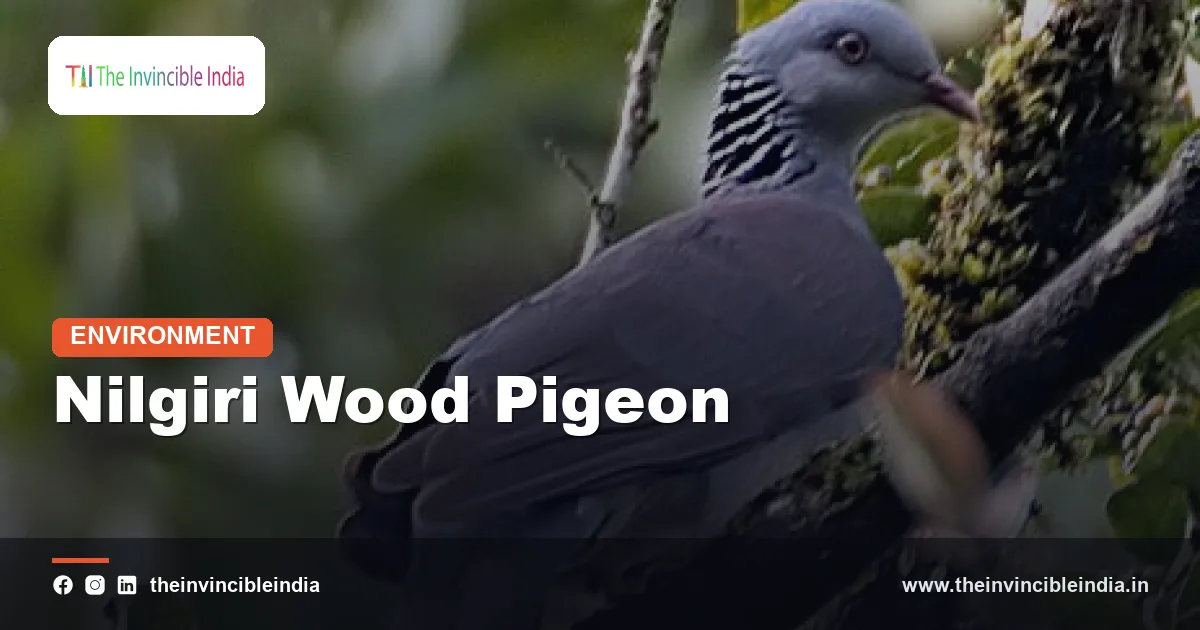
The Nilgiri wood pigeon (Columba elphinstonii) is a large, fruit-eating pigeon found only in the Western Ghats of south-western India, recognised by its dark plumage, wine-coloured back and a black-and-white chequered patch on the back of the neck. The Nilgiri wood pigeon is a shy forest dweller of evergreen hill woodland and the small forest patches called sholas, and it is among the best-known endemic birds of the Western Ghats.
Also called Elphinstone’s pigeon, the species is rarely seen in the open and is often detected first by its deep, owl-like call. This article explains what the Nilgiri wood pigeon is, how to identify it, where it lives, what it eats, how it breeds, why it matters to forest regeneration and what threatens its survival.
| Quick Fact | Details |
|---|---|
| Common name | Nilgiri wood pigeon (also Elphinstone’s pigeon) |
| Scientific name | Columba elphinstonii |
| Family | Columbidae (pigeons and doves) |
| Size | Large pigeon, roughly 35 to 42 cm long |
| Range | Endemic to the Western Ghats of south-western India, from around southern Maharashtra and Goa southwards through Karnataka, Kerala and Tamil Nadu |
| Habitat | Evergreen and semi-evergreen forest, shola forest and forest edges in hill country |
| Diet | Wild fruits, berries and figs; also some seeds and buds |
| Breeding | Flimsy twig platform nest in a tree; typically a single white egg |
| Conservation status | Considered a threatened species by the IUCN, assessed as Vulnerable in recent listings |
Key Takeaways
- The Nilgiri wood pigeon is a large pigeon of the family Columbidae that is endemic to the Western Ghats and is found nowhere else in the world.
- The Nilgiri wood pigeon is identified by its dark grey head, wine-maroon back and a black-and-white chequered patch on the hind neck.
- The Nilgiri wood pigeon feeds mainly on wild forest fruits, berries and figs, and it disperses the seeds of many native hill trees.
- The Nilgiri wood pigeon lives in evergreen forests and high-altitude shola forests, and it is a shy bird that is easier to hear than to see.
- The Nilgiri wood pigeon usually lays a single egg on a loose platform of twigs built in a forest tree.
- The Nilgiri wood pigeon is considered a threatened species, largely because of loss of its hill forest habitat and hunting pressure.
What is the Nilgiri wood pigeon?
The Nilgiri wood pigeon is a large forest pigeon in the genus Columba, the same genus that includes the familiar rock pigeon of Indian cities. Unlike the rock pigeon, which lives close to people, the Nilgiri wood pigeon is a bird of wet hill forests that relies on native trees for both food and nesting.
The scientific name Columba elphinstonii honours Mountstuart Elphinstone, a nineteenth-century British administrator in western India, and the bird was formally described in the early nineteenth century. The species is a classic example of an endemic bird, meaning a species whose natural range is restricted to one limited geographic area, in this case the Western Ghats. The Western Ghats are recognised as a global biodiversity hotspot, and the Nilgiri wood pigeon is among the large-bodied birds that give the region its distinctive wildlife.
The word “Nilgiri” in the name refers to the Nilgiri hills of Tamil Nadu, Kerala and Karnataka, where the bird was well known to early naturalists. The species is not confined to the Nilgiris alone and also occurs in other hill ranges of the southern Western Ghats.
What does the Nilgiri wood pigeon look like?
The Nilgiri wood pigeon looks like a plump, dark pigeon with a small head, a rich maroon or wine-coloured back and a striking chequered neck patch. The plumage is more subdued than that of many fruit pigeons, and the bird often looks almost black against the sky when seen from below.
Key identification points include the following.
- Head and underparts: A dark slate-grey head and grey underparts, which can look pale in good light.
- Back and wings: A deep wine-red or chestnut-maroon mantle and wing coverts, which shows a subtle purple sheen.
- Neck patch: A patch of black feathers edged in white on the hind neck, forming a chequered pattern that gives the bird its distinctive look.
- Bill and legs: A relatively short bill with a pale tip and reddish legs.
- Flight: Strong and direct, with rapid wingbeats and sudden dives into the canopy.
Males and females look alike, and young birds are duller and lack the full chequered patch. The overall size is close to that of a feral rock pigeon, but the Nilgiri wood pigeon appears darker, heavier and more compact in the forest.
Where is the Nilgiri wood pigeon found?
The Nilgiri wood pigeon is found only in the Western Ghats, the mountain chain that runs parallel to India’s west coast. Its range extends from the hills of southern Maharashtra and Goa southwards through Karnataka and Kerala to Tamil Nadu, with the densest populations in the evergreen forests of the southern Western Ghats.
The species lives from foothill evergreen forest at several hundred metres above sea level up to high-altitude shola forest above about 2,000 metres. Important hill ranges for the bird include the Nilgiris, the Anamalai hills, the Palani hills, the Cardamom hills and the Agasthyamalai range. Many of these areas fall within protected areas, such as national parks and wildlife sanctuaries, which provide the unbroken forest cover that the bird needs.
What are sholas?
Sholas are small patches of stunted evergreen forest that occur in the folds and valleys of the high hills of the southern Western Ghats, separated by open montane grassland. The Nilgiri wood pigeon is one of the characteristic birds of this shola-and-grassland landscape. Sholas hold cool, moist, fruit-rich trees that remain productive through the year, which makes them dependable feeding sites for a fruit-eating bird.
What does the Nilgiri wood pigeon eat?
The Nilgiri wood pigeon eats mainly wild fruits, including figs and the berries of many native evergreen trees, along with a smaller amount of seeds and buds. It forages in the canopy and sub-canopy of the forest, sometimes feeding quietly for long periods in a single fruiting tree.
The diet changes with the season and with what is ripe in the forest. When fruiting trees such as figs or members of the laurel family are heavy with berries, several pigeons may gather in the same tree. The bird swallows fruit whole and digests the soft pulp, and the seed passes through the gut and is later dropped elsewhere. In this way, a single pigeon can carry seeds away from the parent tree across forest and grassland, often over long distances.
This feeding habit makes the Nilgiri wood pigeon an ecologically valuable animal. Large-bodied fruit-eating birds can swallow big fruits and move them farther than small birds, and so they help forests regenerate, particularly in sholas, where tree seedlings must establish in patches separated by grassland.
What does the Nilgiri wood pigeon sound like?
The Nilgiri wood pigeon gives a deep, resonant, booming call that is often described as owl-like or as a low “whoop”, repeated in a series of soft, throaty notes. The call carries well through moist forest and is often the first and sometimes the only sign that the bird is present.
Because the pigeon spends much of the day perched quietly among leaves, its call is a more reliable method of detection than sight. Calling is most frequent in the early morning and at dusk, and during the breeding season the males call more often. Birdwatchers who learn the call can locate pigeons far more efficiently, and surveys of the species often rely on counting calling birds along forest trails.
How does the Nilgiri wood pigeon breed?
The Nilgiri wood pigeon breeds by building a loose, flimsy platform nest from a few twigs in a tree or dense shrub, and it typically lays a single white egg. As in most pigeons, the nest looks frail, and the egg can sometimes be seen through the structure from below.
Both parents share the work of incubating the egg and feeding the chick. Young pigeons are fed at first on “crop milk”, a nutritious secretion produced in the crop of both parents, and later on regurgitated fruit pulp. The pigeon chick grows rapidly and leaves the nest after a few weeks. Breeding in the Western Ghats is reported across several months, and timing differs with elevation and the local fruiting season.
The single-egg clutch means that the Nilgiri wood pigeon reproduces slowly. A species that raises only one chick at a time takes longer to recover from population losses, which is one reason conservationists treat the bird with caution.
How does the Nilgiri wood pigeon differ from other pigeons in India?
The Nilgiri wood pigeon differs from other Indian pigeons in its endemic range, dark maroon colouring and chequered neck patch. Several other pigeons of the genus Columba and related genera are found in India, and the comparison below shows how they differ.
| Pigeon | Typical habitat | Distinguishing feature |
|---|---|---|
| Nilgiri wood pigeon | Western Ghats evergreen forest and sholas | Wine-maroon back and black-and-white chequered neck patch |
| Rock pigeon | Cities, villages, cliffs | Grey body, two dark wing bars and a glossy neck; lives near people |
| Ashy wood pigeon | Eastern Himalayan and north-eastern hill forest | Grey body with a pale head and a dark neck collar |
| Speckled wood pigeon | Himalayan forest | Wine-red back spotted with white |
| Snow pigeon | High Himalayan cliffs | Pale grey and white with dark head |
The Nilgiri wood pigeon is the wood pigeon of southern India, while the ashy and speckled species occupy the Himalaya and north-east. This geographical separation is a good example of how closely related species fill similar roles in different mountain regions.
Is the Nilgiri wood pigeon endangered?
The Nilgiri wood pigeon is considered a threatened species and has been assessed as Vulnerable by the International Union for Conservation of Nature (IUCN) in recent listings, because its habitat is small, fragmented and under pressure. Anyone relying on a current status should check the latest IUCN assessment, since categories are reviewed periodically.
The main threats are listed below.
- Habitat loss and fragmentation: Forest has been cleared in the Western Ghats for tea, coffee and cardamom plantations, agriculture, roads, dams and settlements.
- Plantation of exotic trees: Planting of non-native trees such as eucalyptus, acacia and wattle in grasslands and shola margins reduces native fruiting trees.
- Hunting and disturbance: Pigeons have traditionally been hunted for food in some areas, and hunting is illegal in India under wildlife law.
- Climate change: Shifting rainfall and temperature may affect the high-altitude shola forest, which is already confined to cool hill tops.
Protected areas such as Silent Valley, Eravikulam, Mudumalai, Bandipur, Nagarhole, Anamalai and Periyar in the Western Ghats offer refuge, and the bird continues to be recorded in several of them. Conservation of continuous forest corridors between these protected areas is particularly important for such a mobile, fruit-dependent bird.
Where can you see the Nilgiri wood pigeon?
The Nilgiri wood pigeon can be seen in forested hill areas of the Western Ghats, particularly in the Nilgiris, the Anamalai hills, the Palani hills and the high-range forests of Kerala. Sightings are never guaranteed, because the bird is shy and spends long periods motionless in the canopy.
The following tips improve the chances of finding it.
- Visit shola forest edges and fruiting fig trees early in the morning.
- Listen for the deep, owl-like call and follow the sound slowly and quietly.
- Scan the tops of bare or emergent trees, where pigeons often sit to dry in the morning sun.
- Use binoculars or a spotting scope, since the bird is wary and often perches high.
- Travel with a local guide who knows the forest patches and the fruiting seasons.
Why does the Nilgiri wood pigeon matter?
The Nilgiri wood pigeon matters because it is a Western Ghats endemic, a seed disperser for native hill forest and a useful indicator of forest health. Its survival depends on large areas of unbroken evergreen forest with a continuous supply of wild fruit, and so a healthy population suggests a functioning ecosystem.
The bird also carries cultural and scientific value. It features in the ornithological history of southern India, and birdwatchers regard it as a prized sighting in the Nilgiris. Protecting the shola forests that shelter the Nilgiri wood pigeon also protects water catchments, because these cool montane forests and grasslands feed the streams and rivers that flow down from the Western Ghats to millions of people.
Bottom Line
The Nilgiri wood pigeon is a large, dark, wine-backed forest pigeon found only in the Western Ghats, where it eats wild fruit and spreads the seeds of native trees. Its slow breeding and shrinking forest home make habitat protection the key to its future.
Frequently Asked Questions
What is the Nilgiri wood pigeon?
The Nilgiri wood pigeon is a large, fruit-eating pigeon of the family Columbidae that is endemic to the Western Ghats of south-western India. It has a dark grey head, a wine-maroon back and a black-and-white chequered patch on the neck. It lives in evergreen forests and shola patches.
Where is the Nilgiri wood pigeon found?
The Nilgiri wood pigeon is found only in the Western Ghats, from southern Maharashtra and Goa through Karnataka and Kerala to Tamil Nadu. It lives in evergreen forest and high-altitude shola forest, with important populations in the Nilgiri, Anamalai, Palani and Cardamom hills.
What does the Nilgiri wood pigeon eat?
The Nilgiri wood pigeon eats mainly wild fruits, such as figs and berries, and also takes a few seeds and buds. By swallowing fruit whole and dropping the seeds elsewhere, it helps spread native forest trees and aids natural regeneration.
How many eggs does the Nilgiri wood pigeon lay?
The Nilgiri wood pigeon typically lays a single white egg. The egg is laid on a flimsy platform of twigs in a tree or shrub, and both parents incubate it and feed the chick with crop milk and later with regurgitated fruit.
Is the Nilgiri wood pigeon endangered?
The Nilgiri wood pigeon is considered a threatened species and has been assessed as Vulnerable by the IUCN in recent listings. The main threats are loss and fragmentation of Western Ghats forest, planting of exotic trees and hunting. Readers should check the latest IUCN assessment for the current category.
How is the Nilgiri wood pigeon different from the common pigeon?
The Nilgiri wood pigeon differs from the common rock pigeon in habitat, colour and range. It lives in wild hill forest rather than cities, has a wine-maroon back and a chequered neck patch, and is found only in the Western Ghats. The rock pigeon is grey, lives near people and is found across the whole country.
{“@context”:”https://schema.org”,”@graph”:[{“@type”:”FAQPage”,”mainEntity”:[{“@type”:”Question”,”name”:”What is the Nilgiri wood pigeon?”,”acceptedAnswer”:{“@type”:”Answer”,”text”:”The Nilgiri wood pigeon is a large, fruit-eating pigeon of the family Columbidae that is endemic to the Western Ghats of south-western India. It has a dark grey head, a wine-maroon back and a black-and-white chequered patch on the neck. It lives in evergreen forests and shola patches.”}},{“@type”:”Question”,”name”:”Where is the Nilgiri wood pigeon found?”,”acceptedAnswer”:{“@type”:”Answer”,”text”:”The Nilgiri wood pigeon is found only in the Western Ghats, from southern Maharashtra and Goa through Karnataka and Kerala to Tamil Nadu. It lives in evergreen forest and high-altitude shola forest, with important populations in the Nilgiri, Anamalai, Palani and Cardamom hills.”}},{“@type”:”Question”,”name”:”What does the Nilgiri wood pigeon eat?”,”acceptedAnswer”:{“@type”:”Answer”,”text”:”The Nilgiri wood pigeon eats mainly wild fruits, such as figs and berries, and also takes a few seeds and buds. By swallowing fruit whole and dropping the seeds elsewhere, it helps spread native forest trees and aids natural regeneration.”}},{“@type”:”Question”,”name”:”How many eggs does the Nilgiri wood pigeon lay?”,”acceptedAnswer”:{“@type”:”Answer”,”text”:”The Nilgiri wood pigeon typically lays a single white egg. The egg is laid on a flimsy platform of twigs in a tree or shrub, and both parents incubate it and feed the chick with crop milk and later with regurgitated fruit.”}},{“@type”:”Question”,”name”:”Is the Nilgiri wood pigeon endangered?”,”acceptedAnswer”:{“@type”:”Answer”,”text”:”The Nilgiri wood pigeon is considered a threatened species and has been assessed as Vulnerable by the IUCN in recent listings. The main threats are loss and fragmentation of Western Ghats forest, planting of exotic trees and hunting. Readers should check the latest IUCN assessment for the current category.”}},{“@type”:”Question”,”name”:”How is the Nilgiri wood pigeon different from the common pigeon?”,”acceptedAnswer”:{“@type”:”Answer”,”text”:”The Nilgiri wood pigeon differs from the common rock pigeon in habitat, colour and range. It lives in wild hill forest rather than cities, has a wine-maroon back and a chequered neck patch, and is found only in the Western Ghats. The rock pigeon is grey, lives near people and is found across the whole country.”}}]}]}


