

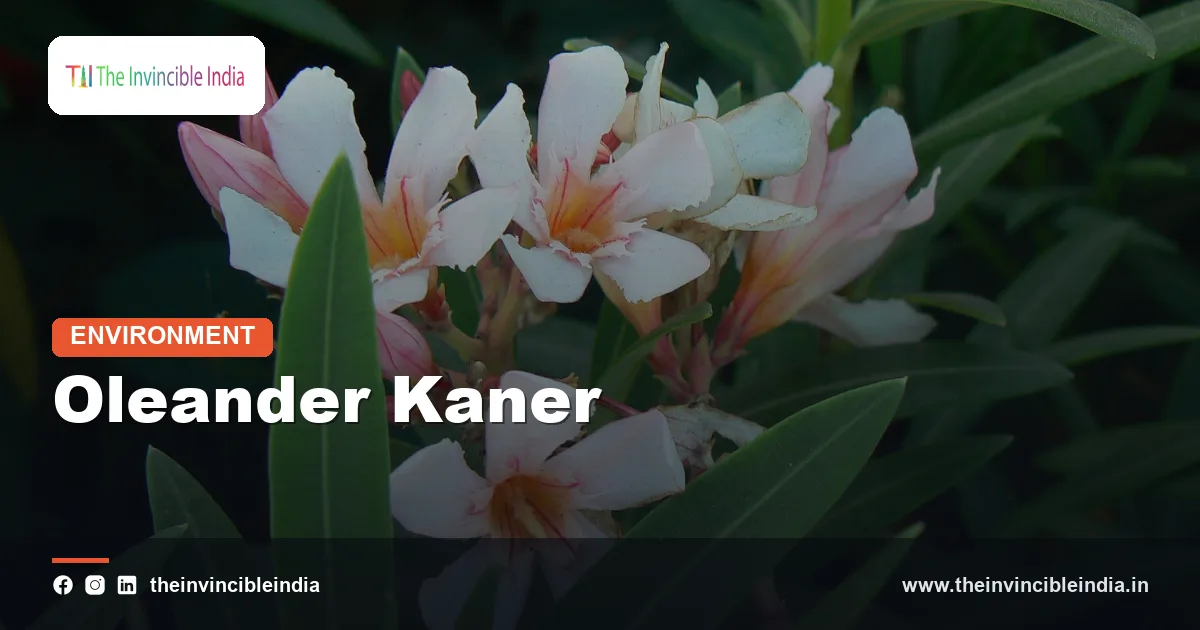
Oleander (Nerium oleander), known in India as kaner, kanher or karavira, is a hardy evergreen flowering shrub that lines roadsides, medians, temple courtyards and gardens across the country and is also one of the most poisonous common ornamental plants. Valued for its showy white, pink, red or salmon blooms and its ability to survive heat, drought and pollution, oleander has been cultivated in South Asia for centuries and is mentioned in Sanskrit literature under the name karavira.
Both halves of oleander’s reputation are accurate: the shrub is among the toughest and most useful landscape plants in India, and every part of it contains cardiac glycosides that can seriously harm people and animals if eaten. This article explains what oleander is, how it grows, where it is used, why it is toxic, and how to handle it sensibly.
Quick Facts
| Scientific name | Nerium oleander |
|---|---|
| Family | Apocynaceae (the dogbane or periwinkle family) |
| Common Indian names | Kaner, kanher, karavira (Sanskrit), karabi (Bengali), arali (Tamil), ganneru (Telugu) |
| Origin | A wide belt from the Mediterranean region through the Middle East and Central Asia to the Indian subcontinent and China |
| Where grown in India | Throughout the country, on roadsides, highway dividers, gardens, industrial areas and temple grounds |
| Flowering season | Mainly spring to autumn, with scattered blooms in warm regions through much of the year |
| Main uses | Ornamental shrub, hedge, screen, pollution-tolerant roadside planting and temple offering |
| Toxic compounds | Cardiac glycosides, including oleandrin, found in all parts of the plant |
| Notable facts | Evergreen, drought and salt tolerant; leaves grow in whorls of three; not the same plant as yellow oleander (Cascabela thevetia) |
Key Takeaways
- Oleander is an evergreen shrub of the Apocynaceae family that grows naturally from the Mediterranean to the Indian subcontinent and is called kaner or karavira in India.
- Every part of oleander, including leaves, flowers, bark, roots, sap and seeds, contains cardiac glycosides such as oleandrin that can disturb the heart rhythm if eaten.
- Oleander thrives on heat, drought, poor soil, salt spray and polluted air, which is why Indian highway authorities plant it widely on road dividers.
- Oleander is often confused with yellow oleander, which is a different species of a different genus, Cascabela thevetia, and is also poisonous.
- Oleander flowers are single or double and appear in white, pink, red, salmon and pale yellow shades, and are offered in worship in many parts of India.
- Anyone who suspects oleander has been eaten should seek urgent medical help, because traditional or home uses of the plant are not safe.
What is oleander and what does kaner mean?
Oleander is an evergreen shrub, usually two to five metres tall, with narrow, leathery, dark green leaves and clusters of funnel-shaped flowers at the tips of its branches. Kaner, kanher and karavira are the Hindi, Marathi and Sanskrit names for the same plant, and almost every Indian language has its own local name.
The plant belongs to the genus Nerium, which has a single widely recognised species, Nerium oleander. It belongs to the Apocynaceae family, which also includes periwinkle, frangipani, adenium and the rubber vine. Members of this family commonly have milky or clear sap and often contain biologically active compounds.
The leaves of oleander grow in whorls of three, or sometimes opposite each other, and have a prominent pale midrib. The flowers have five petals with a small frilly appendage in the centre, and some cultivars have double flowers that look like small roses. The fruit is a pair of long, narrow pods that split open to release many small seeds with tufts of silky hair, which allow the seeds to be carried by wind.
Where does oleander grow and why is it so common in India?
Oleander grows naturally in dry riverbeds, streamsides and rocky ground across the Mediterranean region and parts of Asia, and it is so common in India because it tolerates heat, drought, poor soil, wind and air pollution better than most flowering shrubs. In India it is planted in nearly every state, from the coast to the plains and warm lower hills.
Several traits explain its success in Indian conditions.
- Drought resilience: Narrow, waxy leaves lose little water, so established shrubs survive long dry spells.
- Pollution tolerance: Oleander copes with dust, exhaust fumes and industrial air, which suits highway medians and factory boundaries.
- Salt tolerance: The plant handles coastal winds and moderately saline soil.
- Low maintenance: It needs little feeding or watering and recovers well from pruning.
- Long flowering: Blooms appear over many months, giving long-lasting colour for little cost.
The shrub does best in full sun and well-drained soil. It tolerates short light frosts but can be damaged by prolonged hard cold, which is why it is less reliable in the high Himalayan region.
What colours and varieties of oleander are grown in India?
Oleander is grown in India in white, pale pink, deep pink, red, salmon and pale yellow shades, in both single-petalled and double-flowered forms. Nurseries sell dozens of named cultivars, but the plant is commonly bought simply by colour, such as white kaner, pink kaner or red kaner.
| Type | Description | Typical use |
|---|---|---|
| Single white and pink | Five-petalled flowers; the most common roadside forms and the hardiest | Highway medians, boundary hedges |
| Single red | Deep red or crimson flowers with a simple outline | Gardens, temple compounds, screens |
| Double pink and salmon | Densely petalled blooms that resemble small roses | Ornamental garden shrubs |
| Dwarf cultivars | Compact plants that remain below about a metre or so | Large pots, low hedges |
| Variegated types | Leaves edged with cream or white | Specimen planting |
Some oleander cultivars have a gentle fragrance, particularly certain double and pale-coloured forms, although the scent is much weaker than that of jasmine or tuberose. Yellow-flowered plants that people call yellow kaner are normally yellow oleander, which belongs to a different genus.
Why is oleander poisonous?
Oleander is poisonous because all its parts contain cardiac glycosides, notably oleandrin and neriine, which interfere with the sodium-potassium pump in heart muscle cells and can cause dangerous irregularities in heart rhythm. These compounds act in a similar manner to digoxin, a heart medicine derived from the foxglove plant, but oleander offers no controlled dose.
Toxicity exists throughout the plant and persists even after drying. Poisoning has been recorded in people who chewed the leaves or flowers, drank tea made from them, or used the stems as skewers or sticks for roasting food. Livestock, horses and pets can also be poisoned by eating leaves or by grazing near clippings, and the dried leaves remain hazardous.
Symptoms and what to do
Symptoms of ingestion can include nausea, vomiting, abdominal pain, dizziness, a slow or irregular heartbeat, drowsiness and confusion. Because severe poisoning affects the heart, it is treated as a medical emergency. Anyone who suspects that oleander has been swallowed should go to a hospital or contact a poison information centre without delay and tell doctors which plant was involved. Home remedies and waiting for symptoms to appear are not advised.
Skin and smoke exposure
The milky sap can irritate the skin and eyes in sensitive people, so gloves and eye protection are sensible when pruning. Burning oleander clippings is discouraged because the smoke can irritate the lungs and eyes.
Is oleander the same as yellow oleander?
No, oleander is not the same as yellow oleander: true oleander is Nerium oleander, while yellow oleander is Cascabela thevetia, a separate plant of the same family from tropical America. Yellow oleander has narrow, glossy, willow-like leaves arranged alternately along the stem, bell-shaped yellow or orange flowers, and a rounded fruit with a hard stone that is highly toxic.
Both plants contain cardiac glycosides and both are hazardous. The seeds of yellow oleander, known in India by names such as peela kaner, are a well-documented cause of poisoning in South Asia, and public health literature highlights the need to keep the plant away from children. Because the common names overlap, gardeners are encouraged to identify the plant by its scientific name before handling or advising others.
- Oleander (Nerium): Leaves in whorls of three, funnel-shaped flowers in white, pink or red, long paired pods.
- Yellow oleander (Cascabela): Alternate narrow leaves, yellow or apricot bell-shaped flowers, and a rounded fruit with a hard stone.
How is oleander used in India?
Oleander is used in India chiefly as an ornamental and landscape shrub, as a flowering offering in religious worship, and historically in traditional medicine systems, although its toxicity makes it unsafe for home use. Government agencies, housing societies and homeowners plant it extensively because it survives with minimal care.
Landscaping and roadside planting
Oleander is among the most common shrubs on Indian highway medians, where it also helps cut headlight glare from oncoming traffic. It is used as a hedge, a windbreak and a screen to separate properties, and it is planted around industrial sites because it tolerates polluted air.
Religious and cultural role
Karavira flowers, especially red and white ones, are offered in worship at many temples and home shrines. The flower is mentioned in Sanskrit texts and in classical literature as a familiar garden plant. Its place in ritual does not make the plant safe to eat, and devotees are advised to wash hands after handling blooms.
Traditional medicine
Classical Ayurvedic and other traditional texts describe karavira being used externally for certain skin conditions and in tightly controlled preparations. Modern doctors and toxicologists caution that the margin between a medicinal and a harmful dose is very small, and that deaths have followed the use of oleander as a home treatment. Anyone interested in the plant’s medical potential should rely on qualified practitioners and approved medicines.
How do you grow and care for oleander?
Oleander is grown by planting it in full sun in well-drained soil, watering it moderately until established, and pruning it once a year, and it is propagated easily from stem cuttings. The shrub is very forgiving and rarely needs more than basic care.
- Sunlight: Six or more hours of direct sun give the best flowering; shade reduces blooms.
- Soil: Almost any soil is accepted if it drains well; heavy waterlogged ground causes root problems.
- Watering: Water regularly in the first season, then only during extended dry spells.
- Pruning: Cut back after the main flowering period to keep the shrub bushy; wear gloves and dispose of clippings safely.
- Propagation: Semi-hardwood cuttings root in water or in sand; tools used for pruning should be washed afterwards and not reused for food.
Pests and diseases
Oleander is attacked by sap-feeding insects such as aphids and scale insects, and in India the larvae of the oleander hawk-moth (Daphnis nerii) are a well-known leaf-eating pest. The large green caterpillars can strip a shrub quickly. They are usually removed by hand, and gardeners should wear gloves while doing so. Otherwise the plant is generally healthy, and fungal leaf spots appear mainly in very humid conditions.
How can oleander be kept safely around homes, schools and animals?
Oleander can be kept safely by treating it as a plant to be admired and not eaten, planting it away from play areas and animal enclosures, and using simple handling precautions during pruning. Most poisoning incidents happen when the plant is misidentified, used as a remedy or fed accidentally to livestock.
- Teach children never to chew leaves, flowers or pods of any ornamental shrub.
- Keep clippings away from cattle, goats, horses and pets, because dried leaves stay toxic.
- Never use oleander branches as skewers, cooking sticks or fuel for open-fire cooking.
- Wear gloves and wash hands after pruning, and avoid touching the eyes.
- Do not make teas, pastes or drinks from the plant for any health purpose.
- Label or note oleander plants in school and community gardens so that staff know which shrubs to treat with care.
Balanced guidance does not require removing oleander from every public space. Bodies that manage roadsides and parks have long used it because it survives conditions in which many other plants fail, and the risk of harm is low when the plant is not eaten. The sensible approach is awareness and caution, not alarm.
Bottom Line
Oleander, or kaner, is an evergreen shrub that is both one of India’s most dependable flowering plants and one of its most toxic ornamentals. It is safe to plant and admire, but not to eat, brew or burn, and anyone who suspects accidental ingestion should seek medical help immediately.
Frequently Asked Questions
What is oleander called in Hindi?
Oleander is called kaner or kanher in Hindi, and karavira in Sanskrit. Other common names include karabi in Bengali, arali in Tamil and ganneru in Telugu, while the botanical name is Nerium oleander.
Is oleander poisonous to humans?
Yes, oleander is poisonous to humans because every part of the plant contains cardiac glycosides such as oleandrin. Eating even small amounts of leaves, flowers or seeds can cause vomiting, an irregular heartbeat and serious illness, so urgent medical care is needed after any suspected ingestion.
Is kaner the same as yellow oleander?
No, kaner usually refers to Nerium oleander, while yellow oleander is a different plant called Cascabela thevetia. Both are poisonous, but they differ in leaf arrangement, flower shape and fruit, and yellow oleander seeds are a known cause of poisoning in South Asia.
Why is oleander planted on highways in India?
Oleander is planted on Indian highways because it survives heat, drought, dust and exhaust fumes with little care, and it flowers for many months. The dense evergreen foliage in road medians also reduces headlight glare for drivers on the opposite carriageway.
When does oleander flower in India?
Oleander flowers mainly from spring to autumn in most parts of India, with the heaviest bloom during the warmer months. In regions with mild winters, a few flowers may appear for much of the year, particularly on plants that are pruned after the main flush.
Can oleander be grown in pots?
Yes, oleander grows well in large pots, especially dwarf cultivars, as long as the container has good drainage and receives plenty of sunlight. Gardeners should keep potted oleander away from areas used by children and pets and wear gloves when pruning.
{“@context”:”https://schema.org”,”@graph”:[{“@type”:”FAQPage”,”mainEntity”:[{“@type”:”Question”,”name”:”What is oleander called in Hindi?”,”acceptedAnswer”:{“@type”:”Answer”,”text”:”Oleander is called kaner or kanher in Hindi, and karavira in Sanskrit. Other common names include karabi in Bengali, arali in Tamil and ganneru in Telugu, while the botanical name is Nerium oleander.”}},{“@type”:”Question”,”name”:”Is oleander poisonous to humans?”,”acceptedAnswer”:{“@type”:”Answer”,”text”:”Yes, oleander is poisonous to humans because every part of the plant contains cardiac glycosides such as oleandrin. Eating even small amounts of leaves, flowers or seeds can cause vomiting, an irregular heartbeat and serious illness, so urgent medical care is needed after any suspected ingestion.”}},{“@type”:”Question”,”name”:”Is kaner the same as yellow oleander?”,”acceptedAnswer”:{“@type”:”Answer”,”text”:”No, kaner usually refers to Nerium oleander, while yellow oleander is a different plant called Cascabela thevetia. Both are poisonous, but they differ in leaf arrangement, flower shape and fruit, and yellow oleander seeds are a known cause of poisoning in South Asia.”}},{“@type”:”Question”,”name”:”Why is oleander planted on highways in India?”,”acceptedAnswer”:{“@type”:”Answer”,”text”:”Oleander is planted on Indian highways because it survives heat, drought, dust and exhaust fumes with little care, and it flowers for many months. The dense evergreen foliage in road medians also reduces headlight glare for drivers on the opposite carriageway.”}},{“@type”:”Question”,”name”:”When does oleander flower in India?”,”acceptedAnswer”:{“@type”:”Answer”,”text”:”Oleander flowers mainly from spring to autumn in most parts of India, with the heaviest bloom during the warmer months. In regions with mild winters, a few flowers may appear for much of the year, particularly on plants that are pruned after the main flush.”}},{“@type”:”Question”,”name”:”Can oleander be grown in pots?”,”acceptedAnswer”:{“@type”:”Answer”,”text”:”Yes, oleander grows well in large pots, especially dwarf cultivars, as long as the container has good drainage and receives plenty of sunlight. Gardeners should keep potted oleander away from areas used by children and pets and wear gloves when pruning.”}}]}]}


