

The orange-headed thrush (Geokichla citrina) is a shy, ground-foraging songbird of shaded Indian forests, recognised by the male’s bright orange head and underparts set against slate-grey upperparts. The orange-headed thrush belongs to the true thrush family (Turdidae) and is known as much for its rich, whistled song as for its colour, though it is often heard long before it is seen.
In India the orange-headed thrush occurs along the Himalayan foothills, across the north-east, in the Western and Eastern Ghats and in parts of central India. This article explains what the bird looks like, where it lives, what it eats, how it sings and nests, and how to find it in the forest understorey.
| Quick Fact | Detail |
|---|---|
| Scientific name | Geokichla citrina (earlier placed in the genus Zoothera) |
| Family | Turdidae (true thrushes) |
| Indian names | No single standard vernacular name; known mainly by its English name in field guides |
| Size | About 21 to 22 cm, slightly smaller than a myna |
| Range in India | Himalayan foothills, north-east India, Western and Eastern Ghats, parts of central India |
| Habitat | Moist, shaded forest, bamboo, plantations and well-wooded gardens |
| Diet | Earthworms, insects, snails and small fruits |
| Breeding season | Mainly the monsoon months, roughly May to August |
| Conservation status | Least Concern (IUCN) |
Key Takeaways
- The orange-headed thrush (Geokichla citrina) is a forest-floor thrush whose male has an orange head and underparts and slate-grey upperparts.
- The orange-headed thrush forages on shaded, leaf-littered ground, flicking aside leaves to find earthworms, insects and snails.
- The orange-headed thrush sings a rich, whistled and varied song, most often at dawn, at dusk and during the monsoon breeding season.
- Peninsular forms of the orange-headed thrush show a white face with dark bars, unlike the all-orange head of the Himalayan form.
- The orange-headed thrush builds a cup nest of moss, roots and mud on a stump or tree fork and lays about two to four eggs.
- The orange-headed thrush is assessed as Least Concern by the IUCN, but it depends on shaded, moist forest cover.
What is the orange-headed thrush?
The orange-headed thrush is a medium-small thrush that lives in moist, shady forest and feeds mostly on the ground. It belongs to the genus Geokichla, a group of ground thrushes found across tropical Asia and Africa, many of which have patterned plumage and secretive habits.
The species was long placed in the genus Zoothera, and many older Indian field guides still use that scientific name. Genetic work later separated the ground thrushes into different genera, and Geokichla is now the accepted name in most checklists.
Several regional forms of the orange-headed thrush are recognised. They differ mainly in the pattern of the head and in the depth of orange on the underparts, and some of them are treated by certain authorities as full species. Indian bird-watchers therefore use the general name orange-headed thrush for the whole group.
What does the orange-headed thrush look like?
A male orange-headed thrush has a bright orange head, neck and underparts, a slate-grey back and wings, and a white lower belly and undertail. The bill is dark and the legs are pale pinkish, giving the bird a clean, striking outline when it steps into a patch of sunlight.
In the Himalayan and north-eastern form, the whole head is orange. In the form found in the Western Ghats and much of the peninsula, the face and throat are whitish, marked with two dark bars or ear patches, and the orange is confined to the breast and flanks. Birds from the peninsula are therefore sometimes called white-throated ground thrushes in older books.
The female orange-headed thrush is duller, with an olive-grey back and a paler, buff-orange wash on the underparts. Young birds show pale streaks and spots. Both sexes have a distinctive way of standing upright, with the body held at a steep angle, between bouts of hopping across the forest floor.
Where is the orange-headed thrush found in India?
The orange-headed thrush is found in the Himalayan foothills, the north-east, the Western Ghats, the Eastern Ghats and scattered forests of central India. Outside India it also ranges through Nepal, Sri Lanka and much of South-East Asia.
The bird favours moist, shaded woodland with deep leaf litter, such as evergreen and moist deciduous forest, bamboo thickets, ravines and shady plantations. In winter, individuals may move to lower ground or to other forest patches, and a few reach well-wooded gardens in towns near forest.
The species is not common in dry or open habitats. It needs damp soil to supply the earthworms and insects it eats, so it declines quickly where forest is thinned or understorey is removed.
Regional forms at a glance
- Himalayan foothills and north-east India: head and neck fully orange
- Western Ghats and peninsula: whitish face with dark ear bars, orange on breast and flanks
- Eastern Ghats and central India: forms that blend features of the two groups
What does the orange-headed thrush eat?
The orange-headed thrush eats earthworms, insects, snails and other small invertebrates found in leaf litter, together with berries and soft fruit. It is a typical ground thrush in this respect and spends most of its day on the forest floor.
The bird feeds by walking or hopping slowly, pausing, tilting its head to listen, and then tossing leaves aside with its bill to expose prey. This leaf-turning behaviour is easy to recognise because it makes a soft rustle in dry forest or a wet rummaging sound in damp litter.
The orange-headed thrush also takes small fruits from low shrubs and trees, and in some places joins mixed groups of fruit-eating birds. By moving between feeding sites and carrying seeds in its gut, the bird helps to spread seeds of understorey plants, although its main ecological role is as a predator of soil invertebrates.
How does the orange-headed thrush sing?
The orange-headed thrush sings a rich, whistled, melodious song of clear phrases, usually delivered from a perch within the forest canopy or a low branch. The song is varied and slow, with notes that rise, fall and repeat, and it carries well through dense forest.
Males sing most at dawn and at dusk, and singing becomes especially frequent when the monsoon begins and breeding starts. A hidden male may sing for long stretches without showing himself, which is why many observers record the bird by sound before they see it.
The species also gives a thin, high “tsee” alarm call and a softer scolding note when disturbed. The song is a helpful field mark because it differs from the loud whistles of the whistling thrushes and from the short phrases of forest babblers and robins.
How does the orange-headed thrush breed?
The orange-headed thrush breeds mainly during the monsoon, usually between about May and August. It builds a neat cup nest of moss, fine roots, leaves and mud, placed on a stump, a tree fork, a bank or a low branch not far above the ground.
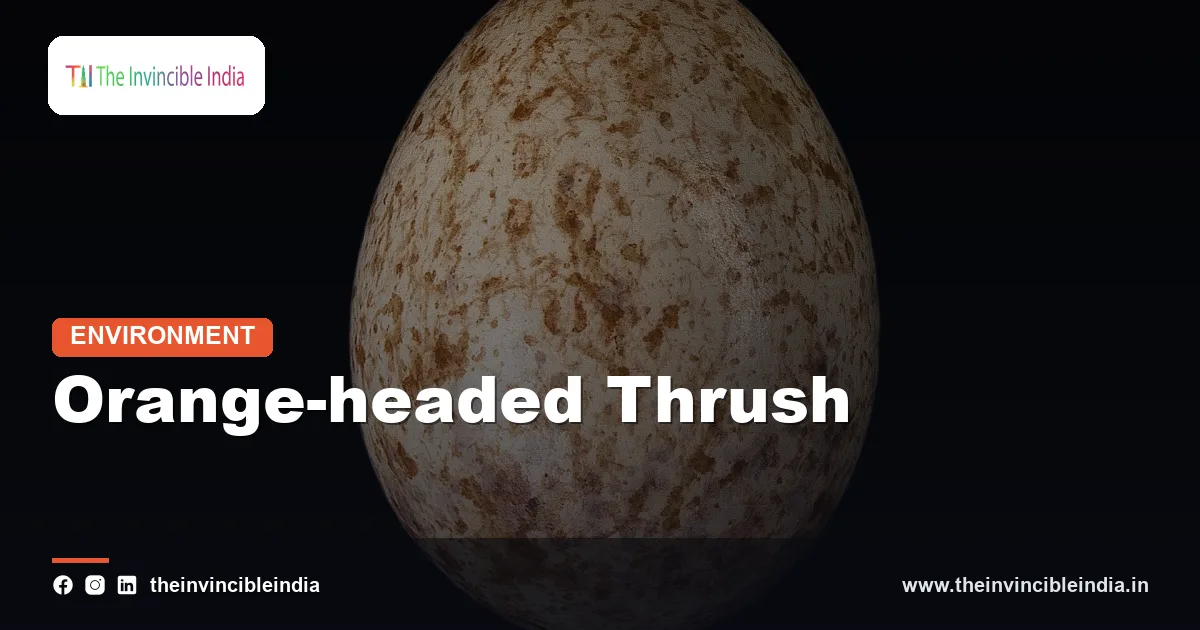
The female lays about two to four pale greenish or bluish eggs with reddish or brownish markings. Both parents feed the young, bringing earthworms and insects collected from the forest floor. The nestlings leave the nest after about two weeks.
Nests are well camouflaged by moss and surrounding foliage, and the adults are quiet near the nest, so the nesting stage is rarely observed. Breeding success depends on a damp forest floor, which keeps earthworm supplies high for feeding the chicks.
| Season | What the orange-headed thrush does |
|---|---|
| Pre-monsoon | Males begin singing; territories are established |
| Monsoon (about May to August) | Nest is built, eggs are laid and chicks are fed |
| Post-monsoon and winter | Birds forage quietly; some move to lower ground or other patches |
Is the orange-headed thrush a migratory bird?
The orange-headed thrush is largely resident or locally migratory in India, rather than a long-distance migrant. Many birds stay in the same forest, while others make short altitudinal or regional movements after breeding, descending from hill forest to the plains edge in winter.
Some winter records from places where the bird does not breed suggest that individuals move across considerable distances, and Himalayan birds are thought to wander to the peninsula. Detailed ringing data are limited, so the full pattern is still being studied by Indian ornithologists.
These seasonal movements explain why the orange-headed thrush may suddenly appear in a garden or small woodland in winter and then disappear by the following spring.
How is the orange-headed thrush different from similar birds?
The orange-headed thrush is different from similar birds mainly through its orange-and-grey plumage and its habit of foraging in forest leaf litter. Several other thrushes share its habitat, so comparison helps in the field.
- Pied thrush: black-and-white patterned, with a bold white wing bar, while the orange-headed thrush lacks any such pattern.
- Scaly thrush: golden-olive with a heavily scaled body, much larger, and not orange.
- Tickell’s thrush: male is bluish-grey above with orange-buff flanks and a white belly, but has no orange head.
- Orange-flanked bush robin: smaller, with a blue back and white eyebrow, and a different posture.
The all-orange head of Himalayan birds is unique among these species, while the white-faced peninsular birds are best recognised by their dark ear bars and upright stance.
Why does the orange-headed thrush matter?
The orange-headed thrush matters because it is an indicator of moist, structurally rich forest and a predator of soil and leaf-litter invertebrates. The bird needs shade, damp soil and leaf cover, so its presence suggests that the forest floor has not been cleared or heavily disturbed.
Habitat loss from clearing, plantation conversion and removal of understorey vegetation is the main pressure on the species. The global population is large and widely distributed, which is why the IUCN lists the orange-headed thrush as Least Concern, but local declines can occur where forest patches become dry and open.
How can bird-watchers find the orange-headed thrush?
Bird-watchers can find the orange-headed thrush by walking quietly along shaded forest trails at dawn or dusk and listening for its whistled song. The species is a rewarding find in the Western Ghats, the Eastern Himalaya and the forests of central India.
- Visit early in the morning, when the bird sings and feeds in the open litter at trail edges.
- Scan damp stream banks, ravines and bamboo clumps, where earthworms and insects are plentiful.
- Stand still and watch for the rustle of leaves being flicked aside, which often gives away a feeding bird.
- Check fruiting trees in the understorey, where the thrush may join other fruit-eating birds.
- Avoid playing recorded calls, which disturbs breeding birds and is discouraged in most protected areas.
A sighting is usually brief, because the orange-headed thrush slips into dense cover at the first sign of movement. Patience and a quiet approach are therefore more useful than a long search.
Bottom Line
The orange-headed thrush is a colourful, secretive forest thrush whose song carries through the shaded understorey of India’s moist woodlands. Protecting leaf-littered, damp forest floors is the most direct way of keeping the species present across the Himalayan foothills, the Ghats and central India.
Frequently Asked Questions
Where can the orange-headed thrush be seen in India?
The orange-headed thrush can be seen in the Himalayan foothills, north-east India, the Western and Eastern Ghats and parts of central India. It prefers moist, shaded forest, bamboo and shady plantations. Early morning visits to quiet forest trails give the best chance.
Why do some orange-headed thrushes have a white face?
Some orange-headed thrushes have a white face because they belong to a peninsular regional form. Birds of the Western Ghats and much of the peninsula show a whitish face with dark ear bars, while Himalayan and north-eastern birds have an all-orange head. Both forms are covered by the same common name.
What does the orange-headed thrush eat?
The orange-headed thrush eats earthworms, insects and snails collected from leaf litter, together with berries and small fruits. It turns leaves aside with its bill while walking slowly across the ground. Damp, undisturbed forest floors therefore matter greatly for it.
When does the orange-headed thrush breed?
The orange-headed thrush breeds mainly in the monsoon, roughly between May and August. It builds a cup nest of moss, roots and mud on a stump or tree fork and lays about two to four eggs. Both parents feed the chicks with earthworms and insects.
Is the orange-headed thrush a migratory bird?
The orange-headed thrush is mostly resident in India, with local and altitudinal movements. Some birds descend from hills to lower forest in winter, and Himalayan birds may wander to other regions. It is not considered a long-distance migrant in the Indian context.
Is the orange-headed thrush a threatened species?
The orange-headed thrush is not globally threatened; the IUCN assesses it as Least Concern. Its range is large and its population is considered stable overall. Local declines can occur where moist forest is cleared or the understorey is removed.
{“@context”:”https://schema.org”,”@graph”:[{“@type”:”FAQPage”,”mainEntity”:[{“@type”:”Question”,”name”:”Where can the orange-headed thrush be seen in India?”,”acceptedAnswer”:{“@type”:”Answer”,”text”:”The orange-headed thrush can be seen in the Himalayan foothills, north-east India, the Western and Eastern Ghats and parts of central India. It prefers moist, shaded forest, bamboo and shady plantations. Early morning visits to quiet forest trails give the best chance.”}},{“@type”:”Question”,”name”:”Why do some orange-headed thrushes have a white face?”,”acceptedAnswer”:{“@type”:”Answer”,”text”:”Some orange-headed thrushes have a white face because they belong to a peninsular regional form. Birds of the Western Ghats and much of the peninsula show a whitish face with dark ear bars, while Himalayan and north-eastern birds have an all-orange head. Both forms are covered by the same common name.”}},{“@type”:”Question”,”name”:”What does the orange-headed thrush eat?”,”acceptedAnswer”:{“@type”:”Answer”,”text”:”The orange-headed thrush eats earthworms, insects and snails collected from leaf litter, together with berries and small fruits. It turns leaves aside with its bill while walking slowly across the ground. Damp, undisturbed forest floors therefore matter greatly for it.”}},{“@type”:”Question”,”name”:”When does the orange-headed thrush breed?”,”acceptedAnswer”:{“@type”:”Answer”,”text”:”The orange-headed thrush breeds mainly in the monsoon, roughly between May and August. It builds a cup nest of moss, roots and mud on a stump or tree fork and lays about two to four eggs. Both parents feed the chicks with earthworms and insects.”}},{“@type”:”Question”,”name”:”Is the orange-headed thrush a migratory bird?”,”acceptedAnswer”:{“@type”:”Answer”,”text”:”The orange-headed thrush is mostly resident in India, with local and altitudinal movements. Some birds descend from hills to lower forest in winter, and Himalayan birds may wander to other regions. It is not considered a long-distance migrant in the Indian context.”}},{“@type”:”Question”,”name”:”Is the orange-headed thrush a threatened species?”,”acceptedAnswer”:{“@type”:”Answer”,”text”:”The orange-headed thrush is not globally threatened; the IUCN assesses it as Least Concern. Its range is large and its population is considered stable overall. Local declines can occur where moist forest is cleared or the understorey is removed.”}}]}]}


