

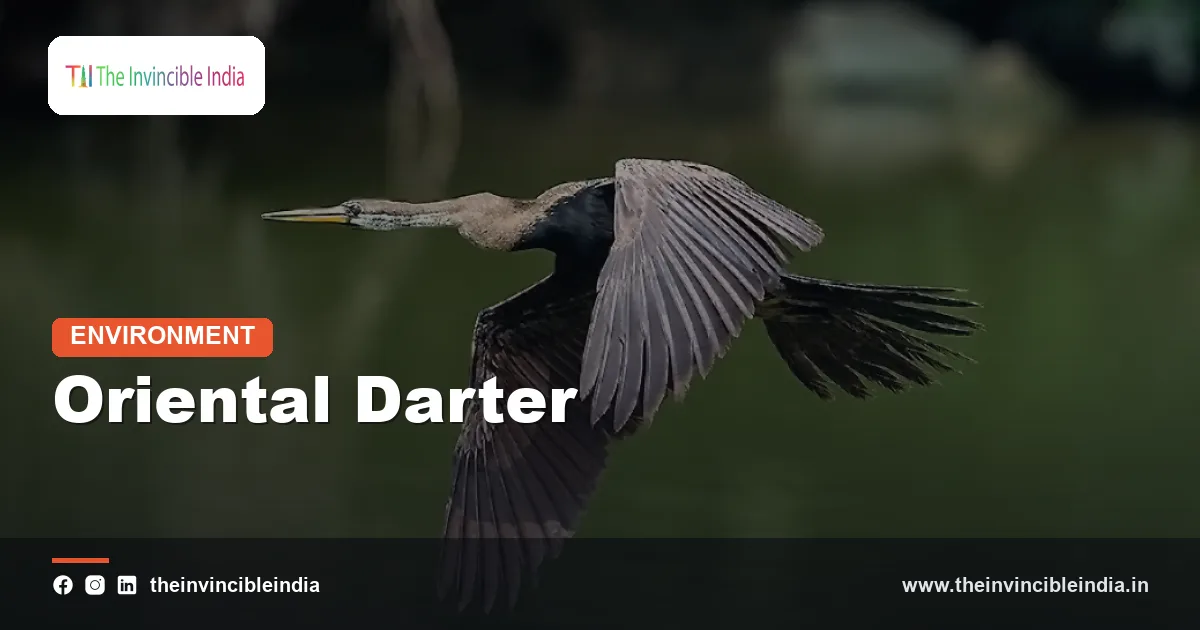
The oriental darter (Anhinga melanogaster), popularly called the snakebird, is a large, long-necked waterbird of South and Southeast Asia that swims with its body submerged and only its thin, snake-like neck and head above the surface, then spears fish with a dagger-shaped bill. It is found in lakes, marshes, reservoirs and slow rivers across India, and it is listed as Near Threatened on the IUCN Red List.
The oriental darter is often mistaken for a cormorant, and the two share the habit of perching with outstretched wings to dry their feathers, but the darter has a distinctly longer, thinner neck, a pointed bill and a stiffer tail. This explainer covers how to recognise the oriental darter, where it lives, how its unusual neck lets it strike like a spring, how it breeds and why it needs protection.
Quick Facts
| Common names | Oriental darter, Indian darter, snakebird |
|---|---|
| Scientific name | Anhinga melanogaster |
| Family | Anhingidae (darters) |
| Length | Roughly 85 to 97 cm, with a wingspan of around 1.2 metres |
| Key features | Very long thin S-shaped neck, straight pointed bill, dark body with silvery streaks, long fan-shaped tail |
| Habitat | Freshwater lakes, marshes, reservoirs, slow rivers and mangrove-edged creeks |
| Diet | Mostly fish, plus frogs, tadpoles, crustaceans and aquatic insects |
| Breeding | Colonial, in trees over or near water; about three to five pale blue-green eggs |
| Global conservation status | Near Threatened (IUCN Red List) |
Key Takeaways
- The oriental darter is a freshwater diving bird nicknamed the snakebird because it often swims with only its thin neck and head showing above the water.
- The oriental darter catches fish by stabbing them with its sharp, straight bill rather than by grabbing them, using a neck that is kinked and acts like a spring.
- The oriental darter has feathers that are not fully waterproof, so it spends long periods perched with its wings spread out to dry.
- The oriental darter belongs to the small family Anhingidae, which contains only a few living species worldwide, and it is a separate family from the cormorants.
- The oriental darter is classified as Near Threatened by the IUCN, mainly because of the loss and degradation of wetlands and nesting trees.
- The oriental darter breeds in mixed colonies with herons, egrets, ibises and cormorants, building stick nests in trees over or beside water.
What is the oriental darter?
The oriental darter is a large waterbird in the family Anhingidae, a small group of long-necked fish-eating birds known as darters or anhingas. It is found from the Indian subcontinent east through Southeast Asia to Indonesia, and it occurs mainly in lowland freshwater wetlands. It was once treated as the same species as the Australasian darter, but the two are now usually recognised as separate species.
The oriental darter is also called the Indian darter, and the name “darter” refers to the bird’s dart-like strike at fish. It is related to cormorants, and both belong to the same larger order of fish-eating water birds, but darters have a different bill, neck and body shape.
Why is the oriental darter called the snakebird?
The oriental darter is called the snakebird because it often swims with its whole body hidden below the water and only its long, slender, serpentine neck and small head poking out, so that it looks like a snake gliding across the surface. When the bird sinks lower to hide, even the head may seem to emerge from the water like a periscope. The resemblance is strongest in slow, weedy ponds where the bird approaches fish unseen.
This low-slung swimming posture is possible because the darter’s plumage is not fully waterproof, so it soaks up water and the bird sits low and can adjust how deeply it floats. It can even sink with almost no ripple, an advantage when stalking prey.
How can you identify an oriental darter?
An oriental darter is identified by its slim body, very long thin neck with a visible kink, a straight sharply pointed bill, a long fan-shaped tail and a dark plumage with silvery-grey streaks on the upper wing. The head and neck are brownish with a pale stripe running down the side of the neck in adults, and the body is blackish and glossy. Juveniles are paler and browner overall, with a duller neck.
In flight, the oriental darter looks like a cross, with its long neck stretched forward, broad wings held flat and a long tail trailing behind. Birds alternate flapping and gliding, and they often soar high on thermal air currents, a behaviour that cormorants seldom show.
How is the darter’s neck unusual?
The darter’s neck is unusual because a hinge-like bend in its vertebrae, formed by a modification of the eighth and ninth neck bones, gives the neck a permanent kink and lets it be shot forward very fast. When the bird holds the neck in an S-curve, the muscles and bones work like a loaded spring. Releasing the curve drives the head and bill forward in a rapid stab, which makes the darter a swift spear-fisher.
Where is the oriental darter found in India?
The oriental darter is found in freshwater wetlands across much of India, including lakes, village tanks, reservoirs, marshes, rivers and the edges of mangroves. It is recorded in states from Punjab, Rajasthan and Gujarat in the north-west, through the Gangetic plains and Assam, to the peninsular states such as Karnataka, Andhra Pradesh, Tamil Nadu and Kerala. It is more often seen in protected wetlands and large water bodies than in small, disturbed ponds.
Well-known places to see the oriental darter include Keoladeo National Park in Rajasthan, Nal Sarovar in Gujarat, Kaziranga National Park in Assam, Ranganathittu Bird Sanctuary in Karnataka and Kolleru Lake in Andhra Pradesh. Outside India, the species occurs in Nepal, Bangladesh, Sri Lanka, Myanmar, Thailand, Cambodia, Malaysia and Indonesia.
What does the oriental darter eat?
The oriental darter eats mainly fish, along with tadpoles, frogs, aquatic insects, crustaceans and other small water animals. The fish it takes are usually small to medium in size, and it prefers waters that are clear enough for it to see prey but with enough plant cover to allow a stealthy approach. A bird may spend much of the day alternating between feeding and drying its wings.
Because it feeds so heavily on fish, the oriental darter is an indicator of wetland health. Where fish stocks collapse because of pollution, overfishing or drying up of water, darters are usually among the first fish-eaters to disappear.
How does the oriental darter hunt?
The oriental darter hunts by swimming slowly underwater, sneaking up on a fish and stabbing it with a lightning-fast thrust of its sharp, slightly serrated bill. It then surfaces, flicks or tosses the impaled fish into the air, catches it and swallows it head-first. The fine serrations near the bill tip help hold slippery prey, and the speed of the thrust is the result of the bird’s special neck structure.
- Stalking: The bird paddles with its large webbed feet while its body stays submerged, so that it can approach fish unseen.
- Spearing: The neck shoots forward and the closed bill impales the prey, unlike a cormorant that mostly seizes fish in a hooked bill.
- Surface handling: The bird shakes off the fish, flips it into position and swallows it whole.
- Patience: The bird may creep along weed beds for some time before it finds a fish within reach.
The darter often swims and dives to depths of a few metres, though many of its dives in shallow tanks last only a short time.
Why does the oriental darter spread its wings?
The oriental darter spreads its wings to dry them because its feathers become waterlogged when it dives and swims, which helps it sink but weighs it down in the air. After a fishing spell, the bird climbs onto a branch, rock or stump and holds its wings out in the sun and breeze. In this pose, with the neck erect and the wings spread, it can look like a heraldic eagle or a small cross.
Spreading the wings may also help regulate body temperature, since the bird loses heat quickly in cold water and has little insulating fat. Perches that are exposed to the sun, such as dead trees in the middle of a lake, are therefore valuable to the species.
How does the oriental darter breed?
The oriental darter breeds in colonies, building a platform of sticks and twigs lined with leaves in a tree or bush standing over or beside water, usually together with herons, egrets, ibises and cormorants. The breeding season varies by region and rainfall, with nesting in much of northern India linked to the monsoon, and in parts of southern India linked to the cooler months. Both sexes build the nest and look after the eggs and chicks.
A clutch normally contains about three to five pale bluish-green eggs, which hatch after roughly four weeks of incubation. The chicks are born almost naked, develop a coat of pale down, and are fed by regurgitation. They leave the nest while still dependent and are fed on branches nearby for some time. Because nest trees stand in water, protecting standing trees in wetlands is as important as protecting the water itself.
How does the oriental darter differ from a cormorant?
The oriental darter differs from a cormorant in its much longer, thinner and kinked neck, its straight pointed bill, its longer tail and its spearing method of fishing. Both groups perch with their wings open and both nest in mixed colonies, which is why they are often confused. The table below lists the main differences.
| Feature | Oriental darter | Cormorants |
|---|---|---|
| Family | Anhingidae | Phalacrocoracidae |
| Neck | Very long, thin, kinked | Shorter, thicker |
| Bill | Straight and sharply pointed | Hooked at the tip |
| Catching method | Stabs or spears fish underwater | Seizes fish in the bill |
| Tail | Long, stiff and fan-shaped | Shorter and wedge-shaped |
| Flight | Frequent soaring on thermals | Mostly flapping flight |
| Swimming posture | Body often submerged, only neck visible | Body sits low but more visible |
What are the other darters of the world?
The darter family Anhingidae contains only a handful of living species, found on different continents: the oriental darter of South and Southeast Asia, the African darter, the Australasian darter and the American anhinga. All of them share the long kinked neck, the spear-like bill and the habit of swimming with the body submerged. The oriental darter is the species that occurs in India, and no other darter is found in the country.
Can the oriental darter fly well?
The oriental darter is a strong and graceful flier despite its waterlogged feathers, and it commonly climbs on rising warm air to soar in wide circles with its neck outstretched. Taking off from water needs a running start, so birds often prefer to launch from a perch. The long tail works as a rudder and a brake, helping the bird to manoeuvre between branches when it lands in a crowded colony.
Is the oriental darter threatened?
The oriental darter is classified as Near Threatened on the IUCN Red List, meaning it is close to qualifying for a threatened category, and its global population is thought to be declining and to number in the tens of thousands at most. The main reasons are the loss, drainage and degradation of wetlands, the felling of colonial nest trees, pollution and disturbance of breeding colonies. Exact numbers vary between surveys and should be treated as approximate.
The species is protected in India under the Wildlife (Protection) Act, 1972, and many of its breeding colonies are inside sanctuaries and national parks. The principal threats are listed below.
- Drainage and conversion of marshes, lakes and floodplains.
- Felling of tall trees where colonies nest, and disturbance of those colonies.
- Water pollution, pesticide residues and falling fish stocks.
- Entanglement in fishing nets and lines.
- Occasional hunting or capture of chicks and eggs for food in some regions.
Where and when can you see the oriental darter?
The oriental darter can be seen throughout the year at suitable wetlands, and it is easiest to find in the early morning or late afternoon when it perches with its wings spread near the water. Scan the dead branches of trees standing in lakes for a black, cross-shaped bird with an upright neck, or look for a periscope-like neck gliding silently across the surface. Mixed heronries in the monsoon or post-monsoon season give the best chance of seeing nests and young.
- Use binoculars from a boat, hide or embankment to avoid disturbing roosting or nesting birds.
- Check the same perches repeatedly, since darters tend to return to favourite drying spots.
- Do not approach nest colonies, because disturbed birds may abandon eggs or chicks.
- Record sightings on citizen-science platforms, which help track the species’ status.
Bottom Line
The oriental darter is a remarkable fish-spearing waterbird whose snake-like neck, submerged swimming and wing-drying posture make it one of the easiest wetland birds to remember. It is Near Threatened, so the long-term outlook depends on conserving wetlands, clean water and the tall trees that hold its colonies.
Frequently Asked Questions
What is an oriental darter?
The oriental darter is a large, long-necked freshwater diving bird of South and Southeast Asia, also called the snakebird. It swims with its body underwater and only its thin neck and head showing, and it spears fish with a sharp, straight bill. It is found in lakes, marshes and reservoirs across India and is listed as Near Threatened.
Why is the oriental darter called a snakebird?
The oriental darter is called a snakebird because it often swims with only its long, thin neck and small head above the water, which looks like a snake moving across the surface. Its plumage soaks up water, letting the bird sit very low. This helps it creep up on fish unseen.
How does the oriental darter catch fish?
The oriental darter catches fish by stabbing them with its sharp, slightly serrated bill. A kink in its neck lets the head shoot forward like a spring, giving a very fast strike. The bird then surfaces, tosses the fish into the air and swallows it head-first.
What is the difference between a darter and a cormorant?
A darter has a much longer, thinner and kinked neck, a straight pointed bill and a long fan-shaped tail, while a cormorant has a thicker neck and a bill hooked at the tip. Darters spear fish, whereas cormorants mostly seize them. Darters also soar on thermals more often than cormorants do.
Why does the oriental darter hold its wings open?
The oriental darter holds its wings open to dry its feathers, which become waterlogged when the bird swims and dives. Wet plumage helps it sink while fishing but makes flight heavy. The pose also helps the bird warm up after time in cool water.
Is the oriental darter endangered?
The oriental darter is classified as Near Threatened by the IUCN, not Endangered, but its global population is thought to be declining. Wetland loss, felling of nest trees, pollution and fishing-net entanglement are the main threats. It is protected in India under the Wildlife (Protection) Act, 1972.
{“@context”:”https://schema.org”,”@graph”:[{“@type”:”FAQPage”,”mainEntity”:[{“@type”:”Question”,”name”:”What is an oriental darter?”,”acceptedAnswer”:{“@type”:”Answer”,”text”:”The oriental darter is a large, long-necked freshwater diving bird of South and Southeast Asia, also called the snakebird. It swims with its body underwater and only its thin neck and head showing, and it spears fish with a sharp, straight bill. It is found in lakes, marshes and reservoirs across India and is listed as Near Threatened.”}},{“@type”:”Question”,”name”:”Why is the oriental darter called a snakebird?”,”acceptedAnswer”:{“@type”:”Answer”,”text”:”The oriental darter is called a snakebird because it often swims with only its long, thin neck and small head above the water, which looks like a snake moving across the surface. Its plumage soaks up water, letting the bird sit very low. This helps it creep up on fish unseen.”}},{“@type”:”Question”,”name”:”How does the oriental darter catch fish?”,”acceptedAnswer”:{“@type”:”Answer”,”text”:”The oriental darter catches fish by stabbing them with its sharp, slightly serrated bill. A kink in its neck lets the head shoot forward like a spring, giving a very fast strike. The bird then surfaces, tosses the fish into the air and swallows it head-first.”}},{“@type”:”Question”,”name”:”What is the difference between a darter and a cormorant?”,”acceptedAnswer”:{“@type”:”Answer”,”text”:”A darter has a much longer, thinner and kinked neck, a straight pointed bill and a long fan-shaped tail, while a cormorant has a thicker neck and a bill hooked at the tip. Darters spear fish, whereas cormorants mostly seize them. Darters also soar on thermals more often than cormorants do.”}},{“@type”:”Question”,”name”:”Why does the oriental darter hold its wings open?”,”acceptedAnswer”:{“@type”:”Answer”,”text”:”The oriental darter holds its wings open to dry its feathers, which become waterlogged when the bird swims and dives. Wet plumage helps it sink while fishing but makes flight heavy. The pose also helps the bird warm up after time in cool water.”}},{“@type”:”Question”,”name”:”Is the oriental darter endangered?”,”acceptedAnswer”:{“@type”:”Answer”,”text”:”The oriental darter is classified as Near Threatened by the IUCN, not Endangered, but its global population is thought to be declining. Wetland loss, felling of nest trees, pollution and fishing-net entanglement are the main threats. It is protected in India under the Wildlife (Protection) Act, 1972.”}}]}]}


