

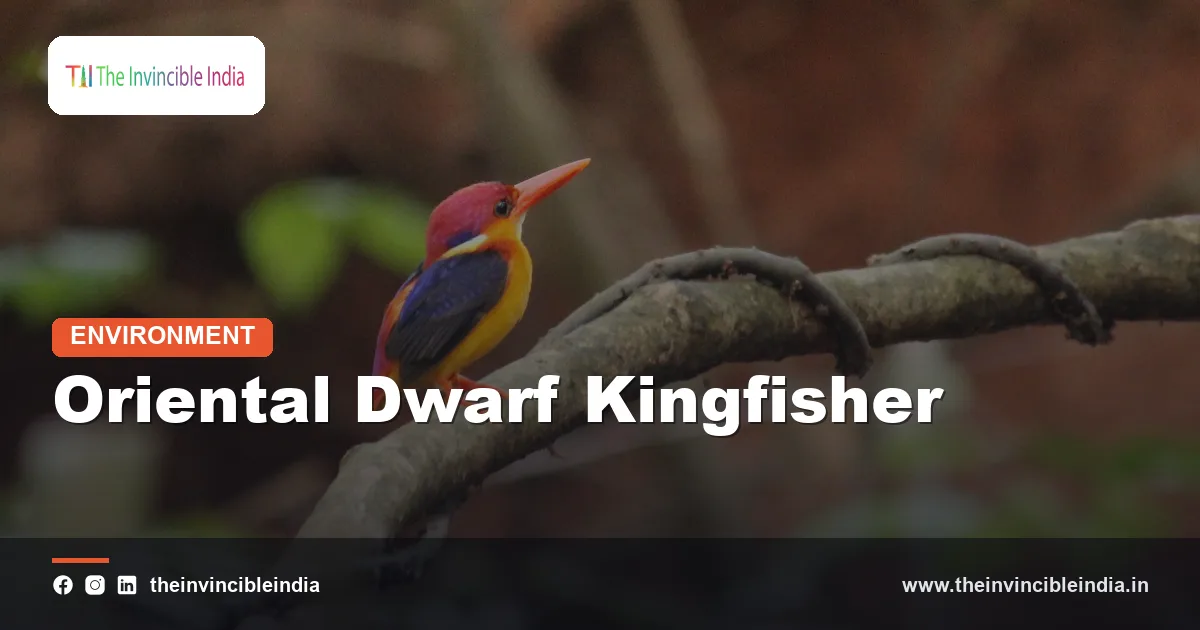
The oriental dwarf kingfisher (Ceyx erithaca) is a tiny, jewel-coloured forest kingfisher of South and Southeast Asia, only about 13 cm long, with a bright red-orange bill, a golden-orange face and underparts, and a back that ranges from violet-blue to rufous depending on the form. In India it is a shy bird of damp evergreen and semi-evergreen forests in the Western Ghats and the northeast, and it is a seasonal favourite of bird watchers because it arrives in many places with the monsoon.
The oriental dwarf kingfisher is one of the smallest kingfishers in the world and one of the hardest to see, since it sits low in shaded forest and often hunts far from open water. This explainer covers its identification, the two colour forms, its range and seasonal movements in India, diet, nesting, conservation and watching tips.
| Quick Facts: Oriental Dwarf Kingfisher | |
|---|---|
| Common name | Oriental dwarf kingfisher (also called the black-backed kingfisher; older Indian books use “three-toed kingfisher”) |
| Scientific name | Ceyx erithaca |
| Family | Alcedinidae (kingfishers), subfamily of river kingfishers |
| Size | About 12-14 cm long; among the smallest kingfishers in Asia |
| Key field marks | Tiny size, red-orange bill, golden-orange underparts, violet-blue or rufous back, white patch on the neck sides |
| India range and habitat | Moist evergreen and semi-evergreen forest in the Western Ghats, the northeast, parts of the Eastern Ghats and some island and delta forests |
| Diet | Insects, spiders, small frogs, lizards, crabs and occasionally tiny fish |
| Breeding | Nests in a short tunnel dug into a forest earth bank or similar mound, mainly in the monsoon months |
| Conservation status | Least Concern (IUCN); legally protected under the Wildlife (Protection) Act, 1972 |
Key Takeaways
- The oriental dwarf kingfisher is one of the smallest kingfishers in Asia, measuring only about 13 cm from bill tip to tail tip.
- The oriental dwarf kingfisher has a bright red-orange bill and golden-orange underparts, with a back that is violet-blue in one form and rufous in another.
- In India the oriental dwarf kingfisher lives in damp evergreen and semi-evergreen forests, notably in the Western Ghats and the northeast.
- The oriental dwarf kingfisher feeds mostly on insects and other small animals taken from the forest floor and low branches, not only on fish.
- The oriental dwarf kingfisher is closely linked to the monsoon in much of India, when birds move into forests to breed in small burrows in earth banks.
- The oriental dwarf kingfisher is classed as Least Concern by the IUCN, though it depends on intact moist forest that continues to be cleared in many regions.
What is the oriental dwarf kingfisher?
The oriental dwarf kingfisher is a very small kingfisher in the family Alcedinidae, belonging to the genus Ceyx, and it is found in forests from India across Southeast Asia to the Sunda islands. It is a compact bird with a large head, a short tail and a long straight bill that looks almost too big for its body.
Unlike the better-known common kingfisher, which is bound to streams and ponds, the oriental dwarf kingfisher is mainly a forest bird. It spends much of its time in shady undergrowth near small streams, puddles and wet ground, and it eats a wide range of small animals rather than depending only on fish. Older Indian field guides often call it the three-toed kingfisher, because the inner front toe is missing, leaving three toes on each foot.
Taxonomists have debated how many species are involved. Some authorities treat the rufous-backed and the black-backed forms as a single species, while others treat the rufous-backed dwarf kingfisher (Ceyx rufidorsa) as a separate species. This article follows the traditional broad treatment, while noting that field guides may differ.
How can you identify the oriental dwarf kingfisher?
You can identify the oriental dwarf kingfisher by its tiny size, bright red-orange bill and glowing orange-yellow underparts, with a blue-violet or rufous back that shows as a flash in dim forest light. No other Indian kingfisher is so small and so colourful at the same time.
Key field marks
- Size: roughly the length of a sparrow’s body but with a stubby tail, much smaller than the common kingfisher.
- Bill: bright coral red to orange-red, long, straight and pointed.
- Face and underparts: warm golden-orange to rufous-yellow, with a pale throat and a small white patch on each side of the neck.
- Back: in the black-backed form, a blackish back with a violet-blue sheen; in the rufous-backed form, a rufous or reddish-orange back with a lilac gloss on the rump.
- Behaviour: sits upright and still on a low perch, then makes quick, buzzing flights.
Male and female look alike. Young birds are duller, with a darker bill tip and less glossy plumage. In dim light under the forest canopy, the bright rump and bill often catch the eye before the rest of the bird is visible.
What are the two colour forms of the oriental dwarf kingfisher?
The oriental dwarf kingfisher occurs in two main colour forms: a black-backed form with a violet-blue sheen and a rufous-backed form with a reddish back. The two differ mainly in the colour of the upperparts, while size, bill and habits are broadly similar.
| Feature | Black-backed form (erithaca group) | Rufous-backed form (rufidorsa group) |
|---|---|---|
| Upper back | Blackish, with deep violet-blue gloss | Rufous to reddish-orange |
| Rump | Bright cobalt or violet-blue | Lilac to violet, sometimes with rufous mixed in |
| Typical region | Mainly Indian subcontinent and parts of mainland Asia | Mainly the Malay region and parts of Southeast Asia; occasional intermediates |
| Status in India | The usual form | Occurs rarely or as an intermediate type, depending on the area |
Because intermediate-looking birds occur where the ranges meet, the exact boundary between the forms is still studied. For most Indian bird watchers, the practical point is that any tiny kingfisher with a red bill and orange underparts in forest is almost certainly this species.
Where does the oriental dwarf kingfisher live in India?
The oriental dwarf kingfisher lives in moist forests in India, mainly in the Western Ghats, the Eastern Himalayan foothills and the northeastern states, with scattered populations in the Eastern Ghats and some other forested pockets. It prefers dense, humid woodland close to streams, seepages and shaded ravines.
Typical Indian habitats
- Western Ghats: wet evergreen and semi-evergreen forests along the west coast hill ranges, from Karnataka and Goa to Kerala.
- Northeast India: tropical forest in the plains and foothills of Assam, Arunachal Pradesh, Meghalaya and neighbouring states.
- Eastern parts: forest patches in Odisha and parts of the Eastern Ghats, and mangrove and delta forests in some regions.
- Island forests: moist forests in the Andaman and Nicobar Islands, where related island forms occur.
Within these areas the bird is usually found below about 1,000 metres, although it may be recorded higher in suitable locations. It favours shady corridors with leaf litter, rotting logs and damp banks, rather than open water or sunlit riverbanks, which makes it a bird of the forest interior.
Why is the oriental dwarf kingfisher called a monsoon bird?
The oriental dwarf kingfisher is called a monsoon bird because in several parts of India, especially the Western Ghats, it appears around the arrival of the monsoon rains and breeds in the wet season. Observers often see it for the first time in the year in June and July, after the first heavy showers wet the forest floor.
The pattern is linked to food and nesting conditions. Rain brings out large numbers of insects, spiders, frogs and other small prey, and it softens earth banks so that pairs can dig their nest tunnels. Some birds are local movers within the Western Ghats, shifting from lower or drier forest to wetter hills, while others may be seasonal visitors from further afield. The details of these movements are not fully worked out, and bird atlases continue to study them.
After the rains, many birds become harder to find. Individuals may move out of their breeding forests as the dry season approaches, and records from other seasons are less frequent, so the best time for sightings remains the monsoon and the weeks soon after it.
What does the oriental dwarf kingfisher eat?
The oriental dwarf kingfisher eats mainly insects and other small invertebrates, together with small frogs, lizards and sometimes tiny fish or crabs. It is a forest-floor hunter more than a diver, and many of its prey animals are caught on land.
Typical prey
- Insects: grasshoppers, crickets, beetles, caterpillars, termites and dragonfly larvae.
- Other invertebrates: spiders, earthworms, small snails and freshwater crabs.
- Small vertebrates: tiny frogs, tadpoles, small lizards and occasionally minnow-sized fish in forest pools.
The bird hunts from a low perch, often only a metre or two above ground. It scans the leaf litter, a stream edge or a muddy patch, then flies down, seizes its prey with the bill and returns to the perch. Larger prey is beaten against a branch before being swallowed. Because the bird relies on small prey, the abundance of forest insects and amphibians is vital to it.
How does the oriental dwarf kingfisher breed?
The oriental dwarf kingfisher breeds by digging a short horizontal tunnel in an earth bank, a mound or a similar soft bank inside the forest. The pair usually works together to excavate the burrow, which ends in a small egg chamber.
The clutch is typically a few round white eggs, and both parents share incubation and feeding of the chicks. In India breeding mainly takes place in the monsoon months, when the soil is soft and prey is plentiful. Nest sites may be located on forest tracks, stream banks, road cuttings or even in the sides of mud mounds, and the entrance hole is only just large enough for the small bird.
The nest tunnel is easily disturbed by trampling, road widening and soil erosion. Because the bird nests at low heights, nests are also vulnerable to predators such as snakes and mongooses. Quiet observation from a distance protects the nest and the chicks.
Is the oriental dwarf kingfisher threatened?
The oriental dwarf kingfisher is not considered threatened globally, since the IUCN lists it as Least Concern on account of its wide distribution across Asia. The species is nevertheless sensitive to forest loss, because it depends on shady, humid forest with intact undergrowth.
The main pressures on the bird in India include:
- Deforestation and conversion of evergreen forest to plantations, farmland and settlements.
- Fragmentation of forest corridors in the Western Ghats and the northeast.
- Loss of stream-side habitat from mining, sand extraction and road building.
- Collisions with glass, wires and vehicles, especially for birds that move at the start of the monsoon.
Like all wild birds native to India, the oriental dwarf kingfisher is protected under the Wildlife (Protection) Act, 1972. Many of its strongholds lie inside national parks, wildlife sanctuaries and reserved forests, which offer the habitat protection it needs.
Where and when can you see an oriental dwarf kingfisher in India?
The best place to see an oriental dwarf kingfisher in India is a damp forest stream or shaded trail in the Western Ghats or the northeast, ideally during the monsoon and just after it. Sightings are more likely in sanctuaries and forest reserves with wet evergreen woodland.
Tips for watching
- Walk slowly along shaded forest trails and stream edges early in the morning or in light rain.
- Scan low perches, fallen logs and roots at knee to head height, not high canopy branches.
- Listen for a thin, high-pitched, whistling or tinkling call, which may be the first sign of the bird.
- Look for the flash of orange and blue in shady patches, since the bird often sits very still.
- Be patient and quiet, and avoid playing recorded calls, which can stress nesting birds.
Birders in states such as Kerala, Karnataka, Goa, Maharashtra, Assam and Arunachal Pradesh often record the species in suitable forest during the rainy season. Because the bird is tiny and secretive, many people notice it only when it moves.
Bottom Line
The oriental dwarf kingfisher is a thumb-sized jewel of India’s wet forests, identified by its red bill, golden-orange underparts and violet or rufous back. It hunts small prey from low perches, nests in earth banks during the monsoon, and survives only where shady, humid forest remains.
Frequently Asked Questions
What is the oriental dwarf kingfisher?
The oriental dwarf kingfisher is a very small, brightly coloured kingfisher of South and Southeast Asian forests, about 13 cm long. It has a red-orange bill, golden-orange underparts and a violet-blue or rufous back. In India it lives mainly in moist forests of the Western Ghats and the northeast.
How big is the oriental dwarf kingfisher?
The oriental dwarf kingfisher is about 12 to 14 cm long, making it one of the smallest kingfishers in Asia. It is much smaller than the common kingfisher, which is around 16 to 17 cm. Its short tail and large bill give it a compact, stubby look.
What does the oriental dwarf kingfisher eat?
The oriental dwarf kingfisher eats mainly insects, spiders, small frogs, lizards and crabs, and only sometimes tiny fish. It hunts from low perches in the forest and flies down to seize prey from the leaf litter or the edge of a stream. Because of this diet it is less dependent on open water than other kingfishers.
Why is the oriental dwarf kingfisher called a monsoon bird?
The oriental dwarf kingfisher is called a monsoon bird because it appears or becomes more visible in many Indian forests when the monsoon begins. Rain brings abundant insects and soft earth for nest tunnels, so breeding is timed to the wet season. Sightings are therefore most common from about June to September.
Where does the oriental dwarf kingfisher nest?
The oriental dwarf kingfisher nests in a short horizontal tunnel dug into an earth bank, mound or similar soft bank inside the forest. Both parents help excavate the burrow and care for the eggs and chicks. The entrance is only just large enough for the tiny bird.
Is the oriental dwarf kingfisher rare in India?
The oriental dwarf kingfisher is not considered globally threatened, but it is secretive and thinly spread, so many people rarely see it. It is classified as Least Concern by the IUCN and is protected in India under the Wildlife (Protection) Act, 1972. Its survival depends on keeping damp evergreen forest intact.
{“@context”:”https://schema.org”,”@graph”:[{“@type”:”FAQPage”,”mainEntity”:[{“@type”:”Question”,”name”:”What is the oriental dwarf kingfisher?”,”acceptedAnswer”:{“@type”:”Answer”,”text”:”The oriental dwarf kingfisher is a very small, brightly coloured kingfisher of South and Southeast Asian forests, about 13 cm long. It has a red-orange bill, golden-orange underparts and a violet-blue or rufous back. In India it lives mainly in moist forests of the Western Ghats and the northeast.”}},{“@type”:”Question”,”name”:”How big is the oriental dwarf kingfisher?”,”acceptedAnswer”:{“@type”:”Answer”,”text”:”The oriental dwarf kingfisher is about 12 to 14 cm long, making it one of the smallest kingfishers in Asia. It is much smaller than the common kingfisher, which is around 16 to 17 cm. Its short tail and large bill give it a compact, stubby look.”}},{“@type”:”Question”,”name”:”What does the oriental dwarf kingfisher eat?”,”acceptedAnswer”:{“@type”:”Answer”,”text”:”The oriental dwarf kingfisher eats mainly insects, spiders, small frogs, lizards and crabs, and only sometimes tiny fish. It hunts from low perches in the forest and flies down to seize prey from the leaf litter or the edge of a stream. Because of this diet it is less dependent on open water than other kingfishers.”}},{“@type”:”Question”,”name”:”Why is the oriental dwarf kingfisher called a monsoon bird?”,”acceptedAnswer”:{“@type”:”Answer”,”text”:”The oriental dwarf kingfisher is called a monsoon bird because it appears or becomes more visible in many Indian forests when the monsoon begins. Rain brings abundant insects and soft earth for nest tunnels, so breeding is timed to the wet season. Sightings are therefore most common from about June to September.”}},{“@type”:”Question”,”name”:”Where does the oriental dwarf kingfisher nest?”,”acceptedAnswer”:{“@type”:”Answer”,”text”:”The oriental dwarf kingfisher nests in a short horizontal tunnel dug into an earth bank, mound or similar soft bank inside the forest. Both parents help excavate the burrow and care for the eggs and chicks. The entrance is only just large enough for the tiny bird.”}},{“@type”:”Question”,”name”:”Is the oriental dwarf kingfisher rare in India?”,”acceptedAnswer”:{“@type”:”Answer”,”text”:”The oriental dwarf kingfisher is not considered globally threatened, but it is secretive and thinly spread, so many people rarely see it. It is classified as Least Concern by the IUCN and is protected in India under the Wildlife (Protection) Act, 1972. Its survival depends on keeping damp evergreen forest intact.”}}]}]}


