

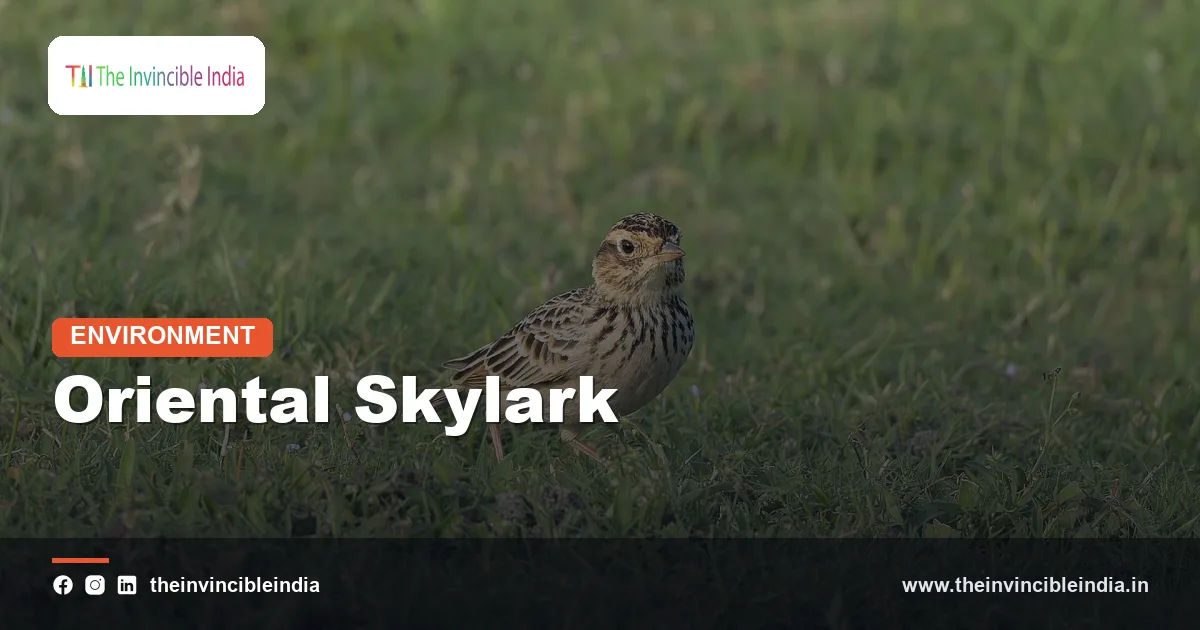
The oriental skylark (Alauda gulgula) is a small, streaky brown songbird of the lark family that lives in the open grasslands, fallow fields and cultivated edges of India and is famous for singing in a long, hovering song-flight high above the ground. It is a ground-dwelling bird with a short crest, a heavily streaked back and breast, and white outer tail feathers, and it is resident across most of the Indian subcontinent. Older books call it the small skylark or Indian skylark.
The oriental skylark was once treated as a race of the Eurasian skylark made famous in English poetry, but it is now regarded as a separate species. Its song, nesting on the open ground and dependence on grassland make it a good indicator of healthy open country. This article explains its identification, range, diet, breeding, song and conservation.
Quick Facts
| Common name | Oriental skylark (also small skylark or Indian skylark) |
|---|---|
| Scientific name | Alauda gulgula |
| Family | Alaudidae (larks) |
| Size | About 16 cm long |
| Range | Throughout most of India, plus Nepal, Bangladesh, Sri Lanka and parts of Southeast Asia and southern China |
| Habitat | Short grassland, fallow and cultivated fields, scrub edges, airfields and river banks |
| Diet | Seeds and grain, plus insects and other small invertebrates, especially in the breeding season |
| Breeding | Grass-lined cup nest on the ground, usually two to four eggs; mainly spring to the monsoon, varying by region |
| Conservation status | Least Concern (IUCN) |
Key Takeaways
- The oriental skylark is a small streaky brown lark, about 16 cm long, that is resident across most of India.
- The oriental skylark has a short, pointed crest that it raises when excited, plus white outer tail feathers that show in flight.
- The oriental skylark is best known for its song-flight, in which the male rises steeply, hovers high in the air and sings continuously for minutes.
- The oriental skylark feeds on the ground, taking seeds, grain and insects as it walks and runs through short grass.
- The oriental skylark nests in a shallow, grass-lined hollow on the ground, usually under a tuft, and typically lays two to four eggs.
- The oriental skylark is listed as Least Concern, but it depends on open grassland and low-intensity farmland that are shrinking in parts of India.
What is the oriental skylark?
The oriental skylark is a small species of lark, in the family Alaudidae, that lives in open country across southern Asia. Larks are a group of mostly brown, ground-living songbirds that are known for elaborate flight songs, long hind claws and a habit of walking rather than hopping. The oriental skylark is one of the commonest larks seen near Indian fields and grassland edges.
The scientific name Alauda gulgula was given by the British army officer and naturalist James Franklin in 1831, and the species name reflects a local Indian name for the bird. The genus Alauda also includes the Eurasian skylark (Alauda arvensis), a species that has inspired English poets and winters in parts of north-western India. The oriental skylark is smaller and has less white on the wing, and these differences led modern authorities to treat the two as separate species.
Several subspecies are recognised across its wide range, differing slightly in size and in the shade of their plumage. Birds in drier regions are typically paler, and those in wetter or more northern areas can look darker and warmer in tone.
How can you identify the oriental skylark?
You can identify the oriental skylark by its streaky buff-brown plumage, small crest, pale supercilium (the stripe above the eye), heavily streaked upper breast and white outer tail feathers. It is about the size of a sparrow, but it looks more slender and stands more upright when it is alert.
Plumage
The upperparts are sandy brown, boldly streaked with darker brown. The throat and belly are whitish to buff, and the breast carries fine dark streaks. The short crest can be raised or flattened, and when flattened it can be hard to see. The bill is short and fairly stout, adapted to picking seeds and small insects.
In flight
In flight, the oriental skylark shows broad, rounded wings and a short tail with white outer feathers. Unlike its larger Eurasian relative, it does not have a strongly marked white trailing edge to the wings. The flight is slightly undulating, and the bird often drops suddenly into grass.
Voice
The call is a dry, buzzy chirrup, and the song is a continuous, varied series of trills, warbles and whistles that can last several minutes. The singing is usually delivered in flight, but males also sing from a low perch such as a clod of earth, a fence post or a termite mound.
Where does the oriental skylark live in India?
The oriental skylark lives in open habitats across most of India, from the plains to the Himalayan foothills, and it also occurs in Nepal, Bangladesh, Sri Lanka and eastwards into Southeast Asia and southern China. It is a resident bird, so individuals largely remain in the same region year-round, though some move locally with changes in food and weather.
Typical habitats are:
- Short grassland and pasture: grazed meadows and open grassy plains are the bird’s natural home.
- Fallow and cultivated fields: the margins of wheat, millet and pulse fields supply seeds and insects.
- Scrub and field edges: low bushes provide perches and nest sites.
- Airfields, playgrounds and river banks: flat, open ground with short vegetation suits the bird well.
The oriental skylark avoids dense forest and tall, thick grass. It does well where the vegetation is kept short, whether by grazing animals, mowing or farming, because the bird needs to see over the ground and run quickly.
What does the oriental skylark eat?
The oriental skylark eats seeds, grains and small insects that it picks up from the ground. Seeds of grasses and weeds make up a large part of its diet through the year, and in the breeding season the bird takes more insects, including grasshoppers, beetles, ants and caterpillars, which are rich in protein for growing chicks.
The bird forages by walking or running in short bursts, stopping to peck at the ground or to look about. It rarely hops. Occasionally it scratches at the soil or picks fallen grain near threshing floors and harvested fields. It may also take small snails and spiders.
The bird’s feeding habits make it useful in farmland. By eating weed seeds and insect pests it contributes, in a small way, to natural control of both. Because it feeds on the ground, it is also vulnerable to pesticides and to changes in how fields are managed.
Why does the oriental skylark sing in flight?
The oriental skylark sings in flight because the song-flight lets the male advertise his territory and attract a mate across a wide, open landscape where there are few high perches. In open grassland a singing bird high in the air can be heard and seen from far away, which makes the display efficient.
During the display, the male launches almost vertically from the ground, sings as he climbs and then hovers on rapidly beating wings at a considerable height, sometimes so high that he is hard to see. He may sing for several minutes without stopping. At the end of the performance he closes his wings and parachutes or plunges back to the ground, often singing during the descent.
The song-flight is most frequent in the breeding season, particularly in the early morning and on cool, calm days. It is a reliable sign that a pair is holding a territory in the area, and it can give a rough indication of the number of breeding pairs in a field or grassland.
How does the oriental skylark breed and nest?
The oriental skylark breeds by building a simple cup nest on the ground, usually in a small hollow under a grass tuft or clod of earth, and the female typically lays two to four eggs. The nest is lined with fine grass and sometimes rootlets, and its location in a depression helps to hide it from predators.
The breeding season varies across India. In many northern and central areas it begins in spring and continues through the monsoon, while in the south it may begin earlier or follow the rains. The eggs are whitish with brown speckles, which camouflage them against the soil. The female does most of the incubation, and both parents bring food to the chicks.
Ground nesting makes the species vulnerable to trampling, grazing animals, farm machinery and predators such as snakes, crows and mongooses. The chicks leave the nest before they can fly well, hiding in the grass and following their parents, which is a common strategy among ground-nesting birds.
How is the oriental skylark different from other larks?
The oriental skylark differs from other Indian larks mainly in its small crest, streaked breast and moderate size, while related larks have different bill shapes, tail patterns or wing markings. The table below compares it with several larks and skylarks that a birdwatcher might see in the same country.
| Bird | Size | Key features | Status in India |
|---|---|---|---|
| Oriental skylark | About 16 cm | Streaked breast, short crest, white outer tail, little white on wing | Resident across most of the country |
| Eurasian skylark | About 18 cm | Larger, longer crest, white trailing edge on wing | Winter visitor, mainly in the north-west |
| Greater short-toed lark | About 14 cm | Paler, unstreaked or lightly streaked breast, short stubby bill | Winter visitor and local resident |
| Ashy-crowned sparrow-lark | About 12 cm | Small, stocky, male with black underparts and ashy crown | Resident in open dry country |
For a quick check, look at the breast streaking and the amount of white on the tail and wings. The oriental skylark is plainer than its Eurasian cousin and has less white in the wing.
Why does the oriental skylark matter?
The oriental skylark matters because it is an indicator of healthy open grassland and low-intensity farmland, and it plays a role in controlling insects and weed seeds. Grassland birds are among the fastest-declining groups of birds worldwide, and a stable population of larks suggests that open habitat still functions well.
The bird also has cultural value. Skylarks appear in poetry and folk tradition in many countries because of their song, and Indian grasslands still carry the sound of the oriental skylark in the early morning. For farmers, a singing lark above a field is usually a sign of good weather and a healthy margin of grass.
Because larks live in open habitats that people use heavily, they connect conservation with agriculture. Protecting pastures, village commons and field margins helps the oriental skylark and a wide group of other species, from quail and pipits to small mammals and reptiles.
Is the oriental skylark threatened?
No, the oriental skylark is not globally threatened and is classed as Least Concern, because it has a very large range and is common in suitable habitat. Local declines are possible where grasslands are converted into plantations, housing or intensive crops.
The main threats are:
- Conversion of natural grassland and village commons to other land uses.
- Spread of tall invasive plants such as Prosopis juliflora, which shades out short grass.
- Use of pesticides that reduce insect food and contaminate seeds.
- Disturbance of ground nests by grazing, harvesting and stray dogs.
Conservation measures that help include protecting grassland reserves, managing grazing at moderate levels, maintaining uncultivated field margins and avoiding mowing or burning during the peak nesting months.
Where and when can you see the oriental skylark?
You can see the oriental skylark all year in open grassland and fields across India, and the best time to watch is early morning, when males perform their song-flights. Look for a small streaky bird walking on bare ground, flat meadows or the edge of cultivated land, and listen for a continuous trilling song coming from high in the sky.
A good strategy is to walk slowly along a field boundary or track, scanning the ground ahead. The bird often stands still and then runs rather than flies, so watch the ground carefully. Binoculars help to confirm the crest and breast streaks.
Bottom Line
The oriental skylark is a small, streaky, ground-nesting lark of Indian grasslands and fields, best known for its long song-flight. It is common and Least Concern, but its future depends on the protection of open, low-intensity habitats.
Frequently Asked Questions
What is the oriental skylark?
The oriental skylark is a small lark, scientifically Alauda gulgula, that lives in open grassland and fields across India and southern Asia. It has streaky brown plumage, a short crest and a famous hovering song-flight. It was once treated as a form of the Eurasian skylark.
Where is the oriental skylark found in India?
The oriental skylark is found across most of India, from the plains to the Himalayan foothills, in short grassland, fallow fields and field edges. It is largely a resident bird. It avoids dense forest and very tall grass.
What does the oriental skylark eat?
The oriental skylark eats seeds, grain and small insects collected from the ground. Insects such as grasshoppers, beetles and caterpillars become more important in the breeding season because they feed the chicks. The bird walks or runs while foraging rather than hopping.
Why does the oriental skylark sing while flying?
The oriental skylark sings in flight to defend its territory and attract a mate in open country where there are few high perches. The male climbs steeply, hovers and sings continuously for minutes before dropping back to the ground. The display is most common in the early morning during the breeding season.
Where does the oriental skylark build its nest?
The oriental skylark builds its nest on the ground, in a shallow hollow often hidden beneath a grass tuft or clod. The nest is a cup lined with fine grass, and the female usually lays two to four speckled eggs. Because the nest is on the ground, it is vulnerable to trampling and predators.
How is the oriental skylark different from the Eurasian skylark?
The oriental skylark is smaller, has a shorter crest and shows less white on the wings than the Eurasian skylark. It is also a resident across most of India, while the Eurasian skylark is mainly a winter visitor in the north-west. The two are now treated as separate species.
{“@context”:”https://schema.org”,”@graph”:[{“@type”:”FAQPage”,”mainEntity”:[{“@type”:”Question”,”name”:”What is the oriental skylark?”,”acceptedAnswer”:{“@type”:”Answer”,”text”:”The oriental skylark is a small lark, scientifically Alauda gulgula, that lives in open grassland and fields across India and southern Asia. It has streaky brown plumage, a short crest and a famous hovering song-flight. It was once treated as a form of the Eurasian skylark.”}},{“@type”:”Question”,”name”:”Where is the oriental skylark found in India?”,”acceptedAnswer”:{“@type”:”Answer”,”text”:”The oriental skylark is found across most of India, from the plains to the Himalayan foothills, in short grassland, fallow fields and field edges. It is largely a resident bird. It avoids dense forest and very tall grass.”}},{“@type”:”Question”,”name”:”What does the oriental skylark eat?”,”acceptedAnswer”:{“@type”:”Answer”,”text”:”The oriental skylark eats seeds, grain and small insects collected from the ground. Insects such as grasshoppers, beetles and caterpillars become more important in the breeding season because they feed the chicks. The bird walks or runs while foraging rather than hopping.”}},{“@type”:”Question”,”name”:”Why does the oriental skylark sing while flying?”,”acceptedAnswer”:{“@type”:”Answer”,”text”:”The oriental skylark sings in flight to defend its territory and attract a mate in open country where there are few high perches. The male climbs steeply, hovers and sings continuously for minutes before dropping back to the ground. The display is most common in the early morning during the breeding season.”}},{“@type”:”Question”,”name”:”Where does the oriental skylark build its nest?”,”acceptedAnswer”:{“@type”:”Answer”,”text”:”The oriental skylark builds its nest on the ground, in a shallow hollow often hidden beneath a grass tuft or clod. The nest is a cup lined with fine grass, and the female usually lays two to four speckled eggs. Because the nest is on the ground, it is vulnerable to trampling and predators.”}},{“@type”:”Question”,”name”:”How is the oriental skylark different from the Eurasian skylark?”,”acceptedAnswer”:{“@type”:”Answer”,”text”:”The oriental skylark is smaller, has a shorter crest and shows less white on the wings than the Eurasian skylark. It is also a resident across most of India, while the Eurasian skylark is mainly a winter visitor in the north-west. The two are now treated as separate species.”}}]}]}


