

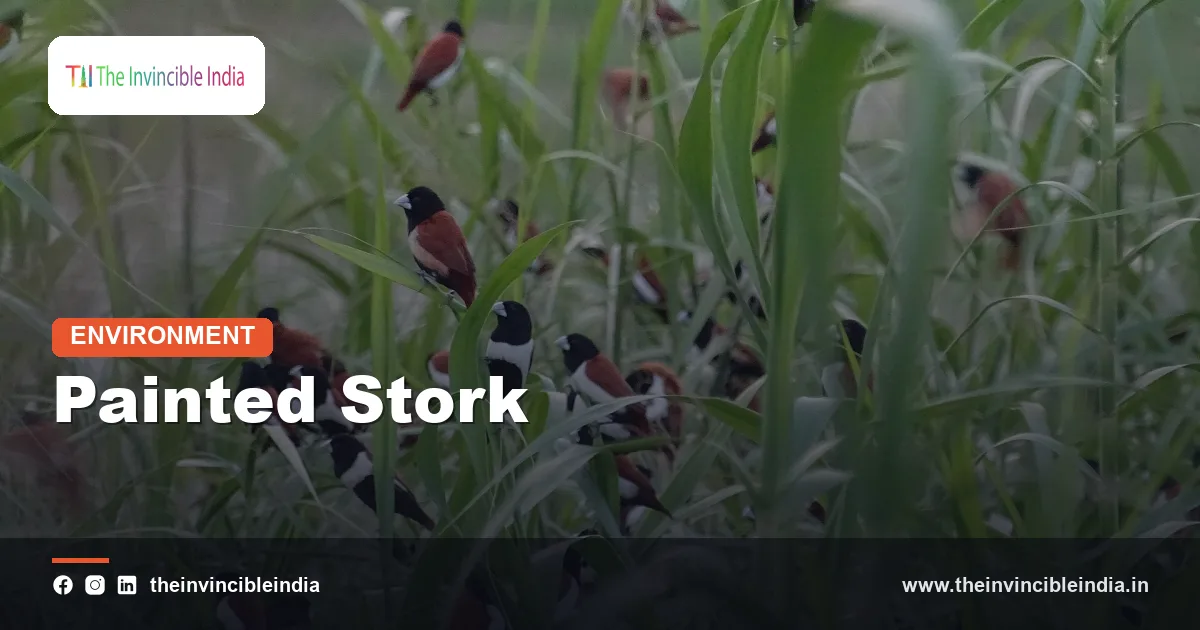
The painted stork (Mycteria leucocephala) is a large wading bird of South and Southeast Asia, recognised by its long yellow-orange down-curved bill, black-and-white plumage, black breast band and rosy-pink tertial feathers, and it nests in noisy mixed colonies at wetlands across India. The painted stork belongs to the stork family, Ciconiidae, and feeds by sweeping its partly open bill through shallow water to catch fish by touch.
The painted stork is one of the most visible and loved waterbirds of Indian lakes, reservoirs and sanctuaries, and it is classed as Near Threatened because wetlands and breeding sites are under pressure. This explainer covers how to identify the painted stork, where it lives, how it feeds and breeds, famous colonies and what threatens it.
| Quick Facts | Details |
|---|---|
| Common name | Painted stork |
| Scientific name | Mycteria leucocephala |
| Family | Ciconiidae (storks) |
| Size | About 90 to 100 cm tall, with a wingspan of roughly 150 cm or more |
| Key features | Long yellow-orange curved bill, bare orange-yellow face, black breast band, pink tertials, pinkish-red legs |
| Habitat | Shallow lakes, reservoirs, marshes, rivers, flooded fields, tanks and coastal wetlands |
| Feeding method | Tactile fishing with a partly open bill held in shallow water |
| Nesting | Large colonies in trees, usually mixed with ibises, spoonbills, cormorants and egrets |
| IUCN status | Near Threatened, with a declining population |
Key Takeaways
- The painted stork is a large black-and-white stork with a yellow-orange curved bill and rosy-pink feathers on its back that give the bird its name.
- The painted stork catches fish by tactile feeding, holding its partly open bill in shallow water and snapping it shut when it feels prey.
- The painted stork nests in dense, noisy tree colonies, often together with ibises, spoonbills, egrets and cormorants.
- The painted stork is listed as Near Threatened by the IUCN because of wetland loss, disturbance and hunting.
- The painted stork is famously protected by villagers at sites such as Kokkare Bellur in Karnataka, where it nests in village trees.
- The painted stork occurs across the Indian subcontinent and extends into Southeast Asia, with large breeding colonies at many Indian bird sanctuaries.
What is the painted stork?
The painted stork is a large wading bird of the stork family that is native to the Indian subcontinent and parts of Southeast Asia and is known for its long yellow bill and its pink-tinged wing feathers. The scientific name Mycteria leucocephala combines Greek roots for “snout” and “white-headed”, while the common name refers to the rosy “painted” look of its tertial feathers.
Storks are long-legged, long-billed birds that fly with the neck extended, unlike herons, which fold the neck into an S-shape. The painted stork belongs to the group of “wood storks” or Mycteria storks, which also includes the milky stork and yellow-billed stork. In India, the painted stork is among the most numerous of the resident storks, alongside the Asian openbill.
Painted storks are social birds that feed, roost and nest in groups. They often gather in flocks of dozens or hundreds at productive wetlands.
How can you identify a painted stork?
A painted stork can be identified by its long, thick, yellow-orange bill that curves down at the tip, its bare orange-yellow face, its mostly white body with a black breast band and its black wings with pink-tinged tertials. The legs are long and pinkish-red.
Adult plumage
- The head is bare and yellow-orange, and the bill is a heavy, down-curved tool with a slightly bulging tip.
- The body is white with a narrow black band across the breast, and the wing coverts are white with black bands.
- The flight feathers are black with a green gloss, and the tertials are rosy pink to pinkish-white, especially bright in breeding season.
- The legs are pinkish-red, and the tail is short and dark.
Juveniles
Young painted storks are dull grey-brown with a paler head and lack the black breast band and the rosy tertials. The bill is yellowish-brown. They acquire adult plumage over about two to four years.
In flight
In flight, the painted stork shows white and black wings with a clear white forewing, outstretched neck and trailing legs. The bird soars on thermals and glides with minimal flapping, often rising in circles over wetlands.
Where does the painted stork live in India?
The painted stork lives in freshwater and brackish wetlands across much of India, including lakes, reservoirs, marshes, rivers, flooded fields and coastal lagoons. It is widely distributed in the Indian plains and peninsula, and it is generally scarce in the high Himalaya and in arid desert interiors without permanent water.
Outside India, the painted stork occurs in Pakistan, Nepal, Bangladesh, Sri Lanka and parts of Southeast Asia such as Cambodia and Vietnam. Birds move locally in response to rainfall, drying wetlands and food. In dry spells, large numbers can congregate at a few remaining water bodies.
Preferred habitats
- Shallow lakes, jheels and reservoirs with muddy margins.
- Wetlands with scattered trees or islands for nesting, such as babul, barringtonia or mangrove trees.
- Village tanks and irrigation lakes in southern and western India.
- Estuaries, lagoons and coastal marshes.
- Flooded paddy fields during the monsoon.
How does the painted stork catch fish?
The painted stork catches fish by tactile feeding, in which it walks through shallow water with its bill partly open and submerged, and snaps the bill shut the moment it touches a fish. The reaction is extremely fast, which lets the bird catch prey that it cannot see in turbid water.
Painted storks sweep the bill from side to side while wading. Some birds also stir the mud with their feet to flush hidden prey. Groups often feed together, which may help to drive fish into reach. After a catch, the bird tosses the fish head-first down its throat.
The diet is mostly small and medium fish, including carp and catfish juveniles, but it also includes frogs, tadpoles, aquatic insects, crustaceans, snails and occasionally small snakes. During dry periods, when fish become concentrated in shrinking pools, painted storks can feed very efficiently.
How does the painted stork breed?
The painted stork breeds in large colonies, building a stick platform nest in a tree and laying a clutch of about three to five eggs, with both parents sharing the work. Colonies are often located over water or on islands that protect the nests from ground predators.
Season and nest sites
Breeding is linked to rainfall and water levels. In northern India the main season follows the monsoon, while in parts of southern India birds often breed in the cooler post-monsoon and winter months. Nesting trees can include babul, tamarind, fig, mangrove and barringtonia, depending on the region.
Eggs and chicks
- Clutches are usually three to five whitish eggs.
- Incubation takes roughly a month and is shared between the parents.
- Chicks hatch at different times, so older chicks can be much larger than their younger siblings.
- Parents feed chicks by regurgitating fish, and young birds fledge after about two months.
Adults are mostly silent away from the nest, but they communicate by bill clattering, and chicks give a clamorous begging call. Mixed colonies can become very loud and crowded.
Which are the famous painted stork colonies in India?
The famous painted stork colonies in India include Keoladeo National Park in Rajasthan, Kokkare Bellur and Ranganathittu in Karnataka, Nal Sarovar in Gujarat, and several sanctuaries in Tamil Nadu, Andhra Pradesh and Odisha. These sites combine shallow wetlands, nesting trees and protection from disturbance.
| Site | State | Why it matters for painted storks |
|---|---|---|
| Keoladeo National Park (Bharatpur) | Rajasthan | A famous wetland sanctuary with large mixed colonies in the monsoon |
| Kokkare Bellur | Karnataka | A village where residents have long protected nesting storks and pelicans |
| Ranganathittu Bird Sanctuary | Karnataka | River islands near Srirangapatna used for nesting by many waterbirds |
| Nal Sarovar | Gujarat | A large shallow lake that attracts waterbirds in numbers |
| Koonthankulam and Vedanthangal | Tamil Nadu | Tank sanctuaries with breeding colonies, with water-dependent seasons |
| Chilika Lake | Odisha | A large brackish lagoon with rich fish and waterbird populations |
The Kokkare Bellur example is often cited as a model of community conservation. Villagers tolerate the noise and droppings of nesting birds and in turn benefit from the fertiliser the colony provides, as well as from visiting birdwatchers.
Is the painted stork endangered?
The painted stork is not listed as endangered but as Near Threatened by the International Union for Conservation of Nature (IUCN), because its global population is believed to be declining. The total is thought to be in the tens of thousands, though exact numbers vary between surveys and years.
Major threats include the drainage and drying of wetlands, felling of nest trees, disturbance and poaching of chicks and eggs at colonies, pollution and fishing activities that reduce food. Dry years can lead to colony failure when water around nest trees disappears and predators gain access. Wild birds are protected under the Wildlife (Protection) Act, 1972, and many colonies lie inside sanctuaries and national parks.
How the painted stork is helped
- Protection of wetland sanctuaries and nest trees.
- Water management that keeps lakes filled during the breeding season.
- Community conservation, as at Kokkare Bellur.
- Reducing pesticide, plastic and sewage pollution in wetlands.
- Regular waterbird counts, which track population trends.
Why does the painted stork matter?
The painted stork matters because it is a top predator of wetland fish and an indicator of the health of large freshwater systems. A thriving painted stork colony signals shallow, fish-rich water, safe nest trees and limited disturbance, so the bird is often used as a flagship for wetland conservation.
The painted stork also supports ecotourism and local livelihoods. Sanctuaries that host breeding storks draw birdwatchers, photographers and students, which brings income to guides, boatmen and nearby businesses. In some places, nutrient-rich guano from colonies has been collected as fertiliser by local farmers.
How is the painted stork different from other Indian storks?
The painted stork differs from other Indian storks in its yellow curved bill, black breast band and pink tertial feathers, which no other resident stork combines. The table below compares it with the storks most often seen in India.
| Stork | Main colour | Bill | Distinguishing mark |
|---|---|---|---|
| Painted stork | White with black bands and pink tertials | Long, yellow-orange, down-curved | Black breast band, orange face |
| Asian openbill | White to grey, black wings | Brownish with a gap between the mandibles | Open gap in the bill |
| Woolly-necked stork | Glossy black with a white neck | Heavy, dark with a reddish tip | White woolly neck, black cap |
| Black-necked stork | White with a glossy black neck and wing band | Long, straight, black | Tall, with a strong red leg colour |
| Lesser adjutant | Grey and black | Heavy, pale, straight | Bare head and naked neck |
Bottom Line
The painted stork is a large, colourful wading stork with a long yellow bill, pink tertials and a black breast band, and it is a conspicuous breeding bird at many Indian wetlands. Its Near Threatened status shows that the lakes, tanks and nesting trees it depends on need steady protection, and community efforts such as Kokkare Bellur show that conservation can work alongside people.
Frequently Asked Questions
Why is it called the painted stork?
The painted stork is called so because of the rosy-pink tertial feathers on its back, which look as if they have been painted. These pink tones are strongest in breeding adults. The rest of the plumage is white with black bands and a black breast band.
Where can I see painted storks in India?
You can see painted storks at wetlands and sanctuaries across India, such as Keoladeo National Park, Kokkare Bellur, Ranganathittu, Nal Sarovar and Chilika Lake. The best viewing times are usually the post-monsoon and winter months when colonies are active. They also feed at many reservoirs and village tanks.
How does the painted stork catch fish?
The painted stork catches fish by tactile feeding, wading through shallow water with its bill partly open and submerged. When the bill touches a fish, it snaps shut very quickly. Some birds also stir the mud with their feet to disturb hidden prey.
Is the painted stork endangered?
The painted stork is not officially endangered but is listed as Near Threatened by the IUCN. Its population is believed to be declining because of wetland loss, disturbance and hunting. Protecting wetlands and breeding colonies is the main conservation need.
When does the painted stork breed in India?
The painted stork breeds during the monsoon in northern and western India and often in the post-monsoon and winter months in the south. Timing depends on local rainfall and water levels. The birds nest in colonies in trees, laying about three to five eggs.
What does the painted stork eat?
The painted stork eats mainly fish, along with frogs, tadpoles, aquatic insects, crustaceans, snails and occasionally small snakes. It hunts in shallow water by feel rather than sight. It feeds most successfully when drying wetlands concentrate fish into small pools.
{“@context”:”https://schema.org”,”@graph”:[{“@type”:”FAQPage”,”mainEntity”:[{“@type”:”Question”,”name”:”Why is it called the painted stork?”,”acceptedAnswer”:{“@type”:”Answer”,”text”:”The painted stork is called so because of the rosy-pink tertial feathers on its back, which look as if they have been painted. These pink tones are strongest in breeding adults. The rest of the plumage is white with black bands and a black breast band.”}},{“@type”:”Question”,”name”:”Where can I see painted storks in India?”,”acceptedAnswer”:{“@type”:”Answer”,”text”:”You can see painted storks at wetlands and sanctuaries across India, such as Keoladeo National Park, Kokkare Bellur, Ranganathittu, Nal Sarovar and Chilika Lake. The best viewing times are usually the post-monsoon and winter months when colonies are active. They also feed at many reservoirs and village tanks.”}},{“@type”:”Question”,”name”:”How does the painted stork catch fish?”,”acceptedAnswer”:{“@type”:”Answer”,”text”:”The painted stork catches fish by tactile feeding, wading through shallow water with its bill partly open and submerged. When the bill touches a fish, it snaps shut very quickly. Some birds also stir the mud with their feet to disturb hidden prey.”}},{“@type”:”Question”,”name”:”Is the painted stork endangered?”,”acceptedAnswer”:{“@type”:”Answer”,”text”:”The painted stork is not officially endangered but is listed as Near Threatened by the IUCN. Its population is believed to be declining because of wetland loss, disturbance and hunting. Protecting wetlands and breeding colonies is the main conservation need.”}},{“@type”:”Question”,”name”:”When does the painted stork breed in India?”,”acceptedAnswer”:{“@type”:”Answer”,”text”:”The painted stork breeds during the monsoon in northern and western India and often in the post-monsoon and winter months in the south. Timing depends on local rainfall and water levels. The birds nest in colonies in trees, laying about three to five eggs.”}},{“@type”:”Question”,”name”:”What does the painted stork eat?”,”acceptedAnswer”:{“@type”:”Answer”,”text”:”The painted stork eats mainly fish, along with frogs, tadpoles, aquatic insects, crustaceans, snails and occasionally small snakes. It hunts in shallow water by feel rather than sight. It feeds most successfully when drying wetlands concentrate fish into small pools.”}}]}]}


