

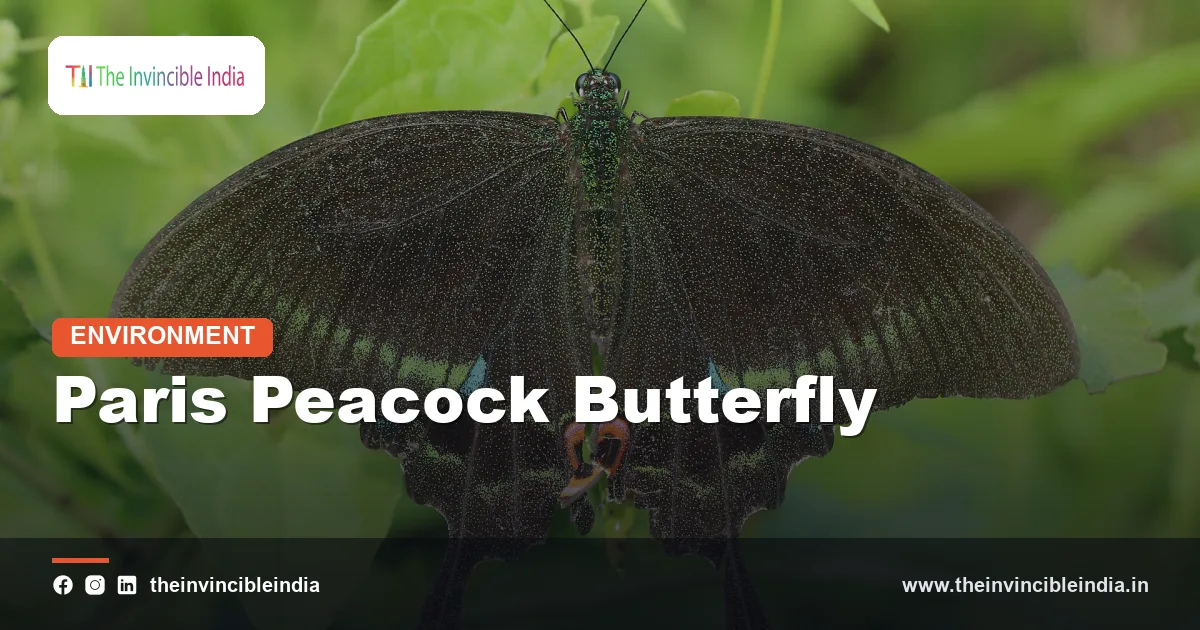
The Paris peacock (Papilio paris) is a large black swallowtail butterfly of Indian hill forests, easily recognised by the glittering green-blue patch of scales on each hindwing and by its fast, powerful flight. The Paris peacock belongs to the swallowtail family Papilionidae, and in India it is found in the Himalayan foothills, the northeast and the hills of the south, where its caterpillars feed on plants of the citrus family.
The Paris peacock is a species that many people notice but few photograph well, because it seldom rests with its wings open for long. It is more often seen sipping minerals from damp ground or visiting flowers along forest trails. This explainer describes how to identify the Paris peacock, where it lives, what it feeds on, how its life cycle works and how it differs from similar peacock swallowtails.
Quick Facts: Paris Peacock Butterfly
| Scientific name | Papilio paris Linnaeus, 1758 |
|---|---|
| Family | Papilionidae (swallowtails) |
| Wingspan | Roughly 10 to 13 centimetres |
| Appearance | Velvety black wings with a large, iridescent blue-green patch on the hindwing and a reddish eye-spot near the tail end |
| Host plants | Members of the citrus family (Rutaceae), including Zanthoxylum, Toddalia asiatica, Clausena and Citrus species |
| Range in India | Himalayan foothills and hills, northeast India, and hill forests of the Western Ghats and southern peninsula |
| Habitat | Moist deciduous and evergreen forests, forest edges, streams and clearings, from foothills to mid-hill elevations |
| Broods | Several overlapping generations a year in warm areas, with most adults seen in the warmer and wetter months |
| Status | Widespread across its range and not regarded as globally threatened |
Key Takeaways
- The Paris peacock (Papilio paris) is a large black swallowtail butterfly with a wingspan of roughly 10 to 13 centimetres.
- The Paris peacock is identified by the shimmering blue-green patch of scales on its hindwing, which looks different at different angles.
- The Paris peacock lives in forests of the Himalayan foothills, the northeast and the hills of southern India.
- The caterpillars of the Paris peacock feed on plants of the citrus family (Rutaceae), such as Zanthoxylum and Toddalia asiatica.
- The male Paris peacock often gathers at damp sand and mud to take up salts and minerals, a habit known as mud-puddling.
- The Paris peacock passes through four stages (egg, caterpillar, pupa and adult) and has several generations in a year in warm regions.
What is the Paris peacock butterfly?
The Paris peacock butterfly is a large swallowtail, in the genus Papilio of the family Papilionidae, that has black wings marked with a brilliant patch of blue-green scales. It is one of several “peacock” swallowtails, a group named for the peacock-like sheen on the wings, and it is among the most striking butterflies of Indian hill forests.
Like other swallowtails, the Paris peacock has a short projection, or tail, at the end of each hindwing, which gives the family its name. Its flight is strong and rapid, with deep wing beats, and it often glides low over forest paths and streams. It is one of the larger butterflies encountered on a forest walk, and it can look almost like a small bat as it flits through shadow.
The species was described scientifically by the Swedish naturalist Carl Linnaeus in 1758. It is widely distributed across southern and eastern Asia, and several regional forms, or subspecies, are recognised, including a form found in the hills of southern India.
How do you identify a Paris peacock?
A Paris peacock is identified by its large size, its velvety black wings and the broad patch of glittering blue-green scales on the hindwing, together with a pale band on the forewing and a reddish spot near the tail. The metallic patch is the most reliable feature, because it changes between blue and green as the butterfly moves.
| Feature | What to look for |
|---|---|
| Size | Large swallowtail, wingspan roughly 10 to 13 centimetres |
| Hindwing patch | Broad, iridescent blue-green area of scales that glitters in light |
| Forewing | Black with a paler greyish or greenish band of scales |
| Tail end | Short tail on the hindwing, with a reddish spot near the base of the tail |
| Underside | Browner and duller than the upperside, with pale markings along the margin |
| Flight | Fast, direct and powerful, often near streams and in shade |
Upperside and underside
On the upperside, the Paris peacock is mostly black with the glittering hindwing patch standing out. On the underside, the wings are duller and brownish, which helps the butterfly blend into leaf litter when it rests with its wings closed. Seeing both sides requires patience, since the butterfly rarely lingers.
Males and females
The two sexes look broadly similar, but females are generally a little larger and may look slightly duller or more rounded in the wings. Males are more often seen because they spend more time patrolling trails and visiting damp ground, while females spend more time searching for host plants on which to lay eggs.
Where is the Paris peacock found in India?
The Paris peacock is found in the hill and foothill forests of northern, northeastern and southern India, in places where moist forest and streams provide shade, nectar and host plants. Its range extends from the Himalayan foothills eastwards through Sikkim, West Bengal and the northeastern states, and a distinct form lives in the hills of the Western Ghats and parts of the southern peninsula.
Outside India, the Paris peacock occurs in neighbouring Himalayan and eastern countries such as Nepal, Bhutan, Bangladesh and Myanmar and extends through mainland Southeast Asia to China and Taiwan. This wide range explains why it is described as a widespread species, although it is usually local within any one forest.
Preferred habitat
The butterfly favours moist deciduous and evergreen forests, forest edges, shaded roads, stream banks and clearings. It is usually seen from the foothills up to mid-hill elevations, and it avoids very dry open country and treeless areas. Wet, undisturbed forest with an intact understorey of host plants supports the healthiest populations.
What does the Paris peacock eat?
The adult Paris peacock feeds on flower nectar and on minerals taken from damp soil, while the caterpillar eats the leaves of plants in the citrus family, Rutaceae. These two diets are separate, and the butterfly needs both nectar sources and suitable host plants in the same landscape.
Adult food: nectar and minerals
Adults sip nectar from a range of flowers, especially brightly coloured, clustered blooms such as lantana, ixora and other forest-edge flowers. Males also gather at wet sand, mud and animal droppings along streams to take up salts and amino acids. This mud-puddling behaviour is common in swallowtails and is thought to supply nutrients that males pass to females during mating.
Caterpillar food: host plants
Females lay eggs on young leaves of host plants in the family Rutaceae. Recorded host plants of the Paris peacock include prickly ash trees of the genus Zanthoxylum, the climbing shrub Toddalia asiatica (wild orange tree), Clausena species and wild or cultivated Citrus. The exact plants used vary with the region and forest type.
Citrus-family plants contain aromatic oils, and the scent helps the female find the right leaf. Because these plants grow mainly in intact forest and forest edges, the survival of the Paris peacock is closely tied to the survival of its host trees and shrubs.
What is the life cycle of the Paris peacock?
The Paris peacock has a complete life cycle of four stages: egg, caterpillar (larva), pupa (chrysalis) and adult. Development from egg to adult takes several weeks in warm weather, so more than one generation can be completed in a year where conditions are favourable.
| Stage | Description |
|---|---|
| Egg | Small, round and pale; laid singly on young leaves of a host plant |
| Caterpillar | Young caterpillars are dark and look like bird droppings; later stages are green with markings that look like eyes, and a hidden scent organ behind the head |
| Pupa (chrysalis) | Green or brownish, attached to a twig or leaf by a silk pad and a girdle of silk, and shaped to look like a part of the plant |
| Adult | Emerges with crumpled wings that expand and harden within hours; feeds on nectar and minerals and mates |
How the caterpillar protects itself
Swallowtail caterpillars have a clever set of defences. Young caterpillars resemble bird droppings, which most predators ignore. Older caterpillars are green and rest on leaves, and when disturbed they push out a forked, brightly coloured organ called the osmeterium from behind the head. The organ releases a strong smell that deters small predators and parasites.
Seasons and broods
The number of generations depends on altitude and climate. In warm, humid lower hills, there are several overlapping generations, and adults can be seen for much of the year. In cooler hills, the butterflies are active mainly in the warmer months and the winter is passed in the pupal stage.
How does the Paris peacock behave?
The Paris peacock is a fast, wary flier that spends its days patrolling forest trails, visiting flowers and drinking at damp patches. Its behaviour has several recognisable features that help observers find and recognise it.
- Mud-puddling: Males gather in small groups at wet sand and mud, often alongside other swallowtails and pierids, and may stay still long enough to be photographed.
- Nectaring: Adults visit flowers while keeping their wings fluttering, which makes close photographs difficult.
- Patrolling: Males fly back and forth along forest paths and stream lines searching for females.
- Basking: In cool morning light, butterflies open their wings in sunny patches to warm their flight muscles.
- Roosting: At night the adults rest among foliage with the wings closed.
Why is it called the Paris peacock?
The Paris peacock gets its scientific species name paris from Linnaeus, who named many swallowtails after heroes of the Trojan War, and its common name “peacock” from the shining, peacock-like sheen on its hindwing. Linnaeus placed these butterflies in a group he called the Trojans, and gave them names such as Priam, Hector, Paris and Helenus.
The peacock part of the English name refers to the swallowtails in the Papilio bianor group, whose scales give a metallic blue or green iridescence. The shine is not caused by pigment but by the microscopic structure of the scales, which reflects light at particular wavelengths and shifts in colour with the angle of view.
How is the Paris peacock different from other peacock swallowtails?
The Paris peacock differs from other peacock swallowtails mainly in its larger size and in the extent, brightness and colour of the glittering patch on the hindwing. Several look-alike species share hill forests, so identification often relies on comparing patch shape and wing pattern in a field guide.
| Species | Group | Key points |
|---|---|---|
| Paris peacock (Papilio paris) | Peacock swallowtail | Large; broad, bright blue-green hindwing patch; reddish spot near the tail |
| Common peacock (Papilio bianor) | Peacock swallowtail | Metallic scales over the wings, with a patch pattern that differs from that of the Paris peacock |
| Banded peacock (Papilio crino) | Peacock swallowtail | Shows a distinct pale band across the wings |
| Red Helen (Papilio helenus) | Black swallowtail | Black wings without a metallic patch, with a large white patch on the hindwing |
The Paris peacock is also sometimes confused with unrelated black and green butterflies. Its large size, strong flight and glittering hindwing patch together separate it from most other species.
What threats does the Paris peacock face?
The Paris peacock is not considered globally threatened, but its populations depend on intact forest, so loss of forest, clearing of host plants and degradation of stream banks can reduce local numbers. Pesticide use at forest edges, fragmentation and collection for trade are additional pressures on butterflies in general.
- Habitat loss: Felling and conversion of moist forest remove host plants and nectar sources.
- Fragmentation: Roads and plantations isolate small forest patches.
- Climate change: Shifts in rainfall and temperature may change the timing of broods and the range at different elevations.
- Collection: The sale of butterflies for decoration and trade can harm local populations, and collecting in protected areas is prohibited under Indian wildlife law.
How can people help Paris peacocks and watch them responsibly?
People can help the Paris peacock by protecting native forest, keeping citrus-family host plants and nectar flowers near forest edges and avoiding pesticides. Watching and photographing butterflies without collecting them is the best way to enjoy the species.
- Plant host plants: In hill gardens near forest, wild citrus-family shrubs support caterpillars.
- Offer nectar: Native flowering shrubs give adults food throughout the season.
- Avoid pesticides: Even small amounts can kill caterpillars.
- Watch quietly: Approach slowly at damp patches on forest roads in the morning, and do not disturb mud-puddling groups.
- Record sightings: Citizen-science platforms and butterfly societies collect records that help track species.
Bottom Line
The Paris peacock is one of India’s most eye-catching hill-forest butterflies, recognised by its black wings, glittering blue-green hindwing patch and rapid flight. Its survival rests on intact forest with citrus-family host plants, flowers for adults and clean streams where males can drink, which makes it a useful indicator of healthy woodland.
Frequently Asked Questions
What is the Paris peacock butterfly?
The Paris peacock is a large black swallowtail butterfly, Papilio paris, with a glittering blue-green patch on each hindwing. It lives in hill forests of India and across southern and eastern Asia. Its wingspan is roughly 10 to 13 centimetres.
Where can the Paris peacock be seen in India?
The Paris peacock can be seen in the Himalayan foothills, the northeastern states and the hill forests of southern India. It is usually found along shaded trails, streams and forest edges. Moist forest from the foothills to mid-hill elevations is the best habitat.
What do Paris peacock caterpillars eat?
Paris peacock caterpillars eat the leaves of plants in the citrus family, Rutaceae. Recorded host plants include Zanthoxylum, Toddalia asiatica, Clausena and Citrus species. The female lays her eggs singly on young leaves.
Why does the Paris peacock have shiny blue-green wings?
The Paris peacock has shiny wings because of the microscopic structure of the scales on its hindwing, which reflects light and produces iridescent colour. The shade changes between blue and green with the viewing angle. This is structural colour and not a pigment.
Is the Paris peacock rare or protected?
The Paris peacock is a widespread species that is not regarded as globally threatened, but it depends on healthy forest. Collecting butterflies in protected areas is prohibited under Indian wildlife law, and some species are specifically scheduled. Anyone interested should check current legal protection before handling or collecting any butterfly.
What is the difference between the Paris peacock and the red Helen?
The Paris peacock has a glittering blue-green patch on the hindwing, while the red Helen is a black swallowtail with a broad white patch on the hindwing and red markings near the lower hindwing edge. Both belong to the genus Papilio, are large, and use citrus-family host plants. The Paris peacock is a peacock swallowtail, whereas the red Helen is a relative with no metallic sheen and little or no tail.
{“@context”:”https://schema.org”,”@graph”:[{“@type”:”FAQPage”,”mainEntity”:[{“@type”:”Question”,”name”:”What is the Paris peacock butterfly?”,”acceptedAnswer”:{“@type”:”Answer”,”text”:”The Paris peacock is a large black swallowtail butterfly, Papilio paris, with a glittering blue-green patch on each hindwing. It lives in hill forests of India and across southern and eastern Asia. Its wingspan is roughly 10 to 13 centimetres.”}},{“@type”:”Question”,”name”:”Where can the Paris peacock be seen in India?”,”acceptedAnswer”:{“@type”:”Answer”,”text”:”The Paris peacock can be seen in the Himalayan foothills, the northeastern states and the hill forests of southern India. It is usually found along shaded trails, streams and forest edges. Moist forest from the foothills to mid-hill elevations is the best habitat.”}},{“@type”:”Question”,”name”:”What do Paris peacock caterpillars eat?”,”acceptedAnswer”:{“@type”:”Answer”,”text”:”Paris peacock caterpillars eat the leaves of plants in the citrus family, Rutaceae. Recorded host plants include Zanthoxylum, Toddalia asiatica, Clausena and Citrus species. The female lays her eggs singly on young leaves.”}},{“@type”:”Question”,”name”:”Why does the Paris peacock have shiny blue-green wings?”,”acceptedAnswer”:{“@type”:”Answer”,”text”:”The Paris peacock has shiny wings because of the microscopic structure of the scales on its hindwing, which reflects light and produces iridescent colour. The shade changes between blue and green with the viewing angle. This is structural colour and not a pigment.”}},{“@type”:”Question”,”name”:”Is the Paris peacock rare or protected?”,”acceptedAnswer”:{“@type”:”Answer”,”text”:”The Paris peacock is a widespread species that is not regarded as globally threatened, but it depends on healthy forest. Collecting butterflies in protected areas is prohibited under Indian wildlife law, and some species are specifically scheduled. Anyone interested should check current legal protection before handling or collecting any butterfly.”}},{“@type”:”Question”,”name”:”What is the difference between the Paris peacock and the red Helen?”,”acceptedAnswer”:{“@type”:”Answer”,”text”:”The Paris peacock has a glittering blue-green patch on the hindwing, while the red Helen is a black swallowtail with a broad white patch on the hindwing and red markings near the lower hindwing edge. Both belong to the genus Papilio, are large, and use citrus-family host plants. The Paris peacock is a peacock swallowtail, whereas the red Helen is a relative with no metallic sheen and little or no tail.”}}]}]}


