

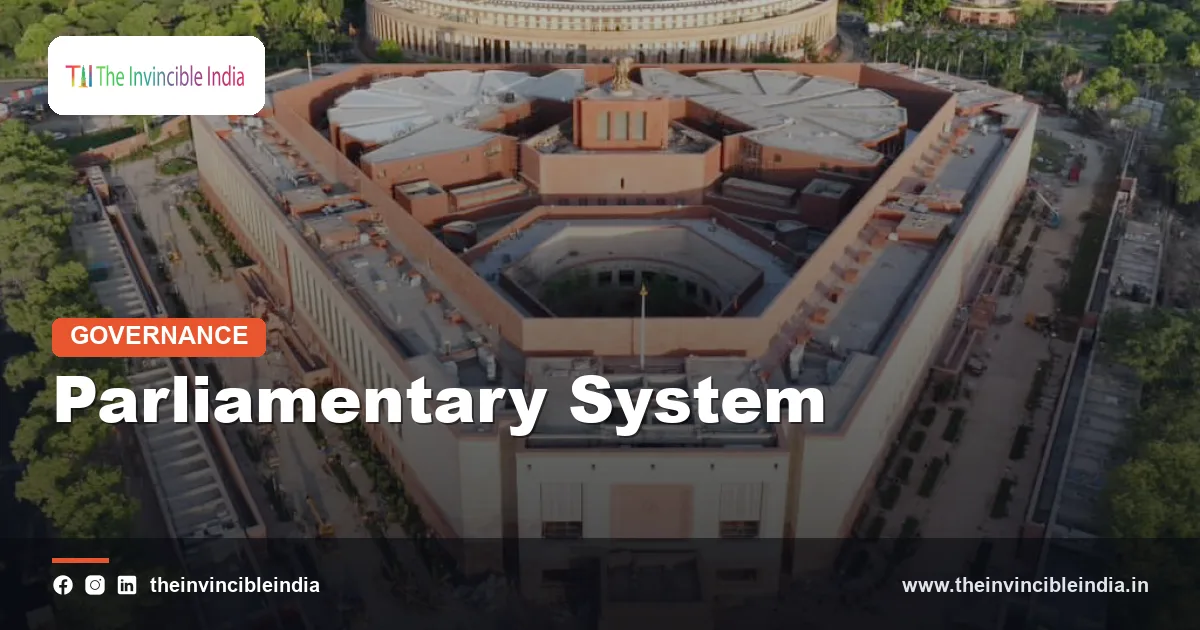
The parliamentary system of government is a form of democratic government in which the executive is drawn from the legislature and remains answerable to it, and India adopted this Westminster-style system in its Constitution of 1950 at both the Union and the State levels. In India, the President is the nominal head of the executive, while real executive power is exercised by the Prime Minister and the Council of Ministers, who must retain the confidence of the Lok Sabha.
The parliamentary system of government in India rests on the fusion of the legislature and the executive, the principle of collective responsibility, and the convention that the government survives only as long as it commands a majority in the popularly elected House. It is contrasted with the presidential system, as in the United States, where the executive and legislature are separately elected. 15 October 2026
| Attribute | Detail |
|---|---|
| System | Parliamentary (Westminster model) democracy |
| Adopted | Constitution of India, in force from 26 January 1950 |
| Nominal executive | President of India (Article 52 and Article 53) |
| Real executive | Prime Minister and Council of Ministers (Articles 74 and 75) |
| Accountable to | Lok Sabha (Article 75(3)) |
| Parliament consists of | The President, the Lok Sabha and the Rajya Sabha (Article 79) |
| Lok Sabha term | Five years unless dissolved earlier (Article 83) |
| Elected seats in Lok Sabha | 543, so a majority needs 272 members |
| Also applies to | State governments, headed by a Governor, a Chief Minister and a Council of Ministers |
Key Takeaways
- The parliamentary system of government in India makes the executive branch accountable to the legislature, and the Council of Ministers is collectively responsible to the Lok Sabha under Article 75(3) of the Constitution.
- The President of India is the nominal head of the executive, while the Prime Minister and the Council of Ministers hold real executive power.
- Under Article 74, the President must act in accordance with the advice of the Council of Ministers, though the President may ask for one reconsideration of that advice.
- A government in India stays in office only while it enjoys the confidence of a majority in the Lok Sabha, and it falls if it loses a vote of no confidence or a key money bill.
- The Lok Sabha has a five-year term, but the President can dissolve it earlier on the advice of the Prime Minister, whereas the Rajya Sabha is a permanent House that is never dissolved.
- The main difference from the United States presidential system is that India does not follow a strict separation of powers between the executive and the legislature.
What is the parliamentary system of government?
The parliamentary system of government is a system in which the head of government is chosen from the legislature, is a member of it, and continues in office only while the legislature’s lower House supports the government. It is also called the cabinet system or responsible government, and it originated in Britain, where it developed gradually over several centuries.
Three features define the system. First, the executive and the legislature are not separate but connected, since ministers sit in Parliament and take part in its debates. Second, the head of state is a ceremonial or constitutional figure, while the head of government wields practical power. Third, the government is responsible to the legislature and can be removed by it through a vote of no confidence.
Countries such as the United Kingdom, Canada, Australia and Japan follow versions of this system. The Indian version is unique in that it combines a written Constitution, a federal structure and an independent judiciary with the parliamentary form.
Why did India choose a parliamentary system?
India chose the parliamentary system of government because the framers of the Constitution were familiar with it from the colonial period and judged it best suited to a diverse country that needed a responsible and accountable executive. Indian legislative bodies had worked under reformed British laws, such as the Government of India Acts of 1919 and 1935, which introduced limited responsible government.
The Constituent Assembly debated the question of stability versus responsibility. A presidential system offers a fixed term and therefore stability, whereas a parliamentary system offers daily accountability to the legislature. The Assembly, guided by members of the Drafting Committee including Dr B.R. Ambedkar, preferred accountability, reasoning that a government of a vast and varied country should be answerable to the elected representatives at all times.
Experience in the colonial legislatures, the familiarity of leaders with British institutions and the desire to avoid concentrating power in one directly elected individual all influenced this choice. The Constitution makes the Union and the States follow the same pattern, which gives the country a uniform model of government.
Who is the nominal executive and who is the real executive?
The President of India is the nominal executive and the Prime Minister along with the Council of Ministers is the real executive. Article 53 vests the executive power of the Union in the President, but Article 74 provides that there shall be a Council of Ministers with the Prime Minister at the head to aid and advise the President.
The President as nominal head
The President is elected indirectly by an electoral college under Article 54 for a five-year term, and acts as head of state. Formal actions such as summoning Parliament, giving assent to bills, appointing governors and judges and promulgating ordinances are taken in the President’s name but, in nearly all cases, on ministerial advice. The Forty-second Amendment of 1976 made the President’s obligation to follow this advice explicit, and the Forty-fourth Amendment of 1978 allowed the President to send the advice back once for reconsideration, after which the reconsidered advice is binding.
The Prime Minister and Council of Ministers as real executive
The Prime Minister is appointed by the President under Article 75, and in practice the President invites the leader of the party or coalition that commands a majority in the Lok Sabha. Other ministers are appointed on the advice of the Prime Minister. The Council of Ministers includes Cabinet Ministers, Ministers of State and, in some governments, Deputy Ministers, and the Cabinet is the inner group that takes major decisions.
The Supreme Court confirmed the constitutional position in Shamsher Singh v. State of Punjab (1974), where it held that the President and the Governors are constitutional heads who act on the advice of their ministers, except in the limited situations where the Constitution gives them discretion.
What does collective responsibility mean?
Collective responsibility means that the Council of Ministers as a whole is answerable to the Lok Sabha for every action and policy of the government, as laid down in Article 75(3) of the Constitution. If the Lok Sabha passes a vote of no confidence against the government, the entire Council of Ministers, including the Prime Minister, must resign.
The principle has several practical consequences:
- All ministers are bound by Cabinet decisions and must defend them in public, even if they disagreed in private. A minister who cannot do so is expected to resign.
- The government rises and falls as a team, so the defeat of a single important proposal can bring down the whole ministry if it is treated as a matter of confidence.
- The Council of Ministers is responsible to the Lok Sabha only, and not to the Rajya Sabha, which can question and debate but cannot remove a government.
Alongside collective responsibility, ministers also hold office during the pleasure of the President under Article 75(2), which in practice means the pleasure of the Prime Minister. A person who is not a member of Parliament can be appointed a minister but must become a member of either House within six months under Article 75(5).
How does a government get formed and stay in office?
A government is formed when the President appoints as Prime Minister the person who can command a majority in the Lok Sabha, and the government stays in office as long as it retains that majority. After a general election, the leader of the single largest party or pre-poll alliance with majority support is normally invited.
If no party wins a clear majority, the result is a hung Lok Sabha and the President must use discretion in judging who can form a stable government. The practice in such cases has been to ask the person to prove the majority on the floor of the House within a given time. A coalition government, in which several parties share ministries, is a common outcome.
A government can lose the confidence of the House in several ways: by a no-confidence motion, by defeat on a money bill or the Budget, by the loss of a vote on a motion of thanks to the President’s address, or by a failed confidence vote moved by the government itself. The shortest-lived governments in India have fallen this way, and in 1999 a government lost a confidence vote by a single vote.
The Tenth Schedule, added by the Fifty-second Amendment in 1985, regulates defection by legislators so that members elected on a party ticket cannot freely change sides and destabilise a government. The Ninety-first Amendment of 2003 capped the size of the Council of Ministers at 15 per cent of the strength of the Lok Sabha (or the State legislative assembly) under Article 75(1A).
How can the Lok Sabha be dissolved?
The Lok Sabha can be dissolved by the President under Article 85, normally on the advice of the Prime Minister and the Council of Ministers, ending its term before five years. A dissolution leads to a fresh general election, and the government continues in a caretaker capacity until a new House is constituted.
The ordinary term of the Lok Sabha is five years from the date of its first sitting under Article 83(2). During a Proclamation of Emergency, Parliament may extend this term by law for one year at a time, with a limit of six months beyond the end of the Emergency. The Rajya Sabha, by contrast, is a continuing House, with one-third of its members retiring every second year.
Dissolution is therefore the government’s counterweight to the House’s power to remove it. The legislature can end the life of a government, and the government can, through the Head of State, send the legislature back to the voters.
How does the parliamentary system differ from the presidential system?
The parliamentary system differs from the presidential system mainly in that the executive in a parliamentary system is drawn from and accountable to the legislature, while in a presidential system the executive is separately elected and independent of the legislature. The United States is the best-known example of the presidential model.
| Feature | Parliamentary system (India) | Presidential system (United States) |
|---|---|---|
| Head of state and government | Separate: President and Prime Minister | Combined in one office, the President |
| Selection of the executive | Leader of the majority in the lower House | Direct election through an electoral college |
| Relationship with the legislature | Fusion; ministers are members of Parliament | Separation; Cabinet members cannot sit in Congress |
| Term of the executive | Depends on majority support | Fixed term of four years |
| Removal | No-confidence vote at any time | Only by impeachment for serious offences |
| Dissolution of the legislature | Possible for the lower House | Not possible |
| Responsibility | Collective to the legislature | Individual to the President |
The Indian version differs from the British one in several ways. India has a written Constitution and a federal structure, and the head of state is elected, not hereditary. The judiciary can strike down laws, which is different from the British doctrine of parliamentary sovereignty, so Indian practice is a blend of parliamentary government with constitutional supremacy.
What are the merits of the parliamentary system?
The merits of the parliamentary system of government include a responsible executive, harmony between the executive and the legislature, flexibility, and a broad representation of diverse interests. These advantages are why many commentators consider it suited to a plural society like India.
- Responsibility: Ministers face questions, debates and motions in Parliament every day, which keeps the executive answerable.
- Harmony: Because the government commands a majority in the House, it can usually pass legislation without prolonged deadlock.
- Ready alternative: The Opposition acts as a government-in-waiting, and a new government can be formed without a fresh election if a viable majority exists.
- Wider representation: Coalition governments bring regional and minority voices into the executive.
- Flexibility: The system can change leadership quickly in a crisis without waiting for a fixed term to end.
What are the demerits of the parliamentary system?
The demerits of the parliamentary system include potential instability, the dominance of the executive over the legislature, weaker separation of powers, and a reliance on party discipline. Critics point to these weaknesses when comparing it with the presidential model.
- Instability: Coalitions and slim majorities can lead to frequent changes of government, as seen in India in the late 1970s and again from 1989 to 1999.
- Executive dominance: A government with a strong majority and a disciplined party can control the legislative agenda, which weakens the independence of individual legislators and the scrutiny function of Parliament.
- Lack of continuity: Policies may change when the government changes, and short-term considerations can crowd out long-term planning.
- Ministers drawn from legislators: The pool of ministers is limited to elected members, and administrative expertise may be secondary to political standing.
- Weak separation of powers: Because the executive and the legislature overlap, there is less of a formal check between them than in a presidential system.
Defenders respond that India’s Parliament has committees, question hour, independent constitutional bodies and a strong judiciary that supply checks, and that the system has produced regular transfers of power since 1947.
Is the parliamentary system part of the basic structure?
The parliamentary form of democracy has been recognised by the Supreme Court as an essential feature of the Constitution, and the court has treated it as part of the basic structure that Parliament cannot destroy by amendment. The basic structure doctrine was set out in Kesavananda Bharati v. State of Kerala (1973) and has been applied in later cases to democracy, federalism and judicial review.
The same system operates in the States. A Governor appointed by the President is the nominal head, and the Chief Minister and the Council of Ministers are collectively responsible to the State Legislative Assembly under Article 164. In S.R. Bommai v. Union of India (1994), the Supreme Court held that the strength of a State government must be tested on the floor of the Assembly and not by the Governor’s opinion alone.
Bottom Line
The parliamentary system of government gives India an executive that is constantly accountable to an elected House. Its strengths are responsibility and flexibility, while its weaknesses are the risk of instability and executive dominance, and the Constitution addresses these through anti-defection rules, a capped ministry size and an independent judiciary.
Frequently Asked Questions
What is the parliamentary system of government in India?
The parliamentary system of government in India is a system in which the executive is drawn from Parliament and is collectively responsible to the Lok Sabha. The President is the nominal head of state, while the Prime Minister and the Council of Ministers exercise real power. The same model is followed in every State.
Who holds real executive power in India, the President or the Prime Minister?
The Prime Minister and the Council of Ministers hold real executive power in India. Article 74 requires the President to act in accordance with their advice, although the President may ask for it to be reconsidered once. The President remains the formal head of state and the Supreme Commander of the armed forces.
What is collective responsibility in the Indian Parliament?
Collective responsibility means the entire Council of Ministers is answerable to the Lok Sabha for the government’s actions. It is enshrined in Article 75(3). If the Lok Sabha withdraws its confidence, the Prime Minister and all ministers must resign together.
How is the Indian parliamentary system different from the American presidential system?
The Indian system places the executive within the legislature, while the American system separates them. In India the Prime Minister is the leader of the majority in the Lok Sabha and can be removed by a no-confidence vote. In the United States the President is elected for a fixed term and can be removed only by impeachment.
Can the Lok Sabha be dissolved before its five-year term ends?
Yes, the Lok Sabha can be dissolved early by the President under Article 85, normally on the advice of the Prime Minister. This happens when the government loses its majority and no alternative government can be formed, or when the government seeks a fresh mandate. The Rajya Sabha is a permanent House and cannot be dissolved.
What are the main advantages and disadvantages of the parliamentary system?
The main advantages are accountability, cooperation between the executive and the legislature, and a broad representation of interests. The main disadvantages are the risk of unstable coalition governments, the dominance of a strong executive and weaker separation of powers. Many scholars see the system as well suited to India’s diversity, with safeguards against its weaknesses.
{“@context”:”https://schema.org”,”@graph”:[{“@type”:”FAQPage”,”mainEntity”:[{“@type”:”Question”,”name”:”What is the parliamentary system of government in India?”,”acceptedAnswer”:{“@type”:”Answer”,”text”:”The parliamentary system of government in India is a system in which the executive is drawn from Parliament and is collectively responsible to the Lok Sabha. The President is the nominal head of state, while the Prime Minister and the Council of Ministers exercise real power. The same model is followed in every State.”}},{“@type”:”Question”,”name”:”Who holds real executive power in India, the President or the Prime Minister?”,”acceptedAnswer”:{“@type”:”Answer”,”text”:”The Prime Minister and the Council of Ministers hold real executive power in India. Article 74 requires the President to act in accordance with their advice, although the President may ask for it to be reconsidered once. The President remains the formal head of state and the Supreme Commander of the armed forces.”}},{“@type”:”Question”,”name”:”What is collective responsibility in the Indian Parliament?”,”acceptedAnswer”:{“@type”:”Answer”,”text”:”Collective responsibility means the entire Council of Ministers is answerable to the Lok Sabha for the government’s actions. It is enshrined in Article 75(3). If the Lok Sabha withdraws its confidence, the Prime Minister and all ministers must resign together.”}},{“@type”:”Question”,”name”:”How is the Indian parliamentary system different from the American presidential system?”,”acceptedAnswer”:{“@type”:”Answer”,”text”:”The Indian system places the executive within the legislature, while the American system separates them. In India the Prime Minister is the leader of the majority in the Lok Sabha and can be removed by a no-confidence vote. In the United States the President is elected for a fixed term and can be removed only by impeachment.”}},{“@type”:”Question”,”name”:”Can the Lok Sabha be dissolved before its five-year term ends?”,”acceptedAnswer”:{“@type”:”Answer”,”text”:”Yes, the Lok Sabha can be dissolved early by the President under Article 85, normally on the advice of the Prime Minister. This happens when the government loses its majority and no alternative government can be formed, or when the government seeks a fresh mandate. The Rajya Sabha is a permanent House and cannot be dissolved.”}},{“@type”:”Question”,”name”:”What are the main advantages and disadvantages of the parliamentary system?”,”acceptedAnswer”:{“@type”:”Answer”,”text”:”The main advantages are accountability, cooperation between the executive and the legislature, and a broad representation of interests. The main disadvantages are the risk of unstable coalition governments, the dominance of a strong executive and weaker separation of powers. Many scholars see the system as well suited to India’s diversity, with safeguards against its weaknesses.”}}]}]}


