

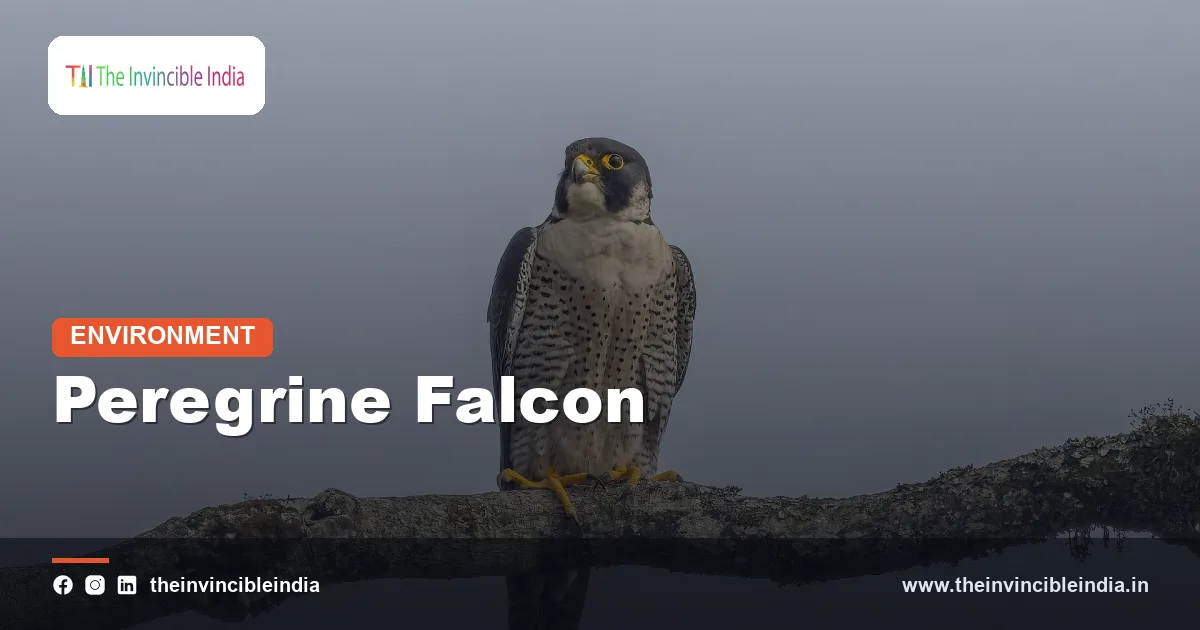
The peregrine falcon (Falco peregrinus) is a powerful, crow-sized bird of prey and the fastest animal on Earth, reaching speeds of well over 300 km/h in its steep hunting dive, called a stoop. It lives on every continent except Antarctica, and in India it occurs both as a resident of cliffs, hills and tall buildings and as a winter visitor from the north.
In Indian birdwatching the peregrine is admired for its speed, its bird-catching skill and its dramatic comeback from the pesticide crisis of the twentieth century. This explainer covers how the peregrine falcon looks, how fast it flies, where it lives in India, what it eats, how it breeds, which Indian races exist and what threatens it.
| Attribute | Details |
|---|---|
| Common name | Peregrine falcon |
| Scientific name | Falco peregrinus |
| Family | Falconidae (falcons and caracaras) |
| Size | About 34 to 58 cm long, wingspan roughly 74 to 120 cm; females are larger than males |
| India range and habitat | Cliffs, rocky hills, coasts, wetlands, open country and large cities across the subcontinent |
| Diet | Almost entirely birds caught in flight, especially pigeons, doves, ducks and waders; occasionally bats |
| Breeding | Scrape on a cliff ledge or building ledge, typically three to four eggs |
| Movement | Resident Indian race plus migrant northern races that winter in India |
| Conservation | Least Concern on the IUCN Red List; listed on CITES Appendix I; protected in India by the Wildlife (Protection) Act, 1972 |
Key Takeaways
- The peregrine falcon is the fastest bird in the world, with dive speeds exceeding 300 km/h during its hunting stoop.
- The peregrine falcon is found on every continent except Antarctica, making it one of the most widespread birds of prey.
- The peregrine falcon in India includes the resident shaheen race, Falco peregrinus peregrinator, as well as migrant races that winter on the subcontinent.
- The peregrine falcon feeds almost entirely on birds caught in the air, and pigeons and doves are among its commonest prey.
- The peregrine falcon declined sharply in the mid-twentieth century because of DDT and recovered in many regions after the pesticide was restricted.
- The peregrine falcon is female-larger than male, a pattern called reverse sexual size dimorphism, with females often about a third heavier.
What is the peregrine falcon?
The peregrine falcon is a large falcon in the family Falconidae, known for its blue-grey back, barred underparts, dark hood and unmatched diving speed. The name peregrine comes from a Latin word meaning wanderer, a reference to the migratory habits of many northern populations.
Falcons differ from hawks and eagles in several ways. They have long, pointed wings, a tooth-like notch on the upper bill and dark eyes. They kill with a bite to the neck of their prey rather than by crushing with the feet alone. The peregrine is the most famous of the true falcons, and it is the species most commonly associated with the sport of falconry.
Worldwide, more than a dozen subspecies are recognised, differing in size and colour. These races include the large, pale northern birds and the darker, smaller tropical forms found in India and Southeast Asia.
How fast is the peregrine falcon?
The peregrine falcon can exceed 300 km/h in a hunting stoop, and values close to 390 km/h have been recorded for trained birds diving from great height. In level flight the bird is much slower, typically cruising at tens of kilometres per hour and reaching about 100 km/h or more in a pursuit.
The stoop works by folding the wings back, tucking in the feet and falling in a steep, streamlined dive. Several body features are thought to help:
- A rigid, bullet-shaped body that reduces drag
- Small bony tubercles in the nostrils that are believed to manage airflow and pressure at high speed
- Extra-sharp eyesight, with a high density of visual cells to track fast prey
- Strong chest muscles and stiff flight feathers
Most captures happen at the end of a dive, when the falcon strikes the prey with its closed or partly closed feet, often killing or stunning it with one blow. The speed record applies to the dive, not to horizontal flight, so a peregrine is the fastest animal in a stoop rather than in flat pursuit.
Speeds are measured in different ways, including radar tracking, instruments carried by the bird and observation of trained falcons diving after a lure. Because the dive depends on height and angle, the speed of a wild peregrine varies from one hunt to another, and many hunting dives are much slower than the record figures. What remains constant is the principle: the falcon trades height for speed and then uses it to deliver a decisive strike.
What does the peregrine falcon look like?
The peregrine falcon has slate-grey upperparts, pale underparts finely barred with dark lines, a black head with moustache-like stripes on the face, and yellow feet. The wings are long and pointed, and the tail is relatively short and barred.
Males and females look similar, but females are noticeably larger and heavier. Young birds are browner above and more streaked than barred below, and they take on adult plumage after their first year.
The Indian resident race, known as the shaheen falcon, is darker and smaller. It typically has a black head, slate-blue back and rich orange-rufous underparts. Its name comes from the Persian word shaheen, used for a falcon or royal hawk. Some authorities treat this form as a separate species, while others keep it as a subspecies of the peregrine.
Where does the peregrine falcon live in India?
The peregrine falcon lives across India wherever it finds open hunting space and a high perch, including sea cliffs, rocky hills, river gorges, wetlands, plains and tall city buildings. The resident shaheen race breeds mainly on cliffs in hill ranges and parts of the Himalayan foothills, the Western Ghats and other rocky regions.
In winter the numbers increase because migrant peregrines from the north arrive in India. They are seen at coasts, large lakes, estuaries, river valleys and open farmland where ducks and waders gather.
Typical Indian haunts
- Rocky ridges and escarpments in the hills
- Large tanks, reservoirs and marshes with plenty of waterfowl
- Coasts and estuaries with wader flocks
- Old forts, towers and tall buildings that mimic cliffs
Cities are attractive because tall buildings act as artificial cliffs and feral pigeons provide a ready food supply. Peregrines have been reported in several large Indian cities, where they perch on high ledges and old monuments.
What does the peregrine falcon eat?
The peregrine falcon eats almost exclusively birds, which it catches in mid-air, and it takes anything from small songbirds to ducks. Pigeons and doves are among the most frequent victims, particularly in cities and farmland. Waders, ducks, parakeets and starlings are also common prey, and small bats are sometimes taken at dusk.
Hunting methods vary with the landscape:
- High stoop from a soaring position above an open area
- Fast, low pursuit that surprises birds in flight
- Waiting on a high perch and launching when a bird passes below
- Night or dusk hunting around artificially lit buildings and over wetlands
The falcon usually plucks its prey at a favourite spot, and the scattered feathers and bones at a plucking post can reveal the presence of a breeding pair. It tends to take weak or slow birds, a pattern that makes it a natural regulator of bird populations.
How does the peregrine falcon breed?
The peregrine falcon breeds by laying its eggs in a simple scrape on a cliff ledge, or on a ledge of a building, without building a proper nest. The female typically lays three to four eggs, which are cream with red-brown blotches.
Both parents share the incubation, which lasts about a month, although the female does most of it. The male brings food and passes it to the female in a mid-air food exchange. The chicks, covered in white down at first, grow quickly and fledge after roughly five to six weeks. Parents continue to feed and train the young birds for several weeks afterwards.
Pairs often return to the same cliff or ledge for many years and defend it aggressively against crows, eagles and other intruders. In India the breeding season generally falls in the cooler, drier months for resident birds, though timing varies with altitude and region.
Is the peregrine falcon found in India all year?
The peregrine falcon is found in India all year because of its resident race, but additional migrant peregrines arrive in the autumn and leave by spring. Northern breeding birds from Europe, central Asia and Siberia travel south to escape the cold and to follow their prey.
This overlap makes identification interesting. A pale, large peregrine on an Indian lake in January is likely to be a visitor, while a darker bird with rufous underparts near a hill cliff is more likely to be the resident shaheen. Wintering peregrines return to the same hunting areas in successive years.
How do Indian peregrine races compare?
Indian peregrine races compare mainly in size, darkness and migratory habits, with the resident shaheen being smaller and darker than the larger, paler northern migrants. The table summarises the broad picture.
| Form | Status in India | Look | Habitat tendency |
|---|---|---|---|
| Shaheen falcon (peregrinator) | Resident | Smaller, dark head, rufous underparts | Cliffs and hills, sometimes tall buildings |
| Northern migrant races | Winter visitor | Larger, paler, finely barred below | Lakes, coasts, plains and estuaries |
The relationship between these forms is debated, and the precise number of migrant races reaching India is difficult to determine in the field. For most observers, the practical clue is the combination of rufous underparts and a hill-cliff habitat, which strongly suggests the shaheen.
How is the peregrine falcon different from other Indian falcons?
The peregrine falcon differs from other Indian falcons mainly in its larger size, heavier build and powerful stoop. India hosts several falcons that are sometimes confused with it, including the laggar falcon, the saker falcon, the Eurasian hobby and the common kestrel.
- Laggar falcon: a paler, brownish resident of dry plains, with less contrast in the head
- Saker falcon: a larger, brown winter visitor of open steppe and farmland
- Eurasian hobby: a smaller, slender falcon with rufous trousers that catches insects and small birds
- Common kestrel: a small, hovering falcon that hunts rodents and insects
The peregrine stands out with its bold dark hood and moustache, barred underparts and compact, anchor-shaped silhouette in flight. It is not a hoverer and instead relies on speed and surprise.
Falconry, the ancient art of hunting with trained birds of prey, has a long history in South Asia, and peregrines and related falcons have been prized by falconers across Asia and the Middle East for centuries. Today, capturing wild birds for falconry or sale is illegal in India, and the peregrine’s value is better recognised as a symbol of healthy wildlife rather than a trophy bird.
The peregrine is also an indicator species. Because it sits at the top of the food chain, it shows the health of the whole bird community below it. A thriving peregrine pair means that there are plenty of healthy prey birds, safe nesting cliffs and relatively low levels of poisons in the environment.
Why did the peregrine falcon decline and recover?
The peregrine falcon declined in the mid-twentieth century mainly because of the pesticide DDT, which accumulated in the bodies of birds that eat other birds and caused eggshell thinning. Thin eggs broke in the nest, and breeding success fell sharply across Europe and North America.
After DDT use was banned or restricted in many countries, along with conservation programmes that included captive breeding and nest protection, many populations recovered. The peregrine has since returned to cliffs and cities where it had vanished. The IUCN rates the species as Least Concern, and international trade is regulated under CITES Appendix I.
Present threats in India include egg and chick collection for falconry and the cage-bird trade, loss of nesting cliffs to mining and quarrying, poisoning from pesticides and disturbance at nests. The species is protected under the Wildlife (Protection) Act, 1972.
Birdwatchers can help by recording peregrine sightings, noting the date, the place and the habitat, and by keeping a respectful distance from active cliff nests. Disturbance during egg-laying and early chick-rearing can make the parents abandon the site. Sharing records through citizen science platforms builds a long-term picture of where the species breeds and how winter visitors move across the country.
Bottom Line
The peregrine falcon is the world’s fastest bird and a skilled hunter of other birds, present in India as both a resident shaheen and a winter visitor. Its recovery from pesticide poisoning shows that bird populations can bounce back when harmful chemicals are controlled and nesting sites are protected.
Frequently Asked Questions
What is a peregrine falcon?
A peregrine falcon is a crow-sized bird of prey in the falcon family, known as the fastest animal in the world during its hunting dive. It has slate-grey upperparts, barred pale underparts and a black hooded head. It is found on every continent except Antarctica, including India.
How fast can a peregrine falcon fly?
A peregrine falcon can exceed 300 km/h in its steep hunting dive, called a stoop. Values near 390 km/h have been recorded for trained birds diving from great height. In ordinary level flight it is much slower.
Is the peregrine falcon found in India?
Yes, the peregrine falcon is found in India throughout the year. A resident race called the shaheen falcon breeds on cliffs and tall structures, and migrant peregrines from the north arrive in winter. They can be seen on hills, coasts, wetlands and in large cities.
What does a peregrine falcon eat?
A peregrine falcon eats mostly birds caught in flight, especially pigeons, doves, ducks and waders. It occasionally takes bats. It usually kills prey with a high-speed strike followed by a bite to the neck.
Where does a peregrine falcon nest?
A peregrine falcon nests on a cliff ledge or similar high ledge, including those on tall buildings, and builds no proper nest, only a scrape. The female usually lays three to four eggs. Pairs often reuse the same site for many years.
Is the peregrine falcon endangered?
No, the peregrine falcon is not endangered and is rated Least Concern by the IUCN. It declined badly in the mid-twentieth century because of DDT, but many populations have recovered. It remains protected in India and is listed on CITES Appendix I to control trade.
{“@context”:”https://schema.org”,”@graph”:[{“@type”:”FAQPage”,”mainEntity”:[{“@type”:”Question”,”name”:”What is a peregrine falcon?”,”acceptedAnswer”:{“@type”:”Answer”,”text”:”A peregrine falcon is a crow-sized bird of prey in the falcon family, known as the fastest animal in the world during its hunting dive. It has slate-grey upperparts, barred pale underparts and a black hooded head. It is found on every continent except Antarctica, including India.”}},{“@type”:”Question”,”name”:”How fast can a peregrine falcon fly?”,”acceptedAnswer”:{“@type”:”Answer”,”text”:”A peregrine falcon can exceed 300 km/h in its steep hunting dive, called a stoop. Values near 390 km/h have been recorded for trained birds diving from great height. In ordinary level flight it is much slower.”}},{“@type”:”Question”,”name”:”Is the peregrine falcon found in India?”,”acceptedAnswer”:{“@type”:”Answer”,”text”:”Yes, the peregrine falcon is found in India throughout the year. A resident race called the shaheen falcon breeds on cliffs and tall structures, and migrant peregrines from the north arrive in winter. They can be seen on hills, coasts, wetlands and in large cities.”}},{“@type”:”Question”,”name”:”What does a peregrine falcon eat?”,”acceptedAnswer”:{“@type”:”Answer”,”text”:”A peregrine falcon eats mostly birds caught in flight, especially pigeons, doves, ducks and waders. It occasionally takes bats. It usually kills prey with a high-speed strike followed by a bite to the neck.”}},{“@type”:”Question”,”name”:”Where does a peregrine falcon nest?”,”acceptedAnswer”:{“@type”:”Answer”,”text”:”A peregrine falcon nests on a cliff ledge or similar high ledge, including those on tall buildings, and builds no proper nest, only a scrape. The female usually lays three to four eggs. Pairs often reuse the same site for many years.”}},{“@type”:”Question”,”name”:”Is the peregrine falcon endangered?”,”acceptedAnswer”:{“@type”:”Answer”,”text”:”No, the peregrine falcon is not endangered and is rated Least Concern by the IUCN. It declined badly in the mid-twentieth century because of DDT, but many populations have recovered. It remains protected in India and is listed on CITES Appendix I to control trade.”}}]}]}


