

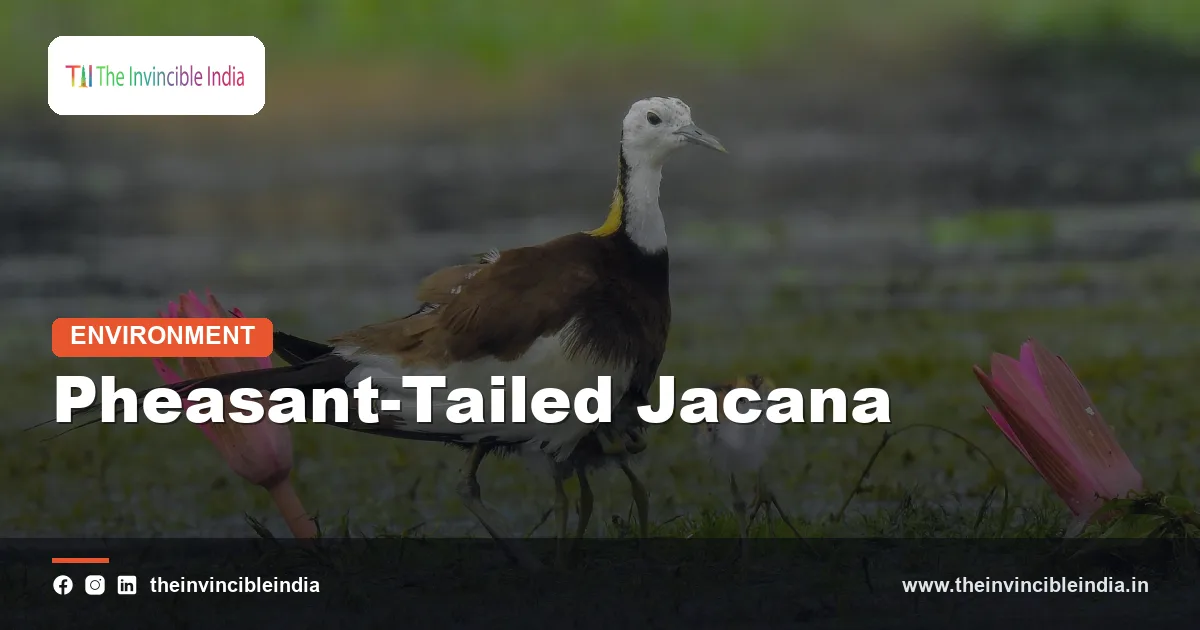
The pheasant-tailed jacana (Hydrophasianus chirurgus) is an elegant wetland bird of South and Southeast Asia that grows a long, drooping, pheasant-like tail and a gleaming white-and-gold plumage in the breeding season, and walks across floating lotus and lily leaves on enormously long toes. In India it is a familiar summer and monsoon sight on lotus-covered ponds, and it is notable for polyandry, a breeding system in which one female mates with several males and each male incubates his own clutch of eggs.
The bird is often called the “water peacock” in Indian languages, a nod to its showy breeding look, and it is one of the most striking wetland birds to photograph and watch. This explainer covers how to identify the pheasant-tailed jacana in both of its plumages, how it moves on water plants, where it lives and migrates in India, how it breeds, what it eats and what threatens it. The information was last reviewed on 23 October 2026.
| Attribute | Detail |
|---|---|
| Common name | Pheasant-tailed jacana (“lily-trotter”, “water peacock”) |
| Scientific name | Hydrophasianus chirurgus |
| Family | Jacanidae (the jacanas) |
| Body length | About 31 cm without tail in the non-breeding state; breeding birds carry an extra long tail |
| Habitat | Lotus and water-lily ponds, marshes, shallow lakes and flooded fields |
| Range | South Asia to Southeast Asia; partly migratory |
| Breeding system | Polyandry: one female mates with several males; males incubate and care for young |
| Breeding season in India | Mainly the monsoon months, with regional variation |
| Conservation status | Least Concern on the IUCN Red List (global assessment) |
Key Takeaways
- The pheasant-tailed jacana is a lily-trotter whose long toes let it walk across floating lotus and lily leaves without sinking.
- In breeding plumage the pheasant-tailed jacana has a white head, a golden-yellow hind neck, a black line down the side of the neck and a long, curved black tail.
- Outside the breeding season the pheasant-tailed jacana loses the long tail and golden neck, and appears brown above and white below with a dark stripe through the eye.
- Pheasant-tailed jacanas are polyandrous: females mate with several males, and each male incubates a clutch of glossy, bronze-brown eggs and raises the chicks.
- The pheasant-tailed jacana is partly migratory in India, with many birds moving in response to monsoon rains and the drying or filling of wetlands.
- The IUCN classifies the pheasant-tailed jacana as Least Concern globally, but wetland drainage and pollution can reduce local populations.
What is the pheasant-tailed jacana?
The pheasant-tailed jacana is a medium-sized wading bird in the family Jacanidae that lives on freshwater wetlands with floating vegetation and is known for its long toes and its spectacular breeding plumage. It is the only species in the genus Hydrophasianus, which is why its scientific name stands alone.
Jacanas are specialised birds found in tropical and subtropical wetlands across the world, and are classed among the waders (shorebirds) in the order Charadriiformes. The pheasant-tailed jacana is the most widely travelled of the Asian jacanas, occurring from the Indian subcontinent and Sri Lanka across Southeast Asia, southern China and the Philippines.
In popular speech across India it is often called the water peacock, in recognition of the long tail and the iridescent look of breeding birds. In English-language birdwatching circles, “lily-trotter” is the more common nickname, a name it shares with all jacanas.
How can you identify a pheasant-tailed jacana?
A pheasant-tailed jacana is identified in the breeding season by its white head and front, golden-yellow nape, black neck stripe and very long, curved black tail, and in the non-breeding season by its brown upperparts, white underparts, dark breast band and broad white eyebrow. Its long legs and toes are the same in both plumages.
Breeding plumage
- Head and front: white face and throat, merging into a golden-yellow patch on the back of the neck.
- Neck stripe: a bold black line running down each side of the neck from behind the eye.
- Body: rich dark brown to chocolate on the back and belly, with a glossy look.
- Tail: long and sickle-shaped, extending well beyond the body and giving the bird its name.
- Wings: mostly white in flight, with dark tips, making the bird flash white as it flies.
Non-breeding plumage
Outside the breeding season, the pheasant-tailed jacana looks much plainer. The crown and back are brown, the face and underparts are whitish, a broad white eyebrow runs over the eye, a dark stripe passes through it, and a dark band crosses the upper breast. The long tail is shed, so the bird looks smaller and more compact than in summer.
Voice
The pheasant-tailed jacana has a distinctive, nasal, mewing call, often rendered as a cat-like “me-ow” that carries across the pond. Birds call mostly in the breeding season, when females defend territories and males guard nests.
How does the pheasant-tailed jacana walk on lotus leaves?
The pheasant-tailed jacana walks on lotus leaves by spreading its weight across a wide area using extremely long, thin toes and claws, which stop its feet from sinking into leaf surfaces or soft vegetation. The same principle lets a snowshoe keep a walker above snow.
The toes of a jacana are many times longer than the toes of a similar-sized wader, and each ends in a long, nearly straight claw. The bird places its feet carefully on the floating leaves and lifts them high between steps, creating a distinctive, stately stride. The leaves flex slightly beneath it but rarely tip.
Other features help with life on the water surface:
- Light body: the bird is slender and light, reducing the pressure on each leaf.
- Swimming ability: the pheasant-tailed jacana can swim and dive when startled, and can crouch with only its head above water.
- Strong flight: unlike its apparently clumsy walk, its flight is quick and direct, with whitish wings flashing in breeding birds.
- Access to prey: walking on vegetation lets it pick insects and snails from the upper and undersides of leaves.
Where is the pheasant-tailed jacana found in India?
The pheasant-tailed jacana is found across much of India wherever lotus, water-lily, water-chestnut or other floating-leaved plants cover still water, with the broad pattern that it breeds widely in the plains during the monsoon and many birds move south in winter. It is also found in Sri Lanka, Bangladesh, Nepal and Myanmar, and into Southeast Asia and beyond.
The bird’s movements are complex and not uniform. Some populations are resident, while others make seasonal movements related to rainfall and wetland conditions. Birds breeding in northern regions generally shift to the south or to areas with open water in winter. Because of this, a pond that has no jacanas in January may hold many in July.
Typical Indian habitats include:
- Lotus-covered village ponds and temple tanks.
- Large lakes and reservoirs with floating vegetation, including many sanctuary wetlands such as those in Rajasthan, Punjab and the north-east.
- Marshes, jheels and oxbow lakes on river floodplains.
- Flooded paddy fields and seasonal pools during the rains.
Birdwatchers often report the species as common where habitat is good, but precise national population estimates are lacking, and counts vary from year to year with rainfall.
How does the pheasant-tailed jacana breed?
The pheasant-tailed jacana breeds mostly during the monsoon on a small floating nest made of aquatic plant material, and the female mates with several males, each of which incubates a separate clutch of four eggs. The nest is usually a flimsy platform on a lotus leaf, water-lily pad or mat of weed.
The breeding cycle follows these stages:
- Display and territory: the female, larger than the male, defends a stretch of water against rival females and displays to males.
- Nest: the male prepares a small nest or accepts one that is a pad of vegetation, often on a floating leaf.
- Eggs: usually four eggs, strikingly glossy and bronze-brown, sometimes described as looking polished or metallic.
- Incubation: the male incubates the eggs for roughly two to three weeks.
- Chick care: the male looks after the chicks, which leave the nest within hours of hatching and feed themselves.
The glossy egg shell is unusual and is thought to help the eggs survive occasional wetting on a nest that is only a little above the water. After the breeding season, the adults moult into their plainer non-breeding plumage and lose the long tail.
Why is the pheasant-tailed jacana polyandrous?
The pheasant-tailed jacana is polyandrous because females hold territories and lay eggs for multiple males, who alone provide incubation and chick care, a pattern that lets a female produce many more eggs in a season than she could if she raised each clutch herself. This is a classic example of sex-role reversal among birds.
Polyandry has several implications for how the species lives:
- Females are typically larger and more aggressive than males, and they win the contests for territory.
- A territory may contain the nests of several males, each at different stages of breeding.
- If a nest is lost to a predator or flood, the female can quickly lay a replacement clutch for that male or another.
- Males can carry chicks tucked beneath their wings, running with the young’s legs dangling out below.
The strategy suits wetlands where floating nests are exposed to predation and water-level changes. By spreading eggs among several males, a female improves the chance that at least some will survive.
What does the pheasant-tailed jacana eat?
The pheasant-tailed jacana eats mainly aquatic insects, snails, small crustaceans and other invertebrates, along with seeds and plant matter picked from floating leaves and shallow water. It forages with a steady, high-stepping walk and picks food from the surface of leaves.
Typical diet items include:
- Water beetles, bugs and aquatic insect larvae.
- Snails and small molluscs.
- Seeds, shoots and parts of aquatic plants such as water-chestnut.
- Small crustaceans and occasionally very small fish or tadpoles.
Because the bird feeds on animals living among the vegetation, its presence reflects a healthy, insect-rich wetland.
How do the two Indian jacanas differ?
The pheasant-tailed jacana and the bronze-winged jacana are the two jacanas found in India, and they differ chiefly in colour pattern, tail and wing colour. The pheasant-tailed jacana is whitish with a long breeding tail, whereas the bronze-winged jacana is dark and glossy with a short tail.
| Feature | Pheasant-tailed jacana | Bronze-winged jacana |
|---|---|---|
| Scientific name | Hydrophasianus chirurgus | Metopidius indicus |
| Breeding plumage | White head, golden nape, long curved tail | Glossy black with bronze wings, short tail |
| Seasonal change | Marked difference between seasons | Little seasonal change |
| Wings in flight | White with dark tips in breeding birds | Mostly dark |
| Call | Nasal, cat-like mewing | Sharp, harsh notes |
| Movements | Partly migratory | Largely resident, with local movements |
| Breeding system | Polyandrous | Polyandrous |
Both species often share lotus ponds, which provides a good chance to compare them side by side. In the non-breeding season the pheasant-tailed jacana’s pale face and breast band still stand out against the bronze-winged jacana’s dark body.
What threats does the pheasant-tailed jacana face?
The pheasant-tailed jacana is not globally threatened, but it depends on freshwater wetlands with floating vegetation, which are lost or degraded in many parts of India through drainage, pollution, encroachment and disturbance. A drop in wetland quality reduces both nesting sites and insect food.
The main pressures are:
- Wetland loss: ponds, jheels and marshes are filled in or reclaimed for farming and construction.
- Pollution: sewage, fertiliser runoff and pesticides reduce water quality and prey.
- Harvest of aquatic plants: heavy collection of lotus, water-chestnut or weed during the breeding season can destroy nests.
- Hunting and egg collection: historically reported in places, and still a concern where enforcement is weak.
- Water-level swings: abrupt flooding or drying of ponds can destroy floating nests.
In India, the bird is a wild bird protected under the Wild Life (Protection) Act, 1972, which covers most native birds. Conservation of village ponds and seasonal wetlands is as important as protection of large sanctuaries.
How can you watch the pheasant-tailed jacana responsibly?
The best way to watch a pheasant-tailed jacana is to visit a lotus-covered pond in the monsoon, at dawn or late afternoon, and observe from the bank with binoculars. Breeding birds are the most spectacular, but they are also the most sensitive to disturbance.
- Visit from June to September in most regions to see breeding plumage.
- Stay on the bank, and do not wade or boat into nesting areas.
- Listen for the mewing call, which often reveals the birds before they are seen.
- Avoid playback of calls, which can stress breeding birds.
- Log observations in citizen-science databases to support monitoring.
Bottom Line
The pheasant-tailed jacana is one of India’s most striking wetland birds, with a seasonal wardrobe, a lotus-leaf stride and a reversed family life in which males do the nesting. Its long-term future depends on clean, vegetated freshwater wetlands staying open and undrained.
Frequently Asked Questions
What is a pheasant-tailed jacana?
A pheasant-tailed jacana is a wading bird of South and Southeast Asia that grows a long, curved tail and a white-and-gold plumage in the breeding season. It walks on floating lotus leaves using very long toes. It is also called the water peacock or lily-trotter.
Why does the pheasant-tailed jacana have a long tail?
The pheasant-tailed jacana grows a long tail in the breeding season as part of its display plumage. The tail is shed after breeding, and the bird looks plainer and smaller in the non-breeding season. The seasonal change is one of the most dramatic among Indian wetland birds.
Is the pheasant-tailed jacana polyandrous?
Yes, the pheasant-tailed jacana is polyandrous, meaning one female mates with several males. Each male incubates his own clutch of eggs and raises the chicks. The female defends territory and lays eggs for multiple males.
Where can I see a pheasant-tailed jacana in India?
You can see a pheasant-tailed jacana on lotus-covered ponds, jheels and wetlands in many parts of India, especially during the monsoon. Both village ponds and sanctuary wetlands can hold the birds. Early morning visits with binoculars are most rewarding.
What does a pheasant-tailed jacana eat?
A pheasant-tailed jacana eats mainly aquatic insects, snails and small invertebrates, along with seeds and plant matter. It picks food from the surface of floating leaves as it walks. A pond with abundant insects and floating plants supports the bird well.
Is the pheasant-tailed jacana a migratory bird?
The pheasant-tailed jacana is partly migratory, with some populations moving in response to the monsoon and to wetland conditions. Birds that breed in northern regions generally shift south in winter. Others stay resident where water remains.
{“@context”:”https://schema.org”,”@graph”:[{“@type”:”FAQPage”,”mainEntity”:[{“@type”:”Question”,”name”:”What is a pheasant-tailed jacana?”,”acceptedAnswer”:{“@type”:”Answer”,”text”:”A pheasant-tailed jacana is a wading bird of South and Southeast Asia that grows a long, curved tail and a white-and-gold plumage in the breeding season. It walks on floating lotus leaves using very long toes. It is also called the water peacock or lily-trotter.”}},{“@type”:”Question”,”name”:”Why does the pheasant-tailed jacana have a long tail?”,”acceptedAnswer”:{“@type”:”Answer”,”text”:”The pheasant-tailed jacana grows a long tail in the breeding season as part of its display plumage. The tail is shed after breeding, and the bird looks plainer and smaller in the non-breeding season. The seasonal change is one of the most dramatic among Indian wetland birds.”}},{“@type”:”Question”,”name”:”Is the pheasant-tailed jacana polyandrous?”,”acceptedAnswer”:{“@type”:”Answer”,”text”:”Yes, the pheasant-tailed jacana is polyandrous, meaning one female mates with several males. Each male incubates his own clutch of eggs and raises the chicks. The female defends territory and lays eggs for multiple males.”}},{“@type”:”Question”,”name”:”Where can I see a pheasant-tailed jacana in India?”,”acceptedAnswer”:{“@type”:”Answer”,”text”:”You can see a pheasant-tailed jacana on lotus-covered ponds, jheels and wetlands in many parts of India, especially during the monsoon. Both village ponds and sanctuary wetlands can hold the birds. Early morning visits with binoculars are most rewarding.”}},{“@type”:”Question”,”name”:”What does a pheasant-tailed jacana eat?”,”acceptedAnswer”:{“@type”:”Answer”,”text”:”A pheasant-tailed jacana eats mainly aquatic insects, snails and small invertebrates, along with seeds and plant matter. It picks food from the surface of floating leaves as it walks. A pond with abundant insects and floating plants supports the bird well.”}},{“@type”:”Question”,”name”:”Is the pheasant-tailed jacana a migratory bird?”,”acceptedAnswer”:{“@type”:”Answer”,”text”:”The pheasant-tailed jacana is partly migratory, with some populations moving in response to the monsoon and to wetland conditions. Birds that breed in northern regions generally shift south in winter. Others stay resident where water remains.”}}]}]}


