

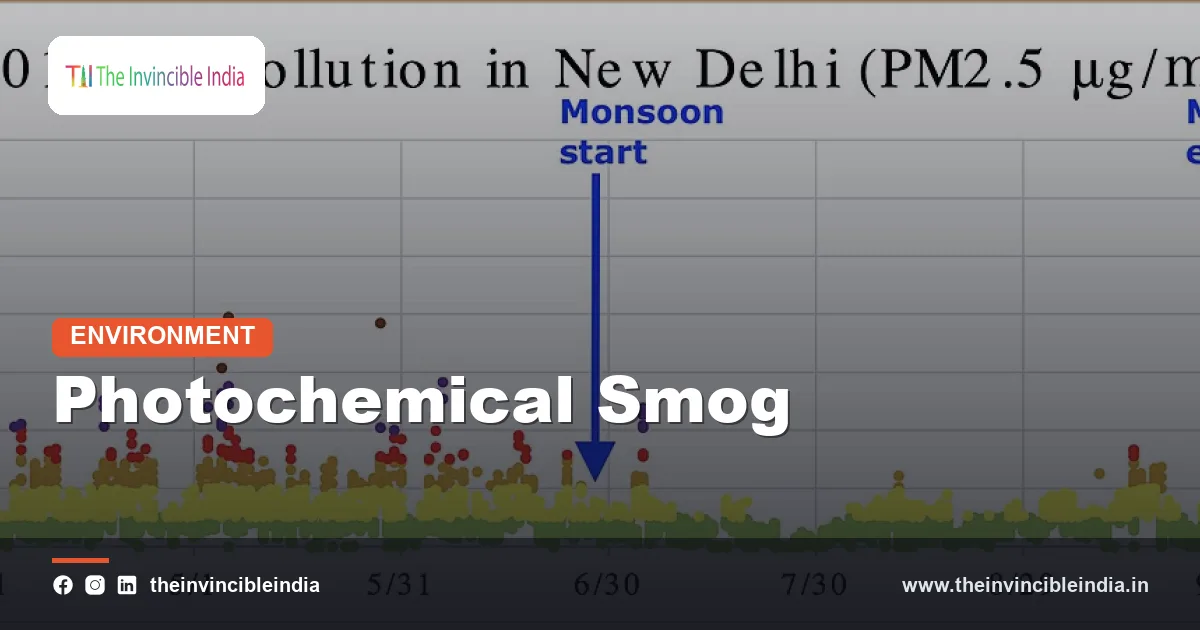
The brownish, eye-stinging haze called photochemical smog forms when strong sunlight triggers chemical reactions between nitrogen oxides and volatile organic compounds from vehicles, industry and fuels, producing ground-level ozone and other irritant gases. Unlike the thick, cold-weather smog most Indians associate with north India’s winters, which is dominated by smoke and fine particles, photochemical smog is a sunshine-driven product. It builds through the day, tends to peak in the afternoon, and is most severe in warm, bright, calm weather. Last reviewed: 3 November 2026.
Ozone high in the sky shields life from ultraviolet radiation, but the same molecule at breathing level is a harmful pollutant. As Indian cities add vehicles, power plants and industrial activity, and as summers grow hotter, ground-level ozone is becoming a bigger part of the national air-quality story. This explainer covers what photochemical smog is, how it forms, where it appears in India, how it differs from winter smog, and what it does to health, crops and cities.
| Term | Photochemical smog (also called summer smog or Los Angeles-type smog) |
|---|---|
| Key ingredients | Nitrogen oxides (NOx), volatile organic compounds (VOCs) and sunlight |
| Main product | Ground-level (tropospheric) ozone, along with peroxyacetyl nitrate (PAN) and aldehydes |
| Appearance | Brownish or yellowish haze, often with reduced visibility and eye irritation |
| Peak timing | Midday to late afternoon, in warm, sunny, still weather |
| Main sources | Vehicle exhaust, industry, power generation, solvents, fuel evaporation, biomass burning |
| Health effects | Eye and throat irritation, cough, breathing difficulty, aggravated asthma |
| Other damage | Reduced crop yields, damage to leaves, rubber and some materials |
Key Takeaways
- Photochemical smog forms when sunlight drives reactions between nitrogen oxides and volatile organic compounds, creating ozone and other irritants at ground level.
- It is a daytime, warm-weather problem that tends to peak in the afternoon, unlike winter smog, which is mostly smoke and fine particles that build overnight.
- Vehicles are a leading source of the precursor gases, with industry, power plants, solvents, fuel vapours and burning also contributing.
- Ground-level ozone can inflame the airways, worsen asthma and reduce lung function, and it also damages crops such as wheat and rice.
- Ozone is a secondary pollutant, so it can be highest downwind of cities and in surrounding rural areas, not only on busy roads.
- Cutting photochemical smog needs reductions in both nitrogen oxides and volatile organic compounds, because controlling only one can sometimes backfire.
What Exactly Is Photochemical Smog?
Photochemical smog is a mixture of ozone, nitrogen dioxide, organic vapours and fine particles produced when sunlight chemically transforms emissions from traffic and industry. The word photochemical simply means light-driven chemistry. The pollutants responsible are not emitted directly in large quantities; they are created in the air.
The name smog comes from smoke and fog, but the photochemical version contains neither in the classical sense. Its signature is a yellow-brown tint and a sharp, irritating quality in the air. The colour comes largely from nitrogen dioxide, a brownish gas, along with haze particles formed in the reactions. People living in affected cities often notice that the sky looks hazy and flat on hot afternoons, even without visible smoke.
Atmospheric scientists first described this kind of pollution in Los Angeles in the mid twentieth century, where sunshine, heavy traffic and a basin-shaped landscape combined to produce it. The same chemistry operates anywhere that the ingredients meet, which includes much of urban India.
How Does Photochemical Smog Form?
Photochemical smog forms through a chain of reactions in which sunlight splits nitrogen dioxide, releasing oxygen atoms that combine with oxygen molecules to make ozone, while volatile organic compounds keep the cycle running. The process can be understood in a few stages.
First, combustion in engines, furnaces and power plants releases nitric oxide, which quickly turns into nitrogen dioxide in the air. Second, at the same time, evaporating fuels, solvents, paints and incomplete combustion release volatile organic compounds, a broad family of carbon-containing vapours. Third, ultraviolet light from the sun breaks nitrogen dioxide apart into nitric oxide and a free oxygen atom. That oxygen atom attaches to an oxygen molecule and forms ozone.
In clean air, the ozone would quickly react back with nitric oxide, so levels stay low. But volatile organic compounds interfere. They form reactive fragments that convert nitric oxide to nitrogen dioxide without using up ozone, so ozone is no longer destroyed as fast and accumulates. The same reactions generate other harmful products, including peroxyacetyl nitrate, aldehydes and secondary organic particles. Because every step needs sunlight, the haze deepens as the day brightens and often reaches its maximum in the early to mid afternoon.
What Conditions Make Photochemical Smog Worse?
Photochemical smog gets worse when intense sunshine, high temperatures and calm air coincide with large emissions of precursor gases. Each factor speeds up the chemistry or prevents dispersal.
Strong ultraviolet radiation is the engine, so clear, bright days produce the most ozone. High temperatures speed up chemical reactions and increase the evaporation of volatile organic compounds from fuel tanks, solvents and vegetation. Light winds and stagnant air allow pollutants to accumulate rather than disperse. Stable weather, such as a persistent high-pressure system, can hold the haze in place for several days.
Geography matters as well. Cities ringed by hills or sited in basins, where air flow is restricted, can hold pollution longer. Since ozone forms over hours, the air mass that leaves a city in the morning can reach peak ozone many kilometres downwind by the afternoon. This is why suburbs and rural areas downwind of urban centres sometimes record higher ozone than the city core.
Seasonally, the main windows in India are the clear, dry, sunny months before the monsoon, especially spring and summer. During the monsoon, clouds, rain and a cleaner marine air flow reduce ozone formation across much of the country. In winter in the north, shorter days, weaker sun and fog lower photochemical activity, although ozone can still be a concern on clear, sunny afternoons.
How Is Photochemical Smog Different From Winter Smog?
Photochemical smog differs from winter smog in being sunlight-driven, oxidising and ozone-rich, whereas winter smog is a cold-weather mixture of smoke, dust and fine particles trapped by a temperature inversion. The two often get confused, but they are chemically and seasonally distinct.
| Feature | Photochemical smog | Winter (particulate) smog |
|---|---|---|
| Main driver | Sunlight-driven chemical reactions | Smoke, dust and fog trapped in cold, still air |
| Typical season | Warm, sunny months | Late autumn and winter |
| Key pollutants | Ozone, nitrogen dioxide, PAN, aldehydes | Fine particles (PM2.5, PM10), sulphates, nitrates, carbon monoxide |
| Time of day | Builds through the day, peaks in the afternoon | Worst at night and early morning |
| Atmospheric condition | Hot, bright, stagnant | Cold, calm, temperature inversion |
| Chemical nature | Oxidising | Often reducing and particle-laden |
| Look | Brownish or yellowish haze | Grey-white, often with fog |
In practice, Indian cities can experience both, and the chemistry overlaps. Even winter haze contains secondary particles formed by photochemical processes, and summer episodes carry dust and smoke. The categories are best seen as the two ends of a spectrum rather than separate worlds.
What Causes Photochemical Smog in Indian Cities?
Photochemical smog in Indian cities is caused mainly by emissions of nitrogen oxides and volatile organic compounds from road transport, industry, power generation and the use of fuels and solvents. A few sources stand out.
Road vehicles are central. Diesel engines emit large amounts of nitrogen oxides, while petrol engines, two-wheelers and older vehicles release unburnt hydrocarbons that behave as volatile organic compounds. Rapid growth in vehicle numbers, traffic congestion and slow-moving traffic all raise emissions per kilometre. Fuel evaporation at petrol pumps and from vehicle tanks adds more organic vapour.
Industry and power plants burn fuel at high temperatures, releasing nitrogen oxides, and many processes use solvents and chemicals that evaporate. Paints, adhesives, cleaning products and printing inks add to the volatile load. Biomass burning, whether of crop residue, firewood, or waste, releases both nitrogen oxides and organic compounds. Natural sources contribute too: many trees release volatile organic compounds, such as isoprene, which can add to ozone formation when mixed with urban nitrogen oxides.
It is the blend that matters. Some Indian cities are rich in nitrogen oxides from traffic, others in organics from industrial clusters or biomass burning, and the balance affects whether ozone rises or falls when one precursor is cut.
Where Is Photochemical Smog a Concern in India?
Photochemical smog is a concern in large, sunny, traffic-heavy urban regions such as Delhi-NCR, Mumbai, Bengaluru, Chennai, Kolkata, Hyderabad and the industrial belts of Gujarat and the Indo-Gangetic Plain. Ground-level ozone monitoring in India has historically been less extensive than monitoring for particles, but available measurements and studies point to frequent exceedances of standards on hot afternoons in several cities.
In Delhi-NCR, ozone is a recurring issue in the hot, dry months from spring to early summer, when the city’s traffic and industry meet strong sunshine. Studies have found that ozone concentrations in and around the capital can exceed health-based limits during these months. Peri-urban and rural sites downwind often record notable ozone as well, because the gas continues to form as polluted air drifts away from its sources.
Other metros show similar patterns, with the severity depending on local emissions, climate and topography. Coastal cities benefit from cleaner sea air and breezes that help dilute pollution, but they still see ozone episodes on still days. Industrial corridors and refinery clusters can generate strong ozone due to high organic vapour emissions. Hill towns and tourist destinations with heavy traffic can also see local ozone rise on clear days.
What Are the Health Effects of Photochemical Smog?
The health effects of photochemical smog include eye irritation, coughing, throat discomfort, chest tightness and worsened asthma, because ozone and its companion pollutants inflame the airways. Ozone is a powerful oxidant, and when inhaled it damages cells lining the respiratory tract.
Short-term exposure on high-ozone days can reduce lung function and trigger breathing difficulty, particularly during outdoor exercise. People with asthma, chronic obstructive pulmonary disease or other respiratory conditions may find symptoms worse, and hospital visits for breathing problems can rise. Children, whose lungs are still developing and who spend more time outdoors, older adults and outdoor workers such as traffic police, delivery riders and construction labourers are among the most exposed.
Long-term exposure is associated with reduced lung function and a higher risk of respiratory illness, though separating the effects of ozone from other pollutants is challenging. Nitrogen dioxide, another part of the mix, also irritates the lungs. Peroxyacetyl nitrate and aldehydes are eye irritants, which explains the stinging eyes that people report during heavy episodes. Because ozone peaks in the afternoon, health advice often focuses on avoiding strenuous outdoor activity during those hours.
How Does Photochemical Smog Affect Crops and Materials?
Photochemical smog damages crops by entering leaf pores and injuring plant tissue, which reduces photosynthesis and yields. Ozone is one of the most damaging air pollutants for agriculture worldwide, and India is considered particularly exposed because of its large cropped area, strong sunshine and rising emissions.
Wheat and rice, the country’s staple cereals, are among the sensitive crops, along with soybean, cotton, pulses and many vegetables. Visible symptoms include small spots, bleaching or yellowing of leaves, but even without visible damage, ozone can slow growth and reduce grain filling. Studies have estimated sizeable yield losses from ozone in India, though the exact figures vary with methodology and are best treated as indicative rather than precise. Because the most ozone-exposed regions often overlap with intensively farmed land, such as the north Indian plains, the stakes for food production are significant.
Ozone also attacks materials. It cracks rubber, fades some dyes and paints, and weakens certain fabrics. Forest and natural vegetation can suffer as well, with potential effects on tree growth and ecosystem health. As a greenhouse gas in the lower atmosphere, ozone also contributes modestly to warming.
Why Is Ozone Tricky to Control?
Ozone is tricky to control because it is a secondary pollutant formed from precursors, and its response to emission cuts is not always straightforward. Reducing nitrogen oxides, for example, can in some urban conditions temporarily increase ozone locally, because nitric oxide from fresh traffic exhaust normally destroys ozone near roads.
Where the air is rich in nitrogen oxides, ozone formation is limited by the supply of organic compounds, so cutting those vapours helps most. Where organic compounds are plentiful, as in many areas downwind of cities and in vegetated regions, cutting nitrogen oxides tends to be more effective. Scientists describe these as different chemical regimes, and a single city can switch between them across seasons and locations.
Another difficulty is that ozone and its precursors travel. An air mass can pick up emissions in one district and develop its ozone far away, so effective action usually needs regional coordination rather than city-by-city fixes. And because monitoring has historically emphasised particles, fewer long-term records exist for ozone, making it harder to track trends and target policy.
What Is India Doing About It?
India is addressing the precursors of photochemical smog mainly through vehicle emission standards, cleaner fuels, industrial controls and urban air-quality programmes, though ozone itself receives less targeted attention than particulate matter. National ambient air quality standards include limits for ozone, and monitoring networks measure it at selected stations.
The shift to Bharat Stage VI emission norms for vehicles, with tighter limits on nitrogen oxides and hydrocarbons, along with improved fuel quality, targets key precursors. Expanding public transport, metro systems, electric buses, electric two-wheelers and charging infrastructure also reduce emissions. Controls on fuel vapours at petrol stations, rules for industrial solvents and efforts to curb open burning contribute as well. Cleaner cooking fuel programmes reduce household biomass burning, while the National Clean Air Programme sets city-level plans for improving air quality, mostly framed around particulate pollution but with co-benefits for precursor gases.
Experts argue that ozone deserves more attention, with wider monitoring, better emission inventories for volatile organic compounds and policies tuned to the local chemical regime.
What Can You Do on High-Ozone Days?
On high-ozone days, the most useful step is to avoid strenuous outdoor activity in the afternoon and shift exercise to early morning or evening when ozone is lower. Ozone levels typically fall after sunset and are often lowest early in the day.
Check local air-quality updates, where available, and pay attention to advisories for sensitive groups. Keep windows closed during the afternoon peak, though note that indoor ozone is generally lower than outdoors because it reacts with surfaces. Take care not to use indoor air cleaners that deliberately generate ozone. People with asthma should keep medication handy and follow their doctor’s advice.
Individuals can also cut their own contribution: share rides or use public transport, keep vehicles well maintained, avoid idling, refuel in the cooler evening hours, choose low-solvent products and avoid burning waste. These actions reduce the precursors that feed the haze.
Bottom Line
Photochemical smog is the sunshine-powered cousin of winter smog: a brown, ozone-rich haze that forms in the afternoon when sunlight cooks traffic and industrial fumes. As India’s cities grow, its summers warm and its vehicle fleet expands, ground-level ozone is moving from a niche concern to a mainstream air-quality, health and food-security issue. Tackling it means curbing both nitrogen oxides and volatile organic compounds, monitoring ozone more widely and recognising that the haze drifting over a farm field may have started on a distant city street.
Frequently Asked Questions
What is photochemical smog in simple terms?
Photochemical smog is a brownish haze created when sunlight reacts with vehicle and industrial emissions, mainly nitrogen oxides and volatile organic compounds. Its key harmful ingredient is ground-level ozone.
Which season is photochemical smog worst in India?
It tends to be worst in the hot, sunny, dry months before the monsoon, when strong sunlight and stagnant air speed up ozone formation. The monsoon usually reduces it through cloud, rain and cleaner air.
How is photochemical smog different from the smog in Delhi’s winter?
Photochemical smog is driven by sunlight and rich in ozone, peaking on warm afternoons. Delhi’s winter smog is mostly smoke, dust and fine particles trapped by cold, calm conditions and a temperature inversion, and it is typically worst at night and early morning.
Is ground-level ozone the same as the ozone layer?
No, they are the same molecule in different places with opposite effects. The ozone layer high in the stratosphere protects us from ultraviolet rays, while ozone at breathing level is a harmful pollutant.
How does photochemical smog affect health?
It irritates the eyes, nose and throat, causes coughing and chest tightness, reduces lung function and can worsen asthma and other respiratory conditions. Children, older adults and outdoor workers are particularly vulnerable.
Does photochemical smog harm crops in India?
Yes, ozone damages leaf tissue and slows photosynthesis, which can reduce yields of sensitive crops such as wheat, rice, soybean and cotton. Studies suggest the losses could be significant in heavily polluted farming regions, though estimates vary.
{“@context”:”https://schema.org”,”@graph”:[{“@type”:”FAQPage”,”mainEntity”:[{“@type”:”Question”,”name”:”What is photochemical smog in simple terms?”,”acceptedAnswer”:{“@type”:”Answer”,”text”:”Photochemical smog is a brownish haze created when sunlight reacts with vehicle and industrial emissions, mainly nitrogen oxides and volatile organic compounds. Its key harmful ingredient is ground-level ozone.”}},{“@type”:”Question”,”name”:”Which season is photochemical smog worst in India?”,”acceptedAnswer”:{“@type”:”Answer”,”text”:”It tends to be worst in the hot, sunny, dry months before the monsoon, when strong sunlight and stagnant air speed up ozone formation. The monsoon usually reduces it through cloud, rain and cleaner air.”}},{“@type”:”Question”,”name”:”How is photochemical smog different from the smog in Delhi’s winter?”,”acceptedAnswer”:{“@type”:”Answer”,”text”:”Photochemical smog is driven by sunlight and rich in ozone, peaking on warm afternoons. Delhi’s winter smog is mostly smoke, dust and fine particles trapped by cold, calm conditions and a temperature inversion, and it is typically worst at night and early morning.”}},{“@type”:”Question”,”name”:”Is ground-level ozone the same as the ozone layer?”,”acceptedAnswer”:{“@type”:”Answer”,”text”:”No, they are the same molecule in different places with opposite effects. The ozone layer high in the stratosphere protects us from ultraviolet rays, while ozone at breathing level is a harmful pollutant.”}},{“@type”:”Question”,”name”:”How does photochemical smog affect health?”,”acceptedAnswer”:{“@type”:”Answer”,”text”:”It irritates the eyes, nose and throat, causes coughing and chest tightness, reduces lung function and can worsen asthma and other respiratory conditions. Children, older adults and outdoor workers are particularly vulnerable.”}},{“@type”:”Question”,”name”:”Does photochemical smog harm crops in India?”,”acceptedAnswer”:{“@type”:”Answer”,”text”:”Yes, ozone damages leaf tissue and slows photosynthesis, which can reduce yields of sensitive crops such as wheat, rice, soybean and cotton. Studies suggest the losses could be significant in heavily polluted farming regions, though estimates vary.”}}]}]}


