

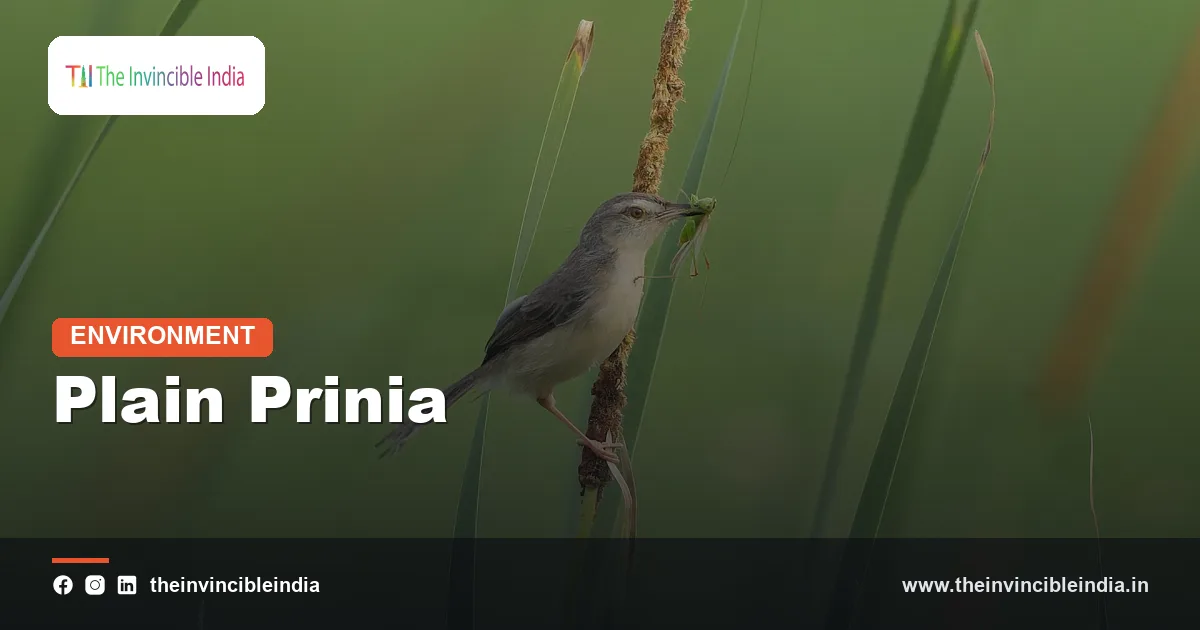
The plain prinia (Prinia inornata) is a small, long-tailed, brown-and-buff warbler that lives in grassland, scrub, crop fields and gardens across most of India and the wider Indian subcontinent. It is one of the most familiar small birds of the Indian countryside, usually noticed first by its loud, rhythmic song and its habit of cocking and flicking a long tail while perched on a grass stem or fence wire.
Despite its modest name, the plain prinia is a lively and widespread resident that feeds almost entirely on insects and breeds in a neatly built ball-shaped nest. This article explains how to recognise the plain prinia, where it lives in India, how it sounds, what it eats, how it nests and how it differs from the similar-looking birds around it.
Quick Facts
| Common name | Plain prinia |
|---|---|
| Scientific name | Prinia inornata |
| Family | Cisticolidae (cisticolas, prinias and allies) |
| Size | Roughly 13 to 14 cm from bill tip to tail tip, with the tail making up about half of that length |
| India range and habitat | Resident across most of the Indian plains and low hills; grassland, scrub, reed edges, crop fields, hedges and gardens |
| Diet | Mainly small insects and their larvae, plus spiders |
| Breeding | Mostly during and after the monsoon; a small ball-shaped nest of grass with a side entrance, in low vegetation |
| Conservation status | Least Concern on the IUCN Red List; common and widespread |
Key Takeaways
- The plain prinia is a small insect-eating warbler of the family Cisticolidae, found in open scrub, grassland, farmland and gardens across India.
- The plain prinia has a long, loosely graduated tail that it habitually cocks, fans and flicks, which is the easiest way to spot it from a distance.
- The plain prinia changes appearance with the season, becoming warmer rufous-brown with a longer tail outside the breeding season and greyer with a shorter tail while breeding.
- The plain prinia builds a small oval nest of grass blades with a side entrance, usually low in grass, crops or shrubs, and lays a small clutch of glossy eggs.
- The plain prinia is classed as Least Concern because it adapts well to farmland and village edges and has a very large range.
- The plain prinia is best told apart from the ashy prinia by its plain brown upperparts, buff underparts and pale eyebrow stripe, since the ashy prinia is greyer with a dark ear patch.
What does the plain prinia look like?
The plain prinia is a slim, brown-backed warbler with a pale eyebrow stripe, buffy underparts, a rounded head and a long tail that is longer than the body. The plumage is deliberately unremarkable, which is the reason for the name, and there are no bold streaks, wing bars or bright colour patches to catch the eye.
The upperparts are an even shade of brown, tinged with rufous in fresh plumage. The underparts are whitish to pale buff, often a little warmer on the flanks. A thin pale line runs above the eye, and the eye itself is pale, which gives the face a gentle, alert look. The wings are short and rounded, suited to brief flights between perches rather than long journeys.
The tail
The tail of the plain prinia is its signature feature. It is graduated, meaning that the central feathers are the longest and the outer feathers progressively shorter, so that the tail tapers when seen from below. The feathers are narrow and loosely held, and each tail feather usually carries a faint dark band near the tip with a pale edge. The bird keeps the tail in constant motion, raising it above the line of the back, wagging it and spreading it.
Males and females
Male and female plain prinias look alike. The sexes cannot be separated in the field, and young birds resemble adults but tend to look a little yellower below and fresher in colour. Because the sexes are identical, birdwatchers usually record simply the number of birds seen, not their sex.
Why does the plain prinia look different in summer and winter?
The plain prinia has two distinct seasonal plumages because it moults before and after the main breeding season, and the two coats differ in colour and tail length. This seasonal change is common among prinias and is one of the reasons beginners sometimes believe they have found two different species.
- Non-breeding plumage: the upperparts are warmer rufous-brown, the underparts buffier, the eyebrow stripe more obvious and the tail longer.
- Breeding plumage: the upperparts become greyer and plainer, the tail is noticeably shorter, and the overall look is cooler and neater.
The shift in tail length matters in practice. A bird in the longer-tailed, rufous coat can look almost like a different bird from the same bird a few months later. Learning the typical posture, call and habitat helps more than relying on colour alone.
Where is the plain prinia found in India?
The plain prinia is found across most of peninsular, central and northern India, mainly in the plains and lower foothills, and it is a resident that does not undertake long migrations. It is a common bird in states from Punjab and Rajasthan through the Gangetic plains, Gujarat, Maharashtra and the peninsula down to Kerala and Tamil Nadu, as well as in eastern India and Assam.
Beyond India the species ranges across Pakistan, Nepal, Bangladesh and Sri Lanka, and east into mainland Southeast Asia. Several regional forms are recognised by ornithologists, differing slightly in shade and size. Local movements occur, such as birds shifting from drying fields to wetter patches after harvest or in a hot season, but the plain prinia does not make a true seasonal migration.
The bird is scarce or absent in dense, closed forest and in high mountain terrain. It favours open or semi-open country, and its density is highest where there is a mix of grass, low shrubs and standing water close by.
Which habitats does the plain prinia prefer?
The plain prinia prefers open, low, tangled vegetation such as tall grass, scrub, hedgerows, sugarcane, paddy edges, reedy margins and the unkempt corners of gardens. It does not need a protected wilderness, which is one reason it stays common near human settlements.
Habitats where it is regularly seen
- Tall grassland and grassy embankments beside canals and tanks
- Scrub and thorn thickets on the edges of villages
- Edges of wheat, sugarcane, paddy and other standing crops
- Reed and rush beds around ponds, lakes and wetlands
- Suburban gardens, cemeteries, railway embankments and vacant plots with weeds
The plain prinia usually forages low, within a couple of metres of the ground, climbing through stems and hopping between grass clumps. It rarely enters deep forest, and it avoids both bare ground and dense tree canopy.
How does the plain prinia sound?
The plain prinia has a loud, repetitive, rhythmic song made of clear, sharp notes, often described as a ringing “tlee-tlee-tlee” delivered from the top of a bush, grass stem or wire. Males sing persistently, especially in the breeding season, and the song is often the first sign that a plain prinia is nearby.
The voice repertoire includes several other sounds:
- A song of repeated, evenly spaced notes that carries across open fields
- A sharp, scolding alarm call given when a person, cat, snake or raptor comes near
- Soft contact notes between members of a pair, which help partners keep track of each other in tall grass
Like other prinias, the plain prinia makes short bursts of song from exposed perches at dawn and again in the evening. Learning the call is the most dependable way to find the species, since the bird itself can disappear quickly into dense stems.
What does the plain prinia eat?
The plain prinia eats small insects, mainly caterpillars, beetles, flies, grasshoppers, bugs and ants, together with spiders and other small invertebrates. It is almost entirely insectivorous and does not depend on seeds or fruit.
The plain prinia feeds by gleaning, which means picking prey from leaves, stems and the ground rather than hawking in the air. It hops through grass and low bushes, peering at leaf surfaces and probing leaf sheaths, and it sometimes makes a short flutter to take an insect off a stem. Pairs and family groups often forage within earshot of each other.
Because it eats large numbers of crop-eating insects, including caterpillars and small bugs that damage standing crops, the plain prinia is considered helpful to farmers. Its role as a natural pest controller is a quiet reason to leave hedgerows and grassy field margins in place.
How does the plain prinia breed?
The plain prinia breeds mostly during and after the monsoon, building a small, oval, ball-shaped nest of grass with a side entrance low in grass, crops or shrubs. The exact timing varies with region and rainfall, and in some parts of India nesting can extend over several months, with more than one brood in a good season.
Nest and eggs
The nest is made of fine grass blades, plant fibres and sometimes cobweb, woven or stitched into a compact structure, and it is often held among living leaves or stems for support. The entrance is a small opening near the top or on the side. The female lays a small clutch, usually three to five glossy eggs with a reddish tone, which are incubated for about twelve days or slightly more.
Raising the young
Both parents generally take part in feeding the nestlings, bringing small caterpillars and other soft insects. The young leave the nest after roughly ten to fourteen days and remain with the adults for a short time, learning to forage in the same grassy patches. Nests are vulnerable to snakes, lizards, crows, rats and sudden rain, so pairs often rebuild and try again.
How is the plain prinia different from similar birds?
The plain prinia is told apart from similar small warblers mainly by its plain brown upperparts, buff underparts, pale eyebrow stripe, long tail and its characteristic song. Several other Indian prinias share the cocked tail and long body shape, so a few comparisons help.
| Bird | Key difference from the plain prinia |
|---|---|
| Ashy prinia | Greyer above with a darker ear patch and a rufous wash on the wings; the plain prinia is warm brown and plainer |
| Graceful prinia | Smaller and paler, with a streaked back and a finely barred tail; the plain prinia lacks streaking |
| Jungle prinia | Larger and heavier with a stronger bill and a bolder, darker-tipped tail; the plain prinia is slimmer |
| Zitting cisticola | Much shorter-tailed and heavily streaked above; the plain prinia has a long tail and no streaks |
| Common tailorbird | Greener upperparts and a rusty crown; the plain prinia has no green or rufous cap |
The simplest approach is to look at the back. A streaked back points to a cisticola or the graceful prinia, while a plain back with a long tail suggests the plain prinia or the ashy prinia. Colour, call and habitat should all agree before an identification is confirmed.
Is the plain prinia an endangered bird?
The plain prinia is not endangered; the International Union for Conservation of Nature (IUCN) lists it as Least Concern because it has a very large range and a stable, common population. The bird thrives in disturbed, open habitats and benefits from irrigated farmland, canal banks and village scrub.
The main local pressures are the clearing of grassy field margins, heavy pesticide use, burning of grass, drainage of wetlands and the loss of weedy corners to construction. These pressures reduce nest sites and insect food, even if they have not yet pushed the species into decline. Indian wildlife law also protects wild birds in general, and the nests of small birds are covered under the broader rules against hunting and trapping.
How can you watch the plain prinia?
The plain prinia is easy to watch because it sings from open perches, tolerates people at a modest distance and lives close to places where people walk, such as fields, parks and village edges. Early morning and the hour before sunset are the best times.
- Listen first for the repeated, ringing song, then scan the tops of bushes, fence posts and wires.
- Use binoculars to check the plain back, pale eyebrow and long, flicking tail.
- Stand quietly near tall grass or crop edges and wait; the bird often climbs into view.
- Avoid walking through grass during the nesting season, since nests are low and easy to flatten.
- Note the season, because the same bird looks different in breeding and non-breeding plumage.
Bottom Line
The plain prinia is a small, common, insect-eating warbler of Indian grassland, farmland and gardens, recognised by its long cocked tail, plain brown plumage and loud rhythmic song. It is a good first bird for beginners because it is easy to find and shows clear behaviour, and its steady presence is a sign of healthy field margins and hedges.
Frequently Asked Questions
What is a plain prinia?
A plain prinia is a small, long-tailed warbler of the family Cisticolidae that lives in grassland, scrub and gardens across India. It is brown above and buff below, with a pale eyebrow stripe and a tail that it constantly cocks and flicks. It feeds on insects and is one of the commonest small birds of open Indian country.
Where can I see the plain prinia in India?
The plain prinia can be seen in open scrub, tall grass, crop edges, reed beds and gardens across most of India’s plains and low foothills. It is common from Punjab and Rajasthan through the Gangetic plains to the southern peninsula and the east. It is usually easiest to find in the early morning, when males sing from exposed perches.
What does the plain prinia sound like?
The plain prinia has a loud, repetitive, ringing song of clear, evenly spaced notes, often written as “tlee-tlee-tlee”. It also gives a sharp scolding alarm call when disturbed. Males sing from the tops of bushes and grass stems, especially during the breeding season.
What does the plain prinia eat?
The plain prinia eats small insects such as caterpillars, beetles, flies, grasshoppers and ants, along with spiders. It picks prey from leaves, stems and the ground while moving low through vegetation. Because it eats many crop pests, the bird is helpful around farmland.
How is the plain prinia different from the ashy prinia?
The plain prinia is warm brown above with a pale eyebrow and buff underparts, while the ashy prinia is greyer above with a darker ear patch and, in many forms, a rufous wash on the wings. The ashy prinia also tends to have a more contrasting look overall. Habitat and voice overlap, so plumage colour is the most useful clue.
Is the plain prinia a protected or threatened species?
The plain prinia is not threatened and is classed as Least Concern by the IUCN. It has a very large range and does well in farmland and village scrub. Like all wild birds in India it is covered by general wildlife protection law, and its main risks are habitat loss and pesticide use.
{“@context”:”https://schema.org”,”@graph”:[{“@type”:”FAQPage”,”mainEntity”:[{“@type”:”Question”,”name”:”What is a plain prinia?”,”acceptedAnswer”:{“@type”:”Answer”,”text”:”A plain prinia is a small, long-tailed warbler of the family Cisticolidae that lives in grassland, scrub and gardens across India. It is brown above and buff below, with a pale eyebrow stripe and a tail that it constantly cocks and flicks. It feeds on insects and is one of the commonest small birds of open Indian country.”}},{“@type”:”Question”,”name”:”Where can I see the plain prinia in India?”,”acceptedAnswer”:{“@type”:”Answer”,”text”:”The plain prinia can be seen in open scrub, tall grass, crop edges, reed beds and gardens across most of India’s plains and low foothills. It is common from Punjab and Rajasthan through the Gangetic plains to the southern peninsula and the east. It is usually easiest to find in the early morning, when males sing from exposed perches.”}},{“@type”:”Question”,”name”:”What does the plain prinia sound like?”,”acceptedAnswer”:{“@type”:”Answer”,”text”:”The plain prinia has a loud, repetitive, ringing song of clear, evenly spaced notes, often written as “tlee-tlee-tlee”. It also gives a sharp scolding alarm call when disturbed. Males sing from the tops of bushes and grass stems, especially during the breeding season.”}},{“@type”:”Question”,”name”:”What does the plain prinia eat?”,”acceptedAnswer”:{“@type”:”Answer”,”text”:”The plain prinia eats small insects such as caterpillars, beetles, flies, grasshoppers and ants, along with spiders. It picks prey from leaves, stems and the ground while moving low through vegetation. Because it eats many crop pests, the bird is helpful around farmland.”}},{“@type”:”Question”,”name”:”How is the plain prinia different from the ashy prinia?”,”acceptedAnswer”:{“@type”:”Answer”,”text”:”The plain prinia is warm brown above with a pale eyebrow and buff underparts, while the ashy prinia is greyer above with a darker ear patch and, in many forms, a rufous wash on the wings. The ashy prinia also tends to have a more contrasting look overall. Habitat and voice overlap, so plumage colour is the most useful clue.”}},{“@type”:”Question”,”name”:”Is the plain prinia a protected or threatened species?”,”acceptedAnswer”:{“@type”:”Answer”,”text”:”The plain prinia is not threatened and is classed as Least Concern by the IUCN. It has a very large range and does well in farmland and village scrub. Like all wild birds in India it is covered by general wildlife protection law, and its main risks are habitat loss and pesticide use.”}}]}]}


