

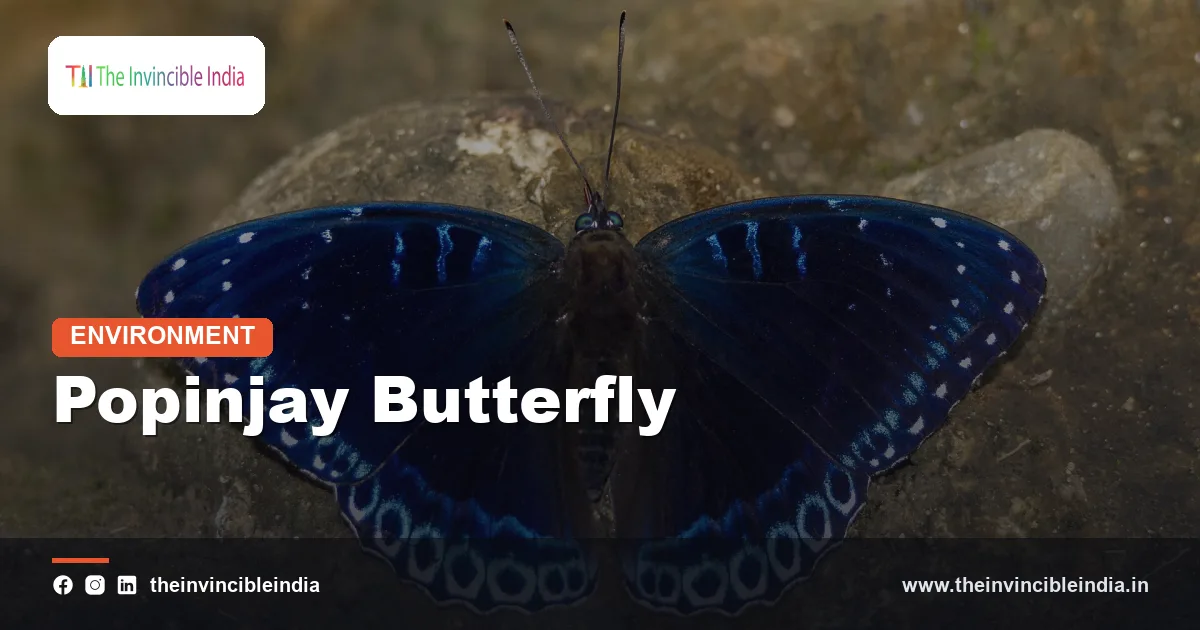
The popinjay (Stibochiona nicea) is a dark, boldly streaked brush-footed butterfly of the shaded, moist forests of the Himalayan foothills and north-east India, known for its slow, gliding flight low through the undergrowth. Its black wings carry bright bluish-white streaks and spots, and its underside is touched with red, which gives the butterfly its showy name.
Although the popinjay is a forest species rather than a garden visitor, it is a rewarding sight for anyone who walks damp trails, stream banks and forest roads in the right regions. This explainer covers how to recognise the popinjay, where it lives, what its caterpillars eat, how it behaves and how it differs from similar dark butterflies. It was last reviewed on 30 October 2026.
| Common name | Popinjay |
|---|---|
| Scientific name | Stibochiona nicea |
| Family | Nymphalidae (brush-footed butterflies) |
| Wingspan | Roughly 6 to 8 cm, with females usually a little broader-winged than males |
| Host plants | Shade-loving plants of the nettle family (Urticaceae), such as species of Pellionia and Elatostema |
| Range and habitat in India | Moist, shaded forest, ravines and stream sides in the Himalayan foothills and north-east India; also found in parts of South-East Asia and southern China |
| Flight season and broods | Several broods through the year in warm, humid zones, with numbers usually highest during and after the monsoon |
| Notable features | Black wings with bluish-white streaks, red-marked underside, slow gliding flight, fondness for damp mud |
Key Takeaways
- The popinjay (Stibochiona nicea) is a black butterfly marked with bluish-white streaks and spots, belonging to the brush-footed family Nymphalidae.
- The popinjay is a forest butterfly of shaded, humid habitats in the Himalayan foothills and north-east India, rather than a species of open plains or city gardens.
- Popinjay caterpillars feed on shade-loving plants of the nettle family (Urticaceae), so the butterfly stays close to damp, leafy undergrowth.
- The popinjay flies slowly and low, often gliding on flat wings between patches of forest light.
- Male popinjays commonly sip moisture and dissolved minerals from damp soil, a habit known as mud-puddling.
- The popinjay is a useful indicator of intact, humid forest understorey, and its main threat is loss and drying of that habitat.
What is the popinjay butterfly?
The popinjay is a medium-sized forest butterfly in the family Nymphalidae, the largest family of butterflies, whose members are called brush-footed because their front legs are small and brush-like. The scientific name of the popinjay is Stibochiona nicea, and the genus Stibochiona contains a small number of related species spread across tropical Asia.
In everyday English, the word popinjay once meant a parrot and later came to describe a vain, showily dressed person. The butterfly is not a loud species in behaviour, but its crisp pattern of pale streaks against a dark ground gives it a dressed-up look, which probably explains the name.
Among Indian butterflies, the popinjay belongs to the group that naturalists seek out on forest trails, because it is not found in most towns. Seeing one usually means that the surrounding habitat still has humid, shaded undergrowth and a running stream or damp ground nearby.
How can you identify a popinjay?
A popinjay is identified by its dark, nearly black upperside patterned with bluish-white streaks and spots that run along the wing veins and edges. The streaks often look slightly iridescent in sunlight, and the pale marks near the wing margins form a broken, dotted border.
Upperside and underside
When the popinjay opens its wings, the black ground colour and ice-blue to whitish markings stand out strongly against the green forest floor. On the underside, the wings carry white streaks on a dark background, and the bases of the wings are marked with red or orange-red patches. The red is easiest to see when the butterfly rests with its wings closed or tilted.
Differences between the sexes
Male and female popinjays are broadly similar in pattern, but females are generally larger with somewhat rounder, broader wings. Males are the more frequent visitors to damp patches, so a butterfly seen sipping at a wet forest road is more likely to be a male.
Size and shape
The wingspan of the popinjay is usually described as about 6 to 8 cm. The wings are rounded rather than sharply pointed, and the body is slim and dark. In the field, size is difficult to judge, so the streak pattern and the slow flight are more reliable clues.
Where does the popinjay live in India?
The popinjay lives in moist, shaded forest across the Himalayan foothills and north-east India, and the same species extends into parts of South-East Asia and southern China. Within India, it is associated with lower and middle elevations where the forest is humid, the canopy is fairly closed and the ground stays damp.
The popinjay prefers a specific kind of microhabitat rather than a whole state or district. Typical places include:
- Shaded ravines and the edges of small forest streams
- Damp forest roads and paths with moist soil
- Understorey patches rich in nettle-family herbs and shrubs
- Forest clearings that receive filtered, dappled sunlight
Because the popinjay depends on humid understorey, it is rarely found in dry scrub, open farmland or heavily built-up areas. Visitors to forested hill regions, wildlife sanctuaries and national parks in the north-eastern states and Himalayan foothills are the people most likely to meet it. Reports from other forest regions of India should be checked against a reliable field guide, since several dark butterflies look superficially alike.
What do popinjay caterpillars eat?
Popinjay caterpillars feed on the leaves of shade-loving plants in the nettle family (Urticaceae), with herbs and small shrubs such as Pellionia and Elatostema commonly recorded as larval food. Because these plants grow in humid, shaded spots, the female popinjay searches the forest floor and stream sides for suitable leaves on which to lay her eggs.
A host plant is the specific plant that a butterfly’s caterpillars can eat. Many butterflies are fussy about hosts, and the popinjay is no exception. A forest patch that loses its damp understorey plants loses the popinjay as well, even if adult butterflies could still find nectar or mud nearby.
Adult popinjays seldom behave like typical flower-visiting butterflies. They are more often noticed settling on damp ground, on rotting material or on leaves in the shade than hovering at blossoms.
How does the popinjay butterfly fly and behave?
The popinjay flies slowly and weakly with a gliding action, usually staying low over the undergrowth and rarely rising into the canopy. It alternates a few wing beats with short glides on flat wings, which makes it look unhurried even when disturbed.
Mud-puddling
Male popinjays are regularly seen at damp soil, stream sand and wet forest roads. This behaviour, called mud-puddling, lets the butterfly take in water and dissolved salts and minerals that are scarce in nectar. The butterfly may remain at one spot for some time, which gives photographers a good opportunity.
Resting posture
When resting, the popinjay often settles on a leaf in the shade with its wings partly open or flat. Dappled light on the dark wings helps it blend into the broken patterns of forest light and shadow.
Territorial and roosting habits
Like many forest nymphalids, the popinjay tends to use favourite perches along a regular route. Returning to the same stretch of path at the same time of day often shows the same individuals, although they cannot be recognised individually without marking.
What is the life cycle of the popinjay?
The popinjay completes the four stages typical of all butterflies: egg, caterpillar (larva), pupa (chrysalis) and adult. The female lays eggs on the leaves of the host plant, the caterpillar feeds and grows through several moults, and the full-grown caterpillar then forms a pupa, which in the brush-footed family generally hangs from a support.
Inside the pupa the body is rebuilt into the winged adult, which emerges, expands and dries its wings and then flies. In the warm, humid parts of its range the popinjay can breed in several broods during the year, so the exact timing varies with local rainfall and temperature rather than following a fixed calendar.
- Egg: laid on host plant leaves in a shaded position
- Caterpillar: feeds on nettle-family foliage and grows through several stages
- Pupa: a suspended chrysalis attached to a plant or support
- Adult: a short-lived flying stage that mates, feeds and lays eggs
When is the best time to see a popinjay?
The best time to see a popinjay is usually during and just after the monsoon, when forest undergrowth is lush and ground moisture is high. In humid north-eastern and Himalayan foothill forests, the butterfly may be found for much of the warm part of the year, but numbers tend to rise when new host-plant growth is plentiful.
Daily timing matters too. Popinjays are most active in the warmer, brighter hours of the morning and early afternoon, and they become hard to find on cloudy, wet or very cool days. A visit after a spell of showers, when the forest paths are damp but not flooded, often brings the best results.
Which butterflies look similar to the popinjay?
Several dark forest butterflies with pale markings can be mistaken for the popinjay, including blue or black crows, some tigers and a number of sailers. The popinjay can be separated by its fine, streaky pale pattern, its red-marked underside and its slow gliding flight close to the ground.
| Feature | Popinjay | Common look-alikes |
|---|---|---|
| Ground colour | Black with bluish-white streaks | Brown or black with broader pale patches |
| Underside | White streaks with red patches at wing bases | Often duller or differently patterned |
| Flight | Slow, low, gliding | Varies from stronger sailing flight to fluttering |
| Habitat | Humid shaded forest, ravines, stream sides | Often a wider range of habitats |
Looking at the underside in a photograph is often the quickest way to confirm a popinjay, because the red base marks and white streaks are distinctive.
Is the popinjay butterfly threatened?
The popinjay is not generally regarded as a rare butterfly within its preferred habitat, but it depends on humid, shaded forest and is therefore vulnerable to loss of that habitat. Clearing of forest, drying of streams and the removal of understorey plants all reduce the places where popinjay caterpillars can grow.
Butterflies of this kind work as indicators of habitat quality. A healthy population of popinjays suggests that the forest understorey, soil moisture and stream edges are in reasonable condition. Habitat protection in forested hill regions therefore helps the popinjay along with many other forest-dwelling insects, plants and animals.
Collecting wild butterflies is regulated in India under wildlife law, and watching and photographing them is the responsible approach. Observers can also contribute to biodiversity records by noting date, place and a clear photograph, which helps researchers track seasonal patterns.
How can you watch and photograph popinjays responsibly?
You can watch popinjays responsibly by walking slowly on existing forest paths, checking damp patches and stream edges, and keeping a respectful distance. Quiet movement, patience and good light are more useful than any equipment.
- Stay on established trails and avoid trampling the understorey where host plants grow.
- Approach mud-puddling butterflies slowly, keeping your shadow off them.
- Photograph both the upperside and the underside, since the underside confirms identity.
- Do not handle, catch or chase butterflies, and do not disturb damp patches they use.
- Follow park or sanctuary rules and use local guides where required.
Bottom Line
The popinjay is a striking black-and-pale nymphalid of humid, shaded forests in the Himalayan foothills and north-east India, easily recognised by its streaked wings, red-marked underside and slow, low, gliding flight. Its survival is tied to damp understorey with nettle-family host plants, which makes it a quiet indicator of forest health.
Frequently Asked Questions
What is a popinjay butterfly?
A popinjay butterfly is a dark brush-footed butterfly, Stibochiona nicea, with bluish-white streaks on its black wings. It lives in humid, shaded forests of the Himalayan foothills and north-east India. The name popinjay refers to its smartly patterned, showy look.
Where can you see popinjay butterflies in India?
Popinjay butterflies can be seen in moist forests of the Himalayan foothills and north-east India. They favour shaded ravines, stream sides and damp forest roads. They are rarely found in dry scrub, open fields or cities.
What do popinjay caterpillars feed on?
Popinjay caterpillars feed on shade-loving plants of the nettle family (Urticaceae), such as Pellionia and Elatostema. These plants grow in damp forest understorey. This dependence on host plants ties the butterfly closely to humid, shaded habitat.
Why do popinjay butterflies sit on damp mud?
Popinjay butterflies sit on damp mud to take in water and dissolved minerals, a habit called mud-puddling. It is mostly seen in males. The minerals are scarce in nectar and are useful for the butterfly’s body and reproduction.
How is a popinjay different from other dark forest butterflies?
A popinjay differs from other dark forest butterflies through its fine bluish-white streaking, red patches at the base of the underside and slow gliding flight. Look-alikes often have broader pale patches or a stronger flight. A photograph of the underside is the most reliable check.
Is the popinjay butterfly endangered?
The popinjay butterfly is not generally treated as a rare species, but it needs humid, shaded forest to survive. Loss of forest, drying of streams and clearing of understorey plants are the main concerns. Protecting forest habitat therefore helps the popinjay.
{“@context”:”https://schema.org”,”@graph”:[{“@type”:”FAQPage”,”mainEntity”:[{“@type”:”Question”,”name”:”What is a popinjay butterfly?”,”acceptedAnswer”:{“@type”:”Answer”,”text”:”A popinjay butterfly is a dark brush-footed butterfly, Stibochiona nicea, with bluish-white streaks on its black wings. It lives in humid, shaded forests of the Himalayan foothills and north-east India. The name popinjay refers to its smartly patterned, showy look.”}},{“@type”:”Question”,”name”:”Where can you see popinjay butterflies in India?”,”acceptedAnswer”:{“@type”:”Answer”,”text”:”Popinjay butterflies can be seen in moist forests of the Himalayan foothills and north-east India. They favour shaded ravines, stream sides and damp forest roads. They are rarely found in dry scrub, open fields or cities.”}},{“@type”:”Question”,”name”:”What do popinjay caterpillars feed on?”,”acceptedAnswer”:{“@type”:”Answer”,”text”:”Popinjay caterpillars feed on shade-loving plants of the nettle family (Urticaceae), such as Pellionia and Elatostema. These plants grow in damp forest understorey. This dependence on host plants ties the butterfly closely to humid, shaded habitat.”}},{“@type”:”Question”,”name”:”Why do popinjay butterflies sit on damp mud?”,”acceptedAnswer”:{“@type”:”Answer”,”text”:”Popinjay butterflies sit on damp mud to take in water and dissolved minerals, a habit called mud-puddling. It is mostly seen in males. The minerals are scarce in nectar and are useful for the butterfly’s body and reproduction.”}},{“@type”:”Question”,”name”:”How is a popinjay different from other dark forest butterflies?”,”acceptedAnswer”:{“@type”:”Answer”,”text”:”A popinjay differs from other dark forest butterflies through its fine bluish-white streaking, red patches at the base of the underside and slow gliding flight. Look-alikes often have broader pale patches or a stronger flight. A photograph of the underside is the most reliable check.”}},{“@type”:”Question”,”name”:”Is the popinjay butterfly endangered?”,”acceptedAnswer”:{“@type”:”Answer”,”text”:”The popinjay butterfly is not generally treated as a rare species, but it needs humid, shaded forest to survive. Loss of forest, drying of streams and clearing of understorey plants are the main concerns. Protecting forest habitat therefore helps the popinjay.”}}]}]}


