

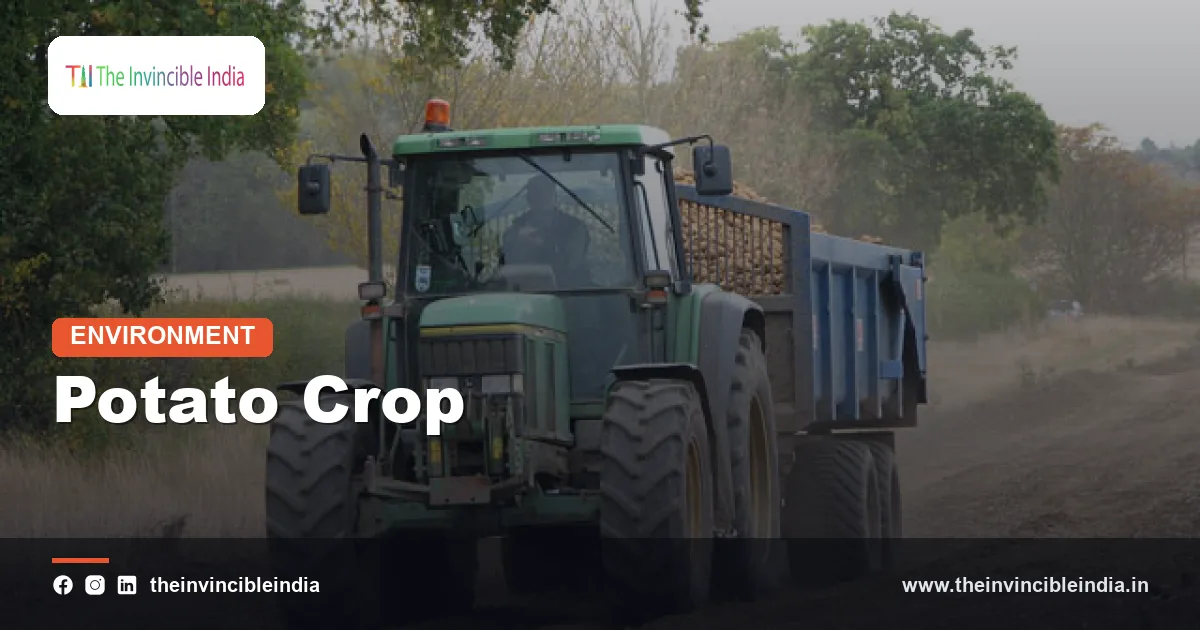
The potato crop (Solanum tuberosum) is a cool-season tuber crop of the nightshade family, Solanaceae, grown in India for its starchy underground stems, which are cooked in almost every regional cuisine and processed into chips, fries and flakes. India is among the largest potato producers in the world, second only to China by most estimates, and the crop is grown mainly in the Indo-Gangetic plains during the winter months. The potato crop was brought to India from the Americas by European traders several centuries ago and has since become one of the country’s most widely eaten vegetables.
This explainer covers what the potato crop is, how it grows, which states produce it, how it is planted, protected, harvested and stored, and why it matters for food security and farm incomes. It also clarifies the difference between the potato and the sweet potato, which are often confused although they belong to different plant families. Production and price figures are given only as qualified, approximate statements.
| Quick Facts: Potato Crop | |
|---|---|
| Common names | Potato; aloo (Hindi) |
| Scientific name | Solanum tuberosum |
| Family | Solanaceae, the nightshade family, which also includes tomato, brinjal and chilli |
| Origin | The Andes of South America, domesticated thousands of years ago in the region of present-day Peru and Bolivia |
| Where grown in India | Uttar Pradesh, West Bengal, Bihar, Gujarat, Punjab, Madhya Pradesh, Assam and the hills of Himachal Pradesh and Uttarakhand |
| Season | Mainly a rabi (winter) crop, planted around October to November and harvested around February to March; hill and late crops follow different calendars |
| Part used | The tuber, a swollen underground stem |
| Importance | India’s leading vegetable crop by output and a staple for households, the processing industry and cold-storage businesses |
Key Takeaways
- The potato crop, Solanum tuberosum, is a tuber crop of the nightshade family that originated in the Andes and reached India through European traders.
- India is among the world’s leading potato producers, ranking second after China by most estimates, with Uttar Pradesh, West Bengal and Bihar as the main producing states.
- Most Indian potatoes are a winter crop planted around October and November and dug between roughly February and March, when cool nights favour tuber formation.
- A potato tuber is a swollen underground stem, not a root, which is why it has eyes that sprout and why it differs botanically from the sweet potato.
- The disease late blight, caused by Phytophthora infestans, is the most serious threat to the potato crop worldwide, and Indian farmers manage it with resistant varieties and timely sprays.
- Large cold-storage facilities hold a major share of the Indian harvest at low temperatures so that potatoes remain available through the summer and rainy months.
What Is the Potato Crop and Where Did It Come From?
The potato crop is a tuber-producing annual plant, Solanum tuberosum, that was first domesticated in the Andes of South America several thousand years ago and later carried across the world after contact between Europe and the Americas. Farmers in the Andes developed hundreds of varieties adapted to altitude, frost and drought, and that genetic diversity remains a valuable resource for plant breeders today.
Potatoes reached Europe in the sixteenth century and spread to Asia with traders and colonial administrators. In India, the crop is generally said to have arrived in the early seventeenth century through European traders, with its cultivation spreading widely under British administration in the nineteenth century. Over time the potato became part of kitchens from Kashmir to Kerala, though the bulk of the crop is grown in the northern and eastern plains.
Today the potato is the fourth-most important food crop in the world after rice, wheat and maize by most rankings. In India it is treated as a vegetable in cooking, although nutritionally it behaves more like a starchy staple, since its main contribution is carbohydrate energy, with useful amounts of vitamin C, potassium and vitamin B6.
How Does a Potato Plant Grow?
A potato plant grows from a piece of seed tuber that sprouts shoots from its eyes, which develop into leafy stems above the ground and underground runners that swell at the tips into new tubers. The plant therefore reproduces mainly by vegetative propagation, in which new plants are cloned from tuber pieces, rather than from true seed.
Each tuber has several eyes, which are clusters of buds. When the seed tuber is placed in the soil and warms, the eyes sprout and send up shoots. Roots grow from the base of these shoots, and thin side-stems called stolons spread outward under the soil. Under suitable day length and cool temperature, the tips of the stolons begin to thicken, and the starch made in the leaves is moved down to fill them.
Tuber formation is sensitive to temperature. Cool nights, in the range of about 15 to 20 degrees Celsius, favour tuber growth, while high soil temperatures slow it or stop it. This is why the potato crop in the plains is timed for the cold season, and why growers in hot areas rely on altitude or on the winter months.
The plant also produces small white, pink or purple flowers and, in some varieties, small green berries that look like tiny tomatoes. These berries contain true seeds, but they are used mainly in breeding, because seedlings from them differ from the parent plant. The leaves, stems and green berries are toxic if eaten.
Is the Potato the Same as the Sweet Potato?
The potato is not the same as the sweet potato, because the two belong to different plant families and form different underground organs. The potato (Solanum tuberosum) is a stem tuber in the nightshade family, Solanaceae, while the sweet potato (Ipomoea batatas) is a storage root in the morning glory family, Convolvulaceae.
In India the sweet potato is called shakarkand and is grown on a smaller scale, often in warmer regions and in the rainy and early winter seasons. Its flesh is sweeter and may be orange, white or purple. The potato, by contrast, is milder in taste, is grown on a far larger area and is central to the vegetable market.
| Feature | Potato | Sweet potato |
|---|---|---|
| Scientific name | Solanum tuberosum | Ipomoea batatas |
| Plant family | Solanaceae (nightshade) | Convolvulaceae (morning glory) |
| Edible part | Stem tuber with eyes | Swollen storage root |
| Hindi name | Aloo | Shakarkand |
| Preferred climate | Cool season | Warm, humid conditions |
| Propagation | Seed tubers | Vine cuttings |
Where Is the Potato Crop Grown in India?
The potato crop is grown across much of India, but the largest producers are Uttar Pradesh, West Bengal and Bihar, with Gujarat, Punjab, Madhya Pradesh, Haryana and Assam also contributing substantial amounts. Uttar Pradesh has long been the leading state, and its western districts around Agra, Farrukhabad and Kanpur are important growing and storage centres.
Production is concentrated in the Indo-Gangetic plains because the cool, dry winter, flat land and irrigation suit the crop. In Punjab and Haryana the crop is often grown for seed, since the winters are cold enough and the aphid population low enough to keep seed tubers relatively free of virus diseases. The hills of Himachal Pradesh and Uttarakhand grow a summer crop, and the Nilgiris, Kodaikanal and Karnataka highlands grow potatoes in the rainy season.
The exact area and output change from year to year with weather, prices and policy, so any specific figure should be read as an approximate figure for a particular year. In general, India harvests tens of millions of tonnes of potatoes annually, and a few large states account for the majority.
How Is the Potato Crop Planted?
The potato crop is planted by placing seed tubers or cut tuber pieces, each with at least two eyes, into furrows or ridges of well-prepared, loose, well-drained soil at the start of the cool season. Sandy loam and loam soils with good drainage are preferred, because they allow tubers to swell freely and make harvesting easier.
Seed tubers and land preparation
Healthy seed tubers are the most important input. Certified seed from approved sources reduces the risk of carrying viruses and other diseases from one season to the next. Farmers plough the field to a fine tilth, add farmyard manure and balanced fertilisers, and form ridges at a measured spacing. Seed tubers of medium size are often planted whole, while larger tubers are cut into pieces.
Earthing up and irrigation
Soil is piled up around the stems a few weeks after emergence, a practice called earthing up. It covers developing tubers, protects them from sunlight that would turn them green, and keeps the soil loose. Irrigation is light and frequent, because the potato has shallow roots and is sensitive to both drought and waterlogging. Many farmers stop irrigation shortly before harvest so that the skin sets firmly.
Varieties
The ICAR-Central Potato Research Institute (CPRI), headquartered in Shimla and established in 1949, has released many improved varieties with the prefix Kufri. Kufri Jyoti, Kufri Bahar, Kufri Pukhraj and Kufri Badshah are examples that have been used for table purposes, while Kufri Chipsona varieties are bred for the processing industry, where low sugar content gives light-coloured chips and fries.
What Diseases and Pests Affect the Potato Crop?
The potato crop is mainly threatened by late blight, early blight, viral diseases transmitted by aphids and whiteflies, and a set of soil pests, with late blight being the most destructive. Late blight is caused by an oomycete, Phytophthora infestans, and thrives in cool, humid and cloudy weather, spreading from leaves to tubers within days.
Late blight is historically significant because it caused the Great Irish Famine of the 1840s, when potatoes were the staple food of a large part of the population. In India it can affect the crop in the hills and in plains during foggy winter spells, and growers protect their fields with preventive fungicide sprays and resistant varieties.
Other problems include early blight, which creates concentric rings on leaves, and common scab, which roughens the tuber skin. Virus diseases such as potato leaf roll and potato virus Y are spread by aphids and degrade seed quality year after year, which is why clean seed production programmes are essential. Soil pests like cutworms and white grubs, and the potato tuber moth in storage in warmer areas, can also damage tubers.
- Use certified, disease-free seed tubers.
- Choose varieties with tolerance to late blight where available.
- Rotate with non-solanaceous crops such as wheat or maize.
- Spray protective fungicides before foggy or humid spells, based on local advisories.
- Remove infected plants and cull piles to reduce spread.
When Is the Potato Crop Harvested and How Is It Stored?
The potato crop is harvested when the vines turn yellow and dry and the tuber skin has hardened, which in the plains generally occurs between about February and March, roughly three to four months after planting. Farmers often cut the vines a week or two before digging so that the skin cures and does not peel during handling.
After digging, tubers are left to dry briefly, graded, bagged and transported. Because the crop comes in a short window but is eaten year-round, storage is essential. India has a large network of cold stores, particularly in Uttar Pradesh and West Bengal, where potatoes are kept at low temperatures, around 2 to 4 degrees Celsius for table potatoes, until they are withdrawn later in the year.
Storage temperature matters for quality. Potatoes kept near freezing convert starch to sugar, which produces a sweet taste and dark colour on frying, so potatoes intended for chips are stored at slightly warmer temperatures. Light exposure causes greening and the build-up of a natural toxin called solanine, so stored and household potatoes should be kept in the dark and green or sprouted parts removed before cooking.
Cold storage also shapes the market. When farmers store their produce, they can sell at a later time, and prices tend to follow the balance between the harvest size and the storage stock. Sharp price falls at harvest and spikes in the lean months are a common feature of the potato market, and policy discussions often centre on storage capacity and processing.
How Is the Potato Used?
The potato is used as a vegetable in curries, snacks and breads, and as a raw material for processed foods, starch and animal feed. In Indian cooking it appears in aloo gobhi, aloo paratha, samosa, dum aloo, masala dosa filling, vada pav and countless regional dishes, and it is a common fasting food in many communities.
The processing sector turns potatoes into chips, French fries, flakes, flour, starch and ready-to-eat snacks. Processing varieties need high dry matter and low sugar, and contract farming arrangements between farmers and processing firms have grown over the years. A fraction of the crop is also used for seed, starch and industrial alcohol.
- Fresh cooking: curries, fries, mashed preparations, parathas and fillings.
- Processed foods: chips, French fries, dehydrated flakes and snack foods.
- Industrial uses: starch, alcohol and animal feed in small shares.
- Seed: a portion of each harvest is set aside as planting material.
Nutritionally, a boiled potato with the skin on provides carbohydrate energy, vitamin C, potassium and some fibre, and it is naturally free of fat. The nutritional effect depends on how it is cooked: deep frying raises the energy content and boiling or baking keeps it lean.
Why Does the Potato Crop Matter for Food Security and Farmers?
The potato crop matters because it produces more edible energy per unit of land and per unit of time than most cereals, which makes it important for food security, nutrition and rural incomes. In a growing season of about three to four months, a potato field can yield many tonnes per hectare, which is why governments and researchers treat the crop as a priority for feeding a large population.
For farmers, the potato is both a cash crop and a risk. Input costs for seed, fertiliser and plant protection are high, and returns depend on market prices that can swing widely between seasons. Cold storage allows farmers to hold their crop and sell when prices improve, but it also adds costs. Many small farmers sell directly at harvest because they cannot afford to wait.
Research and extension play an important role. The CPRI, state agricultural universities and the International Potato Center (CIP), a global research body, supply improved varieties and technical knowledge. Current priorities include varieties that tolerate heat, resist late blight, store well and suit processing, as well as methods that reduce water and chemical use.
Bottom Line
The potato crop is India’s most important vegetable crop by volume, a cool-season tuber grown mostly in the northern and eastern plains and stored widely in cold stores. It differs botanically from the sweet potato, grows from seed tubers, and faces its biggest threat in late blight. Its value lies in high yield, flexible use and the way storage and processing link farms to kitchens across the country.
Frequently Asked Questions
What is the potato crop?
The potato crop is the cultivated plant Solanum tuberosum, grown for its starchy underground tubers. It belongs to the nightshade family and is one of India’s most widely produced vegetables. Most of the crop is grown in the winter season in the northern and eastern plains.
Which states grow the most potatoes in India?
Uttar Pradesh, West Bengal and Bihar are the largest potato-producing states in India. Gujarat, Punjab, Madhya Pradesh, Haryana and Assam also grow significant quantities. Rankings can shift slightly from year to year with weather and prices.
When is the potato planted and harvested in India?
In the northern plains the main potato crop is planted around October to November and harvested around February to March. The crop takes roughly three to four months from planting to harvest. Hill regions follow a different calendar, with planting in spring and harvest in summer or autumn.
Is a potato a root or a stem?
A potato is a stem, not a root: it is a swollen underground stem called a tuber. The eyes on its surface are buds that can sprout into new shoots. This is the key botanical difference from the sweet potato, which is a true storage root.
Why do potatoes turn green and is it safe to eat them?
Potatoes turn green when exposed to light, which increases chlorophyll and a natural toxin called solanine. Green or sprouted parts should be cut away generously before cooking, and heavily green potatoes are best discarded. Storing potatoes in a cool, dark place helps prevent greening.
Why are cold stores important for the potato crop?
Cold stores keep potatoes at low temperatures so that the short winter harvest can be eaten and sold through the rest of the year. They reduce sprouting and rot and give farmers the option of selling later. India has a large network of potato cold stores, mainly in Uttar Pradesh and West Bengal.
{“@context”:”https://schema.org”,”@graph”:[{“@type”:”FAQPage”,”mainEntity”:[{“@type”:”Question”,”name”:”What is the potato crop?”,”acceptedAnswer”:{“@type”:”Answer”,”text”:”The potato crop is the cultivated plant Solanum tuberosum, grown for its starchy underground tubers. It belongs to the nightshade family and is one of India’s most widely produced vegetables. Most of the crop is grown in the winter season in the northern and eastern plains.”}},{“@type”:”Question”,”name”:”Which states grow the most potatoes in India?”,”acceptedAnswer”:{“@type”:”Answer”,”text”:”Uttar Pradesh, West Bengal and Bihar are the largest potato-producing states in India. Gujarat, Punjab, Madhya Pradesh, Haryana and Assam also grow significant quantities. Rankings can shift slightly from year to year with weather and prices.”}},{“@type”:”Question”,”name”:”When is the potato planted and harvested in India?”,”acceptedAnswer”:{“@type”:”Answer”,”text”:”In the northern plains the main potato crop is planted around October to November and harvested around February to March. The crop takes roughly three to four months from planting to harvest. Hill regions follow a different calendar, with planting in spring and harvest in summer or autumn.”}},{“@type”:”Question”,”name”:”Is a potato a root or a stem?”,”acceptedAnswer”:{“@type”:”Answer”,”text”:”A potato is a stem, not a root: it is a swollen underground stem called a tuber. The eyes on its surface are buds that can sprout into new shoots. This is the key botanical difference from the sweet potato, which is a true storage root.”}},{“@type”:”Question”,”name”:”Why do potatoes turn green and is it safe to eat them?”,”acceptedAnswer”:{“@type”:”Answer”,”text”:”Potatoes turn green when exposed to light, which increases chlorophyll and a natural toxin called solanine. Green or sprouted parts should be cut away generously before cooking, and heavily green potatoes are best discarded. Storing potatoes in a cool, dark place helps prevent greening.”}},{“@type”:”Question”,”name”:”Why are cold stores important for the potato crop?”,”acceptedAnswer”:{“@type”:”Answer”,”text”:”Cold stores keep potatoes at low temperatures so that the short winter harvest can be eaten and sold through the rest of the year. They reduce sprouting and rot and give farmers the option of selling later. India has a large network of potato cold stores, mainly in Uttar Pradesh and West Bengal.”}}]}]}


