

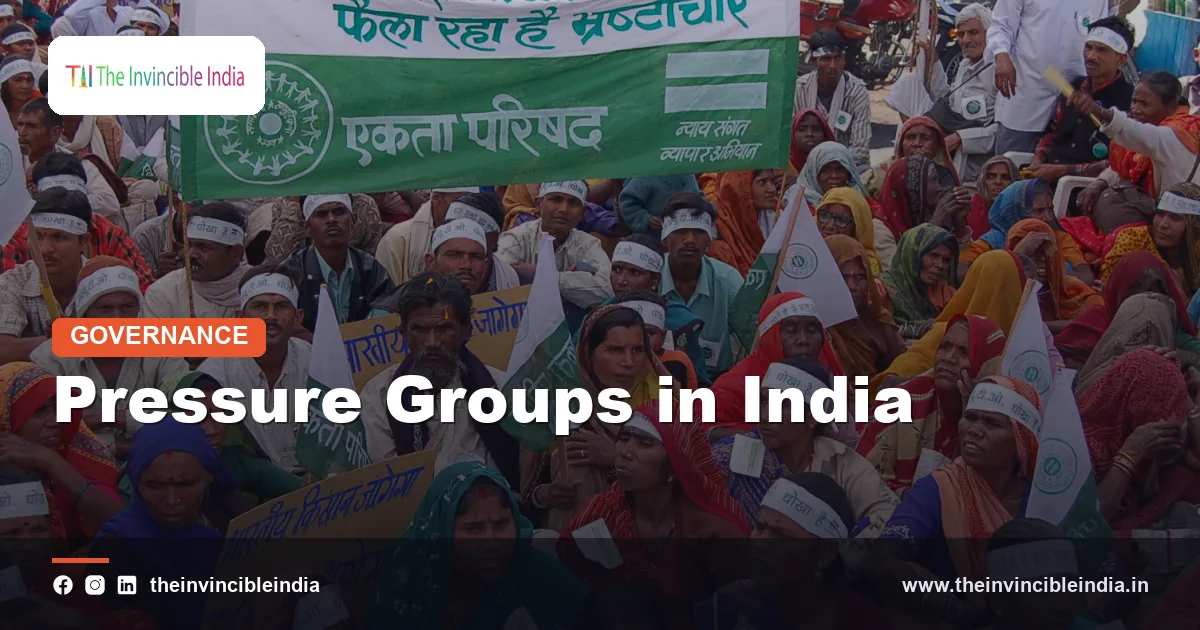
Pressure groups in India are organised associations of citizens or interests that try to influence government policy, legislation and public opinion without contesting elections or seeking to form a government themselves. They include industry chambers such as FICCI and CII, trade unions such as INTUC, AITUC and BMS, farmers’ organisations, caste and community bodies, professional associations such as the Indian Medical Association, student unions and cause-based movements.
Because India is a large, plural democracy with a competitive party system and an active judiciary, pressure groups operate through many channels at once: lobbying ministries, submitting memoranda, filing petitions, mobilising the media, organising strikes and marches, and approaching the courts. This explainer sets out what pressure groups are, how they are classified, how they work and where their influence ends.
| Attribute | Detail |
|---|---|
| Definition | Organised groups that seek to influence public policy without seeking political office |
| Also called | Interest groups, lobbies, advocacy groups, organised interests |
| Constitutional basis | Article 19(1)(a) speech, 19(1)(b) assembly and 19(1)(c) association |
| Main classification | Institutional, associational, anomic and non-associational groups (Almond and Coleman) |
| Business examples | FICCI (1927), CII, ASSOCHAM (1920) |
| Labour examples | AITUC (1920), INTUC (1947), HMS (1948), BMS (1955), CITU (1970) |
| Professional examples | Indian Medical Association (1928), bar associations, teachers’ and engineers’ bodies |
| Main methods | Lobbying, petitions, public interest litigation, strikes, protests, media campaigns |
| Regulation of lobbying | No dedicated lobbying law or public register at the national level |
Key Takeaways
- Pressure groups in India influence policy and public opinion but do not contest elections or aim to form a government, which separates them from political parties.
- The freedom to form associations under Article 19(1)(c) of the Constitution gives pressure groups in India their legal foundation.
- Indian pressure groups are commonly grouped into business, labour, agrarian, caste and community, professional, student, religious and cause-based categories.
- Many Indian trade unions, such as INTUC and BMS, are linked to political parties or ideological families, which blurs the line between pressure groups and party wings.
- India has no comprehensive law that regulates lobbying or requires lobbyists to register publicly, so influence often works through informal channels.
- Courts, the Right to Information Act, 2005 and public interest litigation have become important tools for pressure groups seeking accountability.
What are pressure groups in India?
Pressure groups in India are voluntary or semi-voluntary associations that represent a shared interest or cause and try to shape decisions of the legislature, the executive and the judiciary. They differ from political parties in that they do not field candidates for the purpose of governing, and they usually focus on a narrow set of issues rather than a full programme of government.
The terms “pressure group” and “interest group” are often used interchangeably. Some scholars prefer “interest group” for a body that articulates the material interests of its members, and “pressure group” for any body that actively presses its demands on decision makers. In everyday Indian usage, the two phrases overlap almost entirely.
Pressure groups matter because modern governments make thousands of technical decisions on taxes, tariffs, wages, land, health, education and the environment. Elections alone cannot convey the detailed views of farmers, factory owners, doctors or tribal communities. Pressure groups fill that gap by supplying information, organising opinion and holding authorities to account between elections.
How do pressure groups differ from political parties?
Pressure groups differ from political parties mainly in purpose: a party seeks to win power through elections, while a pressure group seeks to influence those who hold power. Parties must take positions on every major issue, whereas pressure groups can concentrate on one issue or one constituency and remain silent on others.
The distinction is useful but not absolute in India. Several organisations began as pressure groups and later turned into parties, and many unions, student bodies and community organisations maintain close relationships with parties. The following points summarise the usual differences.
- Goal: parties aim to govern, pressure groups aim to influence.
- Accountability: parties answer to voters directly at elections, pressure groups answer mainly to their members and donors.
- Scope: parties offer a broad programme, pressure groups usually press a limited agenda.
- Legal framework: parties register with the Election Commission of India and follow the Representation of the People Act, 1951, while pressure groups register under laws such as the Societies Registration Act, 1860, the Trade Unions Act, 1926 or the Companies Act.
What are the types of pressure groups in India?
The types of pressure groups in India are usually classified by the interest they serve, and the main categories are business groups, labour unions, agrarian groups, professional bodies, caste and community groups, student organisations, religious bodies and cause-based movements. Political scientists also use the broader scheme of Gabriel Almond and James Coleman, which sorts groups by how formally they are organised.
Institutional, associational, anomic and non-associational groups
In the Almond and Coleman scheme, institutional groups operate inside government bodies such as the bureaucracy, the armed forces or legislative party caucuses. Associational groups are formally organised bodies with defined membership, such as trade unions and chambers of commerce. Anomic groups are spontaneous and unorganised, appearing in riots, sudden demonstrations or flash protests. Non-associational groups rest on kinship, caste, region or religion rather than formal membership.
Classification by interest
| Category | What they represent | Well-known examples |
|---|---|---|
| Business and industry | Owners, traders, manufacturers and service firms | FICCI, CII, ASSOCHAM, traders’ federations |
| Labour | Industrial and service workers | AITUC, INTUC, HMS, BMS, CITU |
| Agrarian | Farmers and agricultural workers | Bharatiya Kisan Union, Shetkari Sanghatana, Samyukta Kisan Morcha |
| Professional | Doctors, lawyers, teachers, engineers, journalists | Indian Medical Association, bar associations, university teachers’ associations |
| Caste and community | Caste, tribe or linguistic communities | Nadar Mahajana Sangam, Jat Mahasabha, tribal federations |
| Student | University and college students | ABVP, NSUI, AISF, SFI |
| Religious | Followers of particular faiths or institutions | Jamiat Ulema-e-Hind, Vishva Hindu Parishad, Shiromani Gurdwara Parbandhak Committee |
| Cause-based | A single issue or public interest | Narmada Bachao Andolan, Chipko movement, Association for Democratic Reforms |
How do business pressure groups work in India?
Business pressure groups in India work as industry chambers and associations that present the views of employers and traders to ministries, regulators and parliamentary committees. The Federation of Indian Chambers of Commerce and Industry (FICCI) was established in 1927, and the Confederation of Indian Industry (CII) traces its roots to 1895 before taking its present name in the early 1990s. The Associated Chambers of Commerce and Industry of India (ASSOCHAM) dates from 1920.
These bodies publish policy papers, send delegations before the Union Budget, take part in consultations on trade agreements and comment on draft regulations. Sector-specific associations, such as those for software services, pharmaceuticals, automobiles, steel or small enterprises, press narrower demands on tariffs, taxation, licensing and standards.
Business groups hold an advantage in resources and technical expertise, and ministries often invite them to join advisory committees. Critics argue that this access can tilt policy toward large firms, while supporters say it supplies the commercial knowledge that regulation needs. Both views are part of the continuing debate on how government and industry should interact.
What is the role of trade unions as pressure groups?
Trade unions act as pressure groups by bargaining for wages and working conditions and by pressing the government on labour law, social security and public sector policy. The All India Trade Union Congress (AITUC), founded in 1920, is the oldest central trade union organisation in India, and the Trade Unions Act, 1926 gave registered unions legal recognition.
After independence, central unions grew alongside political currents. The Indian National Trade Union Congress (INTUC) was formed in 1947 and is associated with the Congress party. The Hind Mazdoor Sabha (HMS) emerged in 1948 from socialist traditions, the Bharatiya Mazdoor Sangh (BMS) was founded in 1955 and is linked to the Rashtriya Swayamsevak Sangh family, and the Centre of Indian Trade Unions (CITU) began in 1970 with a left orientation.
Indian unions have historically been strongest in the organised sector, including railways, banking, insurance, ports, mining and public sector enterprises. A large majority of the Indian workforce is in the informal economy and has limited union coverage, so organisations of informal workers, such as the Self-Employed Women’s Association (SEWA) founded in 1972, play a distinct representative role.
Central trade unions often call joint national strikes against policy changes. The Supreme Court has held in T.K. Rangarajan v. Government of Tamil Nadu (2003) that employees have no fundamental right to strike, although the right to form unions is protected by Article 19(1)(c).
Do farmers and agrarian groups act as pressure groups?
Farmers’ organisations act as powerful pressure groups in India because agriculture employs a large share of the population and farm policy affects prices, subsidies, credit, land and trade. Their demands typically concern minimum support prices, procurement, input costs, irrigation, power tariffs and loan relief.
Notable examples include the Shetkari Sanghatana in Maharashtra, led in the late 1970s by Sharad Joshi, and the Bharatiya Kisan Union in northern India, which gained prominence in the 1980s. Regional farmer unions often organise rallies, road and rail blockades and district-level sit-ins. A coalition of farmers’ unions led a prolonged agitation on the borders of Delhi in 2020 and 2021 over three central farm laws, which Parliament later repealed in 2021.
Agrarian groups are often organised along regional and crop lines, so their demands differ between wheat and rice growers, sugarcane growers, dairy farmers and cotton cultivators. This diversity makes a single national farmers’ voice difficult to sustain over time.
How do caste, community and religious groups influence policy?
Caste, community and religious groups influence policy by mobilising a recognised social identity to press for representation, reservations, welfare measures or protection of institutions. Because caste and religion shape social life in India, these groups form one of the most visible categories of non-associational and associational pressure groups.
Early examples include the caste associations of the late nineteenth and early twentieth centuries, such as the Nadar Mahajana Sangam in Tamil Nadu, which worked for education and social advancement. In later decades, community bodies have made demands for inclusion in reservation lists, for language recognition or for protection of religious endowments.
Religious organisations such as the Shiromani Gurdwara Parbandhak Committee, which manages Sikh shrines under a statute of 1925, the Jamiat Ulema-e-Hind and the Vishva Hindu Parishad (founded in 1964) take positions on law, education and temple or mosque administration. Observers note that identity-based mobilisation can widen political participation but can also deepen social divisions when demands are framed in zero-sum terms.
What are professional, student and cause-based groups?
Professional, student and cause-based groups are pressure groups that organise around an occupation, an educational life stage or a specific public issue rather than around class or caste. They tend to rely on expertise, public sympathy and media attention rather than on numbers alone.
Professional associations
The Indian Medical Association (IMA), founded in 1928, comments on health policy, medical education and the safety of doctors. Bar associations press for judicial infrastructure and legal reform, while teachers’ federations raise pay, service conditions and education policy. The Bar Council of India and the Medical Council framework are statutory regulators, which is a different role from voluntary associations that lobby.
Student organisations
Student groups such as the Akhil Bharatiya Vidyarthi Parishad (1949), the National Students’ Union of India (1971), the All India Students’ Federation (1936) and the Students’ Federation of India (1970) raise issues of fees, admissions, examinations and campus governance. Many are affiliated to political parties, and campus movements have at times shaped national debates, as in the Navnirman agitation in Gujarat and the Bihar movement in the early 1970s.
Cause-based movements
Cause-based groups focus on public goods such as the environment, transparency or human rights. The Chipko movement of the 1970s in present-day Uttarakhand protected forests through community action. The Narmada Bachao Andolan, which began in the mid-1980s, questioned the displacement caused by dams on the Narmada river. The Mazdoor Kisan Shakti Sangathan (MKSS), working from Rajasthan in the 1990s, helped build the case for the Right to Information Act, 2005. The Association for Democratic Reforms (ADR), formed in 1999, pursued disclosure of candidates’ criminal and financial records, which led to Supreme Court directions in 2002.
What methods do pressure groups use in India?
Pressure groups in India use a mix of lobbying, petitions, litigation, public demonstrations, strikes and media campaigns, choosing methods according to their resources and the issue at hand. Well-resourced groups tend toward quiet engagement with officials, while mass-based groups rely on visible public action.
- Lobbying and representation: meeting ministers, officials and Members of Parliament, and giving evidence before parliamentary standing committees.
- Petitions and memoranda: submitting written demands to the government, the President or the Governor.
- Public interest litigation (PIL): approaching the Supreme Court under Article 32 or High Courts under Article 226 to enforce rights or compel action.
- Strikes, bandhs and marches: collective withdrawal of labour or public demonstration to raise the cost of ignoring a demand.
- Media and digital campaigns: newspaper advocacy, television debates, online petitions and social media mobilisation.
- Electoral influence: endorsing candidates, mobilising voting blocs or, rarely, supporting formation of a new party.
- Participation in consultative bodies: serving on advisory councils, expert committees and draft-law consultations.
Some methods are restricted by courts. In Communist Party of India (Marxist) v. Bharat Kumar (1998), the Supreme Court upheld a Kerala High Court ruling that a forced bandh is unconstitutional because it infringes the rights of citizens who wish to work and move freely.
What is the legal and constitutional framework for pressure groups?
The legal framework for pressure groups in India rests on the fundamental freedoms of speech, peaceful assembly and association in Article 19(1)(a), (b) and (c), subject to reasonable restrictions in the interest of public order, sovereignty and morality. These freedoms allow citizens to form unions, societies and cooperative bodies, and to demonstrate peacefully without arms.
Specific statutes govern particular kinds of groups. Trade unions register under the Trade Unions Act, 1926, charitable and social bodies commonly register under the Societies Registration Act, 1860 or state societies laws, and trusts under public trust acts. Foreign funding of non-governmental organisations is regulated under the Foreign Contribution (Regulation) Act, 2010, which has been amended over time.
There is no statute that defines or regulates lobbying as a profession. Proposals for a lobbying register have been discussed from time to time, but consultations between companies and government remain largely informal, and the lack of disclosure is a recurrent point in debates on transparency.
How have pressure groups shaped Indian democracy?
Pressure groups have shaped Indian democracy by widening participation, bringing neglected issues onto the national agenda and contributing to major laws. Campaigns by civil society networks helped lead to the Right to Information Act, 2005, the Mahatma Gandhi National Rural Employment Guarantee Act, 2005 and the Forest Rights Act, 2006. Anti-corruption mobilisation around 2011 contributed to the passage of the Lokpal and Lokayuktas Act, 2013.
The National Advisory Council, which existed from 2004 to 2014, gave activists and academics a formal advisory role in the design of social legislation. Parliamentary committees, regulators and court-appointed commissions also regularly invite expert groups to submit views.
Pressure groups also strengthen democracy by monitoring government. Election-related disclosures, budget analysis, social audits of public schemes and environmental clearances have all been scrutinised by civil society organisations that report their findings to citizens and the courts.
What are the limits and criticisms of pressure groups?
The main limits of pressure groups in India are unequal access to power, narrow sectional focus, dependence on parties and the risk that disruption harms the public. Groups with money and organisation, such as large business bodies, generally find it easier to reach decision makers than unorganised workers, small farmers or marginal communities.
Critics also point out that groups tied to political parties may act as extensions of those parties rather than as independent voices. Others note that methods such as prolonged blockades or forced bandhs impose costs on people who have no say in the dispute. Funding by overseas or corporate donors raises questions about accountability and transparency.
Defenders respond that pressure groups are a normal and healthy part of pluralist democracy, and that the answer to unequal access is greater transparency, wider organisation of weaker interests and strong independent institutions. Courts, the Election Commission, the media and the Right to Information framework all act as checks on how influence is used.
Bottom Line
Pressure groups in India are a permanent feature of democratic life, translating the interests of employers, workers, farmers, professionals, communities and causes into demands on the state. Their influence depends on organisation, resources, public sympathy and legal channels, and it is checked by courts, elections and the media. Understanding them helps readers see how policy is shaped between one election and the next.
Frequently Asked Questions
What is a pressure group in simple words?
A pressure group is an organised body of people who try to influence government decisions on a particular interest or cause without contesting elections. Examples in India include FICCI for business, INTUC for workers and the Indian Medical Association for doctors. They use methods such as lobbying, petitions, litigation and protests.
What is the difference between a pressure group and a political party?
A political party contests elections to form or join a government, while a pressure group only tries to influence those in power. Parties take positions on all major issues, whereas pressure groups usually focus on one interest. Parties in India must register with the Election Commission, but pressure groups register under laws such as the Societies Registration Act or the Trade Unions Act.
Which are the main pressure groups in India?
The main pressure groups in India include business bodies such as FICCI, CII and ASSOCHAM, trade unions such as AITUC, INTUC, HMS, BMS and CITU, and farmers’ organisations such as the Bharatiya Kisan Union. Professional bodies like the Indian Medical Association and student organisations such as ABVP, NSUI and SFI are also prominent. Cause-based movements like the Narmada Bachao Andolan and Chipko form another important group.
Is lobbying legal in India?
Lobbying is not specifically prohibited in India, but no national law regulates or defines it. Groups can legally meet officials, submit memoranda and give evidence to parliamentary committees under their freedoms of speech and association. There is no mandatory public register of lobbyists, and this lack of disclosure is often discussed in transparency debates.
What are anomic pressure groups?
Anomic pressure groups are spontaneous, loosely organised groups that appear suddenly, often through riots, flash protests or violent demonstrations. The term comes from the classification of Gabriel Almond and James Coleman. Such groups lack a formal structure or continuous leadership, which distinguishes them from associational groups like trade unions.
Do pressure groups have a constitutional basis in India?
Pressure groups in India rest on the freedoms in Article 19(1) of the Constitution, which protect speech, peaceful assembly without arms and the formation of associations or unions. These freedoms are subject to reasonable restrictions on grounds such as public order and sovereignty. The Constitution does not mention pressure groups by name, and their activities are governed by general law.
{“@context”:”https://schema.org”,”@graph”:[{“@type”:”FAQPage”,”mainEntity”:[{“@type”:”Question”,”name”:”What is a pressure group in simple words?”,”acceptedAnswer”:{“@type”:”Answer”,”text”:”A pressure group is an organised body of people who try to influence government decisions on a particular interest or cause without contesting elections. Examples in India include FICCI for business, INTUC for workers and the Indian Medical Association for doctors. They use methods such as lobbying, petitions, litigation and protests.”}},{“@type”:”Question”,”name”:”What is the difference between a pressure group and a political party?”,”acceptedAnswer”:{“@type”:”Answer”,”text”:”A political party contests elections to form or join a government, while a pressure group only tries to influence those in power. Parties take positions on all major issues, whereas pressure groups usually focus on one interest. Parties in India must register with the Election Commission, but pressure groups register under laws such as the Societies Registration Act or the Trade Unions Act.”}},{“@type”:”Question”,”name”:”Which are the main pressure groups in India?”,”acceptedAnswer”:{“@type”:”Answer”,”text”:”The main pressure groups in India include business bodies such as FICCI, CII and ASSOCHAM, trade unions such as AITUC, INTUC, HMS, BMS and CITU, and farmers’ organisations such as the Bharatiya Kisan Union. Professional bodies like the Indian Medical Association and student organisations such as ABVP, NSUI and SFI are also prominent. Cause-based movements like the Narmada Bachao Andolan and Chipko form another important group.”}},{“@type”:”Question”,”name”:”Is lobbying legal in India?”,”acceptedAnswer”:{“@type”:”Answer”,”text”:”Lobbying is not specifically prohibited in India, but no national law regulates or defines it. Groups can legally meet officials, submit memoranda and give evidence to parliamentary committees under their freedoms of speech and association. There is no mandatory public register of lobbyists, and this lack of disclosure is often discussed in transparency debates.”}},{“@type”:”Question”,”name”:”What are anomic pressure groups?”,”acceptedAnswer”:{“@type”:”Answer”,”text”:”Anomic pressure groups are spontaneous, loosely organised groups that appear suddenly, often through riots, flash protests or violent demonstrations. The term comes from the classification of Gabriel Almond and James Coleman. Such groups lack a formal structure or continuous leadership, which distinguishes them from associational groups like trade unions.”}},{“@type”:”Question”,”name”:”Do pressure groups have a constitutional basis in India?”,”acceptedAnswer”:{“@type”:”Answer”,”text”:”Pressure groups in India rest on the freedoms in Article 19(1) of the Constitution, which protect speech, peaceful assembly without arms and the formation of associations or unions. These freedoms are subject to reasonable restrictions on grounds such as public order and sovereignty. The Constitution does not mention pressure groups by name, and their activities are governed by general law.”}}]}]}


