

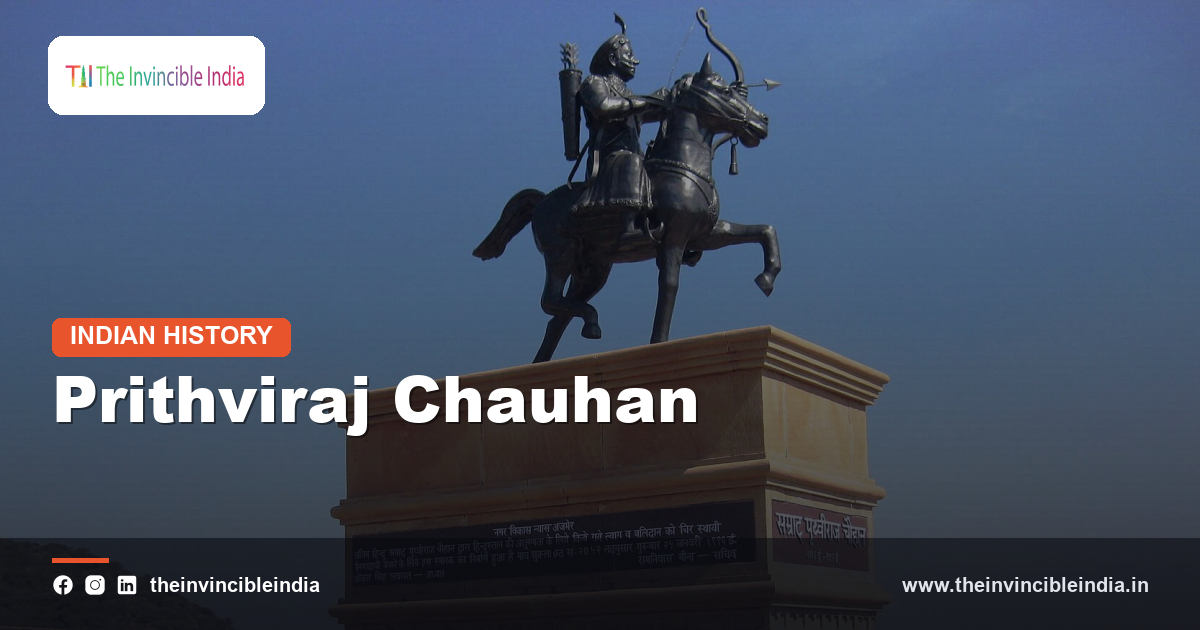
Prithviraj Chauhan remains one of the most celebrated figures among the Rajputs, remembered as a ruler of the Chahamana dynasty who governed from Ajmer and later Delhi during a period of great upheaval in northern India. His reign is remembered above all for his determined resistance against incursions from beyond the northwestern frontier, a struggle that has since passed into legend through generations of bardic retelling. While later poetic traditions embellished his story with heroic and romantic detail, the historical Prithviraj Chauhan stands as a significant figure in the political landscape of his age, a Rajput king whose courage and eventual defeat came to symbolise a pivotal turning point in the history of northern India. This guide explores his life, his kingdom and his enduring place in Indian memory.
Quick Facts
| Detail | Information |
|---|---|
| Dynasty | Chahamana (Chauhan) |
| Region | Ajmer and Delhi, northern India |
| Known for | Resistance to invasion from the northwest |
| Legendary work | The Prithviraj Raso |
| Era | Late medieval northern India |
| Legacy | A celebrated symbol of Rajput valour |
A Legendary Rajput King
Prithviraj Chauhan holds a special place in the popular memory of northern India, remembered as one of the last great Rajput kings to rule an independent kingdom before the region entered a new political era shaped by powers arriving from beyond its northwestern frontier. His reign, centred on the twin seats of Ajmer and Delhi, is recalled through both historical record and a rich tradition of bardic poetry that has elevated him to the status of legend. This dual memory, part history and part folklore, shapes how he is remembered. This standing of Prithviraj Chauhan as a legendary Rajput king reflects both his genuine historical significance and the powerful hold his story continues to exert on the popular imagination of Rajasthan and northern India more broadly.
The Chahamana Dynasty
Prithviraj Chauhan belonged to the Chahamana dynasty, one of several prominent Rajput ruling houses that governed different parts of northern and western India during the medieval period, each associated with its own territory, capital and tradition of martial leadership. The Chahamanas, based in the region around Ajmer, had built a significant kingdom over several generations before Prithviraj came to the throne. This lineage placed him among the established royal houses of the age. This background as a scion of the established Chahamana dynasty gave Prithviraj Chauhan both the resources and the responsibility of a significant Rajput kingdom, setting the stage for the eventful reign that would follow.
Early Life and Accession
Prithviraj Chauhan came to the Chahamana throne while still young, inheriting a kingdom already established as one of the more prominent Rajput states of northern India, and he is remembered as having shown notable energy and ambition from early in his reign. His accession placed him at the head of a kingdom that would soon be tested by both regional rivalries and, later, a far more consequential external threat. This early promise shaped expectations of his rule. This early accession of Prithviraj Chauhan to a position of considerable regional power set the course for a reign that would combine notable achievement with the eventual crisis for which he is most remembered.
Ajmer and Delhi Under Chauhan Rule
Under Prithviraj Chauhan, the Chahamana kingdom extended its authority to include both Ajmer, the traditional seat of the dynasty, and Delhi, a city of growing strategic and symbolic importance in the political geography of northern India. Governing from these two centres, Prithviraj presided over a kingdom of considerable standing among the Rajput states of the period. This dual seat of power reflected the kingdom’s reach. This extension of Chahamana authority to encompass both Ajmer and Delhi under Prithviraj Chauhan reflects the significant reach of his kingdom, positioning him as one of the most prominent Rajput rulers of northern India in his time.
The Rajput Political Landscape
The northern India of Prithviraj Chauhan’s era was home to a number of independent Rajput kingdoms, each governed by its own ruling clan and often engaged in shifting rivalries and alliances with neighbouring states over territory, tribute and prestige. This fragmented political landscape, while allowing for considerable regional autonomy, also meant that Rajput kingdoms rarely presented a fully unified front against outside threats. Such rivalries shaped the politics of the age. This fragmented political landscape among the Rajput kingdoms of the period forms an important backdrop to the story of Prithviraj Chauhan, helping to explain both the opportunities and the vulnerabilities his kingdom faced during his reign.
Conflicts with Rival Kingdoms
Like many rulers of his time, Prithviraj Chauhan was drawn into conflicts with neighbouring Rajput kingdoms, contesting territory and influence in a political environment where military strength and shifting alliances determined the balance of power. These regional rivalries, while significant in their own right, form part of the broader pattern of competition among Rajput states during the period. Such conflicts tested his leadership before the greater challenge arrived. These conflicts with rival kingdoms during the reign of Prithviraj Chauhan illustrate the competitive environment of Rajput politics in this era, providing important context for understanding the wider struggles that would later come to define his legacy.
The Threat from the Northwest
During the later part of Prithviraj Chauhan’s reign, the kingdoms of northern India faced a growing threat from beyond the northwestern frontier, as forces associated with Muhammad of Ghor sought to extend their influence into the Indian subcontinent. This external pressure posed a challenge unlike the regional rivalries Rajput kings were accustomed to managing among themselves. Meeting this threat required cooperation that proved difficult to sustain. This emerging threat from the northwest during Prithviraj Chauhan’s reign set the stage for one of the most consequential confrontations in the political history of medieval northern India, testing the resilience of the Rajput kingdoms of the region.
Confrontations with Muhammad of Ghor
Prithviraj Chauhan led Rajput forces in confrontation against the armies of Muhammad of Ghor on more than one occasion, engagements remembered as pivotal episodes in the broader struggle over control of northern India during this period. Accounts of these confrontations describe a determined defence by Prithviraj and his allies against a formidable external adversary. The outcomes of these engagements varied across the encounters. These confrontations between Prithviraj Chauhan and Muhammad of Ghor represent a defining chapter of his reign, remembered as a critical juncture in the history of northern India’s political and military struggles during the late medieval period.
The Battles for Northern India
The struggle between Prithviraj Chauhan and the forces of Muhammad of Ghor unfolded across more than a single encounter, reflecting the high stakes both sides attached to control of the strategically important region around Delhi and the Gangetic plain. These engagements are remembered in general terms as among the most significant military confrontations of the period, without precise details of scale or casualties reliably established. Their outcome shaped the future course of the region. These battles for control of northern India, fought between Prithviraj Chauhan and Muhammad of Ghor, are remembered as a decisive turning point that shaped the subsequent political history of the subcontinent for centuries to come.
Defeat and Its Aftermath
Prithviraj Chauhan was eventually defeated in his struggle against the forces of Muhammad of Ghor, an outcome that brought an end to Chahamana rule over Delhi and Ajmer and opened the way for new political arrangements in northern India in the period that followed. This defeat is remembered as a significant turning point, marking the decline of independent Rajput authority in the region around Delhi. Its consequences unfolded over the following generations. This defeat of Prithviraj Chauhan and its aftermath mark a watershed moment in Indian history, remembered as the close of an era of Rajput dominance in the Delhi region and the beginning of a new political chapter.
Prithviraj in Bardic Tradition
In the generations following his reign, Prithviraj Chauhan became a central figure of Rajasthani bardic tradition, celebrated by poets and storytellers who wove his life into a rich tapestry of heroic and romantic legend that circulated widely among Rajput communities. This oral and literary tradition elevated Prithviraj from a historical ruler into a symbol of Rajput chivalry and valour. Such tales blended historical memory with poetic imagination. This rich bardic tradition surrounding Prithviraj Chauhan reflects the deep and lasting impression his reign left on Rajput cultural memory, ensuring that his story continued to be told and retold long after the historical events themselves.
The Prithviraj Raso
The most famous literary work associated with Prithviraj Chauhan is the Prithviraj Raso, a lengthy epic poem composed in later centuries that recounts his life and exploits in vivid and often embellished detail, blending historical memory with poetic invention in the tradition of heroic Rajput literature. Scholars treat the work with caution as a historical source while valuing it highly as a window into later Rajput cultural imagination. Its literary influence has been considerable. This epic, the Prithviraj Raso, has profoundly shaped popular understanding of Prithviraj Chauhan, illustrating how bardic literature can transform a historical figure into an enduring cultural icon across succeeding generations.
Folklore and Popular Memory
Beyond formal literature, Prithviraj Chauhan features prominently in the folklore and popular memory of Rajasthan and northern India, remembered in songs, stories and local tradition as a symbol of courage and Rajput identity that continues to resonate among communities in the region. This popular memory has kept his story alive across centuries, independent of formal historical scholarship. Local traditions and festivals sometimes evoke his legacy. This enduring presence of Prithviraj Chauhan in folklore and popular memory demonstrates the depth of his cultural significance, extending his legacy far beyond the historical record into the living traditions of the communities who continue to honour his name.
Historical Fact and Legend
Historians studying Prithviraj Chauhan must carefully distinguish between the verifiable historical record, drawn from inscriptions and contemporary accounts, and the far more elaborate legendary tradition that developed around him in later centuries through works such as the Prithviraj Raso. This distinction is important for understanding both the genuine achievements of his reign and the cultural processes by which historical figures become legendary. Both dimensions contribute to his overall significance. This careful balance between historical fact and legend in the study of Prithviraj Chauhan reflects a broader challenge in medieval Indian history, where oral and poetic traditions often preserve memory in ways that differ from strict historical record.
Ajmer's Heritage Today
The city of Ajmer, long associated with Prithviraj Chauhan and the Chahamana dynasty, remains an important heritage centre in Rajasthan today, home to historical sites and a fort associated with the memory of its former Rajput rulers. The city’s continued association with Prithviraj Chauhan reflects the lasting connection between place and legend in Indian historical memory. Local heritage efforts continue to preserve this connection. This ongoing heritage of Ajmer, tied closely to the memory of Prithviraj Chauhan, ensures that the city remains a point of pilgrimage for those interested in Rajput history and the legendary figures who shaped it.
Prithviraj Chauhan Today
Today Prithviraj Chauhan is remembered as one of the most celebrated figures in the history and folklore of Rajasthan, honoured as a symbol of Rajput courage and remembered through literature, popular tradition and the historical sites associated with his reign in Ajmer and Delhi. His story continues to be told across generations, blending historical memory with enduring legend. Statues and monuments across the region commemorate his legacy. As a Chahamana ruler whose historical resistance and legendary reputation together secure his place in Indian memory, Prithviraj Chauhan endures as one of the most enduring figures of medieval Rajput history.
Sources & Further Reading
- Archaeological Survey of India, on heritage sites of Ajmer (asi.nic.in).
- Sahitya Akademi, on the tradition of Rajasthani bardic literature.
Frequently Asked Questions
Who was Prithviraj Chauhan?
Prithviraj Chauhan was a ruler of the Chahamana dynasty who governed Ajmer and Delhi during the late medieval period, remembered for his resistance against invasion from the northwest and celebrated widely in Rajput legend.
What is Prithviraj Chauhan famous for?
Prithviraj Chauhan is famous for his confrontations with the forces of Muhammad of Ghor and for his enduring legendary status in Rajput bardic tradition, particularly through the epic poem known as the Prithviraj Raso.
What is the Prithviraj Raso?
The Prithviraj Raso is a lengthy epic poem composed in later centuries that recounts the life and exploits of Prithviraj Chauhan, blending historical memory with considerable poetic embellishment in the tradition of Rajput heroic literature.
Which dynasty did Prithviraj Chauhan belong to?
Prithviraj Chauhan belonged to the Chahamana dynasty, also known as the Chauhans, a prominent Rajput ruling house based around Ajmer that also extended its authority to Delhi during his reign.
Why is Prithviraj Chauhan still remembered today?
Prithviraj Chauhan is still remembered today as a symbol of Rajput valour and resistance, his story preserved through historical record, bardic poetry and popular folklore that continue to shape his legendary reputation in Rajasthan and beyond.


