

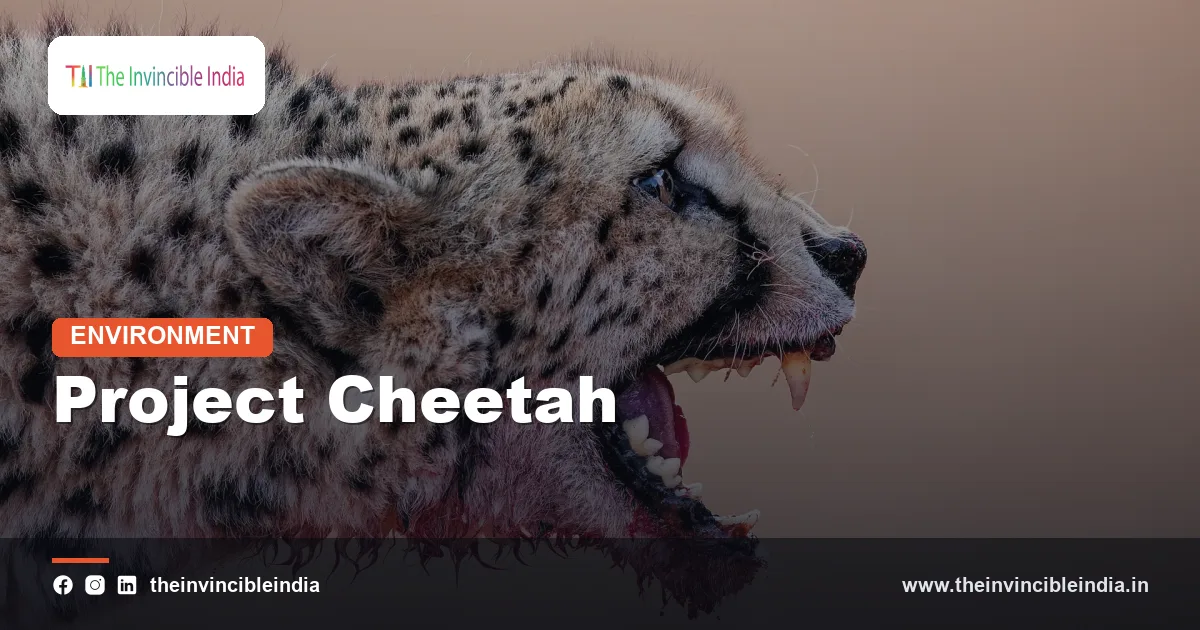
Project Cheetah is India’s programme to bring the cheetah back to the wild after the species disappeared from the country in the middle of the twentieth century. Launched in earnest in September 2022, it is widely described as the world’s first intercontinental translocation of a large carnivore: wild-origin African cheetahs (Acinonyx jubatus) were flown across continents to establish a breeding population in central India.
The idea is bold, and it has been debated almost as intensely as it has been celebrated. Supporters see a chance to restore a lost predator and revive neglected open grasslands and dry forests. Critics ask whether the chosen landscapes are large enough and whether the money is best spent this way. This explainer sets out the history, the logistics, the progress and the setbacks, and the science behind the argument, in a balanced and factual way.
| Aspect | Details |
|---|---|
| Programme | Project Cheetah (Action Plan for Introduction of Cheetah in India) |
| Species introduced | African cheetah (Acinonyx jubatus) |
| Extinct in India | Declared in 1952 (Asiatic cheetah, Acinonyx jubatus venaticus) |
| First batch | 8 cheetahs from Namibia, released on 17 September 2022 |
| Second batch | 12 cheetahs from South Africa, arrived in February 2023 |
| Primary site | Kuno National Park, Madhya Pradesh |
| Legal clearance | Supreme Court permission for an experimental introduction (January 2020) |
| Lead agencies | Ministry of Environment, Forest and Climate Change, NTCA and the Wildlife Institute of India, with the Madhya Pradesh Forest Department |
Why the Cheetah Disappeared from India
The cheetah once ranged across a vast belt that stretched from Africa through West Asia into the Indian subcontinent. In India it lived in the dry plains, scrub and open woodlands of the north-west, the Deccan and central regions. The animal was admired for its speed, and that admiration was part of its undoing. Rulers and nobles kept tamed cheetahs for coursing blackbuck, a hunting tradition recorded in Mughal chronicles and in royal courts for centuries.
Several pressures combined to push the species out. Captive cheetahs rarely bred, so hunters kept capturing wild animals to replace them. Forests and grasslands were cleared for farming and settlement, and the prey on which cheetahs depended, such as blackbuck and chinkara, declined sharply. Sport hunting during the colonial period and shortly after added to the toll.
The last records
- The last confirmed cheetahs in the country are widely reported to have been shot in the 1940s in the Koriya region, in what is now Chhattisgarh.
- The Government of India formally declared the cheetah extinct in the country in 1952.
- The cheetah remains the only large mammal that India is known to have lost in the modern era.
Early Ideas, the Legal Route and the Action Plan
The thought of restoring the cheetah is not new. Conservationists and officials raised it from the 1950s onwards, and serious proposals appeared in the 1970s. Since the cheetah that once lived in India was the Asiatic subspecies, the obvious source was Iran, the last country where a small remnant population of Asiatic cheetahs survives.
The Iran plan that stalled
In the 1970s, India and Iran explored an arrangement under which Iran would supply Asiatic cheetahs, possibly in exchange for Asiatic lions from Gujarat. Political changes in Iran and, more fundamentally, the tiny number of Asiatic cheetahs left in the wild meant the plan never materialised. Iran regarded its few animals as too precious to export. The proposal resurfaced in the 2000s, with similar results.
That left only one realistic source: the much larger, genetically healthier populations of African cheetahs in southern Africa. Scientists note that the Asiatic and African forms diverged in the distant past, but they are closely related and fill the same ecological role, which is why many experts consider the African cheetah a reasonable ecological substitute.
The legal route and the Action Plan
An African-cheetah introduction was first seriously planned around 2009 and was meant to start at sites such as Kuno. In 2013, the Supreme Court halted it, partly on the ground that the species had to be assessed against the claims of the Asiatic lion for a second home. The court revisited the matter, and in January 2020 it allowed the National Tiger Conservation Authority (NTCA) to introduce African cheetahs on an experimental basis in a carefully chosen habitat, under the guidance of expert oversight.
The Wildlife Institute of India and the NTCA then prepared a detailed document, the Action Plan for Introduction of Cheetah in India, released in 2021. It set out a long-term, step-by-step approach.
- Founders first: bring in animals from Africa in several batches over a number of years, rather than all at once.
- Site selection: assess candidate sites for size, prey base, protection and the presence of other carnivores, and pick the best first.
- Landscape approach: aim at building a connected metapopulation across several protected areas rather than a single isolated group.
- Community involvement: work with nearby villages through awareness, jobs and benefit sharing.
- Adaptive management: monitor continuously and change course as data comes in.
Why Kuno Was Chosen
Kuno National Park lies in the Sheopur and Morena districts of Madhya Pradesh, on the Kuno river in the Vindhyan landscape. Its core area is roughly 750 sq km, and with surrounding forest the wider landscape is considerably larger. Kuno was not picked at random. It had been prepared decades earlier as a prospective second home for Asiatic lions from Gir, and in the process villages had been relocated out of the area, the habitat had been improved, and the prey base had been rebuilt.
The Asiatic lion move never happened, because Gujarat did not agree to release animals. That left a ready, protected, relatively undisturbed site with infrastructure in place.
Habitat and prey
- Open forest and grassland: a mix of dry deciduous woodland, savannah-like patches and scrub, similar in structure to cheetah country in southern Africa.
- Prey species: chital (spotted deer) is the main prey, along with sambar, nilgai, chinkara, wild boar and smaller animals.
- Carrying capacity: the Action Plan estimated that the park could hold roughly twenty cheetahs, a figure that critics regard as optimistic.
The Two Batches: Namibia and South Africa
The Namibian batch, September 2022
The first group of eight cheetahs, five females and three males, came from Namibia, home to the world’s largest remaining cheetah population, with support from the Cheetah Conservation Fund. They travelled in a specially modified cargo aircraft from Windhoek to Jaipur and then by helicopter to Kuno. On 17 September 2022, the Prime Minister’s birthday, they were released into quarantine enclosures at the park, an event that drew national and global attention.
The arrival marked the first time the species had been present in the country in roughly seven decades. The animals were fitted with satellite radio collars so that field teams could track their movements around the clock.
The South African batch, February 2023
A second consignment of twelve cheetahs, seven males and five females, came from South Africa in February 2023. They were flown on an Indian Air Force transport aircraft to Gwalior and then moved to Kuno by helicopter. Under an agreement between the two governments, further batches were expected from South Africa over the following years.
These animals were drawn largely from South Africa’s fenced, intensively managed reserves, where cheetahs have been run as a managed metapopulation, with animals moved between reserves to keep genetic diversity healthy. That experience is one reason the project looked feasible on paper.
The translocation batches at a glance
| Batch | Source country | Approximate date | Number | Arrival point |
|---|---|---|---|---|
| First | Namibia | September 2022 | 8 (5 females, 3 males) | Jaipur, then Kuno by helicopter |
| Second | South Africa | February 2023 | 12 (7 males, 5 females) | Gwalior, then Kuno by helicopter |
| Later phases | Southern Africa (discussed) | Planned in stages | Several more over years | Kuno and additional sites |
From Quarantine Bomas to Free Release
Wild cheetahs cannot simply be set loose in a new country. The programme used a soft-release method built around enclosures called bomas. On arrival, each cheetah spent a quarantine period in a small, secure enclosure, as required by animal-health rules, and then moved to larger acclimatisation enclosures inside the park, where it could hunt and settle.
Only after this period were the animals gradually released into the wider forest. The aim was to let them become familiar with the terrain, the prey and the sounds and smells of the area, and to reduce the chance of them wandering out of the park in panic.
Tracking and monitoring
- Radio collars to follow movements and detect kills.
- Dedicated monitoring teams, often trained with African experts, on the ground.
- Veterinary teams to check health, treat injuries and manage emergencies.
- Village-level outreach, including local people as trackers known as “cheetah mitras”.
Milestones: Cubs on Indian Soil
The most celebrated moment came in March 2023, when a Namibian female, Jwala, gave birth to cubs at Kuno, the first cheetah cubs born on Indian soil in over seven decades. Only a small number of the cubs from that first litter survived. Later litters followed, including births to animals that had themselves been brought from Africa, and a first generation of Indian-born cheetahs began to grow up in the park.
Births matter more than arrivals. A population that reproduces and whose young survive to adulthood is the real test of whether the founders are settling in. Wildlife biologists therefore pay close attention to cub survival, which is naturally low among cheetahs everywhere: in the wild, a large share of cubs die before reaching independence, mainly to predators such as lions and leopards, and to hardship.
Setbacks and Deaths
Project Cheetah has also seen difficult episodes. Within months of the second batch, several adult cheetahs died at Kuno, as did some of the early cubs. The reported causes varied. Some animals were affected by pre-existing health conditions, one by kidney problems, and others by injuries from fights, accidents or hunting. A few cubs died from heat stress and weakness.
A particularly debated episode came during the 2023 monsoon, when several cheetahs developed infections and septicaemia. Officials and some veterinarians pointed to a thick winter coat grown by African animals in a humid, wet climate, combined with ticks and moisture, which created skin infections. Others asked whether radio collars might have contributed to wounds. Experts disagreed, and the cause remains argued over. In response, the authorities reviewed protocols, changed how collars were used, and strengthened veterinary care.
What deaths mean for a reintroduction
- Mortality among translocated carnivores is often high in the first years, because the animals adapt to unfamiliar land and climate.
- Success is judged over a long time, not by early survival rates alone.
- Even so, the scale of the early losses prompted court attention, parliamentary questions and a high-level expert review.
The Science and the Criticism
The scientific debate has centred on a few questions. The first is space. Cheetahs are wide-ranging, and in open African landscapes a single animal may use hundreds of square kilometres. Kuno is considerably smaller than many African sites, and the cheetahs have sometimes walked out of the park into nearby farmland and villages. That raises both safety risks for the animals and concerns for local communities.
The second is prey and competition. Kuno has chital and other prey, but critics argue the prey base is lower than in good African cheetah habitat, and that leopards, which are common in the area, can kill cheetah cubs. The third is the human-wildlife interface, with livestock, dogs, roads, wire fences and electrocution risks around the park.
Questions raised by critics
- Is a single site enough to hold a viable population, or should more sites be ready before more animals arrive?
- Could the same funds help species that are closer to the brink, such as the Great Indian Bustard?
- Is it appropriate to substitute African cheetahs for the lost Asiatic form?
- Does the high public profile of the project make it more of a spectacle than science?
The Government’s Case: Ecosystem Restoration
Officials and supporting scientists make a different argument. They say the cheetah is a top predator of open habitats, and that no large carnivore in India occupied that role after its extinction. Bringing it back, they argue, restores a missing piece of the ecosystem and creates a reason to protect savannah-like landscapes, scrub and grasslands, which are often wrongly treated as wasteland and diverted to other uses.
Supporters also point to benefits for local people: employment as trackers and guides, tourism around the park, and improved management of surrounding forest. They stress that reintroductions are inherently experimental, that early losses were expected in the planning documents, and that the animals are managed adaptively rather than left to chance. In this view, the cheetah serves as a flagship species, much as the tiger did when Project Tiger was launched in 1973, drawing attention and funding to an entire habitat.
Expanding Beyond Kuno
From the start, the plan envisaged more than one site. Kuno alone cannot support a long-term, genetically healthy population, so experts identified other protected areas in central and western India that could become additional homes.
- Gandhi Sagar Wildlife Sanctuary (Madhya Pradesh): the best-known second site, being prepared with enclosures, prey and staff to receive cheetahs.
- Nauradehi and other landscapes: considered in assessments as possible additional habitats.
- Sites in Rajasthan and Gujarat: discussed in planning, including grassland areas, subject to habitat work and community consent.
The longer-term vision is a network of connected reserves among which animals can be moved to maintain genetic diversity, much like the managed metapopulation in southern Africa. Further imports from African countries, possibly including Botswana and Kenya as well as Namibia and South Africa, have been discussed. Plans and dates continue to evolve, so the latest official updates should always be checked.
Why Project Cheetah Matters
Whatever the final outcome, the project has changed the conversation about conservation in India in several ways. It has put open natural ecosystems, such as grasslands, savannahs and scrublands, on the map of conservation policy alongside forests, which have long received most of the attention. It has brought in international scientific cooperation and expertise from Namibia and South Africa. And it has tested how India’s protected-area system handles a wide-ranging species that does not fit neatly inside park boundaries.
It also shows how reintroduction differs from protection. Saving an existing species is hard; restoring a vanished one, in changed landscapes and among changed human communities, is harder still. Success will depend on sustained funding, habitat restoration, cooperation from local people, and honest scientific monitoring that is willing to publish bad news as well as good.
Conclusion
Project Cheetah is a long-term experiment in restoring a species that India lost in 1952. It has recorded real milestones, including successful translocations from Namibia and South Africa and cubs born in India, alongside painful losses and open scientific questions about space, prey and management. Its ultimate verdict will not come from one year’s headlines, but from whether a self-sustaining population establishes itself across several sites over many years. For readers, the best approach is to follow it as an unfolding conservation science story rather than as either a triumph or a failure already decided.
Frequently Asked Questions
What is Project Cheetah?
Project Cheetah is India’s programme to reintroduce the cheetah, a species declared extinct in the country in 1952. It involves bringing African cheetahs from Namibia and South Africa to Kuno National Park in Madhya Pradesh and building a breeding population over time.
Why were African cheetahs brought instead of Asiatic cheetahs?
India once had the Asiatic cheetah, but today only a very small remnant population survives in Iran, which did not agree to supply animals. Africa holds far larger and healthier cheetah populations, and the African cheetah is a close relative that fills a similar ecological role, so it was chosen after the Supreme Court allowed an experimental introduction in 2020.
When did the cheetahs arrive in India?
The first group of eight cheetahs from Namibia was released at Kuno on 17 September 2022. A second group of twelve cheetahs from South Africa arrived in February 2023. More animals have been planned in stages.
Why was Kuno National Park chosen?
Kuno had been prepared earlier as a second home for Asiatic lions, so it already had protected status, relocated villages, improved habitat and a prey base including chital. Its open forest and grassland mix also resembles cheetah habitat in southern Africa.
Why have some cheetahs died?
Deaths have been attributed to a mix of causes, including infections during the monsoon, injuries, illness and natural mortality, along with the high losses typical of cub survival. Experts continue to debate how much was due to climate and handling and how much was unavoidable, and management practices have been reviewed.
Will cheetahs be introduced at other sites?
Yes, expansion is part of the plan. Gandhi Sagar Wildlife Sanctuary in Madhya Pradesh is the best-known additional site, and other landscapes have been assessed. The aim is a connected network of habitats rather than a single park.


