

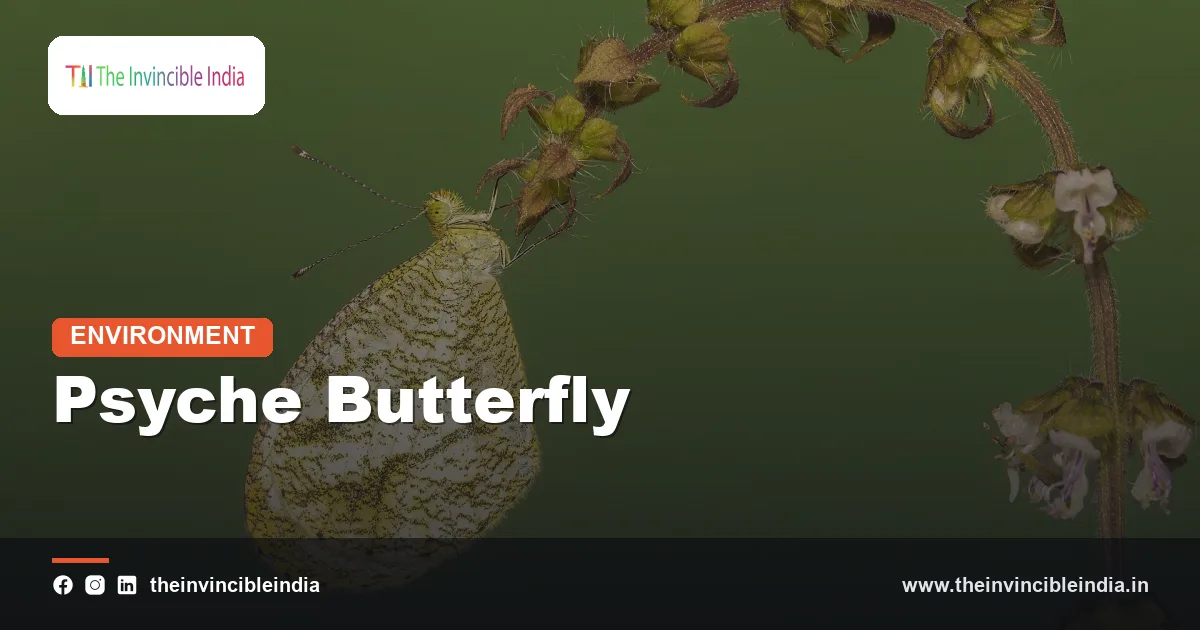
The psyche butterfly (Leptosia nina) is a small, delicate white butterfly of the family Pieridae, found throughout India, that is easily recognised by its weak, fluttering flight close to the ground and its single dark spot on each forewing. Often simply called the psyche, it is among the smallest and most fragile-looking of the Indian whites, and it prefers the shade of bushes, grassy clearings and the edges of forest rather than open sunlight.
The psyche butterfly is common enough to turn up in village outskirts and city parks, yet many people overlook it because it is small and keeps low. This guide explains how to identify it, where it lives, what its caterpillars eat, how its life cycle works and how to find it.
Psyche Butterfly Quick Facts
| Common name | Psyche |
|---|---|
| Scientific name | Leptosia nina (Fabricius, 1793) |
| Family | Pieridae (whites and yellows) |
| Wingspan | Roughly 4 to 5 cm, among the smallest of the Indian whites |
| Caterpillar host plants | Caper-family plants, including Capparis species and Cleome (wild mustard-type herbs) |
| Range and habitat in India | Recorded across most of India from the plains to lower hills; shady scrub, forest edges, grassy clearings, plantations and gardens |
| Flight season | Seen through much of the year in warm regions with overlapping broods, usually most numerous in and after the monsoon |
| Notable features | Slow, bobbing flight low in undergrowth; black forewing tip spot; green-grey streaked underside of hindwing; wet-season and dry-season forms |
Key Takeaways
- The psyche butterfly (Leptosia nina) is one of the smallest white butterflies in India, with a wingspan of roughly 4 to 5 cm.
- The psyche butterfly flies weakly and low through shade, which separates it from larger, faster whites of open ground.
- Psyche caterpillars feed on caper-family plants such as Capparis and Cleome, so the butterfly is found where these plants grow.
- The upperside of the psyche is white with a dark spot at the forewing tip, while the underside is streaked with grey-green lines.
- The psyche shows wet-season and dry-season forms, so the strength of its markings varies through the year.
- The word “psyche” comes from Greek, where it means both “soul” and “butterfly”, which explains the poetic name.
What Is the Psyche Butterfly?
The psyche butterfly is a small pierid butterfly, Leptosia nina, found across South and South-East Asia and in India from the plains to the lower hills. It was described scientifically by Johan Christian Fabricius in 1793 and is placed in the genus Leptosia, a small group of delicate whites.
Pierids are the butterflies commonly called whites and yellows, and most of them are bright and fast-moving. The psyche is an exception: it is slender, pale and almost ghostly, and it behaves more like a drifting petal than a typical white. Many amateur observers first notice it when a tiny white shape floats past a shaded path and settles on a leaf for a moment.
The name “psyche” is borrowed from Greek. In ancient Greek, psyche meant both the soul and the butterfly, and the myth of Psyche shows the mortal princess with butterfly wings. This gave the whole concept of butterflies a long cultural link with spirit and transformation, and it is the reason the English common name sounds so poetic.
How Can You Identify the Psyche Butterfly?
You can identify the psyche butterfly by its small size, its white wings with a single black spot near each forewing tip and its slow, fluttering flight close to the ground. When it settles, the closed wings reveal an underside with soft green-grey streaks that help it blend with leaves and grass.
Upperside
The upperside of the psyche is mainly white. The forewing has a dark patch near the tip, and in many individuals this patch is prominent and rounded. The spot can differ slightly in size and darkness between individuals and between the sexes, so it is best used together with the other features. The hindwing is plain and pale, with little or no marking on the upper surface.
Underside
The underside is more distinctive than the upperside. The hindwing carries pale green-grey streaks, which gives the butterfly a faintly marbled look when it perches. This pattern serves as camouflage when the psyche rests in dappled shade with its wings closed.
Size and shape
The psyche has narrow, rounded wings and a thin body. Next to a common emigrant or a pioneer, it looks tiny. Among the whites that share its range, only a few are as small, and none have the same slow, wavering style of flight.
Where Is the Psyche Butterfly Found in India?
The psyche butterfly is found throughout most of India, including the Western Ghats, peninsular and central India, the Eastern Ghats, the Gangetic plains, the Himalayan foothills and the north-east. Beyond India, the species ranges across Sri Lanka, South-East Asia and into southern China.
Within these regions the psyche prefers:
- Shady forest edges, glades and tracks inside deciduous and semi-evergreen forest.
- Grassy patches with scattered bushes, where the grass provides shelter and the shrubs provide food.
- Plantations, orchards and the shaded edges of farms.
- Parks, campuses and large gardens where there are untrimmed corners.
The species is rarely seen in very dry, open desert or bare agricultural fields because it relies on shade, humidity and host plants. It is mostly a low to mid-elevation butterfly, though it may extend into the lower hills.
What Does the Psyche Butterfly Eat?
Psyche caterpillars eat the leaves of caper-family plants, and the adult butterflies drink nectar from small low flowers. The mother butterfly chooses young shoots on suitable plants and lays her eggs there so that the caterpillars will have fresh food from the moment they hatch.
Host plants
The recorded host plants belong to the caper family (Capparaceae) and its close relatives, including Capparis shrubs and herbs of the genus Cleome, such as wild mustard-type plants common on waste ground. These plants contain mustard-oil compounds, and pierid caterpillars are specialised to tolerate them. The strong chemistry of these plants may also help protect the butterflies from some predators.
Adult food
Adults visit small, easily reached flowers in the shade, and they are often seen on tiny wildflowers and on low shrubs. Because they are so light and stay low, they take nectar from blooms that larger butterflies ignore. Males sometimes gather on damp ground for minerals, although the groups are usually small.
What Is the Life Cycle of the Psyche Butterfly?
The psyche butterfly develops through the four usual butterfly stages of egg, caterpillar, pupa and adult, and in warm parts of India there are several overlapping broods a year. Each full cycle can take only a few weeks in favourable weather.
- Egg: The female lays tiny, pale, elongated eggs, usually one at a time, on young leaves or tender shoots of host plants.
- Caterpillar: The larva is slim and green, sometimes with fine lines, so it blends well with the leaf it eats. It passes through several moults before it is ready to pupate.
- Pupa: The fully grown caterpillar attaches itself to a stem with a silk pad and a silk girdle. The chrysalis is slender and greenish, and it hangs close to the stem.
- Adult: The adult emerges, dries its wings and begins its slow wandering search for food and mates.
Because the caterpillar is small and the host plant often grows in shade, the early stages are hard to find without a close search. Patient observers can follow the cycle by checking young Cleome and Capparis shoots during the rainy months.
How Does the Psyche Butterfly Fly and Behave?
The psyche butterfly flies slowly and weakly, with a floating, bobbing motion just above the ground, and it frequently changes direction. This flight is easy to recognise once you have seen it, and it differs sharply from the stronger, straighter flight of many other whites.
A weak but safe flier
A slow flight might seem like a disadvantage, but the psyche relies on its pale colour, its small size and its shady habitat to avoid notice. It tends to stay close to cover and to drop into grass or foliage when disturbed. Researchers who study butterfly defence often point out that small, slow butterflies can still survive if they use shelter and camouflage well.
Resting habits
When the psyche settles, it usually closes its wings, and the green-grey underside makes it nearly invisible among leaves. Many sightings happen only because the butterfly moved. For photographers, this means that a quiet approach and a patient wait often work better than chasing.
Courtship
Courtship follows the usual pierid pattern: the male flutters around the female, and the pair may perform a short dance before settling. The behaviour is subtle and brief, and it is often missed by casual observers.
Why Does the Psyche Butterfly Look Different in Different Seasons?
The psyche butterfly looks different across the year because it has distinct wet-season and dry-season forms, a feature known as seasonal polyphenism. The strength of the dark forewing spot and the boldness of the underside streaks tend to vary between generations that develop in different weather.
The wet-season generation develops in warm, humid conditions with abundant fresh growth, while the dry-season generation develops when leaves are dry and dull. A different pattern can offer better camouflage against whatever background is present in that season. The exact degree of variation differs from place to place, so it is best to rely on regional guides when comparing individuals.
For a beginner, seasonal variation is a reminder that a small difference in markings does not always mean a different species. Photographs taken at different times of year can show the changes clearly.
How Is the Psyche Different from Similar Butterflies?
The psyche differs from other small white butterflies mainly in its smaller size, the black spot on its forewing and its slow, low flight. The table below compares it with some Indian butterflies that might be confused with it.
| Butterfly | How it differs from the psyche |
|---|---|
| Common gull (Cepora nerissa) | Larger, with a broad black border on the forewing and black-edged veins; flies in more open, sunny places. |
| Pioneer (Belenois aurota) | Larger and a strong flier, often seen in groups during seasonal movements. |
| Small grass yellow (Eurema brigitta) | Yellow rather than white, and the markings are different, though it is also small and low-flying. |
| Dark wanderer (Pareronia ceylanica) | Larger with a blue-grey wash on the upperside; flies in forested areas. |
| Common jezebel (Delias eucharis) | Much larger with a bold red-and-yellow underside, usually flying high in the trees. |
If a tiny, pale butterfly bobs low through shady undergrowth and shows a single dark spot on the forewing tip, it is almost certainly the psyche.
Is the Psyche Butterfly Threatened?
The psyche butterfly is not considered globally threatened, and it is still common across much of its range in India. Its tolerance of gardens and modified habitats helps, but local populations depend on the availability of shady, unsprayed host plants.
Several pressures can reduce its numbers:
- Clearing of scrub, field boundaries and undergrowth for construction and farming.
- Pesticide and herbicide use along fields, roads and railway tracks.
- Tidy gardens that remove wild herbs such as Cleome and the small wildflowers the butterfly feeds on.
- Changing rainfall patterns that affect the growth of host plants.
The easiest way to help is to leave unsprayed, slightly wild patches in gardens and campuses. Many butterfly species survive in towns because someone left a weedy corner untouched.
How Can You See and Photograph the Psyche Butterfly?
You can see the psyche butterfly most easily by walking slowly through shaded scrub, forest edges and garden borders and watching low vegetation for a pale, drifting shape. Overcast mornings and the hours after rain are often productive.
Practical tips
- Look for Cleome, Capparis and other host plants and check young shoots for eggs and caterpillars.
- Stay still when you see a psyche, since it often returns to the same patch after a short flight.
- Use a macro setting or a close-focus lens and photograph the underside, which shows the key streaks.
- Avoid trampling undergrowth, which can destroy eggs and caterpillars.
- Record the date and place so your sighting can be added to community-science databases.
Bottom Line
The psyche butterfly is a tiny, easily overlooked white that rewards patient observation, and its slow, bobbing flight makes it unmistakable once recognised. Leaving wild herbs and shaded undergrowth in place is the simplest way to keep the psyche butterfly part of Indian gardens, forests and village edges.
Frequently Asked Questions
What is the scientific name of the psyche butterfly?
The scientific name of the psyche butterfly is Leptosia nina. It was described by Johan Christian Fabricius in 1793 and belongs to the family Pieridae, the whites and yellows.
How big is the psyche butterfly?
The psyche butterfly has a wingspan of roughly 4 to 5 cm, which makes it one of the smallest white butterflies in India. Its narrow, rounded wings and thin body make it look even more delicate.
What do psyche butterfly caterpillars eat?
Psyche butterfly caterpillars eat the leaves of caper-family plants, including Capparis shrubs and Cleome herbs. The female lays eggs on young shoots so that the caterpillars hatch beside fresh food.
Where can I find the psyche butterfly in India?
The psyche butterfly can be found across most of India, from the plains to the lower hills. Look for it in shady forest edges, grassy clearings, plantations and gardens with untrimmed corners.
Why is it called the psyche butterfly?
The butterfly is called the psyche because the Greek word psyche means both “soul” and “butterfly”. The name matches the species’ light, floating flight and fragile look.
How can I tell the psyche from other white butterflies?
You can tell the psyche from other whites by its small size, the single dark spot near the forewing tip and its slow, bobbing flight through shade. When it rests, the green-grey streaks on the underside of the hindwing are another reliable clue.
{“@context”:”https://schema.org”,”@graph”:[{“@type”:”FAQPage”,”mainEntity”:[{“@type”:”Question”,”name”:”What is the scientific name of the psyche butterfly?”,”acceptedAnswer”:{“@type”:”Answer”,”text”:”The scientific name of the psyche butterfly is Leptosia nina. It was described by Johan Christian Fabricius in 1793 and belongs to the family Pieridae, the whites and yellows.”}},{“@type”:”Question”,”name”:”How big is the psyche butterfly?”,”acceptedAnswer”:{“@type”:”Answer”,”text”:”The psyche butterfly has a wingspan of roughly 4 to 5 cm, which makes it one of the smallest white butterflies in India. Its narrow, rounded wings and thin body make it look even more delicate.”}},{“@type”:”Question”,”name”:”What do psyche butterfly caterpillars eat?”,”acceptedAnswer”:{“@type”:”Answer”,”text”:”Psyche butterfly caterpillars eat the leaves of caper-family plants, including Capparis shrubs and Cleome herbs. The female lays eggs on young shoots so that the caterpillars hatch beside fresh food.”}},{“@type”:”Question”,”name”:”Where can I find the psyche butterfly in India?”,”acceptedAnswer”:{“@type”:”Answer”,”text”:”The psyche butterfly can be found across most of India, from the plains to the lower hills. Look for it in shady forest edges, grassy clearings, plantations and gardens with untrimmed corners.”}},{“@type”:”Question”,”name”:”Why is it called the psyche butterfly?”,”acceptedAnswer”:{“@type”:”Answer”,”text”:”The butterfly is called the psyche because the Greek word psyche means both “soul” and “butterfly”. The name matches the species’ light, floating flight and fragile look.”}},{“@type”:”Question”,”name”:”How can I tell the psyche from other white butterflies?”,”acceptedAnswer”:{“@type”:”Answer”,”text”:”You can tell the psyche from other whites by its small size, the single dark spot near the forewing tip and its slow, bobbing flight through shade. When it rests, the green-grey streaks on the underside of the hindwing are another reliable clue.”}}]}]}


