

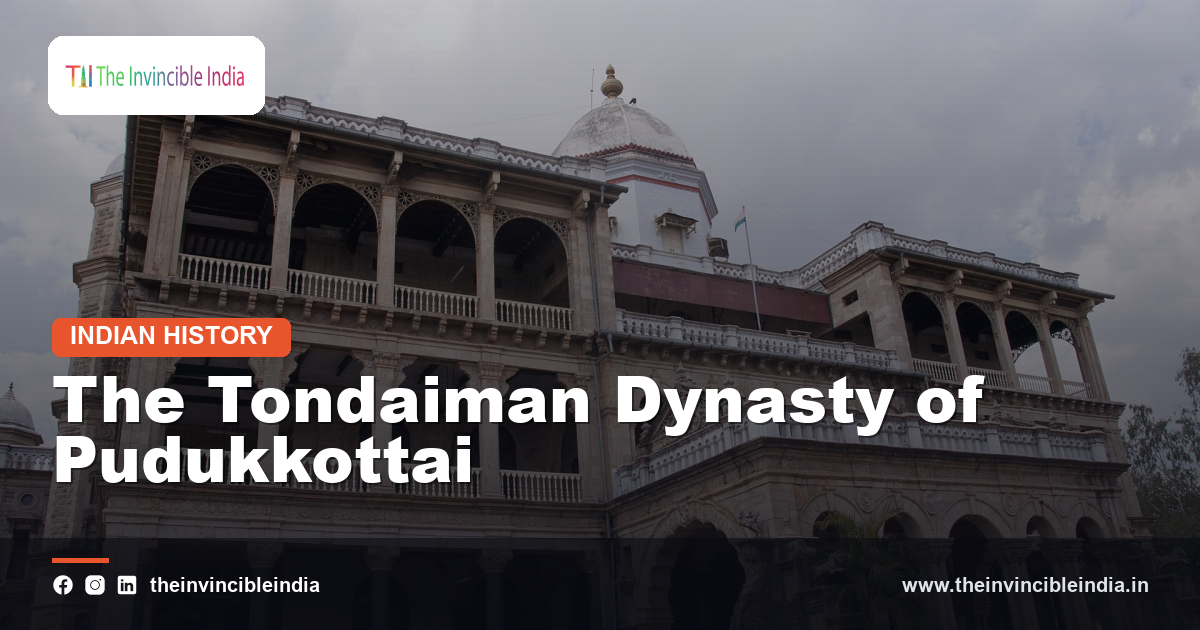
The Tondaiman dynasty of Pudukkottai was a ruling house that governed the Pudukkottai region of the Tamil country, in present-day Tamil Nadu, from the late seventeenth century until the integration of the princely states into independent India. Founded by Raghunatha Raya Tondaiman, the dynasty established a small but enduring state that holds the distinction of having been the only princely state in the Tamil country under British paramountcy. The Pudukkottai state is associated with the imposing Thirumayam fort and, nearby, with the celebrated Sittanavasal Jain caves, known for their ancient paintings. As a ruling house of the southern Tamil country, the Tondaimans belong to the rich history of the region, in the same broad world as the southern dynasty described in our guide to the Chola dynasty. Because several dates and details rest on tradition and the records of the period, this account keeps to general terms where the record is uncertain.
Quick answer: The Tondaiman dynasty of Pudukkottai was a ruling house that governed the Pudukkottai region of the Tamil country, in present-day Tamil Nadu, from the late seventeenth century until the integration of the princely states into independent India. Founded by Raghunatha Raya Tondaiman, it was the only princely state in the Tamil country under British paramountcy. The state is associated with the Thirumayam fort and, nearby, the celebrated Sittanavasal Jain caves, known for their ancient paintings.
Key Takeaways
- The Tondaiman dynasty ruled the Pudukkottai region of the Tamil country, in present-day Tamil Nadu.
- The dynasty was founded in the late seventeenth century by Raghunatha Raya Tondaiman.
- Pudukkottai was the only princely state in the Tamil country under British paramountcy.
- The state is associated with the imposing Thirumayam fort.
- The celebrated Sittanavasal Jain caves, known for their ancient paintings, lie near Pudukkottai.
- The dynasty’s rule ended with the integration of the princely states into independent India.
Read on for the history, culture, and legacy in detail.
Quick Facts
| Detail | Information |
|---|---|
| Dynasty | Tondaiman dynasty of Pudukkottai |
| State | Pudukkottai princely state |
| Period | Late seventeenth century to mid-twentieth century |
| Region | Pudukkottai, present-day Tamil Nadu |
| Capital | Pudukkottai |
| Founder | Raghunatha Raya Tondaiman |
| Distinction | Only princely state in the Tamil country |
| Key Fort | Thirumayam fort |
| Nearby Heritage | Sittanavasal Jain caves |
Who Were the Tondaimans of Pudukkottai?
The Tondaimans of Pudukkottai were a ruling house that governed the Pudukkottai region of the Tamil country, in present-day Tamil Nadu, from the late seventeenth century into the modern era. Taking their name from the Tondaiman title, they established a small but enduring state that became the only princely state in the Tamil country under British paramountcy. The dynasty rose in the political order of the southern Tamil country in the period after the great medieval empires and the Nayak rulers, carving out a territory of its own. The Tondaimans are remembered for their long continuity, their forts and their patronage of temples and culture in the region. As a ruling house with a distinctive place among the states of the south, they occupy an important position in the history of the Tamil country. Their rule combined the authority of a princely dynasty with the character of a small southern state over a long span of history.
Where Is Pudukkottai Located?
Pudukkottai is a region and town in the southern part of present-day Tamil Nadu, in the heart of the Tamil country, surrounded by the plains and historic lands of the south. The region lies among areas long associated with the great dynasties and traditions of the Tamil country, making it part of a landscape rich in temples and heritage. The town of Pudukkottai served as the capital and seat of the Tondaiman dynasty, which ruled the surrounding territory. The region’s position within the Tamil country placed it among the states and powers that contested and shared the south in the period after the medieval empires. Its lands, forts and temples reflect its long history under the Tondaimans. The nearby sites of Thirumayam and Sittanavasal add to the heritage of the region. Pudukkottai was thus both the homeland and the seat of the Tondaiman dynasty in the southern Tamil country.
Who Founded the Tondaiman Dynasty?
The Tondaiman dynasty was founded in the late seventeenth century by Raghunatha Raya Tondaiman, remembered as the ruler who established the line and the state of Pudukkottai. According to tradition and the records of the period, he rose amid the political order of the southern Tamil country and secured authority over the Pudukkottai region, laying the foundation for the enduring dynasty. His founding of the state inaugurated the long rule of the Tondaimans, which continued into the modern era. He is remembered as the progenitor of the dynasty and the founder of its state. As with other rulers of the age, the details of his career are drawn from tradition and the records of the period and are treated with scholarly care. Raghunatha Raya Tondaiman thus holds the honoured place of founder in the history of the Tondaimans. From his foundation the dynasty grew into the only princely state of the Tamil country.
How Did Pudukkottai Become a State?
Pudukkottai became an enduring state through the efforts of the Tondaiman dynasty, which established and preserved its authority over the region from the late seventeenth century onward. In the shifting politics of the southern Tamil country in this period, the Tondaimans secured their territory and maintained it amid the rise and fall of greater powers. As larger states contended for dominance in the south, Pudukkottai managed to preserve its separate existence under its own ruling house. In time, under British paramountcy, the state was recognised as a princely state, holding the distinction of being the only one in the Tamil country. This status allowed the Tondaimans to continue their rule within the framework of the wider authority. The details of the state’s formation and recognition are drawn from the records of the period and are described in general terms. Pudukkottai thus endured as a distinctive princely state through the changing history of the south.
Why Was Pudukkottai the Only Princely State in the Tamil Country?
Pudukkottai held the notable distinction of being the only princely state in the Tamil country under British paramountcy, a status that set it apart among the lands of the south. While much of the Tamil country came under direct administration within the British system, the Tondaiman state of Pudukkottai retained its position as a princely state ruled by its own dynasty. This distinctive status arose from the particular history of the state and its relations with the paramount power, which recognised the continued rule of the Tondaimans. As a princely state, Pudukkottai managed its internal affairs under its ruling house while acknowledging the overarching authority. This made it unique in the Tamil country, where no other such state existed in the same way. The details of this arrangement are drawn from the records of the period and are described in general terms. The distinction gives Pudukkottai a special place in the history of the southern princely states.
What Is Thirumayam Fort?
Thirumayam fort is one of the most notable monuments associated with the region of Pudukkottai, an imposing fort set on and around a rocky hill that guarded the surrounding country. Renowned for its strong ramparts and its commanding position, the fort is a striking example of the fortified landscape of the southern Tamil country. The site is also associated with ancient rock-cut shrines in the vicinity, adding to its religious and historical importance. As a stronghold in the region ruled by the Tondaimans, Thirumayam played a part in the military and political life of the area. Its remains stand among the heritage landmarks of the Pudukkottai region today. As with other forts, the precise history of Thirumayam reflects the contributions of successive powers over time. Thirumayam fort thus embodies the military heritage of the region and its long history, including the era of the Tondaiman dynasty of Pudukkottai.
What Are the Sittanavasal Caves?
The Sittanavasal caves, near Pudukkottai, are among the most celebrated heritage sites of the region, an ancient Jain rock-cut complex renowned above all for its paintings. The site preserves a rock-cut shrine and remains associated with Jain tradition, and it is especially admired for its ancient murals, among the notable examples of early Indian painting in the south. These paintings depict figures and motifs in a style treasured for its artistic quality and its historical importance. Sittanavasal reflects the deep roots of Jain and artistic traditions in the Tamil country, long predating the Tondaiman dynasty, within whose region it later lay. The site stands among the most important ancient monuments of the Pudukkottai area. As with other heritage sites, its history and paintings are studied with scholarly care. The Sittanavasal caves add greatly to the rich heritage of the Pudukkottai region and its place in the artistic history of the south.
How Did the Tondaimans Relate to Larger Powers?
The Tondaimans of Pudukkottai, like other southern ruling houses, had to navigate relations with the larger powers that contended for dominance in the Tamil country across their long history. In the period after the Nayaks, the south saw the rise of various powers, and the Tondaimans engaged with them through patterns of alliance, accommodation and, at times, conflict, as was common among the smaller states. Over time, the region came within the framework of British paramountcy, under which Pudukkottai was recognised as a princely state. The relations of the Tondaimans with these greater powers shaped the fortunes and the continued existence of their state. Their skill in navigating this shifting landscape helped preserve their rule when other states were absorbed. The details of these relations are drawn from the records of the period and are described in general terms. The Tondaimans thus maintained their state through careful engagement with the dominant powers of the south.
How Was the Pudukkottai State Governed?
The Pudukkottai state was governed by the Tondaiman raja, whose authority rested on control of the region, its revenues and its administration, within the wider political order of the Tamil country. As a small but enduring state, Pudukkottai was administered through officials and institutions that managed revenue, justice and the affairs of the territory. Under British paramountcy, as a princely state, it conducted its internal affairs under its ruling house while acknowledging the overarching authority. The modern era saw the development of administration, education and public works in the state, in keeping with the trends of the princely states. The wealth of the region and its careful governance supported the continuity of the dynasty. As in other states, officials and advisers held responsibilities within the structure of government. The details of the administration are drawn from the records of the period. This system of governance enabled the Tondaimans to maintain their enduring rule over Pudukkottai.
What Was the Culture and Patronage of the Tondaimans?
The Tondaimans were patrons of temples, religion and the arts, and their support for the culture of the Tamil country forms an important part of their legacy. As rulers deeply tied to their region, they supported the temples and devotional traditions of the south, as well as learning and the arts at their court. Their patronage reflected the rich religious and cultural heritage of the Tamil country, in which temples held a central place. The state of Pudukkottai is associated with temples, monuments and cultural institutions that developed under the dynasty. In the modern era, the Tondaimans also supported education and public works, in keeping with the character of the princely states. This patronage expressed the devotion and prestige of the dynasty and tied its rule to the cultural life of the south. The details of their patronage are drawn from tradition and the records of the region. Through such support the Tondaimans contributed to the heritage of the Tamil country.
What Temples and Monuments Mark Pudukkottai?
Pudukkottai and its region are marked by a rich array of temples and monuments that reflect the long history of the area and the patronage of the Tondaiman dynasty. The region preserves temples in the traditions of the Tamil country, including ancient rock-cut shrines and later temples supported by the rulers. The imposing Thirumayam fort and the celebrated Sittanavasal caves stand among the most notable heritage sites near the town. The capital itself developed monuments, institutions and buildings under the Tondaimans, especially in the modern era. Together these temples, forts and sites illustrate the depth of the region’s heritage, from ancient times through the era of the dynasty. As with other heritage, these monuments are studied through tradition, inscriptions and archaeology. The temples and monuments of Pudukkottai thus bear witness to the long history of the region and the devotion and patronage of its rulers across many centuries.
How Did Pudukkottai Fare Under the British?
Pudukkottai fared as a recognised princely state under British paramountcy, holding the distinctive position of being the only such state in the Tamil country. Under this arrangement, the Tondaiman rulers continued to govern their territory and manage its internal affairs while acknowledging the overarching authority of the paramount power. The modern era brought developments in administration, education and public works to the state, reflecting the wider trends among the princely states. The relationship with the British framework shaped the fortunes and the continued existence of Pudukkottai, which preserved its status when other territories came under direct administration. The family retained its royal standing and its association with the heritage of the region. The details of this period are drawn from the records of the time and are described in general terms. Under the British framework, Pudukkottai thus continued as a distinctive princely state until the integration of the states into independent India.
How Did Pudukkottai Join India?
Pudukkottai, like the other princely states, became part of independent India in the years following independence in 1947, as the states were integrated into the new nation. With the end of British paramountcy, the rulers of the princely states acceded to India, and Pudukkottai was merged into the republic, becoming part of the Tamil country of the modern state. This transition brought to a close the long rule of the Tondaiman dynasty as a ruling house, though the family retained its historical standing and heritage. The integration of the states was part of the great reshaping of the political map of the subcontinent after independence. For the Tondaimans, it marked the end of their distinctive status as the only princely state of the Tamil country. The details of the integration belong to the broadly recorded history of the period. The joining of Pudukkottai to India thus closed the final chapter of the Tondaiman dynasty as a ruling house.
Why Is the Tondaiman Dynasty Significant?
The Tondaiman dynasty of Pudukkottai is significant as the only princely state in the Tamil country under British paramountcy and as an enduring ruling house of the southern Tamil country. Founded in the late seventeenth century by Raghunatha Raya Tondaiman, the dynasty preserved its small state through the shifting politics of the south over a long span of history. Its distinctive status among the lands of the Tamil country gives it a special place in the history of the southern princely states. The region’s heritage, including the Thirumayam fort and the celebrated Sittanavasal caves, reflects the depth of its history, and the patronage of the Tondaimans added to the culture of the south. For students of Indian history, the dynasty offers a vivid example of a small southern state that endured where others were absorbed. Its significance rests on this combination of long continuity, distinctive status and rich regional heritage.
The Tondaiman Dynasty Today
The Tondaiman dynasty of Pudukkottai is remembered today through the heritage of the Pudukkottai region, including the imposing Thirumayam fort, the celebrated Sittanavasal caves, and the temples and monuments of the area. These sites draw visitors, pilgrims and admirers of history, art and architecture, standing as enduring symbols of the long history of the region and the rule of the Tondaimans. The memory of Pudukkottai as the only princely state of the Tamil country remains a distinctive part of the historical identity of the south. The family retains its historical standing and its association with the heritage of the region. Scholars continue to study the forts, caves, temples and records of the area to refine the understanding of the dynasty and its place in the history of the Tamil country. For readers of Indian history, the Tondaimans offer a striking example of an enduring southern state. Their legacy endures in the heritage of Pudukkottai.
Sources & Further Reading
- Archaeological Survey of India (asi.nic.in).
- Ministry of Culture, Government of India (indiaculture.gov.in).
- Department of Tourism, Government of Tamil Nadu (tamilnadutourism.tn.gov.in).
Frequently Asked Questions
Who were the Tondaimans of Pudukkottai?
The Tondaimans were a ruling house that governed the Pudukkottai region of the Tamil country, in present-day Tamil Nadu, from the late seventeenth century into the modern era. They are notable as the rulers of the only princely state in the Tamil country under British paramountcy.
Who founded the Tondaiman dynasty?
The Tondaiman dynasty was founded in the late seventeenth century by Raghunatha Raya Tondaiman, remembered as the ruler who established the line and the state of Pudukkottai. From his foundation the dynasty endured into the modern era.
Why was Pudukkottai special?
Pudukkottai held the distinction of being the only princely state in the Tamil country under British paramountcy. While much of the Tamil country came under direct administration, the Tondaiman state retained its position as a princely state ruled by its own dynasty.
What is Thirumayam fort?
Thirumayam fort is an imposing fort near Pudukkottai, set on and around a rocky hill, renowned for its strong ramparts and commanding position. It is also associated with ancient rock-cut shrines nearby and stands among the heritage landmarks of the region.
What are the Sittanavasal caves?
The Sittanavasal caves, near Pudukkottai, are an ancient Jain rock-cut complex renowned above all for their paintings, among the notable examples of early Indian painting in the south. They reflect the deep roots of Jain and artistic traditions in the Tamil country.
How did Pudukkottai join India?
Pudukkottai, like the other princely states, became part of independent India in the years following independence in 1947, as the states were integrated into the new nation. The accession brought to a close the long rule of the Tondaiman dynasty as a ruling house.


