

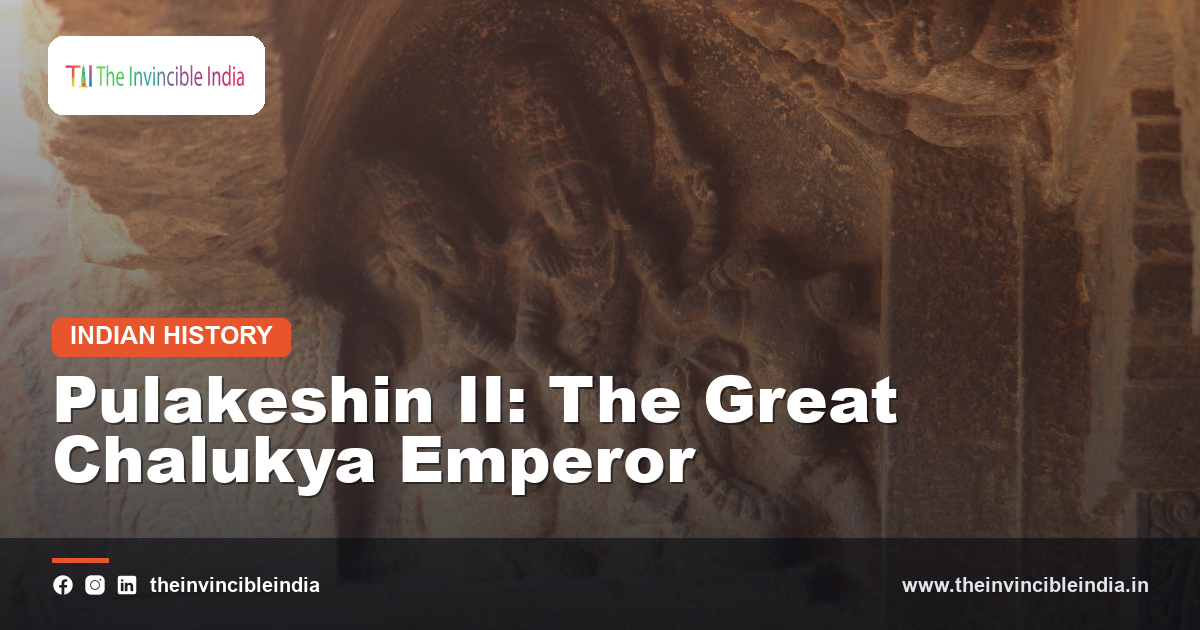
Pulakeshin II is remembered as the greatest ruler of the Badami Chalukyas, the dynasty that rose to command the Deccan plateau in the early medieval age. Reigning from the fortress capital of Vatapi, he consolidated a kingdom shaken by dynastic struggle, extended its authority over neighbouring powers, and gained lasting fame for checking the southward advance of the northern emperor Harsha. His achievements were praised in a celebrated Sanskrit inscription at Aihole, and his reign has long been seen as a high point of the Deccan. Like the great imperial dynasties of the north, the Chalukyas built a state that shaped the politics, art and architecture of an entire region. This guide explores the world, the career and the legacy of Pulakeshin II.
Quick Facts
| Detail | Information |
|---|---|
| Dynasty | Badami (Vatapi) Chalukyas |
| Capital | Vatapi, present-day Badami |
| Region | The Deccan plateau |
| Famous inscription | The Aihole inscription |
| Best-known event | Halting the northern emperor Harsha |
| Era | Early medieval India, seventh century CE |
The Chalukyas and Their Deccan Homeland
The Chalukyas of Badami rose to power in the Deccan during the early medieval age, in the lands that today form much of Karnataka and the surrounding regions. Their homeland was a plateau of rich black soil, rocky hills and river valleys, a country well suited to agriculture, to trade and to the building of strong hill fortresses. From this base the dynasty grew from a regional power into one of the leading kingdoms of the subcontinent. The Chalukyas gave the Deccan a long period of political stability and cultural creativity, and their kings patronised learning, religion and architecture on a generous scale. It was into this rising dynasty that Pulakeshin II was born, and it was this inheritance that he would carry to its height. The story of the great Chalukya emperor begins with the plateau kingdom that shaped him and the dynasty that raised him.
Vatapi, the Fortress Capital
The capital of the early Chalukyas was Vatapi, the place now known as Badami, set within a dramatic landscape of red sandstone cliffs. The city was protected by steep hills on several sides and by a natural stronghold that made it hard to attack, while its water tank and surrounding fortifications gave it both beauty and strength. Vatapi became the political and ceremonial heart of the kingdom, a place where kings ruled, temples were built and artisans worked in stone. The caves carved into the sandstone cliffs show how seriously the dynasty took the arts of religion and design. Pulakeshin II ruled from this fortress capital, and its walls and hills stood as the symbol of Chalukya power. Vatapi was the stage on which the greatness of the dynasty was displayed and the centre from which the Deccan was governed.
The Early Years and the Struggle for the Throne
The early years of Pulakeshin II were marked by dynastic uncertainty. Traditional accounts tell that a conflict over succession arose within the royal family after the death of an earlier ruler, and that the young prince had to secure his place in a time of danger and rivalry. By overcoming these troubles, he emerged as the undisputed king and began the work of restoring the authority of the dynasty. The fact that he came to the throne through struggle shaped the character of his reign, which was marked by determination, energy and a readiness to act decisively. A kingdom that had been weakened by internal division was soon made strong again under his leadership. His rise from a contested succession to firm kingship is one of the defining episodes of his life and the first step towards the imperial standing his dynasty would achieve.
Consolidating the Kingdom
Once secure on the throne, Pulakeshin II turned to the task of consolidating his kingdom. He brought restless feudatories and neighbouring chiefs under control, restored order within the realm and strengthened the machinery of government. Rulers who had taken advantage of the dynasty’s troubles were made to accept Chalukya authority once again, and the borders of the kingdom were made secure. A strong administration, loyal governors and a capable army were the foundations on which his later conquests rested. The kingdom he ruled was not a distant empire held together by chance but a well-organised state with a firm centre. The work of consolidation, though less famous than his great victories, was what made those victories possible. By first making his own house strong, Pulakeshin II laid the ground for the wider triumphs that would earn him his place among the great kings of the Deccan.
Campaigns Against Neighbouring Powers
The reign of Pulakeshin II was a time of vigorous military expansion. According to the praise recorded in his own age, he campaigned against a number of neighbouring kingdoms and dynasties of the south and west, and brought many of them under his sway or forced them into submission. These campaigns widened the borders of the Chalukya state and brought tribute and prestige to the king. The kingdoms around the Deccan, whether in the coastal belt, the southern plateau or the lands towards the north, learned to reckon with the power of Vatapi. Each campaign added to the standing of the dynasty and to the confidence of its ruler. Without needing exact lists of every battle, it is clear that the king earned a reputation as a formidable and successful commander. The expansion of Chalukya power under Pulakeshin II was among the great political achievements of the age.
The Contest with Harsha
The most famous event of the reign was the encounter with Harsha, the powerful emperor of the north, whose empire had spread over much of the Gangetic plain. Harsha sought to extend his authority southwards, and his advance brought him into confrontation with the Chalukya king in the region of the Narmada river. The outcome, as it is widely remembered, was that Harsha could not push beyond that frontier, and the river came to mark a boundary between the northern and southern powers. For a ruler of the Deccan to check the greatest king of the north was an achievement that echoed across the subcontinent. It confirmed Pulakeshin II as a leader of the first rank and made his name known far beyond his own kingdom. The contest with Harsha is the best-known episode of his reign and the one that most clearly established his greatness.
The Title of Lord of the South
After his success against the northern emperor, Pulakeshin II was celebrated as the great lord of the southern region, a title that expressed the new standing of the Chalukya state. It was a claim to leadership over the whole of the Deccan and the south, made by a king whose power had been proved in battle. Such titles were an important part of royal culture in early India, announcing a ruler as supreme among his peers and worthy of reverence. The grandeur of the title matched the reality of a kingdom that had grown into one of the leading powers of the subcontinent. Poets and court officials used it to describe the king and to celebrate his reign, and it was remembered long after. The title of lord of the south summed up the stature of Pulakeshin II and the paramount position that the Chalukyas had reached in his time.
The Aihole Inscription
The reign of Pulakeshin II is known to history above all through the famous Aihole inscription, a long Sanskrit eulogy composed by the court poet Ravikirti. Engraved on a stone at a temple in Aihole, it praises the king, recounts the glory of his lineage and describes his victories in elegant verse. The inscription is a landmark in the history of Indian writing, valued both as a work of poetry and as an invaluable source for the politics of the age. It shows how deeply learning and literature were valued at the Chalukya court, and how kings used inscriptions to proclaim their achievements to future generations. Much of what is known about the reign of Pulakeshin II comes from this single record. The Aihole inscription remains the most important voice from his own era and the finest tribute to the Chalukya emperor.
The Persian Embassy and Distant Contacts
The fame of Pulakeshin II is said to have reached beyond the borders of India. Tradition holds that he exchanged diplomatic greetings with the ruler of Persia, and the scene of an embassy at a royal court is traditionally associated with a famous painting in the Ajanta caves. Whether understood as history, tradition or a mixture of both, the story reflects the wide reputation of the Chalukya king and the links between India and the lands of western Asia. The Deccan was connected to the sea routes and trading networks of the age, and its ports and markets brought it into contact with distant peoples. A kingdom of such prosperity and power naturally drew the notice of other courts. The tradition of the embassy captures the sense that Pulakeshin II was a ruler known across a wide world, and that the Chalukyas took their place among the great powers of their time.
Xuanzang and the Chalukya Kingdom
Among the visitors who travelled through India in the age of Pulakeshin II was the Chinese Buddhist pilgrim Xuanzang, whose detailed travel account is one of the most valuable records of the period. He described the lands of the Deccan, and his observations offer a picture of the Chalukya kingdom as seen by an outside witness. The pilgrim spoke of a country with a strong and confident people, a respected ruler and a warlike tradition, and he noted the great authority of the king. His account complements the praise of the court poet by adding the view of a foreign observer. That a scholar travelling from far-off China took note of the Chalukya king shows how far his reputation had spread. The testimony of Xuanzang is one of the precious outside windows into the age and an enduring record of the standing of Pulakeshin II.
Governance and Administration
The Chalukya state under Pulakeshin II was governed through a system of royal authority supported by officials, governors and local chiefs. The king stood at the head of the administration, assisted by ministers and a body of officers who looked after revenue, justice and the defence of the realm. Provinces were placed under capable administrators, while subordinate rulers, who accepted the overlordship of Vatapi, governed their own territories and supplied troops and tribute when needed. This arrangement allowed a large and varied kingdom to be held together without the constant presence of the king. Land, agriculture and trade provided the wealth on which the state depended. Without needing to claim precise details, it is clear that the Chalukyas built an effective and durable system of rule. The well-ordered administration of the kingdom was a quiet but essential foundation of the success of Pulakeshin II.
Religion and Patronage
The Chalukya age was a time of religious richness, and the rulers of the dynasty supported a variety of faiths. Hindu traditions devoted to Vishnu and Shiva flourished, and the Jain tradition also enjoyed the respect and patronage of the court, as the inscription at a Jain temple in Aihole itself reminds us. Buddhist communities too found a place within the wide world of the Deccan. This spirit of coexistence and generous patronage helped make the kingdom a centre of religious and artistic life. Temples, monasteries, shrines and learned institutions were supported by the royal house and by wealthy donors. The king himself was celebrated as a patron of Sanskrit learning and of sacred traditions. The religious breadth of the Chalukya court, expressed through generous support for many faiths, was a lasting feature of the age of Pulakeshin II and of his dynasty.
The Birth of Temple Architecture
The Chalukya kingdom is celebrated as a cradle of temple architecture in India. In the towns of Aihole, Badami and later Pattadakal, builders experimented with the forms of the temple, trying out different layouts, pillars, roofs and towers, and creating a rich variety of structures in stone. Many of these buildings belong to the wider Chalukya age and not only to the reign of one king, but the creative spirit they reveal was nurtured by the stability and prosperity that rulers like Pulakeshin II provided. Aihole has even been called a laboratory of temple design because of the many styles that appear there. The architectural achievements of the Chalukyas influenced the temple traditions of the Deccan and the south for centuries. The temples of this region stand as a lasting monument to the cultural flowering of the dynasty during and after the age of its greatest king.
The Rock-Cut Caves of Badami
The cliffs of Badami contain a group of rock-cut cave temples that count among the finest works of early Chalukya art. Carved directly into the red sandstone, these caves are dedicated to different traditions, with shrines for Vishnu and Shiva and a cave for the Jain faith, each adorned with sculpture, pillars and graceful figures. The carvings display a confident mastery of form, and the skill of the sculptors is evident in the lively images of deities and guardians. The caves show how the Chalukyas combined the older tradition of rock-cut architecture with their own creative vision. They also reflect the religious breadth of the age, with different faiths represented side by side in the same hills. The caves of Badami remain among the most admired monuments of the Deccan and a vivid reminder of the artistic world of the Chalukya kings.
The Conflict with the Pallavas
The great rivals of the Chalukyas in the south were the Pallavas of Kanchipuram, and the long struggle between the two dynasties shaped the politics of the age. Pulakeshin II fought against the Pallava kings and gained notable successes, extending Chalukya influence into the lands of the southeast. But the rivalry did not end with his victories. A later Pallava ruler, Narasimhavarman, mounted a great campaign against the Chalukya capital, and Vatapi fell, a defeat remembered as a grave setback for the dynasty. Traditional accounts connect the fall of the city with the end of the reign of Pulakeshin II. The contest between the Chalukyas and the Pallavas was a defining feature of the history of the peninsula, and it was a struggle in which fortune turned in both directions. The rivalry marks both the peak and the troubled close of the story of the great Chalukya emperor.
The Eastern Chalukyas and the Spread of the Dynasty
One of the lasting results of the reign of Pulakeshin II was the extension of Chalukya influence into the eastern regions of the peninsula. After conquests in the lands of the east coast, a member of the royal family was placed to govern the region, and from this arrangement a new branch of the dynasty arose, known as the Eastern Chalukyas. This line ruled in the Andhra country for a long period and became an important power in its own right, with its own traditions of literature and temple building. The spread of the family shows how far the vision of Pulakeshin II extended and how enduring his political achievements proved. Even when the main line suffered reverses, the dynasty continued through its other branch. The rise of the Eastern Chalukyas stands as a lasting consequence of the expansion of Chalukya power in the age of its greatest king.
Decline of the Early Chalukya Line and Revival
The fall of Vatapi to the Pallavas brought a severe crisis to the early Chalukya line. For a period the kingdom was shaken, and its authority was weakened by loss of the capital and by internal difficulties. Yet the dynasty did not vanish. Later rulers worked to restore the power of the family, recovering territory and rebuilding the strength of the state, and the Chalukyas of Badami went on to enjoy another phase of prosperity before the dynasty was eventually replaced by a new power in the Deccan. The resilience of the family after the catastrophe testifies to the strong foundations laid by Pulakeshin II and his predecessors. A dynasty that could recover from the loss of its capital had deep roots in the land. The story of decline and revival is an important chapter in the history of the Chalukyas after the great emperor.
Pulakeshin II in Memory and Heritage
Pulakeshin II has been remembered for centuries as one of the great kings of the Deccan. His name is associated with courage, with the defence of the south against the greatest power of the north, and with the glory of the Chalukya dynasty. The Aihole inscription ensured that his deeds were not forgotten, and the monuments of Aihole, Badami and Pattadakal give the world a vivid picture of the culture of his age. Historians regard him as a ruler who raised a regional kingdom to imperial rank and gave the Deccan a place of equality with the north. In the modern heritage landscape, the temples and caves of the Chalukya country attract scholars and travellers from around the world. Pulakeshin II lives on both in the written word and in the stone monuments of his dynasty, a symbol of the proud and creative history of the Deccan.
Pulakeshin II Today
Today Pulakeshin II is remembered as a great emperor whose reign belongs to the shared heritage of India. The temples, caves and inscriptions of the Chalukya country draw visitors to Badami, Aihole and Pattadakal, where the legacy of the dynasty can be seen and studied. Pattadakal is recognised as a World Heritage Site, and the whole region is valued as a treasury of early temple architecture. The story of the king appears in history books, school lessons and the cultural memory of Karnataka, where he is honoured as a symbol of strength and pride. His career reminds modern readers that the Deccan was a centre of power, art and learning in its own right, not merely a land on the edge of northern empires. The memory of Pulakeshin II continues to inspire, a lasting reminder of the greatness of the Chalukya age.
Sources & Further Reading
- Archaeological Survey of India (asi.nic.in).
- Ministry of Culture, Government of India (indiaculture.gov.in).
Frequently Asked Questions
Who was Pulakeshin II?
Pulakeshin II was the most celebrated ruler of the Badami Chalukyas, who made his dynasty the leading power of the Deccan. He is remembered for his conquests and for halting the advance of the northern emperor Harsha.
What is the Aihole inscription?
It is a long Sanskrit eulogy composed by the court poet Ravikirti and engraved at Aihole. It praises Pulakeshin II and describes his victories, and it is the most important source for his reign.
Where was the capital of the Chalukyas of Badami?
The capital was Vatapi, which is now known as Badami in Karnataka. It was a fortress city set among red sandstone cliffs and was home to famous rock-cut caves.
What was Pulakeshin II most famous for?
He is best known for checking the southward advance of Harsha near the Narmada river. This success earned him lasting fame and a title that celebrated him as lord of the south.
What happened to the Chalukya capital after his reign?
Tradition holds that the Pallava king Narasimhavarman captured Vatapi after a great campaign against it. The dynasty later recovered and continued to rule for some time.


