

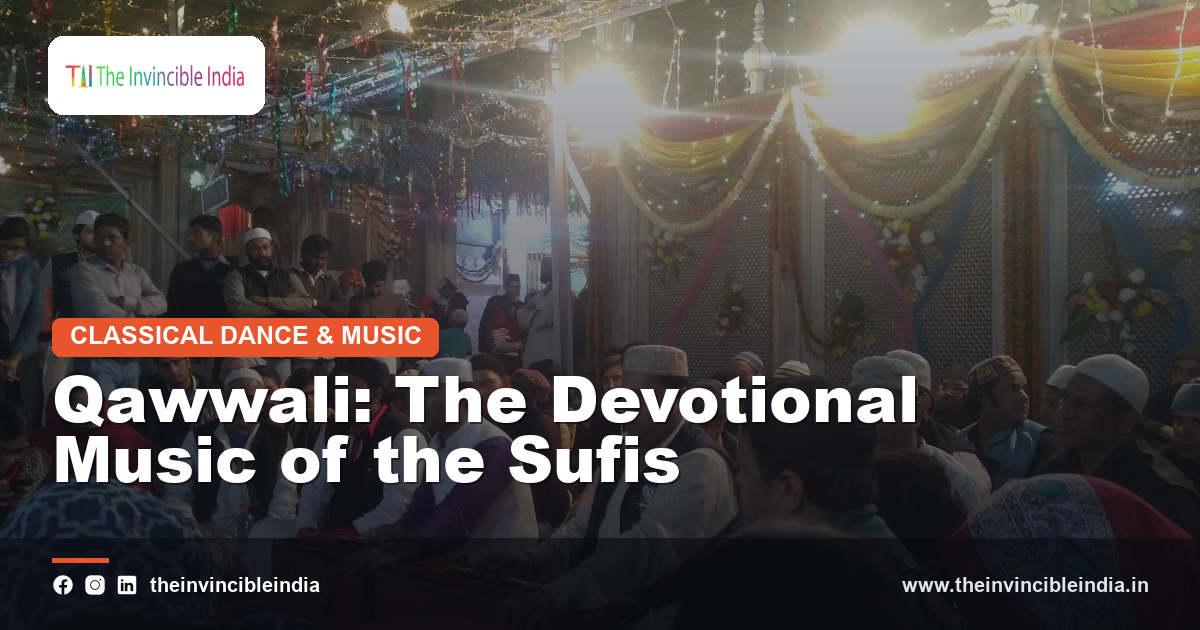
Qawwali is the devotional music of the Sufis, a powerful and ecstatic form of group singing that has been performed at the shrines of Sufi saints for centuries. Rising from a lead singer and chorus, carried by harmonium, drums and rhythmic hand-clapping, and building from a gentle beginning to soaring, rapturous heights, qawwali expresses the soul’s love and longing for the divine. It is at once a spiritual practice and a musical art of great beauty and emotional force, beloved across the Indian subcontinent and, in recent decades, around the world. Rooted in the mystical tradition of Sufism, qawwali has a distinctive form, a rich history and a lineage of celebrated singers. This guide explores its origins, performance, forms, spiritual meaning and enduring appeal.
Quick Facts
| Detail | Information |
|---|---|
| Type | Sufi devotional music, performed by a group |
| Purpose | To express and awaken love and longing for the divine |
| Setting | Traditionally performed at dargahs, the shrines of Sufi saints |
| Associated with | Amir Khusrau and the Chishti order of Sufism |
| Instruments | Harmonium, dholak or tabla, and hand-clapping |
| Form | Lead singer and chorus, building to ecstatic climaxes |
Music as Devotion
Qawwali is, above all, a form of worship, a means by which the Sufis seek to draw near to the divine through music. In the Sufi tradition, music and poetry are powerful vehicles for spiritual experience, capable of stirring the heart and awakening love for God, and qawwali is the great musical expression of this belief. Performed as an act of devotion rather than mere entertainment, it aims to move both performers and listeners towards a state of spiritual ecstasy. This devotional purpose is the key to understanding qawwali: its beauty, its energy and its emotional power all serve the deeper aim of connecting the soul with the divine.
The Sufi Tradition
Qawwali grows from Sufism, the mystical dimension of Islam, which emphasises the inward search for God through love, devotion and direct spiritual experience. The Sufis established orders, each with its own teachers, practices and shrines, and music came to play a central role in the devotional life of several of them. The gatherings at which qawwali is sung are part of this mystical tradition, occasions for remembrance of God and for seeking spiritual closeness through music and poetry. To appreciate qawwali fully is to understand it within this Sufi context, as an expression of a whole tradition of love-centred, mystical devotion that has flourished in the subcontinent for centuries.
Amir Khusrau and the Origins
The origins of qawwali are traditionally associated with the great thirteenth- and fourteenth-century poet, scholar and musician Amir Khusrau, a disciple of a renowned Sufi saint of the Chishti order in Delhi. Khusrau is honoured as a founding figure of qawwali, credited with shaping the form by blending the musical and poetic traditions of the region with Persian influences to create a new devotional music for the Sufi gatherings. A towering figure in the cultural history of the subcontinent, he is remembered for his poetry, his musical innovations and his devotion. The tradition of qawwali as it developed traces its inspiration to Khusrau and the Chishti Sufism of his time.
The Dargah and the Gathering
The natural home of qawwali is the dargah, the shrine of a Sufi saint, where it is sung as part of the devotional life of the shrine. At these shrines, gatherings are held at which qawwals, the singers of qawwali, perform before the assembled devotees, especially on the anniversaries of the saints and other special occasions. The music draws the community together in shared devotion, and the atmosphere can become charged with emotion and spiritual fervour. The dargahs of the great Sufi saints across the subcontinent are famous centres of qawwali, and the tradition of singing at these shrines is central to the life and continuity of the form.
The Qawwali Party
Qawwali is a group performance, sung by an ensemble known as a party. At its head is the lead singer, who carries the main melody and improvises, often supported by one or more secondary singers, and behind them sits a chorus that repeats key lines and responds to the leader. The harmonium provides the melody, the dholak or tabla supplies the driving rhythm, and, distinctively, the whole party marks the beat with vigorous hand-clapping. This combination of a powerful lead voice, a responding chorus, insistent rhythm and clapping gives qawwali its characteristic sound and its building energy, and the coordination of the party is central to the force of a performance.
The Structure of a Performance
A qawwali performance has a characteristic shape, unfolding gradually from a gentle opening to a soaring climax. It often begins with an instrumental prelude and a slow, free introduction of the poetry, before the rhythm enters and the song proper begins. As the performance develops, the tempo and intensity rise, the lead singer improvises and elaborates, repeating and dwelling on especially powerful lines, and the chorus and clapping drive the music forward. The performance builds in waves towards moments of great intensity and rapture. This gradual, cumulative building of emotional and spiritual energy is essential to qawwali and to its power to move performers and listeners alike.
The Poetry of Qawwali
At the heart of qawwali is its poetry, sung in several languages including Persian, Urdu and others, and drawn from the rich tradition of Sufi devotional verse. The poems express love and longing for the divine, praise of God, the Prophet and the saints, and the mystical yearning of the soul, often using the imagery of earthly love and intoxication to convey spiritual truths. The lead singer chooses and interprets these verses, weaving in couplets and dwelling on lines that carry deep meaning. The beauty and depth of the poetry, and the way the singer brings it to life, are central to the emotional and spiritual impact of qawwali.
Forms of Qawwali
Qawwali embraces several forms defined by their devotional subject. The hamd is a song in praise of God, and the naat is a song in praise of the Prophet, both often used to open a gathering. The manqabat praises a revered saint or figure, and other forms express various devotional themes. Alongside these, the tradition includes songs of divine love and mystical longing that form the emotional heart of many performances. These forms give qawwali a structure of devotion, moving from praise of God to celebration of the saints and expression of the soul’s yearning, and a gathering may progress through several of them.
The Path to Ecstasy
The ultimate aim of qawwali is to induce a state of spiritual ecstasy, in which the listener is carried beyond ordinary awareness towards a sense of the divine. As a performance builds in intensity, with the repetition of powerful phrases, the rising rhythm and the fervent singing, listeners may be moved to profound emotion, and some enter a state of rapture. This ecstatic experience is the goal towards which the whole art is directed, the moment when music becomes a vehicle for spiritual transport. The capacity of qawwali to move a gathering to such heights of feeling is the measure of its power and the reason for its central place in Sufi devotion.
The Role of the Qawwal
The qawwal, the singer of qawwali, is far more than a performer; he is a bearer of a devotional tradition. Traditionally, qawwals belong to hereditary families and lineages that have sung at the shrines for generations, preserving the repertoire, the melodies and the manner of performance. A great qawwal combines a powerful voice, deep knowledge of the poetry and music, the skill to improvise and interpret, and the spiritual sensitivity to move a gathering towards ecstasy. The qawwal serves both the saint at whose shrine he sings and the assembled devotees, and the finest are revered figures whose art can bring listeners to tears and rapture.
Music and Rhythm
Musically, qawwali draws on the melodic tradition of North Indian music, using ragas and expressive vocal techniques, but in a form shaped by its devotional purpose and group performance. The harmonium supports and doubles the melody, the dholak or tabla provides a strong, driving rhythm, and the hand-clapping adds a powerful rhythmic layer that propels the music forward. The rhythm is central to the building energy of a performance, its insistent pulse carrying the singing towards its climaxes. This blend of rich melody, strong rhythm and communal clapping gives qawwali its distinctive and irresistible momentum, at once musically sophisticated and emotionally overwhelming.
The Great Qawwals
The qawwali tradition has produced many great singers, and in recent times some have achieved fame far beyond the shrines and the subcontinent. Celebrated qawwals brought the form to concert stages, recordings and international audiences, their powerful voices and passionate performances winning admirers around the world and introducing qawwali to global listeners. Through their artistry, qawwali became known internationally as one of the great devotional musics of the world, admired even by those unfamiliar with its language or tradition. These singers built on the deep heritage of the hereditary qawwal families, carrying the ancient devotional art to new audiences while keeping its spiritual heart intact.
Qawwali Beyond the Shrine
While its true home remains the dargah, qawwali has in modern times spread far beyond the shrine, performed in concerts, featured in films and enjoyed by vast audiences as a musical art in its own right. Film music of the subcontinent embraced the qawwali, giving it huge popularity, and concert performances brought it to listeners at home and abroad. This wider life has made qawwali one of the best-loved musical forms of the region, cherished for its beauty and energy even apart from its devotional setting. Yet at its heart qawwali remains a spiritual art, and its power in the concert hall still flows from the deep devotional tradition from which it springs.
Qawwali Today
Today qawwali flourishes both in its traditional home at the Sufi shrines and on stages and recordings around the world. The hereditary qawwal families continue to sing at the dargahs, preserving the ancient devotional tradition, while celebrated performers carry the form to global audiences and new generations discover its power. Qawwali endures because it speaks to something deep in the human spirit, the longing for the divine and the joy of devotion, expressed through music of great beauty and overwhelming emotional force. In its ecstatic energy and its spiritual depth, qawwali remains one of the most powerful and beloved devotional traditions of the subcontinent and of the world.
Sources & Further Reading
- Sangeet Natak Akademi, national academy for music, dance and drama, on the devotional music traditions of India (sangeetnatak.gov.in).
- Ministry of Culture, Government of India, on Sufi music and the qawwali tradition (indiaculture.gov.in).
Frequently Asked Questions
What is qawwali?
Qawwali is the devotional music of the Sufis, a form of ecstatic group singing traditionally performed at the shrines of Sufi saints. Led by a singer and chorus and carried by harmonium, drums and hand-clapping, it expresses love and longing for the divine.
Who is associated with the origins of qawwali?
Qawwali is traditionally associated with the great thirteenth- and fourteenth-century poet and musician Amir Khusrau, a disciple of a renowned Chishti Sufi saint of Delhi, who is honoured as a founding figure of the form.
Where is qawwali traditionally performed?
Qawwali is traditionally performed at the dargah, the shrine of a Sufi saint, as part of the devotional life of the shrine, especially on the anniversaries of the saints and other special occasions.
What instruments are used in qawwali?
A qawwali party uses the harmonium for melody, the dholak or tabla for rhythm, and vigorous hand-clapping to mark the beat, supporting a lead singer and a responding chorus.
What is the aim of qawwali?
The ultimate aim of qawwali is to induce a state of spiritual ecstasy, carrying performers and listeners towards a sense of the divine through the building intensity of the music, the poetry and the devotion.


