

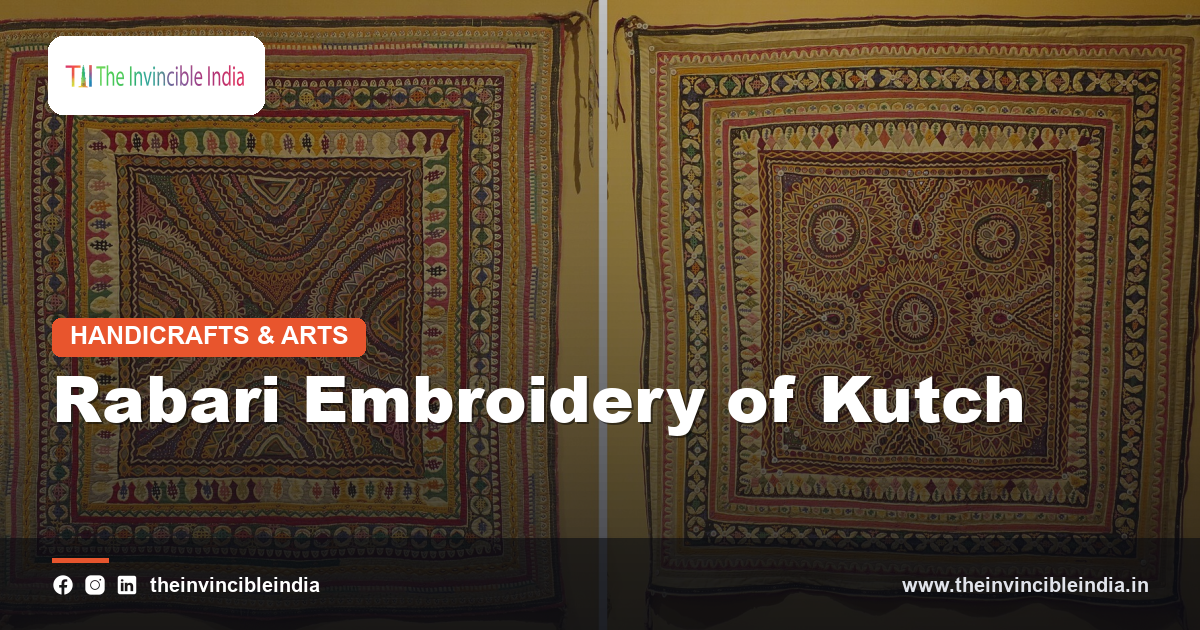
Rabari embroidery is one of the most vibrant needlework traditions of Kutch in Gujarat, created by the women of the Rabari community, a group historically associated with herding and a mobile pastoral way of life. Worked in bright silk and cotton thread and often studded with small pieces of mirror, the embroidery covers blouses, skirts, veils, and household textiles in dense, richly coloured patterns. For the Rabari, needlework is far more than decoration, since it records identity, marks the stages of life, and represents skill that a young woman brings to her new household. Its bold visual language sits alongside other celebrated Indian needle arts such as Bandhani tie-dye of the same western region. This guide traces the origins, techniques, motifs, and living significance of Rabari embroidery.
Quick Facts
| Detail | Information |
|---|---|
| Community | Rabari (Rebari) pastoral community |
| Region | Kutch, Gujarat |
| Core Techniques | Mirror work, chain stitch, and herringbone stitch |
| Typical Base Cloth | Cotton, often in dark shades |
| Common Motifs | Flowers, peacocks, and geometric forms |
| Maker | Women of the community |
The Rabari Community and Its Way of Life
The Rabari, also spelt Rebari, are a pastoral community found in Gujarat and Rajasthan, with a long association with tending livestock such as sheep, goats, and camels. In Kutch, their way of life has traditionally involved moving with herds in search of grazing, a rhythm shaped by the seasons and the availability of pasture in a dry landscape.
This mobile existence has influenced their material culture. Belongings needed to be portable and durable, and clothing and textiles became a way of carrying identity, beauty, and family history wherever the community travelled. Embroidery flourished within this setting, and it remains one of the clearest expressions of Rabari cultural life.
Kutch as a Crafts Landscape
Kutch, the large district of western Gujarat, is one of the richest craft regions of India. Its varied communities have produced distinctive traditions in embroidery, weaving, block printing, and resist dyeing, each with its own colours and stitches. The Rabari embroidery is one strand within this remarkable diversity.
The arid, open landscape of the region often contrasts sharply with the brilliance of its textiles. Against a backdrop of pale earth and sparse vegetation, the saturated reds, pinks, oranges, and blues of embroidered garments stand out with special force. This interplay between austere setting and exuberant colour is a recurring theme in the cultural identity of the whole Kutch region.
Embroidery as Women's Knowledge
Among the Rabari, embroidery is traditionally the work of women, who learn the skill from mothers, aunts, and older relatives from an early age. Girls begin by practising simple stitches and gradually take on more complex compositions as their confidence grows, developing a personal style within the shared conventions of the community.
Much of this work is done in the intervals between household and herding duties, often in the company of other women. The activity therefore has a social dimension, offering a space for conversation and shared learning. It also gives women a recognised form of artistic authority, since the quality of a woman’s needlework is widely respected within her community and reflects on her family.
Embroidery, Dowry, and Life Stages
Rabari embroidery is closely tied to marriage and the transitions of life. A young woman traditionally prepares embroidered garments and household textiles that she will bring to her marital home, and these pieces demonstrate her skill, patience, and the standing of her family.
Clothing also signals the stage of a woman’s life, and different garments and styles of decoration may be associated with girlhood, marriage, and later years. In this sense the embroidery works almost as a visible language, allowing members of the community to read something of a person’s status from what she wears. The craft thus carries meanings that go well beyond ornament, anchoring personal and family milestones in cloth.
Materials and Base Cloth
Rabari embroidery is typically worked on cotton cloth, frequently in dark shades such as black or deep red, which allow the brightly coloured thread to glow. Silk floss has long been prized for its sheen, though cotton and other threads are also used, and modern synthetic threads have entered the craft in many places.
The mirror pieces that give the work its sparkle are small and reflective, attached to the fabric by encircling stitches. Together, the dark ground, the shining thread, and the flashes of mirror create a rich contrast of light and colour. The choice of materials reflects both aesthetic preferences and the practical need for cloth that can withstand the demands of an outdoor, active life.
The Art of Mirror Work
Mirror work is the most recognisable feature of Rabari embroidery. Small mirrors are held in place on the cloth by a framework of thread, and then surrounded with decorative stitching that both secures the mirror and creates a border around it. The technique requires patience and precision to keep each mirror steady and neatly framed.
The gleam of mirrors is admired for its beauty, and in many traditions it is also associated with protection and the warding off of misfortune. Whatever its symbolic meaning for a particular wearer, the effect is unmistakable: garments catch and scatter light as the wearer moves, giving Rabari clothing a shimmering quality that is instantly identifiable and greatly admired.
Stitches and Techniques
Beyond mirror work, Rabari embroidery uses a range of stitches that build up dense surface decoration. Chain stitch is often used to outline and fill forms, while herringbone and other interlacing stitches produce textured bands. Buttonhole stitch may be employed to frame mirrors and to add structure to a design.
These stitches are combined with great freedom, and skilled embroiderers work largely from memory and sense of proportion rather than from drawn patterns. The finished surface often leaves very little of the base cloth visible, so that the garment becomes a continuous field of colour and texture. This density is one of the defining characteristics that distinguish Rabari work from lighter embroidery traditions elsewhere.
Colours and Their Meaning
The palette of Rabari embroidery is bold and saturated, with strong reds, pinks, oranges, yellows, greens, and blues set against darker backgrounds. Colours are chosen not only for visual effect but also for their traditional associations and for the way they harmonise across an entire garment.
Embroiderers exercise careful judgement in balancing intense hues so that the overall effect is lively rather than chaotic. The contrast between light and dark, warm and cool, is used to create rhythm and emphasis. This sophisticated handling of colour, developed through practice and shared community taste, is a major reason why the work continues to attract admiration from designers and textile enthusiasts around the world.
Motifs and Design Vocabulary
The motifs of Rabari embroidery draw on the surrounding world. Flowers, leaves, and plants appear frequently, as do birds such as the peacock, and forms suggested by animals and the pastoral environment. Many designs are arranged geometrically, with repeated units forming borders and central fields.
Motifs are often simplified and stylised, reduced to bold, easily read shapes that suit the scale of the stitching and the dense colouring. Different groups within the wider community may favour particular arrangements, so that an experienced observer can sometimes recognise subtle differences of origin. In this way, the design vocabulary acts as both a shared heritage and a marker of finer distinctions within the community.
Garments and Household Textiles
Rabari embroidery decorates a wide range of items. Women’s blouses, skirts, and veils are among the most elaborately worked pieces, while other embroidered items include bags, hangings, and covers made for the household. Some pieces are made for daily use, and others are reserved for weddings and festive occasions.
The scale of work varies from small accessories to large ceremonial textiles that can take a great deal of time to complete. Each item reflects the same sense of colour and pattern, so that a household filled with such textiles has a unified visual character. This integration of embroidery into every part of life shows how deeply the craft is woven into Rabari culture.
Subgroups and Regional Variations
The Rabari community is made up of several subgroups, and differences in dress and embroidery are among the ways in which these groups distinguish themselves. Variations may appear in the choice of colours, the arrangement of motifs, the density of stitching, and the style of garments.
These distinctions are a reminder that Rabari embroidery is not a single uniform style but a family of related traditions. Each subgroup maintains its own conventions while sharing a general visual language with the others. Understanding these variations deepens appreciation of the craft, and it shows how carefully communities use textiles to express belonging, lineage, and a shared sense of who they are.
Comparison with Other Kutch Embroideries
Kutch is home to many embroidery styles, each associated with particular communities. Some favour fine, closely worked geometric patterns, while others emphasise bold floral forms or large expanses of mirror work. Rabari embroidery is notable for its dense, richly coloured surfaces and the prominent use of mirrors.
Comparing these styles also draws attention to the wider family of Indian needle arts, from the darning-based Phulkari of Punjab to the delicate Chikankari of Lucknow. Against this varied background, the Rabari tradition stands out for its bold colour, its connection to pastoral life, and its close ties to women’s community knowledge.
Changing Times and Adaptation
Like many traditional communities, the Rabari have experienced significant change in recent decades. Shifts in livelihood, settlement, and access to education have altered patterns of daily life, and with them the conditions under which embroidery is made and worn.
Some younger women wear traditional garments less often, while others continue the practice with pride. New materials and ready-made goods have also entered the market. Yet the craft has proved adaptable, finding fresh forms while retaining its distinctive character. This capacity to change without losing identity has been essential to the survival of Rabari embroidery, and it illustrates how living traditions respond to the world around them.
Craft Livelihoods and Cooperatives
In recent decades, embroidery has become a source of income for many women in Kutch. Craft organisations, cooperatives, and social enterprises have helped artisans reach wider markets, often by adapting traditional skills to new products such as bags, cushion covers, wall hangings, and accessories.
Such initiatives can strengthen the economic independence of women and encourage younger members of the community to value the craft. The best of them respect traditional designs and ensure that artisans receive fair payment for their labour. When livelihoods and heritage support one another in this way, the craft gains a secure footing, and its makers can take pride in work that is both culturally meaningful and economically sustaining.
Buying and Caring for Rabari Textiles
Those wishing to acquire Rabari embroidery should look for well-finished stitching, securely attached mirrors, and colours that remain firm. Buying from recognised craft organisations or directly from artisans helps to ensure authenticity and fair returns, and it discourages the circulation of low-quality machine imitations.
Embroidered textiles need gentle care. They are best cleaned by careful hand washing or professional attention, avoiding harsh rubbing around the mirrors, and dried away from direct sunlight. Storing them flat or loosely folded in breathable cloth prevents damage to the thread and the mirror settings. With thoughtful treatment, a Rabari piece can be enjoyed and admired for a very long time.
Rabari Embroidery Today
Today Rabari embroidery remains one of the most celebrated craft traditions of Kutch. Its bold colours, sparkling mirrors, and dense stitching are admired in India and abroad, and it continues to be practised by women who carry forward the knowledge inherited from their families.
The craft endures because it is rooted in real cultural meaning, from marriage and identity to community pride. Every embroidered garment is a record of skill, time, and belonging. Respecting the makers, buying thoughtfully, and understanding the culture behind the cloth are the surest ways to help this luminous tradition flourish for years to come.
Sources & Further Reading
- Ministry of Culture, Government of India (indiaculture.gov.in).
- Development Commissioner (Handicrafts), Ministry of Textiles (handicrafts.nic.in).
Frequently Asked Questions
What is Rabari embroidery?
Rabari embroidery is the richly coloured, mirror-studded needlework created by women of the Rabari community in Kutch, Gujarat. It decorates garments, dowry textiles, and household items with dense stitching.
Who are the Rabari?
The Rabari, also spelt Rebari, are a pastoral community of Gujarat and Rajasthan traditionally associated with herding livestock. Their textiles and clothing are an important expression of their identity.
What stitches are used in Rabari embroidery?
The work combines mirror attachment with chain stitch, herringbone stitch, and buttonhole stitch, among others. These are layered to produce dense, textured surfaces with little base cloth visible.
What is the significance of mirror work?
Mirrors add a shimmering brilliance to the garments and are often associated with beauty and protection. The technique also demonstrates the precision and patience of the embroiderer.
How should Rabari embroidered textiles be cared for?
They should be cleaned gently, preferably by careful hand washing, and dried away from direct sun. Storing them flat or loosely folded in breathable cloth protects the thread and mirror settings.


