

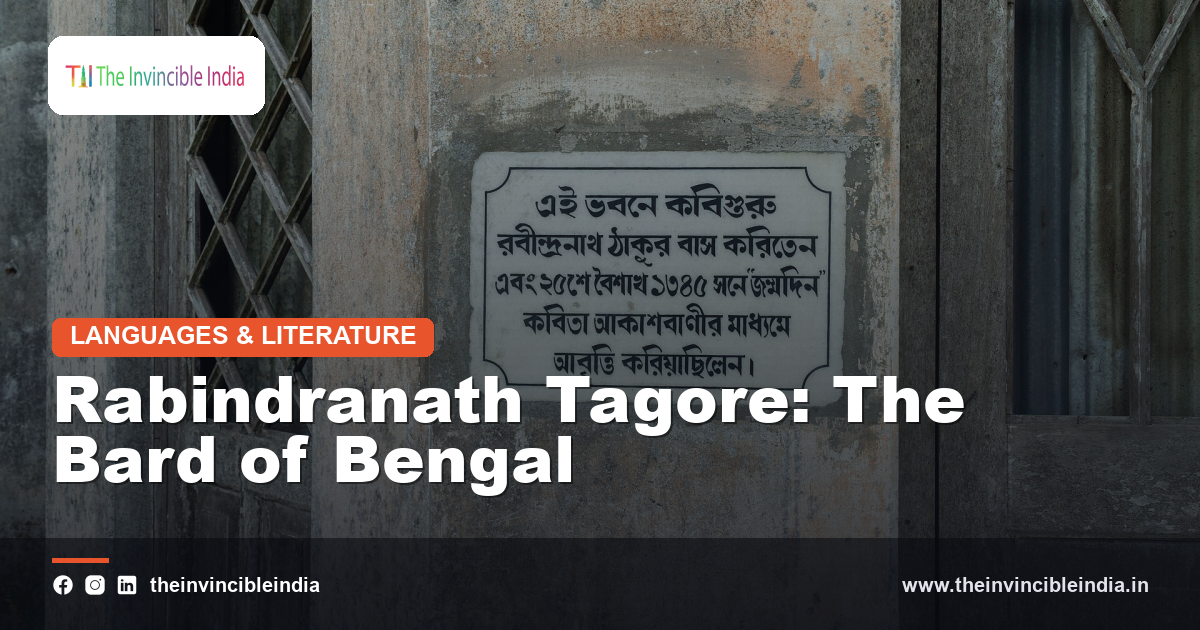
Rabindranath Tagore was one of the greatest figures in the cultural history of India, a towering Bengali poet, writer, composer, philosopher, painter and educator whose genius reshaped the literature and culture of his land. Affectionately known as the Bard of Bengal, he became the first non-European and the first Indian to win the Nobel Prize in Literature, bringing Indian letters to the attention of the world. A giant of the Indian renaissance, he composed thousands of songs, wrote poetry, novels, plays and essays, founded a unique institution of learning, and even penned the words that became the national anthems of two nations. This guide explores the life, works and enduring legacy of Rabindranath Tagore, one of the supreme creative spirits of modern India and a master of its languages and letters.
Quick Facts
| Detail | Information |
|---|---|
| Type | Poet, writer, composer, philosopher and polymath |
| Language | Wrote chiefly in Bengali |
| Honour | First non-European to win the Nobel Prize in Literature |
| Famous work | Gitanjali, a collection of devotional poems |
| National anthems | Wrote the words of the anthems of India and Bangladesh |
| Founded | A unique institution of learning at Santiniketan |
A Towering Genius
Rabindranath Tagore stands as one of the towering geniuses of modern India, a creative spirit of extraordinary range and depth whose work transformed the culture of his country. Poet, novelist, short-story writer, playwright, essayist, composer, painter, educator and philosopher, he mastered an astonishing variety of fields, and in each he left a rich and enduring legacy. His genius helped usher in a renaissance in Bengali and Indian culture, and his influence spread far beyond India. Few figures in any culture have combined such breadth of talent with such depth of achievement. As poet and polymath, national icon and world figure, Tagore holds a place of unique importance in the cultural heritage of India.
The Bard of Bengal
Tagore is affectionately known as the Bard of Bengal, a title that reflects his supreme place in the literature and culture of Bengal and the deep love in which he is held. Writing chiefly in the Bengali language, he raised its literature to new heights and shaped its modern form, and his poems and songs became woven into the very fabric of Bengali life. So beloved and influential is he that he is often referred to by an affectionate honorific expressing reverence and love. For Bengalis, Tagore is not merely a great writer but a cultural presence woven into daily life, and his songs and words are cherished across the generations as a defining expression of Bengali identity and feeling.
A Life of Creativity
Tagore was born into a distinguished and cultured Bengali family that was at the heart of the cultural and intellectual life of its time, an environment that nurtured his prodigious talents from an early age. He began writing poetry as a boy and went on to a life of ceaseless creativity, producing an immense body of work across many forms over a long career, while also travelling widely, engaging with the great questions of his age, and founding his unique school. His life spanned a period of great change in India, and he was both a product and a shaper of the cultural awakening of his era. His long life of creativity left a legacy of astonishing richness and variety.
The Nobel Prize
In a landmark moment for Indian and Asian literature, Tagore became the first non-European and the first Indian to be awarded the Nobel Prize in Literature, a recognition that brought his work, and Indian letters, to the attention of the whole world. The prize was awarded above all for his collection of devotional poems, which had been translated and had made a deep impression on readers in the West with their beauty and spiritual depth. This great honour established Tagore as a world figure and a bridge between the cultures of India and the West, and it remains a source of immense pride in India, a milestone in the recognition of Indian literature on the world stage.
Gitanjali
The work above all associated with Tagore’s Nobel Prize and his world fame is Gitanjali, meaning song offerings, a collection of devotional poems of great beauty and spiritual depth. In these poems, Tagore gave exquisite expression to his profound and personal sense of the divine, blending devotion, nature and human feeling in verse of luminous simplicity and grace. When Gitanjali was translated into English, it captivated readers in the West with its spiritual beauty, winning the admiration of great writers and helping to secure Tagore the Nobel Prize. Gitanjali remains the most celebrated of Tagore’s works internationally and a treasured expression of his spiritual vision, admired around the world for its beauty and depth.
A Master Poet
Above all, Tagore was a poet, and his poetry is the heart of his achievement, ranging across an immense variety of themes, moods and forms over his long career. He wrote of nature, love, the divine, humanity, the nation and the deepest questions of life, in verse of great beauty, feeling and philosophical depth. His mastery transformed Bengali poetry, giving it new forms, new subjects and a new music, and his poems are cherished and recited to this day. Whether in devotional verse, lyric poetry or reflective meditation, Tagore’s poetic genius shines, and it is as a poet that he is most deeply loved. His poetry is among the greatest treasures of modern Indian literature.
The Songs of Tagore
One of Tagore’s most remarkable and beloved achievements is his vast output of songs, both the words and the music of which he composed, creating a whole genre known as Rabindra Sangeet, the songs of Tagore. He composed thousands of songs on themes of love, nature, devotion, the seasons and the nation, and these songs, with their beautiful melodies and exquisite lyrics, are woven into the emotional life of Bengal, sung on every occasion of joy and sorrow. Rabindra Sangeet is a living, cherished tradition, a unique fusion of poetry and music that is one of Tagore’s most distinctive and beloved contributions. Through his songs, Tagore lives in the daily emotional life of his people.
Novels and Short Stories
Tagore was also a master of prose fiction, a pioneering novelist and one of the great short-story writers of the modern age. His novels explored the social, political and personal questions of his time with insight and subtlety, and his short stories, of which he wrote many, are considered masterpieces of the form, capturing the lives, joys and sorrows of ordinary people, especially the rural folk and women of Bengal, with sympathy and artistry. Through his fiction, Tagore brought a new realism and humanity to Bengali prose and addressed the great questions of society and the human heart. His novels and stories are treasured as major achievements of modern Indian literature.
Plays and Essays
The creative range of Tagore extended further still, to drama and to the essay. He wrote many plays, often poetic and symbolic, exploring philosophical and human themes and experimenting with dramatic form, and these works form an important part of his legacy in the theatre. He was also a profound and prolific essayist and thinker, writing on literature, society, politics, education, religion and the great questions of his age, and engaging in dialogue with thinkers around the world. His essays reveal the depth and independence of his mind and his engagement with the issues of his time. Together, his plays and essays add yet more dimensions to the astonishing range of his creative and intellectual achievement.
The Educator of Santiniketan
Tagore was also a visionary educator who founded a unique school and university at Santiniketan, embodying his ideals of learning in harmony with nature and across cultures. Dissatisfied with conventional education, he created an institution where learning took place in a natural setting, blending the best of Indian and world traditions, nurturing creativity, and bringing together students and scholars from around the world. This institution grew into a distinguished centre of learning and culture, giving lasting form to Tagore’s educational philosophy. His work as an educator, expressing his belief in a humane, creative and internationally minded education, is one of the important and enduring dimensions of his many-sided genius and legacy.
Writer of National Anthems
A remarkable testament to Tagore’s stature is that he wrote the words of the national anthems of two nations. The song that became the national anthem of India was composed by Tagore, as was the song that became the national anthem of Bangladesh, a distinction unique in the world. That the words of the anthems of two countries flowed from the pen of a single poet reflects the extraordinary reach and depth of his genius and his profound engagement with the idea of the nation and humanity. This unique honour underlines Tagore’s place not only as a great poet but as a figure of national and international significance, whose words continue to be sung by millions.
A Painter Too
In a further expression of his boundless creativity, Tagore took up painting later in his life and produced a large and striking body of visual art. His paintings, distinctive and expressive, revealed yet another dimension of his artistic genius and won recognition in their own right. That a man already supreme as a poet, writer and composer should, in his later years, become a significant painter is a measure of the extraordinary range and restless creativity of his spirit. His paintings are treasured as an important part of his legacy and as a fascinating expression of his artistic vision, adding the visual arts to the astonishing list of fields in which Tagore achieved distinction.
A Voice for Humanity
Beyond his art, Tagore was a great humanist and a voice for universal values, whose vision transcended the boundaries of nation, religion and culture. He believed in the unity of humanity and the harmony of cultures, engaging with thinkers around the world and championing ideals of freedom, creativity and human dignity. He was critical of narrow nationalism and violence and looked towards a world united in mutual understanding. His humane, universal vision, expressed in his writings and his life, gives his legacy a moral and spiritual dimension that speaks powerfully across the world to this day. As a voice for the unity and dignity of humanity, Tagore was a moral as well as an artistic giant.
Tagore Today
Today Rabindranath Tagore remains one of the most beloved and revered figures in Indian culture, his songs sung, his poems recited, his stories read and his ideals honoured across the country and the world. Rabindra Sangeet lives on as a cherished tradition, his institution continues as a centre of learning, and his works remain central to Bengali and Indian literature. His national anthems are sung by the millions of two nations, and his humane, universal vision continues to inspire. As poet and polymath, national icon and world figure, master of language and voice for humanity, Tagore endures as one of the supreme creative spirits of modern India and a giant of world literature.
Sources & Further Reading
- Ministry of Culture, Government of India, on Rabindranath Tagore and Bengali literature (indiaculture.gov.in).
- Sahitya Akademi, national academy of letters, on Tagore and modern Indian literature (sahitya-akademi.gov.in).
- The Nobel Prize organisation, on the Nobel Prize in Literature awarded to Tagore (nobelprize.org).
Frequently Asked Questions
Who was Rabindranath Tagore?
Rabindranath Tagore was a towering Bengali poet, writer, composer, philosopher and polymath, known as the Bard of Bengal. He was the first non-European and first Indian to win the Nobel Prize in Literature and a giant of the Indian renaissance.
What did Tagore win the Nobel Prize for?
Tagore won the Nobel Prize in Literature, becoming the first non-European to do so, above all for his collection of devotional poems Gitanjali, which had been translated and deeply impressed readers in the West with its beauty and spiritual depth.
What is Rabindra Sangeet?
Rabindra Sangeet is the genre of songs composed by Tagore, both words and music, of which he created thousands on themes of love, nature, devotion and the nation. These songs are woven into the emotional life of Bengal and remain a cherished living tradition.
Did Tagore write national anthems?
Yes. Tagore wrote the words of the national anthem of India and also of the song that became the national anthem of Bangladesh, a distinction unique in the world, reflecting the extraordinary reach of his genius.
What was Santiniketan?
Santiniketan was the site of the unique school and university founded by Tagore, embodying his ideals of learning in harmony with nature and across cultures. It grew into a distinguished centre of learning that gave lasting form to his educational philosophy.


