

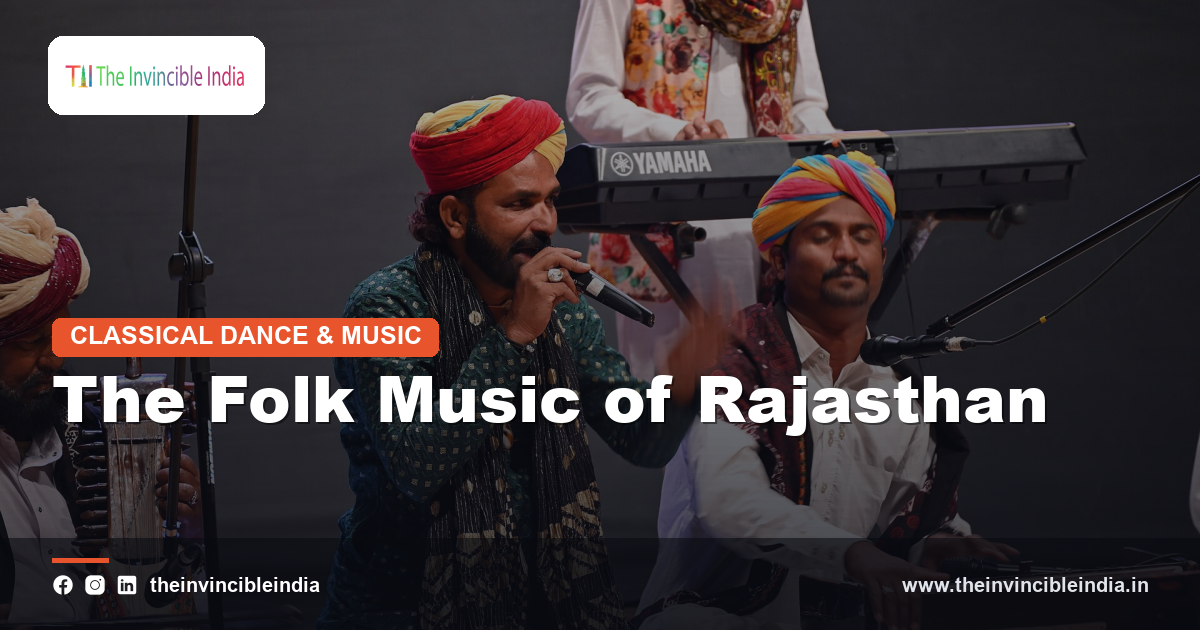
The folk music of Rajasthan is one of India’s richest living musical traditions, shaped by the vast spaces of the Thar Desert and carried for generations by hereditary communities of professional musicians. Unlike the concert conventions of Carnatic music in the south, Rajasthani folk music grew from an intimate patron-performer relationship, in which musician families sang for the households and courts that supported them across generations. Instruments such as the bowed kamaicha and sarangi, the metal khartal and the double flute algoza give the music its distinctive desert sound, while its songs speak of love, valour, devotion and the rhythms of desert life. This guide surveys its communities, instruments, themes and continuing global reach.
Quick Facts
| Detail | Information |
|---|---|
| Type | Folk music tradition |
| Origin | Rajasthan, western India |
| Hereditary communities | Manganiar and Langa musicians |
| Key instruments | Kamaicha, sarangi, khartal, morchang, algoza |
| Themes | Desert life, devotion, valour, love, the seasons |
| Performance context | Weddings, festivals and hereditary patronage |
Music Born of the Thar Desert
The folk music of Rajasthan carries the imprint of the vast, arid landscape from which it arose, its long melodic lines and spacious phrasing evoking the openness of the Thar Desert. In a region of scattered settlements and demanding seasonal rhythms, music served both as entertainment and as a vital thread connecting communities, marking births, weddings, harvests and festivals with appropriate song. Distinct musical styles developed across different districts and communities of Rajasthan, yet a shared desert sensibility runs through them, favouring soulful vocal lines, sustained drones and instruments capable of carrying a melody across open ground. This landscape-shaped character remains one of the most recognisable features of Rajasthani folk music today.
The Manganiar Musicians
The Manganiars are a hereditary community of professional musicians found chiefly in western Rajasthan, whose members have served as singers and instrumentalists for patron families across many generations. Manganiar musicians perform at weddings, births and other significant occasions for their patrons, drawing on an extensive repertoire of songs suited to each occasion and often incorporating devotional themes alongside courtly praise and celebration. Music making within Manganiar families is typically passed down from parent to child, with children absorbing the repertoire and technique from an early age through constant exposure and practice. This close, inherited relationship between music and livelihood has preserved a remarkably rich and varied song tradition within the community.
The Langa Musicians
The Langas are another hereditary musician community of Rajasthan, historically associated with particular patron communities and known for their distinctive vocal style and instrumental skill, especially on bowed and wind instruments. Like the Manganiars, Langa musicians traditionally performed for specific patron families, singing praise songs, ballads and devotional pieces suited to weddings and festive occasions. The Langa repertoire includes songs tied to particular seasons, deities and social occasions, reflecting a similarly close bond between musical practice and community life. Together the Manganiar and Langa traditions represent two of the most celebrated strands of Rajasthani folk music, each with its own stylistic character and instrumental specialities.
Hereditary Patrons and Community Bonds
Central to the traditional practice of Rajasthani folk musicians was a long-standing relationship with patron families, who supported musicians in exchange for performance at important family and community occasions across generations. This system gave musicians a defined social role and a stable, if modest, livelihood, while ensuring that patron families had access to skilled performers for weddings, births and festivals. The relationship was often passed down alongside the musical repertoire itself, with particular musician families serving particular patron lineages over long periods. While economic and social change has reshaped these traditional bonds in recent times, the memory and structure of this patronage system continue to inform how the music is organised and performed.
The Kamaicha: A Bowed Desert Instrument
The kamaicha is a distinctive bowed instrument closely associated with Manganiar musicians, built with a rounded body covered in skin and played upright with a bow drawn across its strings to produce a warm, resonant tone. Its sound underlies many Manganiar vocal performances, providing a sustained melodic and drone accompaniment that supports the singer’s voice across long musical phrases. The instrument requires considerable skill to construct and to play, and its craftsmanship and performance technique have traditionally been passed down within musician families alongside the vocal repertoire. The kamaicha remains one of the most emblematic instruments of Rajasthani folk music, prized for its distinctive timbre and its deep association with desert musical culture.
The Sarangi in Rajasthani Music
The sarangi, a bowed short-necked instrument found in various forms across North India, also has an important place in Rajasthani folk music, particularly among Langa musicians, where it provides rich melodic accompaniment to song. Its many sympathetic strings give the sarangi a resonant, voice-like quality that is often described as closely mirroring the human singing voice, making it a natural partner to vocal performance. Rajasthani sarangi playing has its own regional character, distinct from the sarangi traditions of Hindustani classical music, shaped by the specific melodic and rhythmic demands of local folk repertoire. Its presence underscores the deep connections between Rajasthan’s folk instrumental traditions and the broader bowed-instrument heritage of North India.
Khartal and Morchang: Rhythm Without Drums
Much of the rhythmic texture in Rajasthani folk music comes not from drums alone but from smaller handheld instruments such as the khartal, a pair of wooden clappers played with dazzling speed and precision, and the morchang, a small metal jaw harp that produces a twanging, resonant rhythm when plucked near the mouth. These instruments require considerable dexterity, and skilled khartal players are celebrated for their rapid, intricate patterns performed as an accompaniment to song and dance. Their compact size made them well suited to the itinerant, resource-modest lifestyle of many traditional performers. Together they contribute a light, percussive sparkle that complements the deeper tones of the kamaicha and sarangi.
The Algoza, the Double Flute
The algoza is a distinctive double flute of Rajasthan and neighbouring regions, consisting of two pipes played simultaneously by a single musician, one typically sustaining a drone while the other carries the melody. Playing the algoza demands specialised breath control, since the performer must maintain continuous airflow across both pipes, often using circular breathing techniques to sustain unbroken melodic lines. Its bright, reedy tone is well suited to outdoor performance and to the long, flowing melodic phrases characteristic of desert folk song. The algoza remains a beloved instrument among rural audiences and continues to be featured prominently in folk performances and recordings of Rajasthani music.
Themes of Love, Valour and the Seasons
The song repertoire of Rajasthani folk musicians ranges widely across themes of romantic love, heroic valour, devotion and the changing seasons, reflecting the varied occasions for which music was traditionally required. Ballads recount tales of legendary lovers and courageous figures from regional lore, sung with dramatic intensity to captivate listeners, while other songs mark particular seasons or agricultural moments with appropriate melodies and lyrics. Wedding songs celebrate union and new beginnings, and devotional songs address regional deities and saints. This thematic breadth allowed musician communities to serve every significant occasion in the life of their patrons, and it continues to give Rajasthani folk music its remarkable variety and emotional range.
Devotional and Sufi Strands
Alongside secular ballads and celebratory songs, Rajasthani folk music includes a significant devotional strand, with songs addressed to regional deities, saints and mystic figures revered across community and religious lines. Sufi-influenced songs and those honouring folk saints hold a respected place in the repertoire of many musician families, reflecting the historically syncretic religious culture of the region in which Hindu and Muslim communities often shared musical practice and patronage. These devotional pieces are performed with particular reverence and are often reserved for appropriate occasions such as religious festivals or pilgrimages. This strand highlights how Rajasthani folk music has long served as a bridge between different communities and faiths within the region.
Songs for Weddings and Life-Cycle Ceremonies
Weddings and other life-cycle ceremonies have traditionally been among the most important occasions for Rajasthani folk musicians, who are engaged to sing songs appropriate to each stage of the celebration, from the arrival of the groom’s party to the final farewell of the bride. Such songs mark and heighten the emotional significance of these transitions, giving ceremonial structure to what might otherwise be private family occasions. Musician families often maintain an extensive repertoire specific to different castes, regions and occasions, reflecting the detailed social knowledge required to serve their patrons appropriately. This close integration of music into the life-cycle rituals of Rajasthani society remains one of the tradition’s defining features.
Women's Folk Singing Traditions
Alongside the professional musician communities, Rajasthani women maintain their own rich tradition of folk singing, performed within households and communities during weddings, festivals and everyday domestic occasions rather than as professional engagements. These songs, often sung in groups, address themes of family relationships, seasonal change, devotion and the experiences particular to women’s lives, providing an important complement to the repertoire of hereditary musician families. Passed down informally from mother to daughter and among women of a community, this tradition represents a vital and often under-documented strand of Rajasthani musical culture. Its continued practice within homes and villages preserves an intimate, communal dimension of the region’s musical heritage.
Oral Transmission Across Generations
Rajasthani folk music has been preserved chiefly through oral transmission, with knowledge of songs, melodies and instrumental technique passed down within families and communities rather than through written notation. Children of musician families typically begin absorbing the tradition from early childhood, learning by listening, observing and gradually participating in performances alongside elder relatives. This method of transmission has allowed considerable regional and family variation to flourish within a broadly shared musical idiom, giving Rajasthani folk music its rich diversity of styles. While recordings and documentation projects have supplemented oral transmission in recent decades, the living, person-to-person teaching relationship remains central to how the tradition continues to be passed on.
Courtly Patronage and Royal Courts
Beyond village and household patronage, the royal courts of Rajasthan’s princely states historically provided significant support to accomplished folk musicians, who performed at court occasions and were sometimes retained as court artists. Such patronage offered opportunities for musicians to refine their craft before appreciative and knowledgeable audiences, and court support helped sustain particularly skilled performers and their families. Though the political structures of princely patronage have long since changed, this history of courtly appreciation contributed to the prestige and refinement of certain strands within Rajasthani folk music. The legacy of this patronage can still be seen in the polish and sophistication of the finest traditional performers today.
Rajasthani Folk Music on the Global Stage
In recent decades Rajasthani folk musicians, particularly from the Manganiar and Langa communities, have gained international recognition, touring and performing at festivals around the world and collaborating with musicians from other traditions and genres. This global exposure has introduced audiences far beyond Rajasthan to the distinctive sounds of the kamaicha, sarangi and algoza, and has provided welcome new opportunities and income for musician families whose traditional patronage arrangements have evolved over time. Documentary films, recordings and cultural exchange programmes have further raised the profile of these traditions internationally. This wider recognition has helped ensure that a music once confined largely to Rajasthan’s villages and courts now reaches a truly global audience.
Rajasthani Folk Music Today
Today Rajasthani folk music remains a vibrant living tradition, performed at weddings, festivals, tourist gatherings and international concert stages alike, sustained by hereditary musician communities alongside new generations of trained performers. Cultural festivals within Rajasthan continue to showcase the depth and variety of the repertoire, while recordings and global tours carry its distinctive instruments and songs to ever wider audiences. Efforts to document and support traditional musician families help balance the pressures of modern economic life with the preservation of an art passed down through generations. In its blend of desert-shaped melody, hereditary craftsmanship and enduring communal purpose, Rajasthani folk music continues to represent one of India’s richest regional musical heritages.
Sources & Further Reading
- Sangeet Natak Akademi, national academy for music, dance and drama, on the folk music traditions of Rajasthan (sangeetnatak.gov.in).
- Ministry of Culture, Government of India, on the intangible musical heritage of Rajasthan (indiaculture.gov.in).
Frequently Asked Questions
What is Rajasthani folk music?
Rajasthani folk music is the traditional music of Rajasthan, carried chiefly by hereditary communities such as the Manganiars and Langas, who perform songs of love, valour, devotion and celebration on instruments including the kamaicha, sarangi and algoza.
Who are the Manganiar and Langa musicians?
The Manganiars and Langas are hereditary communities of professional musicians in Rajasthan who traditionally performed for patron families at weddings and other significant occasions, passing their repertoire and instrumental skill down across generations.
What is a kamaicha?
The kamaicha is a bowed instrument with a skin-covered body, closely associated with Manganiar musicians, prized for its warm, resonant tone that provides sustained melodic accompaniment to vocal performance.
What instruments provide rhythm in Rajasthani folk music?
Rhythm in Rajasthani folk music is often provided by handheld instruments such as the khartal, a pair of wooden clappers, and the morchang, a small metal jaw harp, played with considerable speed and dexterity.
Is Rajasthani folk music performed internationally?
Yes, Rajasthani folk musicians, particularly from the Manganiar and Langa communities, regularly tour and perform at festivals worldwide, and their music has gained significant international recognition in recent decades.


