

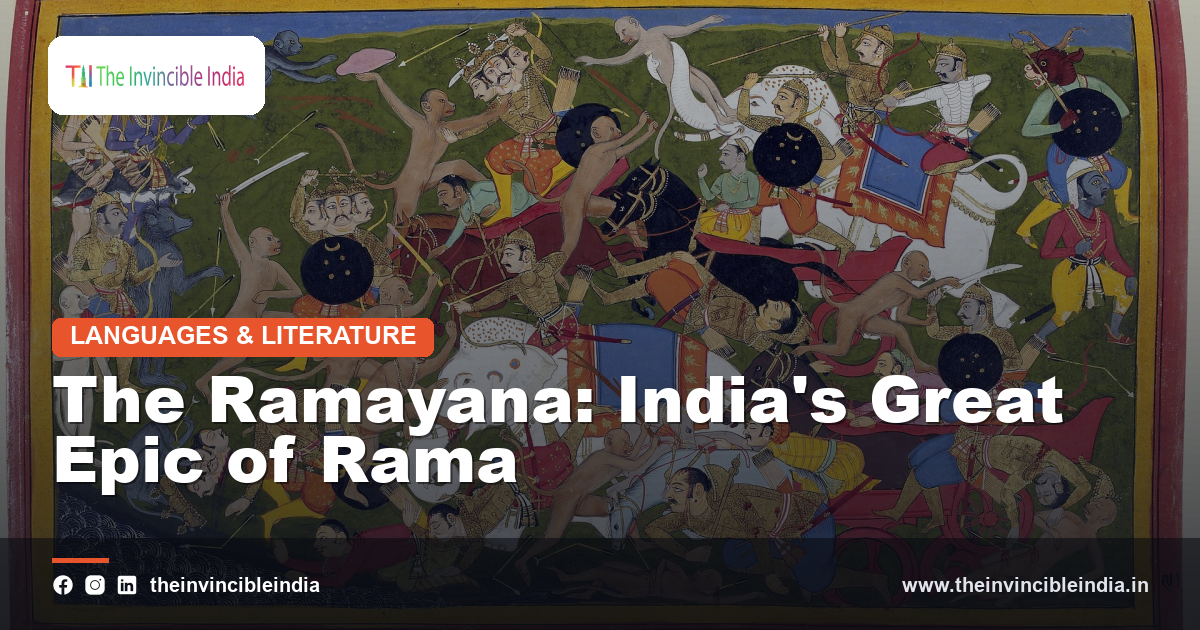
The Ramayana is one of the two great epics of India and one of the most beloved and influential stories in the world. It tells the tale of Rama, the prince of Ayodhya, his exile to the forest, the abduction of his wife Sita by the demon king Ravana, and the great war fought to rescue her, a story of love, duty, loyalty and the triumph of good over evil. Traditionally attributed to the sage Valmiki and composed in Sanskrit, the Ramayana has been retold in countless languages and forms across India and Asia for thousands of years. Its characters and values are woven deep into the culture of the subcontinent. This guide explores its story, its author, its characters, its many versions, its values and its enduring influence.
Quick Facts
| Detail | Information |
|---|---|
| Type | One of the two great epics of India |
| Traditional author | The sage Valmiki |
| Language | Composed in Sanskrit |
| Hero | Rama, prince of Ayodhya, revered as an avatar of Vishnu |
| Central story | The exile of Rama and the rescue of Sita from Ravana |
| Influence | Retold across India and Asia in many languages |
One of India's Great Epics
The Ramayana is, with the Mahabharata, one of the two great epics of India, foundational works that have shaped the culture, values and imagination of the subcontinent for thousands of years. It tells the story of Rama, an ideal prince and hero, and its narrative of love, loyalty, sacrifice and the struggle between good and evil has captivated audiences across the ages. More than a story, the Ramayana is a treasury of ideals and values, a sacred text and a living presence in the religious and cultural life of India. Its enduring popularity and its profound influence make it one of the greatest and most beloved epics in the literature of the world.
The Sage Valmiki
The Ramayana is traditionally attributed to the sage Valmiki, who is honoured as the author of the original Sanskrit epic and revered as the first poet, the adi kavi, of the classical tradition. According to tradition, Valmiki composed the great poem in elegant Sanskrit verse, giving the story its enduring literary form. His Ramayana is regarded as the foundational version from which the countless later retellings flow, and it is celebrated as a masterpiece of poetry as well as a sacred text. The figure of Valmiki, the sage-poet who gave the world the Ramayana, holds a place of deep reverence in Indian tradition as the fountainhead of the great epic.
The Story Begins in Ayodhya
The Ramayana opens in the kingdom of Ayodhya, ruled by the righteous King Dasharatha, whose eldest son and heir is the noble prince Rama, beloved by all for his virtue, courage and grace. Rama wins the hand of the princess Sita, and all seems set for him to inherit the throne. But through the working of court intrigue and an old promise, the king is bound to send Rama into exile in the forest for many years and to place another son on the throne. This turn of events, and Rama’s calm acceptance of his fate out of duty and honour, sets in motion the great story of the epic and establishes its central themes.
The Exile to the Forest
Bound by duty and honouring his father’s word, Rama accepts his exile without complaint, and he is joined in the forest by his devoted wife Sita and his loyal brother Lakshmana, who refuse to let him go alone. Together they leave the comforts of the palace to live a simple life in the wilderness, and their years in the forest form a central part of the story. Rama’s willingness to give up his throne and endure hardship for the sake of duty and his father’s honour is presented as a model of virtue. The exile, and the devotion of Sita and Lakshmana, embody the ideals of duty, love and loyalty that lie at the heart of the epic.
The Abduction of Sita
The great crisis of the Ramayana comes when Sita is abducted by Ravana, the powerful demon king of Lanka, who carries her away to his island kingdom. Through cunning and deception, Ravana lures Rama and Lakshmana away and seizes Sita, taking her captive far across the sea. This act sets in motion the central quest of the epic: Rama’s desperate search for his beloved wife and his determination to rescue her and defeat the demon who has wronged her. The abduction of Sita is the pivotal event of the story, transforming the tale of exile into an epic of quest, war and the struggle to restore what is right against a mighty foe.
Hanuman and the Search
In his search for Sita, Rama gains powerful allies, above all Hanuman, the mighty and devoted monkey hero, and the army of the vanaras, or monkey people. Hanuman, renowned for his strength, courage and boundless devotion to Rama, plays a crucial role: it is he who makes the great leap across the sea to Lanka, finds Sita in captivity, and brings word of her to Rama. Hanuman’s devotion, valour and selfless service have made him one of the most beloved figures in Indian religion and culture, worshipped as a god in his own right. His role in the search for Sita is among the most cherished parts of the whole epic.
The Great War
With the help of Hanuman and the army of the vanaras, Rama builds a bridge across the sea to Lanka and wages a great war against Ravana and his demon forces to rescue Sita. The war is fought with epic heroism on both sides, culminating in the final battle between Rama and the mighty Ravana. In the end, Rama slays Ravana and defeats the forces of evil, freeing Sita and vindicating the cause of righteousness. This great war, and the ultimate triumph of Rama over Ravana, is the climax of the epic, embodying its central theme of the victory of good over evil, of dharma over adharma.
The Return to Ayodhya
After the defeat of Ravana and the rescue of Sita, Rama’s long exile at last comes to an end, and he returns in triumph to Ayodhya to be crowned king. His homecoming is celebrated with great rejoicing, and the people light lamps to welcome him, an event connected in tradition to the festival of Diwali. Rama’s reign, known as Ram Rajya, is remembered as an ideal age of justice, prosperity and righteous rule, a golden age held up as a model of good government. The return of Rama and the establishment of his just reign bring the great story to its resolution and complete the epic’s vision of the triumph of virtue.
Rama as the Ideal Man
At the heart of the Ramayana is the figure of Rama, presented as the ideal man and the embodiment of virtue, duty and righteousness. Revered as an avatar, or incarnation, of the god Vishnu, Rama is held up as a model of the perfect son, husband, brother and king, who upholds his duty and honour even at great personal cost. His unwavering commitment to dharma, or righteousness, in the face of hardship and temptation is the moral core of the epic. For countless generations, Rama has been an ideal to aspire to, and the phrase Maryada Purushottam, the perfect man of honour, expresses the reverence in which he is held.
Sita and the Other Characters
The Ramayana is rich in memorable characters who embody its values. Sita, Rama’s devoted wife, is revered as a model of virtue, devotion and inner strength, enduring her ordeal with dignity and faithfulness. Lakshmana embodies loyalty and brotherly love, and Hanuman devotion and selfless service, while Ravana, for all his power and learning, embodies the destructive force of pride and desire. Around them are many other figures, noble and villainous, who enrich the story. These characters, each embodying particular virtues or vices, have become cultural archetypes in India, their names and qualities part of the shared moral vocabulary of the culture, and their stories are known and loved by all.
A Story of Values
Beyond its gripping narrative, the Ramayana is above all a story of values, a teaching in the form of an epic. It upholds the ideals of duty and righteousness, loyalty and devotion, honour and sacrifice, and the ultimate triumph of good over evil. The characters embody these values, and the events of the story test and affirm them. For thousands of years, the Ramayana has served as a moral and spiritual guide, teaching by example the ideals of a good and righteous life. This role as a repository of values, woven into the culture and passed on through the generations, is central to the profound and enduring importance of the epic in Indian life.
The Many Ramayanas
One of the most remarkable features of the Ramayana is that it exists not in one version but in countless retellings, composed in many languages and forms across India and beyond over the centuries. While the Sanskrit epic of Valmiki is the foundational version, great poets in the various regional languages created their own beloved Ramayanas, each with its own character and emphasis. These many versions, differing in details and in spirit, reflect the vast reach and living vitality of the story across the diverse cultures of the subcontinent. The existence of so many Ramayanas, each cherished in its own region and tradition, is a testament to the extraordinary and enduring popularity of the epic.
The Ramayana Across Asia
The influence of the Ramayana reaches far beyond India, for the epic spread across much of Asia, especially Southeast Asia, where it took root in many cultures. In countries across the region, the story of Rama was adopted and adapted, becoming part of local literature, art, dance and drama, often with distinctive regional versions and characters. The Ramayana is depicted in the temple carvings, paintings, puppet shows and dance-dramas of many Asian lands, testifying to its extraordinary reach. This spread of the Ramayana across Asia, and its deep integration into the cultures of many countries, makes it one of the most influential stories in the history of the world.
The Ramayana in Art and Performance
The Ramayana has inspired an immense wealth of art and performance across the ages. Its scenes and characters are depicted in painting, sculpture and temple carving throughout India and Asia, and its story is enacted in countless forms of dance, drama and folk performance. The tradition of the Ramlila, the popular dramatic enactment of the story performed especially around the autumn festivals, brings the epic to life for communities across northern India each year. The Ramayana is also retold through puppet shows, recitations, music and, in modern times, film and television. This vast presence in art and performance keeps the epic vividly alive in the culture and imagination of the people.
A Living Sacred Text
For millions, the Ramayana is not only a great epic but a sacred text, revered and turned to for spiritual guidance and blessing. Its verses are recited in worship, its story is retold in devotion, and its hero Rama is worshipped as a beloved god. Reading or hearing the Ramayana is regarded as a spiritually meritorious act, and the epic is woven into the religious life of countless homes and communities. This sacred status, alongside its role as literature and cultural treasure, gives the Ramayana a place of unique importance. It lives not only in books and performances but in the daily devotion and faith of millions, a truly living scripture.
The Ramayana Today
Today the Ramayana remains one of the most beloved and influential stories in India and across much of Asia, its characters and values as alive as ever in the culture and faith of the people. It continues to be read, recited, performed and worshipped, retold in countless forms from traditional Ramlila to modern film and television, and cherished in every region and language. Its ideals of duty, devotion and the triumph of good over evil continue to inspire and guide. Ancient yet ever fresh, sacred yet universally beloved, the Ramayana endures as one of the greatest epics of humanity and a living treasure of Indian and world culture.
Sources & Further Reading
- Ministry of Culture, Government of India, on the epics and sacred literature of India (indiaculture.gov.in).
- Sahitya Akademi, national academy of letters, on the Ramayana tradition (sahitya-akademi.gov.in).
- The Ramayana of Valmiki, the foundational Sanskrit epic.
Frequently Asked Questions
What is the Ramayana?
The Ramayana is one of the two great epics of India, telling the story of Rama, prince of Ayodhya, his exile to the forest, the abduction of his wife Sita by the demon king Ravana, and the great war to rescue her, a tale of duty, love and the triumph of good over evil.
Who wrote the Ramayana?
The Ramayana is traditionally attributed to the sage Valmiki, honoured as the first poet, or adi kavi, who composed the original Sanskrit epic. His version is regarded as the foundational one, from which countless later retellings flow.
Who is Hanuman in the Ramayana?
Hanuman is the mighty and devoted monkey hero of the Ramayana, renowned for his strength, courage and boundless devotion to Rama. He leaps across the sea to Lanka, finds the captive Sita, and plays a crucial role in the war, and is worshipped as a god in his own right.
Why does Rama return to Ayodhya connect to Diwali?
Rama’s triumphant return to Ayodhya after defeating Ravana and completing his exile is celebrated with the lighting of lamps to welcome him, an event connected in tradition to the festival of Diwali, the festival of lights.
Are there many versions of the Ramayana?
Yes. Besides Valmiki’s Sanskrit epic, the Ramayana exists in countless retellings composed in many languages across India and Asia, each with its own character and emphasis, reflecting the story’s vast reach and enduring popularity.


