

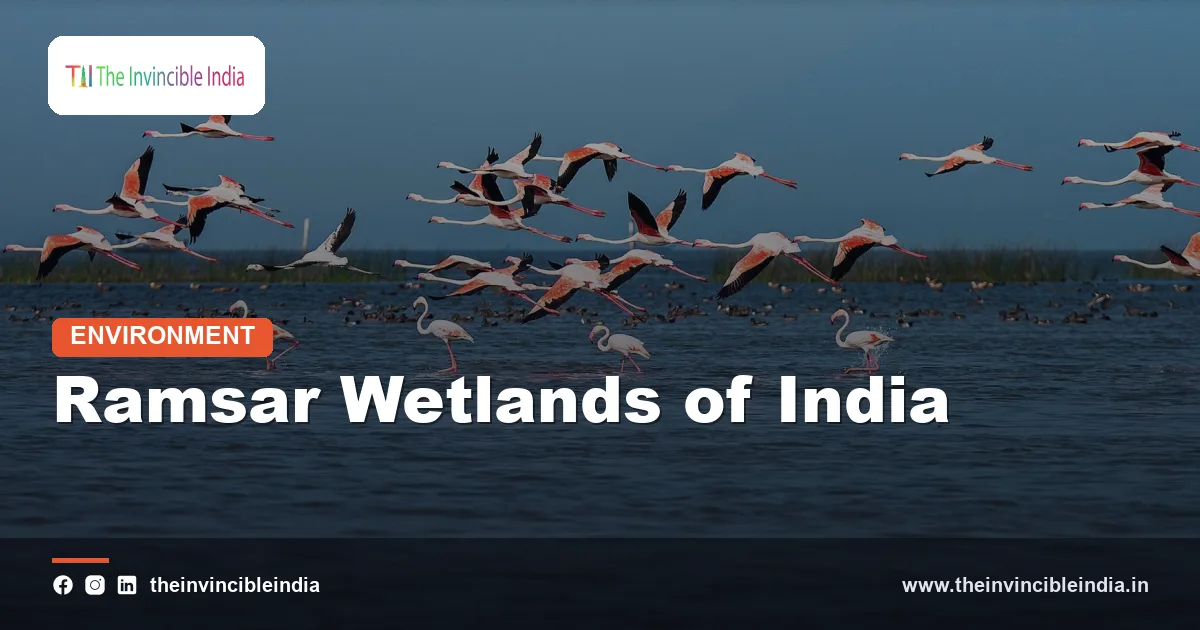
Ramsar wetlands are wetlands of international importance that a country has formally placed on the global list kept under the Convention on Wetlands, a treaty adopted in 1971 in the Iranian city of Ramsar on the shores of the Caspian Sea. India joined the convention in 1982, and since then the country has built one of the largest national networks of such sites in Asia, stretching from the high-altitude lakes of Ladakh to the mangrove deltas of the Bay of Bengal.
For many people a wetland is simply a swamp or a muddy patch of land, but these landscapes are among the most productive and useful ecosystems on Earth. They store water, clean it, soften floods, hold carbon, feed millions of people and shelter birds that fly thousands of kilometres each year. This explainer covers what wetlands are, what the Ramsar Convention requires, how India’s sites are chosen and protected, and the pressures that put them at risk. Figures about the number of sites are approximate and dated, because India keeps adding to the list. Last reviewed: 1 October 2026.
Quick Facts
| Item | Detail |
|---|---|
| Treaty name | Convention on Wetlands of International Importance, especially as Waterfowl Habitat |
| Adopted at | Ramsar, Iran, on 2 February 1971 (entered into force in 1975) |
| India joined | 1982 |
| India’s first sites | Chilika Lake (Odisha) and Keoladeo National Park (Rajasthan), listed in 1981 |
| Number of Indian sites | Over 80 (approximate and dated; the figure keeps rising) |
| States with many sites | Tamil Nadu and Uttar Pradesh are among the leaders |
| Domestic rules | Wetlands (Conservation and Management) Rules, 2017 |
| Mapping effort | National Wetland Inventory and Assessment |
| Observed each year | World Wetlands Day on 2 February |
What Are Wetlands?
The Ramsar Convention uses a deliberately broad definition. A wetland is any area of marsh, fen, peatland or water, whether natural or artificial, permanent or temporary, with water that is static or flowing, fresh, brackish or salt. The definition even includes stretches of sea whose depth at low tide does not exceed six metres. In other words, wetlands are places where water is the main factor shaping the soil, plants and animals that live there.
The many faces of a wetland
- Inland wetlands: freshwater marshes, lakes, ponds, oxbow lakes, rivers and floodplains, such as the Harike wetland at the confluence of the Beas and Sutlej.
- Coastal wetlands: lagoons, estuaries, salt marshes, tidal flats and mangroves, such as Chilika and the Sundarbans.
- High-altitude wetlands: glacial and snow-fed lakes in the Himalaya, such as Tso Moriri in Ladakh.
- Salt lakes: inland saline lakes such as Sambhar in Rajasthan.
- Human-made wetlands: reservoirs, village tanks, rice paddies and fish ponds, which the Convention also recognises when they support wildlife or wise human use.
- Marine systems: seagrass beds and coral reefs in shallow water, which count as wetlands under the treaty.
This variety is important to remember. A wetland is not a single type of landscape, and a Ramsar site can be a cold mountain lake, a tropical mangrove forest or even a managed wastewater system near a big city.
Why Wetlands Matter: Ecosystem Services
Scientists describe the benefits that nature provides to people as ecosystem services. Wetlands deliver an unusually long list of them, which is why conservationists often call them the kidneys and sponges of the landscape.
Water storage, purification and recharge
Wetlands hold large volumes of rainwater and river flow and release it slowly. Plants and microbes in the water trap sediments and break down nutrients and some pollutants, so water leaving a healthy wetland is often cleaner than the water that entered it. Many wetlands also let water seep down into aquifers, recharging groundwater that villages and cities rely on during the dry months.
Flood control and coastal protection
Floodplains and marshes act as natural reservoirs that absorb excess river water during the monsoon, reducing the height and speed of floods downstream. Mangroves and coastal marshes break the force of waves and storm surges and help hold shorelines together, a lesson that cyclone-prone regions of the Indian coast know well.
Carbon storage and climate
Peatlands, mangroves and saltmarshes lock away large amounts of carbon in waterlogged soils. When these ecosystems are drained or cleared, that stored carbon can escape into the atmosphere. Protecting wetlands is therefore a quiet but meaningful part of climate action.
Biodiversity, fisheries and livelihoods
Wetlands shelter fish, amphibians, reptiles, mammals and plants, many of them found nowhere else. Millions of Indians earn their living from wetland fisheries, reed and lotus harvesting, grazing, tourism and water-based farming. The Loktak Lake fishers of Manipur and the traditional fishing communities of Chilika are well-known examples.
The Ramsar Convention and the Idea of Wise Use
The Convention was born from concern for waterbirds and their habitats, and its full name still refers to waterfowl habitat. Over the decades its scope widened to cover wetlands of every kind and the people who depend on them. Its administrative secretariat is based in Gland, Switzerland, and countries that join are called Contracting Parties.
Three commitments
By joining, a country accepts three broad obligations:
- to work towards the wise use of all wetlands within its territory;
- to designate suitable wetlands for the List of Wetlands of International Importance and to manage them so that their ecological character is maintained;
- to cooperate internationally on shared wetlands, shared species and shared river basins.
What does wise use mean?
Wise use is the central idea of the treaty. It means maintaining the ecological character of a wetland while allowing sustainable benefits for people. In practice, wise use does not mean locking a wetland away from everyone. It means that fishing, grazing, tourism and water supply should continue in ways that do not degrade the system for future generations. This approach suits a country like India, where many wetlands are lived-in landscapes rather than empty wilderness.
Being listed does not create a new legal protection by itself and does not hand control to any foreign body. The wetland remains under national and state law, and the designation is a public commitment to protect it.
How a Site Qualifies: The Ramsar Criteria
A country cannot list just any wetland. Each candidate site must meet at least one of nine criteria set by the Convention, which are grouped into two broad families.
Representative, rare or unique wetlands
The first criterion applies to a site that contains a representative, rare or unique example of a natural or near-natural wetland type found within a particular biogeographic region. It recognises that some wetland types, such as a floating-mat lake or a high-altitude marsh, are rare and deserve protection for that reason alone.
Sites of importance for biodiversity
The remaining criteria focus on life. A site can qualify if it supports vulnerable, endangered or critically endangered species, or threatened ecological communities. It can also qualify if it supports populations of plant and animal species that are important for maintaining the biological diversity of a region, or if it provides refuge during critical stages of a life cycle or during harsh conditions.
Several criteria are specific to waterbirds and fish. A wetland qualifies if it regularly supports 20,000 or more waterbirds, or if it regularly supports at least one per cent of the individuals in a population of one species or subspecies of waterbird. Other criteria cover sites that support a significant proportion of indigenous fish species or serve as an important food source, spawning ground or migration path for fish.
After a country submits its nomination with a detailed description, the site is added to the Ramsar List. The government is expected to prepare a management plan and to report any change in the site’s ecological character.
India’s Ramsar Network
India’s story with the Convention began quietly. The country joined in 1982, and its first listed sites, Chilika Lake and Keoladeo National Park, were designated in 1981. For years the list grew slowly, and by the early 2010s only a little over two dozen Indian sites were on it. Then the pace picked up sharply, with large batches of new sites added in the early 2020s, and the country now has over 80 Ramsar sites, one of the biggest national lists in Asia. The exact figure changes as new designations are announced, so readers should check the official Ramsar Sites Information Service for the latest count.
Geographic spread
The sites are scattered across almost every region of India. Tamil Nadu has the largest number of sites among the states, and Uttar Pradesh follows with many river, lake and floodplain wetlands. Other states with several sites include Odisha, Kerala, Punjab, Himachal Pradesh, Jammu and Kashmir, Rajasthan, Gujarat, West Bengal and Assam. The list covers lakes, river stretches, reservoirs, village tanks, lagoons, mangroves and salt pans.
Why the numbers rose
The rapid growth reflects several developments: a wider search for qualified sites across the states, the mapping work done under the National Wetland Inventory, renewed policy attention to wetland health, and the involvement of state wetland authorities. Importantly, many of the newer sites are modest in size and lie close to towns, which makes community awareness especially valuable.
Notable Ramsar Sites of India
The table below lists some of the best-known Indian Ramsar wetlands and what makes each of them distinctive.
| Site | State or Union Territory | Notable feature |
|---|---|---|
| Chilika Lake | Odisha | One of the largest brackish-water lagoons in Asia; winter home to huge numbers of migratory waterbirds and a population of Irrawaddy dolphins |
| Keoladeo National Park | Rajasthan | Bharatpur bird sanctuary and World Heritage site, famed for wintering waterfowl |
| Loktak Lake | Manipur | Floating mats of vegetation called phumdis; home to Keibul Lamjao, the world’s only floating national park |
| Wular Lake | Jammu and Kashmir | One of the largest freshwater lakes in India, important for fisheries and waterbirds |
| Sambhar Lake | Rajasthan | India’s largest inland saltwater lake, a famous salt-making and flamingo-visiting site |
| East Kolkata Wetlands | West Bengal | City wastewater is treated naturally and reused in fish ponds and farms |
| Sundarbans | West Bengal | Vast mangrove delta of the Ganga and Brahmaputra systems and the habitat of the Bengal tiger |
| Point Calimere | Tamil Nadu | Coastal wetland complex known for flamingos and other shorebirds |
| Harike Wetland | Punjab | Reservoir and wetland at the meeting of the Beas and Sutlej rivers |
| Nalsarovar Bird Sanctuary | Gujarat | Shallow freshwater lake, a major waterbird winter destination |
| Deepor Beel | Assam | Freshwater lake close to Guwahati, a wetland inside a growing city |
| Tso Moriri | Ladakh | High-altitude lake that is a breeding area for the bar-headed goose |
Chilika and Keoladeo: the pioneers
Chilika is a shallow lagoon separated from the Bay of Bengal by a sandy strip, and its water ranges from fresh to salty depending on the season. Fishing families depend on it, and in winter it fills with ducks, waders and other migrants. Keoladeo, in Bharatpur, was once a royal duck-shooting reserve and later became a protected national park. It is a human-managed wetland where water levels are controlled to suit wintering birds.
Loktak and its floating park
Loktak is the largest freshwater lake in the north-east. Its phumdis, floating masses of soil, vegetation and organic matter, are so thick in places that they form the Keibul Lamjao National Park, the only floating national park in the world. The park shelters the sangai, a rare brow-antlered deer that is found naturally only in Manipur.
Wetlands and the Central Asian Flyway
Many of India’s Ramsar sites matter far beyond the country’s borders because they lie along the Central Asian Flyway, one of the great bird migration routes of the world. Every year, millions of birds travel between their breeding grounds in the Arctic and Central Asia and their wintering grounds in South and South-East Asia and beyond. India sits near the southern end of this route and serves as a key wintering and stopover area.
Why birds need a chain of wetlands
Migratory birds cannot fly non-stop for the whole journey. They need a chain of healthy wetlands along the way to rest and to feed. If one link in that chain is drained, polluted or built over, the birds may arrive weakened or fail to complete the journey. This is why wetland conservation is an international task, and it explains why the Convention emphasises cooperation between countries.
Famous visitors
- Bar-headed geese, which breed on high-altitude lakes in Central Asia and winter in the Indian plains, crossing the Himalaya on the way.
- Greater and lesser flamingos, seen at Sambhar, Point Calimere and the Gujarat wetlands.
- Ducks, teals and waders, which gather in the thousands at Chilika, Harike and Nalsarovar.
- Siberian cranes, which used to winter at Keoladeo in earlier decades and are now rarely, if ever, seen in India.
Rules and Institutions: How India Manages Its Wetlands
India has no single law devoted only to wetlands. Instead, wetland protection draws on the Environment (Protection) Act, 1986, the Wild Life (Protection) Act, 1972 for sites that lie within protected areas, and several state laws. The key rulebook is the Wetlands (Conservation and Management) Rules, 2017, which replaced an earlier set issued in 2010.
The 2017 rules
The Rules define wetlands, set out activities that are prohibited, such as conversion for non-wetland uses, dumping of solid waste, discharge of untreated wastes and effluents, and permanent construction within a wetland, and give states a bigger role. Each state and Union Territory is expected to set up a State Wetlands Authority to identify and notify wetlands, prepare a list of activities to be regulated or permitted, and promote wise use. A National Wetlands Committee, under the Union environment ministry, advises on policy and monitors implementation. Certain categories, such as river channels, paddy fields and main irrigation canals, are excluded from the definition used by the Rules, though other laws may still cover them.
The National Wetland Inventory
Protecting what you have not mapped is hard. The National Wetland Inventory and Assessment, carried out using satellite remote sensing by the Space Applications Centre of ISRO for the Union environment ministry, produced a nationwide map of wetlands and has since been updated. The data help state authorities identify sites that deserve closer attention and track whether wetlands are shrinking or being altered over time.
Other supporting efforts
Alongside the legal framework, the central government runs programmes for lake and wetland conservation, and several states work with local communities, universities and non-governmental groups. A wetland health monitoring approach, management plans and citizen-science bird counts all add to the picture.
The Montreux Record: A Warning List
The Montreux Record is a register of Ramsar sites where changes in ecological character have occurred, are occurring or are likely to occur as a result of technological developments, pollution or other human interference. It is named after the Swiss city where a Convention conference recommended it, and it works as a flag that the site needs priority attention rather than as a punishment.
Indian sites on the record
Keoladeo National Park and Loktak Lake are the Indian sites that have featured on the Montreux Record, in each case because of concerns such as water shortages, siltation, invasive plants and pressures from nearby development. Chilika Lake was also added at one stage, but it was later removed after a major restoration effort, which included opening a new mouth to the sea to restore the salinity balance, clearing silt and involving fisher communities. Its removal was widely cited as a conservation success.
Why the list matters
Being on the record can unlock technical advice from the Convention’s advisory mechanism and draw attention to a site that needs funding and monitoring. Countries are encouraged to take sites off the list once the threats have been addressed, and Chilika showed that this can be done.
Threats to Wetlands
Despite their value, wetlands remain among the most threatened ecosystems both in India and across the world. Many have been lost over the last century, often because they were viewed as wasteland that could be put to better use.
- Urbanisation and encroachment: lakes and floodplains near cities are filled in for housing, roads and commercial buildings. Loss of these natural sponges contributes to urban flooding.
- Pollution: untreated sewage, industrial effluents, plastic waste and agricultural runoff full of fertiliser and pesticide lead to oxygen loss and algal blooms.
- Drainage for agriculture: marshes and floodplains are drained and converted into farmland, especially where land is scarce.
- Invasive species: water hyacinth and other aggressive plants spread across lakes, blocking sunlight, choking channels and pushing out native species.
- Altered water flow: dams, barrages, embankments and excessive extraction change the natural rhythm of floods and dry spells that wetlands depend on.
- Siltation: soil washed from deforested catchments gradually fills lakes and reduces their depth and area.
- Climate change: altered rainfall, rising seas and more extreme heat and drought add pressure, particularly to coastal and high-altitude systems.
These threats usually act together. A lake that is shrinking because of encroachment becomes more vulnerable to pollution, and a polluted lake supports fewer fish and birds, which reduces the income and attention it receives from local communities.
Conclusion: Why Wetland Conservation Matters
Ramsar wetlands are more than scenic bird habitats. They support drinking water, food, flood protection, climate regulation and culture, and for millions of people they are the foundation of daily life. India’s growing list of sites shows that the country takes this seriously, but a listing is only a starting point. Lasting protection depends on good management plans, clear boundaries, treated wastewater, controlled water extraction, restoration of damaged areas and above all the partnership of local people who know these landscapes best.
The wise-use principle offers a practical guide. Wetlands can keep serving people, so long as the people who use them also keep them healthy. As cities expand and the climate changes, the Ramsar network will be a test of whether development and nature can coexist.
Frequently Asked Questions
What is a Ramsar site?
A Ramsar site is a wetland that a country has designated as being of international importance under the Ramsar Convention, a treaty adopted in 1971. The wetland must meet at least one of the Convention’s nine criteria, such as supporting threatened species or large numbers of waterbirds. The site stays under national law, but the country commits to maintaining its ecological character.
Which were the first Ramsar sites in India?
Chilika Lake in Odisha and Keoladeo National Park in Rajasthan were India’s first Ramsar sites, designated in 1981. India formally became a party to the Convention in 1982. Many more sites were added over the following decades, with a particularly rapid rise in recent years.
How many Ramsar sites does India have?
India has over 80 Ramsar sites, which is one of the largest national networks in Asia, though the exact number keeps changing as new sites are added. Tamil Nadu has the largest number among the states, and Uttar Pradesh is also home to many. For the latest figure, check the official Ramsar Sites Information Service or the Union environment ministry.
What is the Montreux Record?
The Montreux Record is a list of Ramsar sites where the ecological character has changed or is threatened by human activity, pollution or development. It highlights sites that need priority conservation action. Keoladeo National Park and Loktak Lake have featured on it, and Chilika Lake was removed after successful restoration.
Does Ramsar designation automatically protect a wetland?
Designation is a commitment to wise use rather than a standalone law. Actual protection comes from national and state laws, such as the Wetlands (Conservation and Management) Rules, 2017, the Wild Life (Protection) Act, 1972 where applicable, and from management plans and community involvement. The international listing adds visibility, accountability and sometimes access to technical support.
Why are migratory birds so closely linked to Ramsar wetlands?
The Convention was originally created to protect waterbird habitats, and many Ramsar criteria refer to waterbird numbers. Migratory birds on routes like the Central Asian Flyway depend on a chain of healthy wetlands for resting and feeding. If one link is lost, the whole journey is at risk.


