

Rani Gaidinliu is remembered as one of the youngest and most remarkable figures among India’s freedom fighters, a Naga leader from the Zeliangrong community of Manipur and the surrounding hill region who took up the cause of resistance to colonial rule while still a teenager. Closely associated with the spiritual and political movement begun by her elder relative Haipou Jadonang, she carried forward his mission after his death, blending religious leadership with a determined stand against British authority in the Naga Hills. Her defiance led to her imprisonment for a substantial portion of her youth, yet she emerged after independence to continue working for the welfare and cultural dignity of her people. This guide traces her early life, her movement, and her enduring legacy.
Quick Facts
| Detail | Information |
|---|---|
| Known as | Naga spiritual and political leader |
| Community | Zeliangrong Naga community |
| Movement | Heraka religious and reform movement |
| Associated with | Haipou Jadonang, whose mission she carried forward |
| Known for | Long imprisonment for resisting colonial authority |
| Title given | “Rani”, conferred in recognition of her leadership |
A Young Leader of the Naga Hills
Rani Gaidinliu is remembered as an extraordinary example of youthful leadership within India’s freedom struggle, a young woman from the Naga Hills who assumed a position of considerable spiritual and political responsibility while still in her teenage years. Belonging to the Zeliangrong community, a grouping of related Naga peoples inhabiting parts of present-day Manipur and neighbouring hill areas, she grew into her role at a time of considerable social and political ferment among the Naga tribes. Her rapid rise to leadership reflected both her personal conviction and the trust placed in her by a community seeking guidance amid changing times. As a young leader of the Naga Hills, Gaidinliu’s story remains one of remarkable early responsibility and courage.
Early Life Among the Zeliangrong
Rani Gaidinliu was born into a Zeliangrong Naga family in the hill region straddling present-day Manipur, growing up within a community that maintained strong traditional beliefs and social structures even as colonial administration extended its reach into the Naga Hills. Her childhood unfolded against a backdrop of gradual social change, as new religious influences and administrative pressures began to affect long-established tribal ways of life. From an early age, she is remembered as having shown an unusually serious and thoughtful disposition, drawn toward questions of community welfare and cultural continuity. This upbringing within a tradition-conscious Zeliangrong household shaped the convictions she would carry into her later leadership.
The Influence of Haipou Jadonang
A formative influence on Rani Gaidinliu’s life was her association with Haipou Jadonang, an elder relative and spiritual leader who initiated a movement among the Zeliangrong Naga combining religious revival with resistance to outside interference in tribal affairs. Gaidinliu became closely associated with Jadonang’s movement from a young age, absorbing his teachings and his vision of a revitalised Naga community grounded in its own traditions. Jadonang’s leadership provided the foundation upon which Gaidinliu would later build her own role, particularly after circumstances required her to carry his mission forward. This early association with Jadonang decisively shaped the direction of Gaidinliu’s subsequent life and work.
The Heraka Movement
The movement associated with Jadonang and continued by Rani Gaidinliu came to be known as the Heraka movement, a religious reform effort among the Zeliangrong Naga that sought to purify and revitalise traditional beliefs while also addressing the social and political concerns of the community under colonial administration. The Heraka movement combined spiritual teaching with a message of communal self-respect and resistance to outside exploitation, resonating strongly among Naga villagers facing considerable pressure from colonial and missionary influences. This blending of religious reform with political consciousness gave the movement a distinctive character that colonial authorities viewed with considerable suspicion. The Heraka movement remains central to understanding Gaidinliu’s life and leadership.
Assuming Leadership After Jadonang
Following the death of Haipou Jadonang, Rani Gaidinliu, still only a teenager, assumed leadership of the movement he had begun, a remarkable responsibility for someone so young to carry. She continued to promote the religious and social teachings associated with the Heraka movement while also taking on a more overtly political role, encouraging Naga villagers to resist colonial demands and administrative interference. Her ability to command the loyalty of followers considerably older than herself speaks to the strength of conviction and personal authority she demonstrated from an early age. This assumption of leadership after Jadonang marked the beginning of the most consequential phase of her life.
Resistance to Colonial Authority
Under Rani Gaidinliu’s leadership, the Heraka movement increasingly took on a posture of resistance to colonial authority in the Naga Hills, encouraging villagers to refuse certain administrative demands and to look instead to their own traditional and religious leadership for guidance. This resistance troubled colonial administrators, who viewed the movement as a challenge to their control over the region’s tribal population. Gaidinliu’s growing influence among Naga villages made her a particular focus of colonial concern, as her leadership threatened to unite scattered Zeliangrong communities against outside authority. This resistance to colonial control forms the core of Gaidinliu’s contribution to India’s wider freedom struggle.
Pursuit by Colonial Authorities
As her movement grew in influence, Rani Gaidinliu became the subject of an intensive pursuit by colonial authorities determined to suppress what they regarded as a dangerous challenge to their administration of the Naga Hills. She evaded capture for a period by moving between villages that offered her shelter and support, relying on the loyalty of her Zeliangrong followers to escape detection. This period of pursuit demonstrated both the seriousness with which colonial authorities viewed her movement and the depth of popular support she commanded among the Naga population. The eventual conclusion of this pursuit would bring about the most difficult chapter of her early life.
Capture and Trial
Rani Gaidinliu was eventually captured by colonial authorities, still a teenager at the time, and brought to trial for her role in leading resistance to colonial administration in the Naga Hills. The proceedings that followed treated her as a serious political threat despite her young age, reflecting the concern colonial officials felt regarding her influence over the Zeliangrong community. Her trial and the sentence that followed marked a dramatic turning point, transforming a young religious and community leader into a long-term political prisoner. This capture and trial began the lengthy period of imprisonment that would define much of her early adult life.
Years of Imprisonment
Rani Gaidinliu spent a substantial portion of her youth and early adulthood in colonial prisons, moved between different jails over the course of her long imprisonment for her role in leading resistance in the Naga Hills. These years represented an extraordinary sacrifice, removing her from her community during what would otherwise have been formative years of her life. Despite the hardship of prolonged imprisonment, she is remembered as having maintained her convictions and her commitment to the welfare of her people throughout this difficult period. Her years of imprisonment stand as one of the most striking examples of sustained personal sacrifice among India’s freedom fighters.
Recognition by Nationalist Leaders
Rani Gaidinliu’s long imprisonment and her steadfast resistance to colonial authority drew the attention and admiration of nationalist leaders associated with the wider Indian freedom movement, most notably Jawaharlal Nehru, who is remembered for having taken a particular interest in her cause and for bestowing upon her the title of “Rani” in recognition of her leadership and courage. This recognition connected her regional struggle in the Naga Hills to the broader national movement for independence, even though her activities had unfolded largely apart from mainstream nationalist politics. This acknowledgement by national leaders helped ensure that her story would be remembered well beyond her own region.
Release After Independence
Rani Gaidinliu was released from prison around the time of India’s independence, emerging after many years of confinement to find a rapidly changing political landscape in the newly independent nation. Her release marked the beginning of a new chapter in her life, one in which she would continue to work for the welfare and cultural identity of the Zeliangrong Naga community, now within the framework of an independent India. This transition from imprisoned freedom fighter to community leader in independent India reflects the remarkable continuity of purpose that characterised her entire life. Her release after independence allowed her to resume the work she had begun as a teenager.
Later Work for Naga Welfare
In the decades following her release, Rani Gaidinliu devoted herself to the social, cultural and spiritual welfare of the Zeliangrong Naga community, continuing to promote the values associated with the Heraka movement while also engaging with the changing political circumstances of the Naga Hills in independent India. She worked to preserve traditional Naga culture and belief even as new political movements emerged in the region, maintaining a steady and moderate influence among her people. This later work for Naga welfare extended her legacy well beyond her youthful years of resistance and imprisonment, cementing her as a lifelong servant of her community.
National Honours and Recognition
Rani Gaidinliu’s contributions to India’s freedom struggle and to the welfare of the Naga people received formal recognition from the government of independent India, including national honours conferred in acknowledgement of her lifelong service and sacrifice. Such recognition placed her firmly within the national pantheon of freedom fighters, alongside more widely known figures from other parts of the country. These honours reflect a growing appreciation of the diverse regional contributions that together made up India’s long struggle against colonial rule. This national recognition ensures that Gaidinliu’s story remains part of the country’s official historical memory.
A Voice for Women in the Freedom Struggle
Rani Gaidinliu’s story holds particular significance as an example of the role women played in India’s freedom struggle, demonstrating that leadership in resistance movements was not confined to men or to the more widely documented centres of nationalist activity. Her rise to prominence while still a teenager, and her sustained commitment through years of imprisonment, offer a striking illustration of female leadership emerging from within tribal and community structures rather than from urban, formally educated backgrounds. This dimension of her story has drawn growing attention in efforts to present a fuller and more inclusive account of the freedom struggle. Gaidinliu’s example enriches the wider narrative of women’s contributions to India’s independence.
Memorials and Commemoration
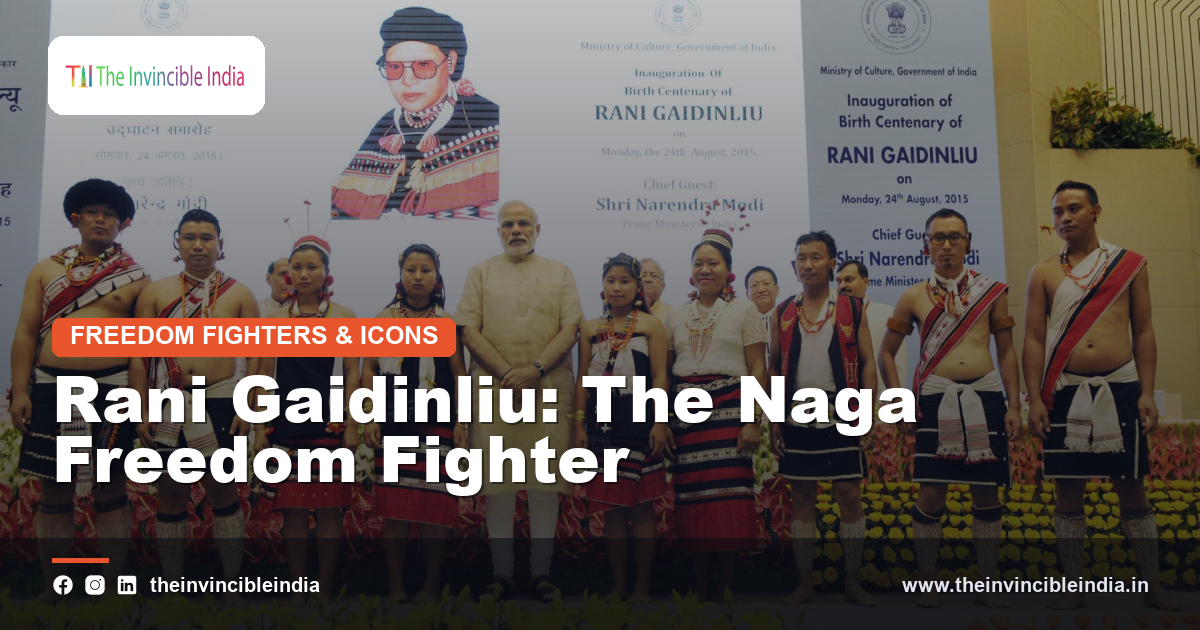
Rani Gaidinliu is remembered today through memorials, institutions and commemorative events across the Naga Hills and in wider national contexts, honouring both her youthful resistance to colonial rule and her lifelong service to her community. Public spaces and institutions bearing her name serve as reminders of her contribution to the freedom struggle and to the cultural life of the Zeliangrong Naga people. These acts of remembrance help ensure that her story reaches audiences well beyond the specific region where her movement originated. Such memorials and commemorations reflect the continuing regard in which Rani Gaidinliu is held across India.
Rani Gaidinliu Today
Today Rani Gaidinliu is remembered as one of the most remarkable figures of India’s freedom struggle, honoured for the extraordinary courage and conviction she displayed from a very young age in resisting colonial authority in the Naga Hills. Her story continues to be told in historical accounts, educational settings and commemorations that seek to present a fuller picture of the diverse contributions that shaped India’s path to independence. She is remembered particularly for the rare combination of spiritual leadership, political resistance and lifelong community service that defined her life. As a young Naga freedom fighter of exceptional resolve, Rani Gaidinliu endures as an inspiring figure in India’s national memory.
Sources & Further Reading
- Ministry of Culture, Government of India, on women in the freedom struggle (indiaculture.gov.in).
- Ministry of Tribal Affairs, Government of India, on tribal history and leaders (tribal.nic.in).
Frequently Asked Questions
Who was Rani Gaidinliu?
Rani Gaidinliu was a young Naga spiritual and political leader of the Zeliangrong community who led resistance to colonial authority in the Naga Hills and spent many years imprisoned for her convictions before independence.
What was the Heraka movement?
The Heraka movement was a religious reform and revitalisation movement among the Zeliangrong Naga, begun by Haipou Jadonang and carried forward by Rani Gaidinliu, that combined spiritual teaching with resistance to colonial interference.
Why was Rani Gaidinliu imprisoned?
Rani Gaidinliu was imprisoned by colonial authorities for leading resistance to colonial administration in the Naga Hills through the Heraka movement, spending a substantial part of her youth in custody.
Why did Jawaharlal Nehru call her Rani?
Jawaharlal Nehru is remembered for taking a keen interest in her cause and conferring upon her the title Rani, meaning queen, in recognition of her leadership and sustained courage in resisting colonial rule.
How is Rani Gaidinliu remembered today?
Rani Gaidinliu is remembered through memorials, national honours and commemorative events, honoured as a symbol of youthful courage, women’s leadership, and lifelong service to the Naga community.


