

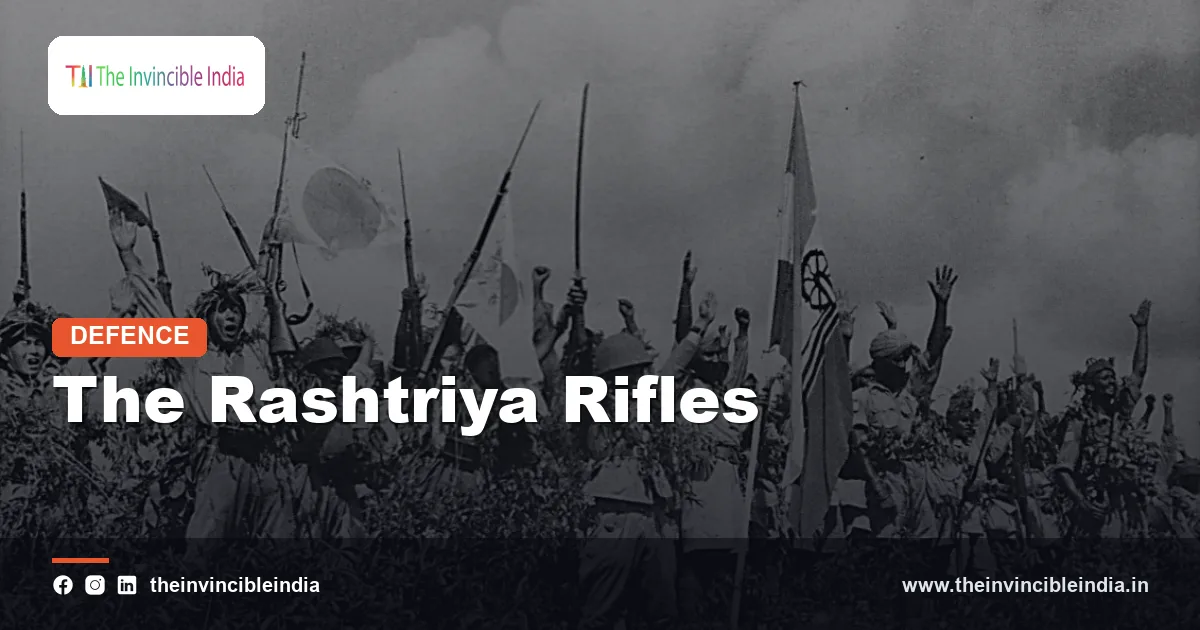
The Rashtriya Rifles is a dedicated force of the Indian Army that is trained and organised for counter-insurgency and counter-terrorism operations. It was raised in 1990 to take on a task that had been growing for the regular infantry in Jammu and Kashmir: dealing with militancy inside populated areas while the rest of the Army remained focused on the Line of Control and on conventional defence. Its name means “National Rifles”, and its motto is commonly rendered as “Dridhta aur Veerta”, meaning firmness and valour.
Unlike a traditional regiment with a single recruiting base, the Rashtriya Rifles draws its officers and soldiers from across the Army on tenures of deputation. This gives it a mixed, pan-Indian character and a steady flow of experience from every arm of the service. This explainer covers how the force came to be, how it is organised into Force headquarters, sectors and battalions, what role it plays in Jammu and Kashmir, how it works with other agencies, and the ethos and challenges that define its work.
| Item | Details |
|---|---|
| Full name | Rashtriya Rifles (RR) |
| Raised | 1990, as a counter-insurgency force of the Indian Army |
| Primary area of operation | Jammu and Kashmir |
| Headed by | Director General, Rashtriya Rifles, a Lieutenant General, with headquarters in Delhi |
| Formations | Counter Insurgency Forces such as Romeo, Victor, Delta, Kilo and Uniform |
| Manning | Officers and soldiers on deputation from infantry and other arms of the Army |
| Motto | Dridhta aur Veerta (Firmness and Valour) |
| Operational control | Army corps under the Northern Command |
Why the Rashtriya Rifles Was Raised
By the late 1980s, an armed insurgency had taken root in the Kashmir Valley, and by 1990 it had spread to other parts of Jammu and Kashmir. Infantry battalions that had been trained for conventional warfare were increasingly drawn into internal security duties, which affected their readiness for their primary role along the border. The Army needed a force that could specialise in the sub-conventional spectrum without weakening the conventional one.
The answer was the Rashtriya Rifles, formed in 1990 by drawing battalion-sized units from the existing Army and giving them a specific task. The force started with a limited number of units and expanded over the following years as the requirement grew. Its creation reflected a clear organisational principle: a separate force for counter-insurgency would build up local knowledge, standard procedures and skills, while regular units would remain available for the border and for conventional tasks.
Structure: Force, Sector and Battalion
The Rashtriya Rifles has a layered organisation that mirrors the Army’s own structure but is built around territorial responsibility.
Directorate General
The Directorate General of Rashtriya Rifles, headed by a Lieutenant General, is the parent headquarters in Delhi. It oversees the raising, training, doctrine, welfare and manning of the force, while operational control in the field rests with Army corps and commands.
Counter Insurgency Forces
The battalions are grouped under higher headquarters called Counter Insurgency Forces, each commanded by a Major General and each assigned a geographical area. Each Force is responsible for a region of Jammu and Kashmir and works under a corps headquarters. Below the Force are sectors, normally commanded by a Brigadier or equivalent, and under each sector are several battalions.
Battalions
A Rashtriya Rifles battalion is similar in size to an infantry battalion and is commanded by a Colonel. Battalions are numbered, and each is attached to a parent regiment or arm, which is the source of its core personnel. The unit is divided into companies and platoons, which carry out day-to-day tasks in an assigned area of responsibility.
The Counter Insurgency Forces
The Counter Insurgency Forces are known by phonetic alphabet names, a convention that makes radio communication and public reference simple. Their areas of responsibility cover the main regions of Jammu and Kashmir.
| Force | Broad area of responsibility |
|---|---|
| Victor Force | South Kashmir |
| Uniform Force | North Kashmir |
| Delta Force | Doda and Kishtwar region of the Chenab valley |
| Kilo Force | Pir Panjal region and the Rajouri-Poonch belt |
| Romeo Force | Rajouri and Poonch districts of the Pir Panjal range |
The boundaries and arrangements of these formations have been adjusted over the years to match the changing operational picture, so this table should be read as a general guide and not as a fixed order of battle. The mapping of Forces to districts is sometimes reorganised by the Army to respond to the evolving situation.
How Personnel Are Drawn: The Deputation System
Rashtriya Rifles does not have its own separate recruitment. Officers and soldiers are posted from the infantry regiments and from other arms and services of the Army, such as artillery, engineers, signals and supply, for a fixed tenure that is normally a few years. After the tenure, they return to their parent units.
- Regimental identity: a battalion is usually linked to a parent regiment, such as the Rajputana Rifles, the Sikh Regiment, the Dogra Regiment, the Jat Regiment, or the Garhwal Rifles, and draws much of its manpower from it.
- Specialists: technical staff and support personnel come from the appropriate corps.
- Rotation: the system allows the Army to share the burden of counter-insurgency widely, and it also spreads operational experience across the force.
The advantage of this model is flexibility and a wide pool of talent. The downside, often noted by military writers, is that rotation can disrupt continuity, since officers who have built up local knowledge move on at the end of a tenure. The Army has tried to address this through structured handing-over procedures and training.
Role in Jammu and Kashmir
The Rashtriya Rifles carries out a range of tasks in the state’s inland areas, working alongside the Jammu and Kashmir Police, the Central Reserve Police Force and other agencies. The responsibilities are broadly divided into operational and non-operational ones.
Operational tasks
- Counter-terrorism operations, including cordon-and-search and intelligence-based missions.
- Domination of an assigned area through patrolling, vehicle checkpoints and static posts.
- Supporting the counter-infiltration grid close to the Line of Control, which also includes the Army’s border battalions and the Anti-Infiltration Obstacle System.
- Protection of vital installations, road routes and the annual Amarnath Yatra, in coordination with other forces.
Operations that are well known
Operation Sarp Vinash, carried out in 2003 in the Pir Panjal region of Poonch, is frequently cited as a major example of large-scale operations against militants in forested high terrain. Over the years, many other operations have been mounted by units of the force, and the force has earned a long list of gallantry awards.
Winning Hearts and Minds: Operation Sadbhavana
An important feature of the Army’s approach in Jammu and Kashmir has been the belief that military action alone cannot resolve an insurgency. For that reason, Rashtriya Rifles units have also taken part in civic and welfare programmes known collectively as Operation Sadbhavana, which began in the late 1990s.
- Setting up Army Goodwill Schools in remote areas, along with coaching and scholarship programmes.
- Organising medical camps and veterinary camps in villages without regular access to doctors.
- Building small infrastructure such as bridges, water points and community halls.
- Offering skills training and employment opportunities to young people.
- Organising educational tours that take students from the region to other parts of India.
These activities are intended to build trust between soldiers and local residents. The Army describes them as a form of outreach that supports the wider political and developmental efforts of the civil administration.
Training, Doctrine and Ethos
Soldiers who join the Rashtriya Rifles undergo specialised preparation before they take up positions in the field. The training covers small-team tactics in built-up areas, search and cordon techniques, road safety, handling of explosives, intelligence-led operations and counter-ambush drills. There are also emphases on the rules of engagement and on conduct towards civilians.
Doctrine
The Army’s doctrine on sub-conventional operations, published in 2006, sets out the principles that guide these deployments. They include minimum necessary force, respect for human rights, the winning of public confidence and the primacy of civil authorities in political matters. The Army also has human rights cells and an internal system of inquiry and discipline to deal with complaints, which were set up in the 1990s.
Ethos
The force’s motto, firmness and valour, summarises the expected combination of steadiness under stress and courage in action. Members describe their work as slow, demanding and often unseen, with long periods of routine vigilance punctuated by moments of danger.
Terrain and the Operating Environment
Jammu and Kashmir offers three very different operating environments, and the Rashtriya Rifles has had to adapt to each of them. In the Kashmir Valley, the work takes place largely in towns, orchards, villages and along busy roads, where militants can blend into the civilian population and where every action is observed. In the Pir Panjal and Chenab regions, dense forests, steep slopes and snow-bound passes favour small groups that know the ground, and operations may last for days with limited communication. Along the higher reaches near the Line of Control, harsh weather and altitude add to the strain.
Adapting to each setting
- Urban and rural settings: emphasis on precise, intelligence-based action, minimal collateral damage and close coordination with the local police.
- Forested hills: long-range patrolling, ambushes, tracking and the use of local guides and surveillance devices.
- High-altitude areas: acclimatisation, specialised clothing and winter-warfare skills, along with air support for supply and casualty evacuation.
Technology has become an increasingly important part of this environment. Units now use drones, thermal imagers, night-vision equipment, improved communication sets and protected vehicles, alongside traditional skills such as map reading and reading the terrain. These tools complement, but do not replace, the human intelligence and community contacts that have always been central to counter-insurgency. A typical Rashtriya Rifles company base is therefore a mixture of a fortified camp, an intelligence hub and a point of contact for the neighbouring villages, and the commander is expected to be as comfortable talking to a village headman as directing an operation.
Legal Framework and Challenges
Operations in areas declared “disturbed” take place under the Armed Forces (Special Powers) Act, which gives the forces certain powers during counter-insurgency. The use of this law has been discussed widely in public and judicial forums in India, with arguments both for and against it, and the Army maintains that it operates within the law and the guidelines laid down by courts.
Beyond the legal question, the force faces several practical challenges. Sustained operations in difficult terrain require strong physical and mental fitness. Frequent deployments away from families take a personal toll. Maintaining good relations with the local population requires discipline and sensitivity, and a single incident can influence public perception for years. There is also the matter of stress management, which the Army has addressed through welfare measures, counselling and the rotation of personnel between field and peace postings.
Recognition, Sacrifice and Legacy
Since its inception, the Rashtriya Rifles has received a substantial number of gallantry and distinguished service awards, including the Ashoka Chakra, Kirti Chakra and Shaurya Chakra, many of them awarded posthumously. Units of the force have also received Chief of the Army Staff unit citations for their work.
The force is among the Army’s most experienced counter-insurgency organisations, and its work has influenced the Army’s training and doctrine for internal security operations. For the soldiers concerned, it represents a distinct culture within the Army, one that values patience, restraint, local engagement and teamwork in a setting where the line between combatant and civilian is not always visible. The force’s evolution continues in line with the changing security environment in Jammu and Kashmir. Last reviewed: 2 October 2026.
Frequently Asked Questions
When was the Rashtriya Rifles raised and why?
The Rashtriya Rifles was raised in 1990 as a specialised counter-insurgency force of the Indian Army. It was created so that regular infantry battalions could stay focused on the border and conventional tasks, while a dedicated force dealt with militancy in Jammu and Kashmir.
How is the Rashtriya Rifles organised?
It is headed by a Director General, a Lieutenant General, in Delhi. In the field, battalions are grouped under sectors, which in turn come under Counter Insurgency Forces such as Victor, Delta, Kilo, Romeo and Uniform, working under Army corps headquarters.
Where do Rashtriya Rifles soldiers come from?
Officers and soldiers are posted on deputation from regiments and other arms of the Indian Army for a fixed tenure. The force has no separate recruitment, so its personnel return to their parent units once the tenure ends.
What are the Counter Insurgency Forces?
These are higher formations of the Rashtriya Rifles, each commanded by a Major General and named with phonetic alphabet words. Each Force is responsible for a geographical area of Jammu and Kashmir, for example Victor Force in south Kashmir and Uniform Force in the north.
What is Operation Sadbhavana?
Operation Sadbhavana is the Army’s civic and welfare initiative in Jammu and Kashmir, which began in the late 1990s. It includes schools, medical camps, small infrastructure projects and skill training intended to build trust with local communities.
What is the motto of the Rashtriya Rifles?
The motto is “Dridhta aur Veerta”, which means firmness and valour. It reflects the expected combination of steadiness in prolonged operations and courage when facing danger.


