

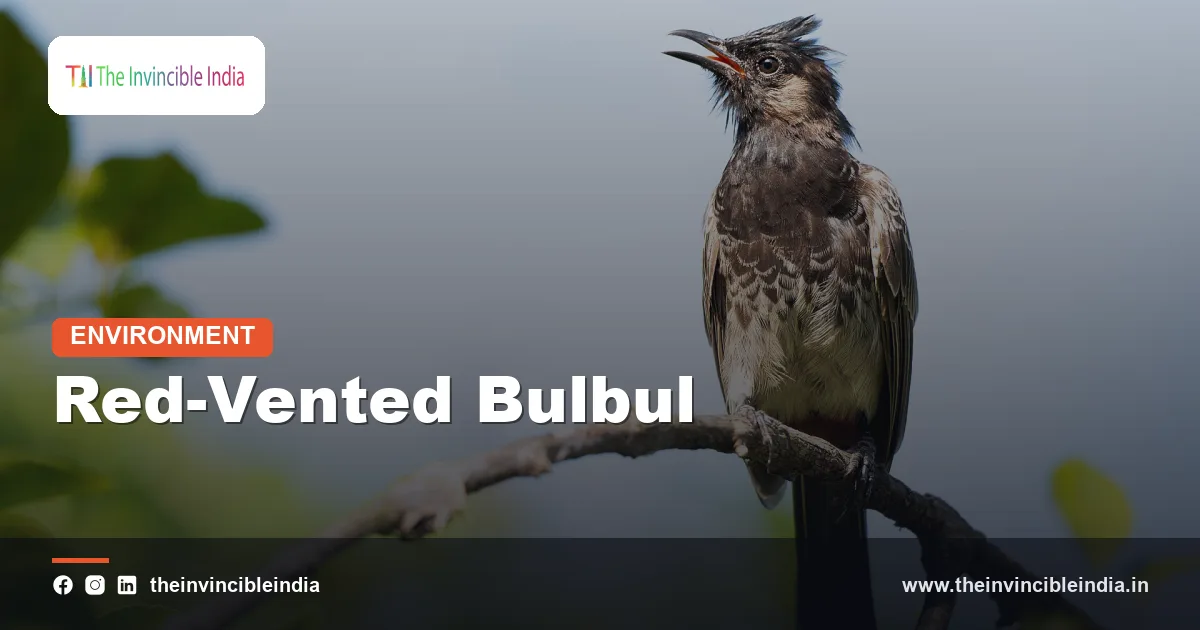
The red-vented bulbul (Pycnonotus cafer) is a bold, noisy and highly adaptable songbird of the Indian subcontinent, identified by its blackish, scaly-looking plumage, a short crest, a white rump and a crimson patch under the tail. It is one of the most common birds in Indian gardens, parks and city streets, and outside its native range it has been listed among the world’s most damaging invasive alien species.
This explainer covers how to identify the red-vented bulbul, where it lives in India, what it eats, how it calls, how it breeds, and why it is considered invasive when it is introduced to other countries. It was last reviewed on 23 October 2026, and population statements are kept general because bird numbers change over time.
Red-Vented Bulbul Quick Facts
| Common name | Red-vented bulbul |
|---|---|
| Scientific name | Pycnonotus cafer |
| Family | Pycnonotidae (bulbuls) |
| Size | About 20 cm long |
| Key features | Dark scaly body, short crest, white rump, crimson vent, white-tipped tail |
| Diet | Fruit, nectar, buds, seeds and insects |
| Native range | Indian subcontinent and parts of Myanmar |
| Introduced range | Hawaii, Fiji, Samoa, Tonga and other Pacific islands; attempted or limited elsewhere |
| IUCN status | Least Concern; listed among the 100 worst invasive alien species by the Invasive Species Specialist Group |
Key Takeaways
- The red-vented bulbul is a dark, scaly-looking songbird about 20 cm long with a crimson patch under the tail and a white rump.
- The red-vented bulbul is native to the Indian subcontinent and is one of the most common birds of Indian gardens, towns and scrubland.
- The red-vented bulbul eats fruit, nectar, buds and insects, and it readily visits gardens and farms.
- The red-vented bulbul is noisy and bold, with a loud, chattering voice that is heard from dawn throughout the day.
- The red-vented bulbul has been introduced to several Pacific islands and other regions, where it spreads weed seeds and damages crops.
- The red-vented bulbul is classified as Least Concern by the IUCN, yet the Invasive Species Specialist Group lists it among the world’s 100 worst invasive alien species.
What is the red-vented bulbul?
The red-vented bulbul is a medium-small passerine bird in the bulbul family, Pycnonotidae, and it is native to South Asia. Its scientific name is Pycnonotus cafer, and it is among the best-known garden birds of India, Pakistan, Nepal, Bangladesh, Bhutan, Sri Lanka and Myanmar.
The Latin name cafer is commonly explained as a reflection of an early mistake about where the first specimens came from, since the bird is Asian and not African. Several subspecies are recognised across its range, and they differ in shade and in the amount of scaling on the body.
The common name describes the crimson undertail coverts, called the vent. In Hindi and other Indian languages the bird is simply called a bulbul, though the word is also used for other birds and, in Persian poetry, for the nightingale.
How do you identify a red-vented bulbul?
A red-vented bulbul is identified by its dark brown or blackish head and breast, scaly-looking body feathers, a short crest, a white rump and a bright crimson patch under the tail. The tail is dark with a broad white tip, which shows clearly when the bird flies away.
Useful field marks include the following.
- Head: black or very dark brown, with a short, rounded crest that is less tall than that of the red-whiskered bulbul.
- Body: brown with pale edges to the feathers that create a scaly or scalloped look, especially on the back and breast.
- Rump: a conspicuous white patch above the tail, seen mainly in flight.
- Vent: bright crimson under the tail, which can look red even from a distance.
- Sexes: males and females look alike, and young birds are duller with a paler vent.
The red-vented bulbul can be confused with the red-whiskered bulbul, but the red-whiskered has a tall pointed crest, a red spot behind the eye and a white cheek.
Where does the red-vented bulbul live?
The red-vented bulbul lives throughout most of India in gardens, scrub, orchards, light woodland, farmland and cities, from the plains up to moderate hill elevations. It prefers open and disturbed habitats over dense forest, and it often thrives where people have planted fruiting trees and shrubs.
Within India the species is widespread, and it is one of the first birds noticed in a new neighbourhood. Different subspecies occur in different regions, such as northern and north-eastern India, the peninsula and the south, and they vary in colour pattern.
The bird is mostly resident, staying in the same area through the year, though small local movements follow fruiting seasons. Its ability to use balconies, hedges, rooftops and street trees has made it a classic urban bird.
What does the red-vented bulbul eat?
The red-vented bulbul eats a varied diet of fruits, nectar, flower buds, seeds and insects, and it adjusts its food to what is available. Berries and soft fruits form much of the diet, and the bird takes insects such as caterpillars, beetles and termites, especially when feeding young.
It feeds on figs, lantana berries, papaya, guava, banana, tomato and many other cultivated and wild fruits. It also visits flowers for nectar and sometimes eats petals and buds. This flexible diet lets the bird live in many habitats.
The red-vented bulbul is both useful and troublesome. It disperses seeds of many native plants and eats insects, but it can also damage ripening fruit and vegetables in orchards and kitchen gardens.
What does the red-vented bulbul sound like?
The red-vented bulbul has a loud, cheerful and chattering voice, with calls often described as a sharp “be-careful” or “pik-pik-pee” phrase repeated through the day. The notes are varied and carry well, so the bird is easy to hear in gardens and streets.
Calls change with the situation. A short, harsh alarm call warns of cats, snakes and birds of prey, while softer notes are used between members of a pair. Groups of bulbuls may mob a predator together, and the noise often draws other birds to the scene.
Singing is most intense at dawn and during the breeding season, and the bird often calls from a prominent perch such as a wire, rooftop or treetop.
How does the red-vented bulbul breed?
The red-vented bulbul breeds by building an open, cup-shaped nest of twigs, grass and rootlets in a shrub, hedge or tree, usually at a low to medium height. The nest is often placed in gardens and on ledges, and sometimes in odd places such as hanging pots or wall niches.
The female lays about two or three pinkish eggs with reddish-brown spots and incubates them for about two weeks, while the male guards the area. Both parents feed the chicks with insects and fruit. The young leave the nest roughly two weeks after hatching, and pairs may raise more than one brood a year.
The breeding season varies across the country but is often concentrated in the warmer months of the year. Eggs and chicks are frequently lost to crows, cats and squirrels.
Why is the red-vented bulbul considered an invasive species?
The red-vented bulbul is considered an invasive species outside India because it has established itself in several regions where it was introduced and has harmed crops and native ecosystems. It is one of only a small number of birds on the Invasive Species Specialist Group’s list of 100 of the world’s worst invasive alien species.
The main concerns are as follows.
- Crop damage: the bird eats fruit and vegetables and can cause losses in orchards and gardens.
- Seed spread: it spreads seeds of weeds and other non-native plants, which can alter native vegetation.
- Competition: it may compete with native birds for food and nest sites, although the strength of this effect varies.
- Quick adaptation: its tolerance of disturbed habitats helps it establish populations from small numbers.
Populations became established on Pacific islands including Hawaii (such as Oahu), Fiji, Samoa and Tonga. Countries such as Australia and New Zealand treat the bulbul as an unwanted species and have run control or eradication efforts where birds appeared.
Red-vented bulbul compared with the red-whiskered bulbul
The red-vented bulbul and red-whiskered bulbul are the two bulbuls most often seen in Indian gardens, and they are easy to separate once the head and rump are checked. The table below sets out the main differences.
| Feature | Red-vented bulbul | Red-whiskered bulbul |
|---|---|---|
| Scientific name | Pycnonotus cafer | Pycnonotus jocosus |
| Crest | Short, rounded | Tall, pointed |
| Face | Dark, no red spot | White cheek with red spot behind the eye |
| Body | Dark brown, scaly look | Brown above, whitish below |
| Rump | White, conspicuous in flight | Brown |
| Habitat | Cities, gardens, scrub, farmland | Greener gardens, light woodland |
| Invasive listing | Among world’s 100 worst invasive alien species | Introduced in places; not on that list |
Is the red-vented bulbul protected in India?
The red-vented bulbul is generally protected in India as a native wild bird under the Wildlife (Protection) Act, 1972, which prohibits the capture, trade and keeping of wild birds. Because it is so common, it does not face conservation concern, and the IUCN lists it as Least Concern.
The key distinction is between native and introduced ranges. In India, the red-vented bulbul is a natural part of the ecosystem, where predators, parasites and competitors keep it in balance. In places where it has been introduced, the same adaptability that helps it succeed becomes a problem.
Residents of introduced regions are advised not to release cage birds and to report sightings of the bulbul to biosecurity agencies, while residents of India can simply enjoy and watch the bird.
How can gardeners live with red-vented bulbuls?
Gardeners can live with red-vented bulbuls by protecting ripening fruit with simple physical barriers and by accepting the bird as a harmless and even helpful neighbour for most of the year. In India the bulbul is a native bird, so the aim is protection of crops and not removal of the birds.
- Cover prized fruit such as guava, papaya or tomatoes with fine netting or paper bags just before ripening.
- Pick fruit soon after it ripens, since fully ripe fruit left on the plant attracts birds quickly.
- Plant a few extra berry-bearing shrubs on the garden edge, which can draw birds away from the main crop.
- Use reflective strips or moving objects as short-term deterrents, and change them from time to time because the birds quickly learn.
- Avoid harming nests, which are protected along with the birds under the Wildlife (Protection) Act, 1972.
The benefits of the bulbul are easy to overlook. The red-vented bulbul eats many caterpillars and beetles that damage garden plants, and it disperses seeds of native fruiting trees. In its home range, the bird is part of the normal balance of garden wildlife and not a pest to be controlled.
Bottom Line
The red-vented bulbul is a bold, loud and adaptable songbird that has made itself at home in Indian cities and gardens, and its crimson vent and white rump make it easy to recognise. It is a normal and valued part of Indian wildlife, yet its record abroad shows how a hardy bird can become a serious invasive species once carried outside its native range.
Frequently Asked Questions
Why is it called the red-vented bulbul?
It is called the red-vented bulbul because of the crimson patch of feathers under its tail, known as the vent. The bird also has a dark scaly body, a short crest and a white rump. These features separate it from the red-whiskered bulbul.
Is the red-vented bulbul native to India?
Yes, the red-vented bulbul is native to India and the wider Indian subcontinent. It occurs naturally in India, Pakistan, Nepal, Bangladesh, Bhutan, Sri Lanka and parts of Myanmar. In India it is among the most widespread garden birds.
Why is the red-vented bulbul considered invasive?
The red-vented bulbul is considered invasive outside its native range because it has formed large populations on islands and in other regions where it was introduced. It damages fruit and vegetable crops and spreads weed seeds. The Invasive Species Specialist Group lists it among 100 of the world’s worst invasive alien species.
What does the red-vented bulbul eat?
The red-vented bulbul eats fruits, nectar, buds, seeds and insects. Berries, figs, papaya and guava are common foods, and insects are fed to the chicks. Its flexible diet is one reason it succeeds in so many habitats.
How can I tell a red-vented bulbul from a red-whiskered bulbul?
You can tell them apart by the crest, face and rump. The red-vented bulbul has a short crest, a dark face and a white rump, while the red-whiskered bulbul has a tall pointed crest, a red spot behind the eye and a white cheek. Both have a crimson vent.
Does the red-vented bulbul need protection in India?
No, the red-vented bulbul does not need special conservation action in India because it is common and widespread, and the IUCN lists it as Least Concern. It remains legally protected as a native wild bird under the Wildlife (Protection) Act, 1972. Keeping gardens green with fruiting plants helps it thrive.
{“@context”:”https://schema.org”,”@graph”:[{“@type”:”FAQPage”,”mainEntity”:[{“@type”:”Question”,”name”:”Why is it called the red-vented bulbul?”,”acceptedAnswer”:{“@type”:”Answer”,”text”:”It is called the red-vented bulbul because of the crimson patch of feathers under its tail, known as the vent. The bird also has a dark scaly body, a short crest and a white rump. These features separate it from the red-whiskered bulbul.”}},{“@type”:”Question”,”name”:”Is the red-vented bulbul native to India?”,”acceptedAnswer”:{“@type”:”Answer”,”text”:”Yes, the red-vented bulbul is native to India and the wider Indian subcontinent. It occurs naturally in India, Pakistan, Nepal, Bangladesh, Bhutan, Sri Lanka and parts of Myanmar. In India it is among the most widespread garden birds.”}},{“@type”:”Question”,”name”:”Why is the red-vented bulbul considered invasive?”,”acceptedAnswer”:{“@type”:”Answer”,”text”:”The red-vented bulbul is considered invasive outside its native range because it has formed large populations on islands and in other regions where it was introduced. It damages fruit and vegetable crops and spreads weed seeds. The Invasive Species Specialist Group lists it among 100 of the world’s worst invasive alien species.”}},{“@type”:”Question”,”name”:”What does the red-vented bulbul eat?”,”acceptedAnswer”:{“@type”:”Answer”,”text”:”The red-vented bulbul eats fruits, nectar, buds, seeds and insects. Berries, figs, papaya and guava are common foods, and insects are fed to the chicks. Its flexible diet is one reason it succeeds in so many habitats.”}},{“@type”:”Question”,”name”:”How can I tell a red-vented bulbul from a red-whiskered bulbul?”,”acceptedAnswer”:{“@type”:”Answer”,”text”:”You can tell them apart by the crest, face and rump. The red-vented bulbul has a short crest, a dark face and a white rump, while the red-whiskered bulbul has a tall pointed crest, a red spot behind the eye and a white cheek. Both have a crimson vent.”}},{“@type”:”Question”,”name”:”Does the red-vented bulbul need protection in India?”,”acceptedAnswer”:{“@type”:”Answer”,”text”:”No, the red-vented bulbul does not need special conservation action in India because it is common and widespread, and the IUCN lists it as Least Concern. It remains legally protected as a native wild bird under the Wildlife (Protection) Act, 1972. Keeping gardens green with fruiting plants helps it thrive.”}}]}]}


