

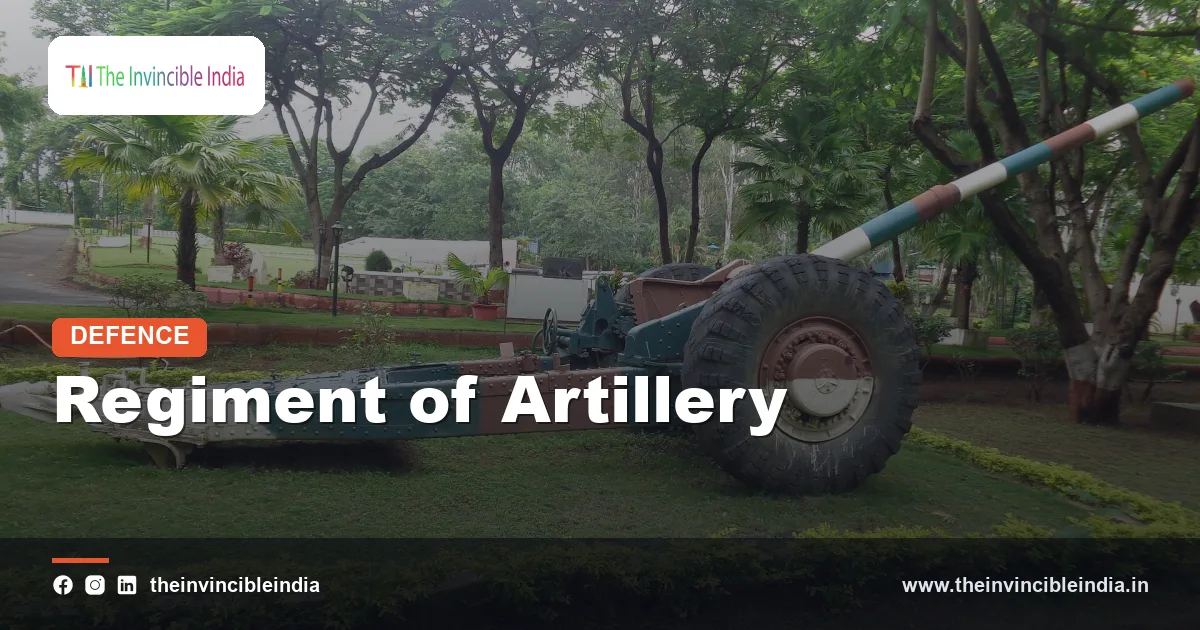
The Regiment of Artillery is the second-largest arm of the Indian Army and its principal source of firepower, supporting infantry and armoured formations with guns, howitzers, mortars, rockets and missiles. Known to soldiers as the “God of War”, the Regiment traces its origins to the raising of a mountain battery in 1827, and its motto is “Sarvatra Izzat-o-Iqbal”, meaning “Everywhere with Honour and Glory”. Gunners are found wherever the Army fights, from the high Himalayas to the plains and deserts.
This explainer covers the history of the Regiment of Artillery, its main types of weapons, the well-known modernisation programmes (Dhanush, ATAGS, K9 Vajra and M777), the Pinaka rocket system and its role in battle. It relies only on publicly known facts and does not describe current deployments or strength.
| Attribute | Detail |
|---|---|
| Parent force | Indian Army |
| Arm of service | Combat support arm; second-largest arm after the Infantry |
| Origin | Raising of a mountain battery in 1827; Artillery Day is observed on 28 September |
| Motto | Sarvatra Izzat-o-Iqbal (Everywhere with Honour and Glory) |
| Nickname | “God of War” |
| Training institutions | School of Artillery, Devlali and Artillery Centre, Nasik Road (Maharashtra) |
| Main weapons | Field guns, medium guns, howitzers, mortars, multi-barrel rocket launchers, missiles |
| Notable systems | Bofors FH-77B, Dhanush, ATAGS, K9 Vajra-T, M777, Pinaka |
Key Takeaways
- The Regiment of Artillery is the Indian Army’s main firepower arm and the second-largest arm of the Army after the Infantry.
- The Regiment of Artillery traces its history to 1827, and the Army celebrates Artillery Day every year on 28 September.
- The Bofors FH-77B howitzer proved its worth in the 1999 Kargil conflict, and the Army has since pursued a broad modernisation of its 155 mm gun inventory.
- Indigenous and imported systems now operate side by side, including the Dhanush gun, the Advanced Towed Artillery Gun System (ATAGS), the K9 Vajra-T self-propelled gun and the M777 ultralight howitzer.
- The Pinaka multi-barrel rocket launcher, developed by the Defence Research and Development Organisation (DRDO), gives the Regiment of Artillery an indigenous area-saturation capability.
- Air defence artillery was part of the Regiment of Artillery until 1994, when it was separated to form the Corps of Army Air Defence.
What is the Regiment of Artillery?
The Regiment of Artillery is the Indian Army’s arm responsible for delivering indirect and direct fire on the enemy, using weapons that range from light mortars to long-range rocket and missile systems. It is a combat support arm, which means that its primary mission is to help other arms, mainly the Infantry and the Armoured Corps, to win the battle.
Gunners are organised into regiments, which are the unit-level formations of the arm, and regiments are grouped into artillery brigades and divisions at higher levels. Each manoeuvre formation, such as an infantry or armoured division, has artillery support attached to it.
The Regiment is led by the Director General of Artillery at Army Headquarters in New Delhi. It is distinct from the Corps of Army Air Defence, which was carved out of it in 1994.
How did the Regiment of Artillery begin?
The Regiment of Artillery began in 1827, when a mountain battery was raised for the Bombay Army of the British East India Company, and this event is marked as the Regiment’s birthday. Mountain batteries, which carried light guns on mules, were a natural fit for the rugged frontier regions.
After the Revolt of 1857, the British authorities disbanded most Indian artillery units, apart from the mountain batteries, and for many decades Indian soldiers had a limited role in the heavier artillery. The process of Indianisation in the 1930s gradually opened the field artillery to Indians, and in 1935 the Royal Indian Artillery was formed as a distinct regiment of the British Indian Army.
During the Second World War, the Royal Indian Artillery expanded greatly and served in North Africa, Italy, Burma and Malaya, as well as the defence of India. After Independence in 1947, the Regiment was reorganised as the Regiment of Artillery of the Indian Army, and it has served in every major conflict since.
| Period | Development |
|---|---|
| 1827 | A mountain battery is raised; the origin of the Regiment of Artillery |
| After 1857 | Indian artillery largely disbanded, except mountain batteries |
| 1935 | Royal Indian Artillery formed during the Indianisation of the Army |
| 1939-1945 | Large expansion and service in multiple theatres in the Second World War |
| 1947-48 | Independence and the first Jammu and Kashmir operations |
| 1994 | Air defence artillery separated to form the Corps of Army Air Defence |
| 1999 | Kargil conflict; massed fire from Bofors guns and other weapons |
Why is artillery called the “God of War”?
Artillery is called the “God of War” because heavy, accurate fire has been the deciding factor in so many battles, and a phrase of this kind has long been used for the arm in many armies. Artillery has accounted for a very large share of battlefield casualties in conventional wars, and it is what allows infantry to advance under cover of fire.
In the Indian Army the title is used with pride, alongside the Regiment’s own motto of “Sarvatra Izzat-o-Iqbal”. The expression reflects the arm’s reputation for decisive effect, whether in a defensive battle where concentrated fire breaks an assault or in an offensive where artillery neutralises enemy positions.
What weapons does the Regiment of Artillery use?
The Regiment of Artillery uses several families of weapons: towed and self-propelled guns and howitzers, mortars, rocket launchers, missiles and surveillance systems. Each family has a distinct tactical role.
- Guns and howitzers: Guns fire at a flatter trajectory and longer ranges, while howitzers fire at higher angles and are well suited to hilly terrain. Calibres typically include 105 mm, 130 mm and 155 mm.
- Mortars: Short-range, high-angle weapons of calibres such as 81 mm and 120 mm, easy to carry and useful in mountains.
- Rocket launchers: Multi-barrel systems that fire many rockets in quick succession over a wide area.
- Missiles: Precision long-range weapons, including the BrahMos supersonic cruise missile, which is operated by dedicated missile units.
- Surveillance and target acquisition: Radars, unmanned aerial vehicles and observation equipment that locate targets and correct fire.
The Army defines its artillery regiments by type, such as field, medium, heavy, light, mountain, rocket, missile and surveillance and target acquisition units.
What is the Bofors gun and why does it matter?
The Bofors FH-77B is a Swedish-designed 155 mm towed howitzer that India bought under a contract signed in 1986, and it became the backbone of the Army’s medium artillery for decades. The weapon is known for its range, accuracy and high rate of fire, and for the political controversy surrounding the purchase in the late 1980s.
The gun’s reputation was cemented in the Kargil conflict of 1999, when Bofors howitzers fired in the direct-fire role against enemy positions on mountain peaks, helping Indian infantry to retake heights such as Tololing. The experience of Kargil underlined the importance of mobile, accurate 155 mm firepower in the mountains, and it influenced later procurement decisions.
The ageing of the Bofors fleet and the absence of new 155 mm guns for many years led to a push for modernisation, which began to bear fruit from the mid-2010s onwards.
How is the Regiment of Artillery being modernised?
The Regiment of Artillery is being modernised through a mix of indigenous development and carefully chosen imports, with the goal of replacing ageing guns with standardised 155 mm systems. The Army has described this programme in public as the Field Artillery Rationalisation Plan, which aims to move towards 155 mm calibre across its gun inventory.
Dhanush
The Dhanush is an indigenous 155 mm, 45-calibre towed howitzer, based on the design of the Bofors gun and manufactured by the Gun Carriage Factory in Jabalpur. It is often called the “Desi Bofors” and was inducted in the late 2010s.
Advanced Towed Artillery Gun System (ATAGS)
The ATAGS is a 155 mm, 52-calibre towed howitzer developed by the DRDO’s Armament Research and Development Establishment (ARDE) in Pune with industry partners from the private sector. It is an example of the “Make in India” approach in defence and has a longer barrel for greater range.
K9 Vajra-T
The K9 Vajra-T is a 155 mm, 52-calibre tracked self-propelled gun, built in India by Larsen and Toubro under licence from a South Korean design, the K9 Thunder. A contract for 100 guns was signed in 2017, and the system is suited to desert and plains operations, where its mobility is an advantage.
M777 ultralight howitzer
The M777 is a 155 mm, 39-calibre towed howitzer from the United States, built using titanium to make it light enough to be airlifted by helicopter. India signed a deal for 145 guns in 2016, and the first units arrived in 2018. The gun is particularly useful in the mountains.
| System | Calibre | Type | Origin |
|---|---|---|---|
| Bofors FH-77B | 155 mm | Towed howitzer | Sweden |
| Dhanush | 155 mm | Towed howitzer | India (upgraded Bofors design) |
| ATAGS | 155 mm | Towed howitzer | India (DRDO with industry) |
| K9 Vajra-T | 155 mm | Self-propelled tracked gun | India, from a South Korean design |
| M777 | 155 mm | Ultralight towed howitzer | United States |
What is the Pinaka rocket system?
The Pinaka is an Indian multi-barrel rocket launcher system, developed by the DRDO’s Armament Research and Development Establishment, which fires a salvo of rockets to saturate a large area. It is named after the bow of Lord Shiva in Hindu tradition.
The original Pinaka used 214 mm rockets and was first employed in operations during the Kargil conflict in 1999. Newer versions have been developed with extended ranges and guided rockets, which improve accuracy considerably. The launcher is mounted on a wheeled truck, so it can move quickly after firing.
Besides the Pinaka, the Army has used other rocket systems of Soviet and Russian origin, such as the 122 mm Grad and the long-range 300 mm Smerch, both of which have been operated by rocket regiments.
How does artillery support the battle?
Artillery supports the battle by neutralising or destroying enemy positions, breaking up attacks, shielding friendly troops with smoke or illumination and striking targets deep behind the front line. The key tasks are commonly described as support to the manoeuvre arms, counter-battery fire and deep strike.
- Close support: Fire called in by forward observers attached to infantry and armoured units.
- Counter-battery: Locating and engaging enemy guns using weapon-locating radars.
- Suppression: Keeping the enemy’s heads down while friendly troops advance or withdraw.
- Interdiction: Striking supply lines, assembly areas and headquarters in the enemy’s depth.
The artillery officer who accompanies the infantry or tank commander and directs fire onto targets is known as the forward observation officer. This partnership between the observer and the gun line is the essence of the arm.
What role do surveillance and target acquisition play?
Surveillance and target acquisition (SATA) units locate targets and observe the fall of shot, so that guns and rockets can be used accurately. They rely on radars, unmanned aerial vehicles and other sensors.
A well-known example is the Swathi weapon-locating radar, developed by the DRDO and produced by Bharat Electronics Limited, which detects the origin of enemy artillery or mortar fire and helps with counter-battery operations. Drones have become increasingly important in recent years, since they let gunners see targets in real time and adjust fire with precision.
What are the best-known battles involving the Regiment of Artillery?
The Regiment of Artillery has played an important role in every major conflict of independent India, including the 1947-48 war in Jammu and Kashmir, the wars of 1962, 1965 and 1971, and the 1999 Kargil conflict. Public accounts of these wars emphasise the contribution of gunners in holding defensive positions and supporting offensives.
In the Kargil conflict, massed artillery fire and the direct-fire use of Bofors guns were credited with softening enemy positions before infantry assaults. In earlier wars, artillery was prominent in the defensive battles on the western front and in the advance in the east in 1971. Gunners have also served on United Nations peacekeeping missions.
Bottom Line
The Regiment of Artillery remains the Indian Army’s largest source of fire support and a pillar of its combat power. Its modernisation, from Dhanush and ATAGS to K9 Vajra-T, M777 and Pinaka, shows a shift towards standardised 155 mm calibre, greater mobility, indigenous manufacture and better target acquisition.
Frequently Asked Questions
What is the Regiment of Artillery in the Indian Army?
The Regiment of Artillery is the arm of the Indian Army that provides heavy fire support with guns, howitzers, mortars, rockets and missiles. It is the second-largest arm of the Army after the Infantry. Its units support infantry and armoured formations in both offence and defence.
When is Artillery Day celebrated in India?
Artillery Day is celebrated on 28 September every year. The date marks the raising of a mountain battery in 1827, which is regarded as the origin of the Regiment of Artillery.
Why is artillery called the “God of War”?
Artillery is called the “God of War” because concentrated and accurate fire often decides the outcome of battles. It is the arm that has inflicted a very large share of casualties in conventional wars and enables infantry and tanks to advance. The nickname is used with pride in the Indian Army.
What are Dhanush and ATAGS?
Dhanush and ATAGS are indigenous 155 mm towed howitzers. The Dhanush is an upgraded version of the Bofors design with 45-calibre barrel, made at the Gun Carriage Factory in Jabalpur. The ATAGS is a 52-calibre gun developed by the DRDO with private-sector partners, designed for longer range.
What is the Pinaka rocket launcher?
The Pinaka is a multi-barrel rocket launcher developed by the DRDO that fires a salvo of rockets over a wide area. The first version used 214 mm rockets and was used during the Kargil conflict in 1999. Later versions offer greater range and guided rockets.
How is the Regiment of Artillery different from the Army Air Defence Corps?
The Regiment of Artillery fires at ground targets, while the Corps of Army Air Defence protects forces and assets from aerial threats. Air defence was part of the Regiment of Artillery until 1994, when it was made a separate arm. Both retain close professional links.
{“@context”:”https://schema.org”,”@graph”:[{“@type”:”FAQPage”,”mainEntity”:[{“@type”:”Question”,”name”:”What is the Regiment of Artillery in the Indian Army?”,”acceptedAnswer”:{“@type”:”Answer”,”text”:”The Regiment of Artillery is the arm of the Indian Army that provides heavy fire support with guns, howitzers, mortars, rockets and missiles. It is the second-largest arm of the Army after the Infantry. Its units support infantry and armoured formations in both offence and defence.”}},{“@type”:”Question”,”name”:”When is Artillery Day celebrated in India?”,”acceptedAnswer”:{“@type”:”Answer”,”text”:”Artillery Day is celebrated on 28 September every year. The date marks the raising of a mountain battery in 1827, which is regarded as the origin of the Regiment of Artillery.”}},{“@type”:”Question”,”name”:”Why is artillery called the “God of War”?”,”acceptedAnswer”:{“@type”:”Answer”,”text”:”Artillery is called the “God of War” because concentrated and accurate fire often decides the outcome of battles. It is the arm that has inflicted a very large share of casualties in conventional wars and enables infantry and tanks to advance. The nickname is used with pride in the Indian Army.”}},{“@type”:”Question”,”name”:”What are Dhanush and ATAGS?”,”acceptedAnswer”:{“@type”:”Answer”,”text”:”Dhanush and ATAGS are indigenous 155 mm towed howitzers. The Dhanush is an upgraded version of the Bofors design with 45-calibre barrel, made at the Gun Carriage Factory in Jabalpur. The ATAGS is a 52-calibre gun developed by the DRDO with private-sector partners, designed for longer range.”}},{“@type”:”Question”,”name”:”What is the Pinaka rocket launcher?”,”acceptedAnswer”:{“@type”:”Answer”,”text”:”The Pinaka is a multi-barrel rocket launcher developed by the DRDO that fires a salvo of rockets over a wide area. The first version used 214 mm rockets and was used during the Kargil conflict in 1999. Later versions offer greater range and guided rockets.”}},{“@type”:”Question”,”name”:”How is the Regiment of Artillery different from the Army Air Defence Corps?”,”acceptedAnswer”:{“@type”:”Answer”,”text”:”The Regiment of Artillery fires at ground targets, while the Corps of Army Air Defence protects forces and assets from aerial threats. Air defence was part of the Regiment of Artillery until 1994, when it was made a separate arm. Both retain close professional links.”}}]}]}


