

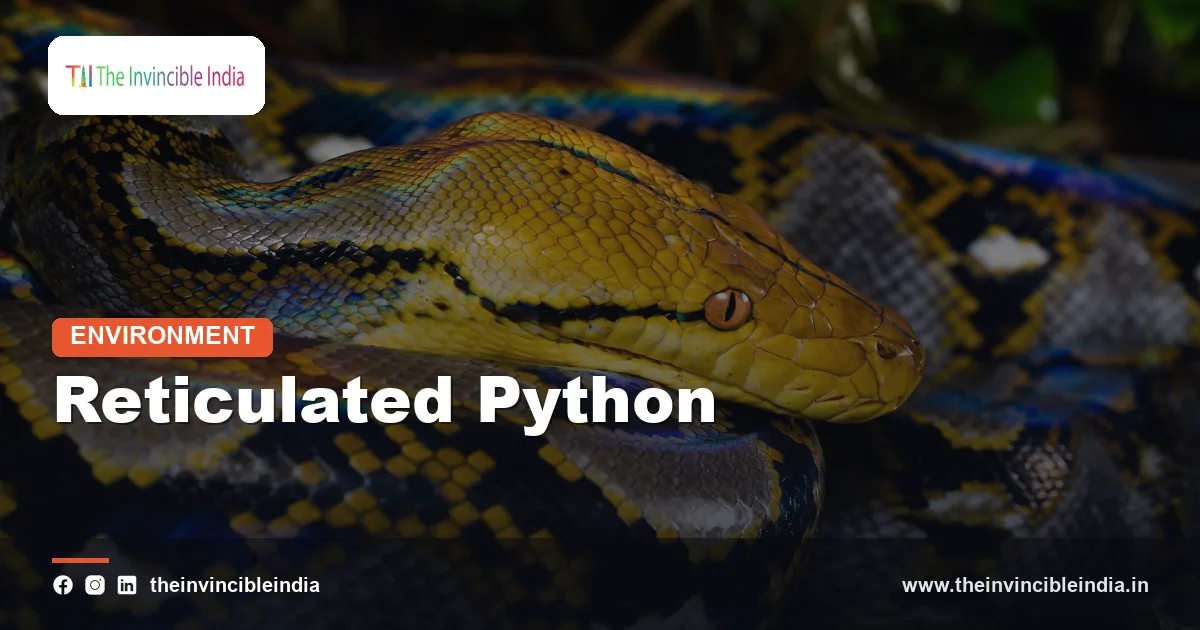
The reticulated python (Malayopython reticulatus) is the world’s longest snake, a powerful, non-venomous constrictor that can exceed six metres and that is found in India only in parts of the north-east and in the Andaman and Nicobar Islands. It takes its name from the net-like, geometric pattern on its back, and it is a very different animal from the Indian rock python, which is far more widespread in the country.
The reticulated python kills by wrapping its coils around prey and squeezing, not by poison, and it feeds mainly on mammals and birds. It is a protected species in India, it is shy in the wild, and it plays an important role in controlling rodents and other animals in tropical forests.
Quick Facts: Reticulated Python
| Common name | Reticulated python (also called reticulate python) |
|---|---|
| Scientific name | Malayopython reticulatus (earlier called Python reticulatus) |
| Family | Pythonidae (pythons) |
| Size | Usually 3 to 6 metres; the longest snake in the world, with the biggest individuals exceeding 6 metres |
| Range in India | Parts of north-eastern India and the Andaman and Nicobar Islands; much wider range across South-East Asia |
| Habitat | Tropical rainforest, forest edges, river banks, swamps and areas near villages and plantations |
| Diet | Carnivorous: rodents, civets, monkeys, pigs, deer, birds and other mammals |
| Breeding | Egg-laying; the female lays a large clutch and coils around the eggs until they hatch |
| Status | Least Concern (IUCN); protected under the Wildlife (Protection) Act, 1972; CITES Appendix II |
Key Takeaways
- The reticulated python (Malayopython reticulatus) is the longest snake in the world, regularly reaching three to six metres in length.
- The reticulated python is non-venomous and kills its prey by constriction, and it swallows its food whole.
- In India the reticulated python occurs only in parts of the north-east and in the Andaman and Nicobar Islands, which are the western edge of its range.
- The reticulated python is named for the net-like, diamond-patterned markings that break up its outline in forest shadow and leaf litter.
- The reticulated python lays large clutches of eggs, and the female stays coiled around them until they hatch.
- The reticulated python is protected under India’s Wildlife (Protection) Act, 1972, and attacks on people are very rare.
What Is the Reticulated Python?
The reticulated python is a very large, non-venomous snake of the family Pythonidae that holds the record as the longest snake species on Earth. It is a heavy-bodied constrictor with a long, muscular body, a distinct head and a strongly patterned back.
Pythons are an old group of snakes found in Africa, Asia and Australia. They have small remnants of hind limbs in the form of spurs, they have heat-sensing pits along the lips and they kill by squeezing rather than by venom. The reticulated python was long placed in the genus Python, but it was later moved to its own genus, Malayopython, after genetic studies.
The species is the longest snake, but not the heaviest. The green anaconda of South America is bulkier and heavier, while the reticulated python is longer and more slender.
How Long Does the Reticulated Python Grow?
The reticulated python commonly grows to between three and six metres, and the largest verified individuals have been measured at more than six metres. Stories of snakes ten metres long or more have never been confirmed with reliable measurements, and they should be treated as exaggerations.
Females grow larger than males, and growth continues slowly throughout life. A hatchling is only about half a metre to 70 cm long, but it grows quickly in its first years if food is plentiful. In India, the animals on the Nicobar Islands and in the north-east are usually smaller than record-size snakes from Indonesia and the Malay region.
| Snake | Typical claim to fame | Approximate maximum length |
|---|---|---|
| Reticulated python | Longest snake in the world | More than 6 metres |
| Green anaconda | Heaviest snake | About 5 to 6 metres |
| King cobra | Longest venomous snake | Around 5 metres |
| Burmese python | One of the biggest pythons | About 5 metres |
| Indian rock python | Large python of the Indian mainland | Around 3 to 4 metres, rarely more |
How Can You Identify a Reticulated Python?
A reticulated python can be identified by the complex pattern of black-edged diamond and irregular shapes in brown, tan, yellow and olive along its back, together with a long narrow head marked with a dark stripe. The pattern gives the species its name, since “reticulated” means net-like.
- Pattern: an overlapping network of dark-edged shapes, with a pale centre in many individuals.
- Head: long and slim, with a black line down the middle and a dark band through each eye.
- Lips: heat-sensing pits along the upper and lower lip scales that detect warm-blooded prey.
- Scales: smooth, with a distinct rainbow-like shimmer in sunlight.
- Body: long, powerful and muscular, slimmer than that of an anaconda of the same length.
The Indian rock python, which has large, irregular blotches and a spearhead mark on the head, is the species most often mistaken for it in India.
Where Does the Reticulated Python Live in India?
The reticulated python lives in India only in the extreme north-east and on the Andaman and Nicobar Islands, which lie at the western limit of its range. Records come from the forests of states in north-eastern India, and the snake is better known from the Nicobar group than from the Andaman Islands proper.
Elsewhere it ranges widely across South-East Asia, including Myanmar, Thailand, Malaysia, Singapore, Indonesia and the Philippines. It is a snake of tropical lowland forest, but it is also adaptable and may turn up in plantations, canals, villages and even towns in parts of its range, where rats and poultry attract it.
Why is it uncommon in the rest of India?
The reticulated python needs a warm, humid, tropical climate and dense cover close to water. Drier regions of the mainland are the home of the Indian rock python instead. The two species do not overlap widely in India, which keeps competition between them low.
What Does the Reticulated Python Eat?
The reticulated python eats mammals and birds, ranging from rats and civets to monkeys, pigs and small deer in the case of the largest snakes. Young pythons eat rodents and birds, and the prey becomes larger as the snake grows.
The python hunts mostly at night. It waits in ambush near trails, burrows or water and strikes quickly, grabbing prey with its teeth and wrapping the body in coils. Heat-sensing pits help it find warm-blooded animals even in darkness.
After a large meal, the snake may not eat again for weeks or even months, because its slow metabolism can handle long fasts. Wild pythons that live near human settlements sometimes take chickens, goats or dogs, which is the main reason that people come into conflict with them.
How Does the Reticulated Python Kill Its Prey?
The reticulated python kills its prey by constriction, which means it coils its body around the animal and tightens with each breath the prey takes. The pressure stops blood flow and breathing quickly, and death usually follows within minutes.
The snake then swallows the dead animal whole, usually head first. The jaws are connected by stretchy ligaments, and the two halves of the lower jaw can move independently, which lets the snake open its mouth very wide. Strong stomach acids and enzymes digest the prey, including most of the bone, and the digestion may take several days.
The reticulated python has no venom, and the bite of a python is only a means of holding prey. A bite is painful because of the many sharp, curved teeth, but it is not poisonous.
How Does the Reticulated Python Breed?
The reticulated python breeds by laying eggs, and a female may lay several dozen eggs, with large females laying a hundred or more in a clutch. The female stays with the eggs and coils around them for roughly two to three months until they hatch.
During this time the female does not feed, and she can raise the temperature of the eggs by making her muscles shiver. This helps keep the clutch warm and protects it from predators. After hatching, the young are on their own. They are about half a metre or more in length and are active hunters from the start.
Males search for females in the breeding season, and several males may follow a single female. In the wild, reticulated pythons are thought to live for roughly twenty years or longer, and captive animals have lived longer.
How Is the Reticulated Python Different From the Indian Rock Python?
The reticulated python differs from the Indian rock python (Python molurus) in length, pattern, range and habitat: it is longer and more slender, with a net-like pattern, and it lives in the humid north-east and the islands, whereas the rock python lives across much of the mainland. Both are non-venomous constrictors and both are protected by law.
| Feature | Reticulated python | Indian rock python |
|---|---|---|
| Scientific name | Malayopython reticulatus | Python molurus |
| Maximum length | More than 6 metres | Around 3 to 4 metres, rarely more |
| Build | Long and relatively slender | Thick and heavy for its length |
| Pattern | Net-like network of dark-edged diamonds | Large, irregular blotches in brown on a pale ground |
| Head mark | Dark central line along the head | Spear-shaped mark on the top of the head |
| Range in India | North-east and the Nicobar Islands | Much of mainland India, in forest, grassland and scrub |
The Burmese python (Python bivittatus), which occurs in the north-east and in other parts of South and South-East Asia, is another large relative that can be confused with both of these species.
How Does the Reticulated Python Move and Swim?
The reticulated python moves mainly by rectilinear crawling, in which belly scales grip the ground in a slow, straight line, and it also uses sideways wriggling when it needs to move fast. Despite its enormous size, the snake can climb trees and cross rivers with ease.
The python is a good swimmer and has been known to cross wide stretches of water, which helps to explain how the species colonised so many islands in Asia. It spends time in streams and swamps and may rest in water to keep cool. Young snakes are more likely to climb, while heavy adults stay near the ground or the water’s edge.
Most of its life is spent motionless. The python usually rests in a hollow, under dense vegetation or in water, and moves mainly to find food or a mate. A healthy wild snake is not a roaming hunter, and its secretive habits explain why it is seldom seen.
Is the Reticulated Python Dangerous to Humans?
The reticulated python is not usually dangerous to humans, because it avoids people and attacks on humans are extremely rare, but it is one of the few snakes large enough to be capable of killing a person. Almost all of the small number of documented fatal incidents have taken place in South-East Asia, and many involved handling or very large snakes.
In India, encounters are uncommon because of the species’ limited range. If a python is found near a home or poultry shed, people should stay calm and keep a distance, keep children and pets away and call the forest department or a trained snake rescuer. Attempting to catch, kill or photograph a large python at close range is dangerous for both people and the snake.
Pythons are an essential part of ecosystems because they keep rodents and other small mammals in check. Killing them out of fear is not necessary and, in India, is illegal.
Is the Reticulated Python Protected in India?
Yes, the reticulated python is protected in India under the Wildlife (Protection) Act, 1972, which bans hunting, capturing and trading the species and its parts. It is also listed in Appendix II of CITES, which regulates international trade, and it is assessed globally as Least Concern.
The main global threat is the commercial skin trade, since the python’s skin is used for leather goods. In India the main threats are loss of forest in the north-east and the islands, killing of snakes found near villages and the accidental death of pythons on roads. Because the Indian population is small and at the edge of the species’ range, it needs careful monitoring.
Anyone who sees an injured or trapped python should report it to the local forest authorities and avoid handling it.
Bottom Line
The reticulated python is a record-breaking but retiring snake that survives in India only in a few forested regions. It is non-venomous and protected, and understanding it helps to replace fear with respect for one of the most remarkable reptiles in the region.
Frequently Asked Questions
What is the reticulated python?
The reticulated python (Malayopython reticulatus) is the longest snake in the world and a non-venomous constrictor. It is named for the net-like pattern on its back. In India it is found in parts of the north-east and the Andaman and Nicobar Islands.
Is the reticulated python venomous?
No, the reticulated python is not venomous. It kills prey by wrapping its coils around the animal and squeezing. Its bite can still be painful because of its sharp teeth, so it should not be handled.
How long can a reticulated python grow?
A reticulated python commonly grows to between three and six metres, and the largest verified snakes are over six metres long. Females are larger than males. Claims of ten-metre snakes have not been confirmed.
Where is the reticulated python found in India?
The reticulated python is found in India in parts of north-eastern India and in the Andaman and Nicobar Islands. These areas are at the western edge of its range, which extends across South-East Asia. It prefers warm, humid, forested habitat near water.
Do reticulated pythons attack humans?
Reticulated pythons rarely attack humans, and they usually avoid people. They are large enough to be dangerous in theory, but fatal incidents are very rare and mostly reported from South-East Asia. They eat mainly rodents, birds and other animals.
Is it legal to keep a reticulated python in India?
No, it is illegal to capture, keep or trade a wild reticulated python in India. The species is protected under the Wildlife (Protection) Act, 1972. Offenders can face fines and imprisonment, and found animals should be reported to the forest department.
{“@context”:”https://schema.org”,”@graph”:[{“@type”:”FAQPage”,”mainEntity”:[{“@type”:”Question”,”name”:”What is the reticulated python?”,”acceptedAnswer”:{“@type”:”Answer”,”text”:”The reticulated python (Malayopython reticulatus) is the longest snake in the world and a non-venomous constrictor. It is named for the net-like pattern on its back. In India it is found in parts of the north-east and the Andaman and Nicobar Islands.”}},{“@type”:”Question”,”name”:”Is the reticulated python venomous?”,”acceptedAnswer”:{“@type”:”Answer”,”text”:”No, the reticulated python is not venomous. It kills prey by wrapping its coils around the animal and squeezing. Its bite can still be painful because of its sharp teeth, so it should not be handled.”}},{“@type”:”Question”,”name”:”How long can a reticulated python grow?”,”acceptedAnswer”:{“@type”:”Answer”,”text”:”A reticulated python commonly grows to between three and six metres, and the largest verified snakes are over six metres long. Females are larger than males. Claims of ten-metre snakes have not been confirmed.”}},{“@type”:”Question”,”name”:”Where is the reticulated python found in India?”,”acceptedAnswer”:{“@type”:”Answer”,”text”:”The reticulated python is found in India in parts of north-eastern India and in the Andaman and Nicobar Islands. These areas are at the western edge of its range, which extends across South-East Asia. It prefers warm, humid, forested habitat near water.”}},{“@type”:”Question”,”name”:”Do reticulated pythons attack humans?”,”acceptedAnswer”:{“@type”:”Answer”,”text”:”Reticulated pythons rarely attack humans, and they usually avoid people. They are large enough to be dangerous in theory, but fatal incidents are very rare and mostly reported from South-East Asia. They eat mainly rodents, birds and other animals.”}},{“@type”:”Question”,”name”:”Is it legal to keep a reticulated python in India?”,”acceptedAnswer”:{“@type”:”Answer”,”text”:”No, it is illegal to capture, keep or trade a wild reticulated python in India. The species is protected under the Wildlife (Protection) Act, 1972. Offenders can face fines and imprisonment, and found animals should be reported to the forest department.”}}]}]}


