

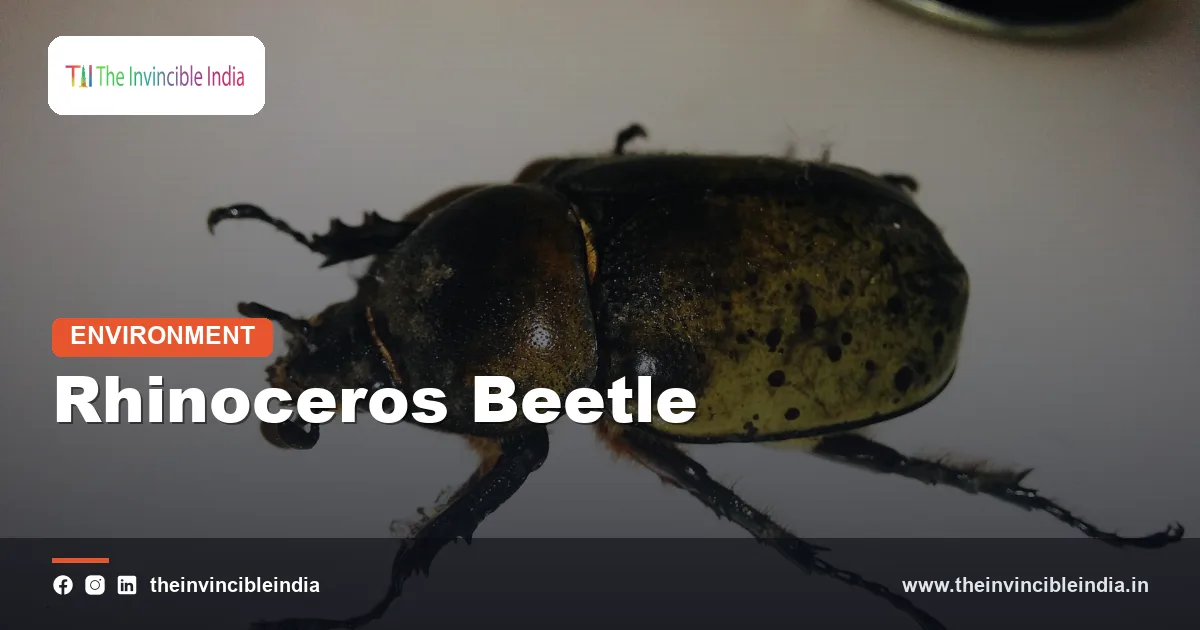
The rhinoceros beetle is a large, glossy, horned scarab beetle whose C-shaped grubs live in rotting wood, compost and manure, and whose adults are among the strongest insects for their size. In India the name is most often used for the coconut rhinoceros beetle (Oryctes rhinoceros), a well-known pest of coconut palms, and for the even larger Asian species Xylotrupes gideon, whose males carry a dramatic forked horn.
Despite their fearsome look, rhinoceros beetles are harmless to people: they cannot sting, they do not bite, and the horn is used only against rival beetles and for digging. This explainer covers what the rhinoceros beetle is, how its life cycle works, why farmers in coastal India worry about it, and the ecological work its grubs quietly do in the soil.
| Quick Facts | Details |
|---|---|
| Common name | Rhinoceros beetle (also horned beetle or unicorn beetle) |
| Scientific group | Family Scarabaeidae, subfamily Dynastinae (order Coleoptera) |
| Key species in India | Oryctes rhinoceros (coconut rhinoceros beetle) and Xylotrupes gideon (Asian rhinoceros or Atlas-type beetle) |
| Adult size | Roughly 3 to 6 cm long, depending on the species and sex |
| Larval habitat | Decaying logs, rotting coconut trunks, compost heaps, cattle manure and sawdust |
| Life cycle | Complete metamorphosis: egg, three larval stages, pupa, adult; usually several months to a year in total |
| Pest status | Adults of Oryctes rhinoceros damage coconut, oil palm and other palms; many other rhinoceros beetles are not pests |
| Danger to humans | None; no venom, no sting, no disease transmission |
| Main controls | Sanitation, pheromone traps, the fungus Metarhizium anisopliae and the Oryctes nudivirus |
Key Takeaways
- The rhinoceros beetle is a horned scarab beetle in the subfamily Dynastinae, named for the horn on the head of the male that resembles a rhinoceros horn.
- The coconut rhinoceros beetle, Oryctes rhinoceros, is a recognised pest of coconut and oil palm in southern and coastal India because the adult bores into the crown of the palm.
- Rhinoceros beetle grubs feed on decaying organic matter such as compost, rotting logs and manure, which makes the larval stage a natural recycler rather than a crop pest.
- The horn of a rhinoceros beetle is a tool for male-to-male contests and digging; it is not a weapon used against humans, and the beetle is not dangerous to touch.
- Rhinoceros beetles are widely reported to lift or pull many hundreds of times their own body weight, one of the highest strength-to-weight ratios among animals.
- Good sanitation, pheromone traps and biological agents such as the fungus Metarhizium anisopliae are the main ways Indian growers keep the coconut rhinoceros beetle in check.
What is a rhinoceros beetle?
A rhinoceros beetle is any of the large, stout-bodied scarab beetles in the subfamily Dynastinae, most of which carry one or more horns on the head or the thorax. The group belongs to the family Scarabaeidae, which also contains dung beetles, cockchafers and chafers, and it falls within Coleoptera, the order of beetles.
Dynastinae includes some of the heaviest beetles on Earth, such as the Hercules beetle of the Americas and the Goliath beetles of Africa (a related but separate group). In India the best-known members are Oryctes rhinoceros and Xylotrupes gideon, together with several lesser-known species in forests and plantations across the country. The shiny brown to black body is armoured by hardened forewings called elytra, which protect the folded flight wings beneath.
The name is descriptive. A rhinoceros beetle is called that because the curved horn projecting from the head of the male looks like the nose horn of a rhinoceros. In some species the female has only a small bump or a short horn, which makes the sexes easy to tell apart.
What does a rhinoceros beetle look like?
A rhinoceros beetle has a rounded, convex, shiny body that is usually dark brown, reddish brown or black, with a prominent horn on the head and often a smaller ridge or horn on the thorax. Adult Oryctes rhinoceros is typically around 3 to 5 cm long, while large males of Xylotrupes gideon can be somewhat bigger, particularly when the horn is counted.
The legs are stout and spiny, with strong claws suited to gripping bark and digging through soil. The antennae end in a small fan-like club, a feature shared by all scarab beetles. Males usually have longer horns than females, and horn size varies a great deal within one species because it depends on how well the larva was fed.
Quick ways to recognise the two common Indian types
- Oryctes rhinoceros: dark brown to black, a single backward-curving horn on the head, with a rough pit on the thorax of the male.
- Xylotrupes gideon: robust, often reddish brown to black, males with a large forked horn on the head and a smaller horn on the thorax.
- Females of both: smaller horns or only a low bump, and a more rounded outline.
Where is the rhinoceros beetle found in India?
The rhinoceros beetle is found across much of peninsular, eastern and north-eastern India, with the coconut rhinoceros beetle most abundant in the humid coastal belts of Kerala, Karnataka, Tamil Nadu, Andhra Pradesh, Odisha, West Bengal and the Andaman and Nicobar Islands. These are exactly the regions where coconut and areca palms are grown in large numbers, so the beetle and the crop overlap closely.
The beetle is native to South and South-East Asia. Larvae need decaying organic matter, so they are common wherever there are old stumps, dumped palm trunks, farmyard manure or large compost heaps. Adults fly at night, are strongly attracted to lights, and are frequently found on verandas, near street lamps and around houses during the monsoon months, when many species emerge.
Xylotrupes gideon is more of a forest and garden species. It is seen from the Western Ghats to the Himalayan foothills and the north-east, and it is often noticed after rains when adults feed on tree sap and ripe fruit.
How does the rhinoceros beetle life cycle work?
The rhinoceros beetle develops through complete metamorphosis, passing through four stages: egg, larva (grub), pupa and adult. The whole cycle in Oryctes rhinoceros commonly takes about six to nine months in warm Indian conditions, although it varies with temperature, food quality and species.
- Egg: The female lays small whitish eggs, often in batches, in decaying wood, compost or manure. They hatch in roughly one to two weeks.
- Larva: The creamy-white, C-shaped grub with a brown head and three pairs of legs feeds on rotting material. It passes through three instars, or growth stages, and is the longest stage, often lasting several months.
- Pupa: The grub builds a protective earthen cell and transforms into a pupa over a few weeks. The horn and adult body form inside.
- Adult: The beetle emerges, rests for a time, and then flies at night to feed and mate. Adults can live for several months.
Because the grub is the longest stage and the one that actually grows the beetle, the size of an adult, including its horn, reflects how much food the grub found. Well-fed grubs produce large, long-horned males.
What does the rhinoceros beetle eat?
The rhinoceros beetle eats different foods at different stages of life: grubs eat decaying plant matter, while adults of the pest species feed on the sap of living palms and other plants. This split is the reason one insect can be both a useful recycler and a farm pest.
Grubs
The larvae feed on rotting logs, decomposing coconut trunks, leaf litter, compost, cattle dung and sawdust heaps. They do not attack healthy living roots as a rule. By chewing and digesting dead plant material, they break it into finer, more nutrient-rich matter that soil fungi and bacteria can finish processing.
Adults
Adult Oryctes rhinoceros bore into the crown of a palm, usually near the unopened spear leaf, and chew through tissue to drink sap. Adults of Xylotrupes gideon feed mostly on sap oozing from trees and on overripe fruit, and are far less damaging to crops.
Why is the rhinoceros beetle a coconut pest?
The coconut rhinoceros beetle is a pest because the adult bores into the soft crown of a coconut palm, cutting developing fronds and sometimes damaging the growing point. The damage shows up as a characteristic pattern when the fronds unfold.
- V-shaped or fan-shaped cuts in the leaflets, as if trimmed with scissors, appear once the damaged spear leaf opens.
- Holes and chewed fibre may be visible at the base of the fronds.
- Repeated attacks reduce the photosynthetic area, delay flowering and lower nut yield.
- In severe cases, or when the growing point is destroyed, the palm can die. Beetle wounds can also let in secondary pests such as the red palm weevil and fungal rots.
Young palms and heavily attacked plantations suffer most. The pest is important in coconut-growing states because coconut supports the livelihoods of many small farmers and the coir, oil and tender-coconut trades. Oil palm, date palm, palmyra palm and areca nut can also be attacked.
How is the rhinoceros beetle controlled in India?
The rhinoceros beetle is controlled mainly through an integrated approach that removes breeding sites, traps adults and uses natural enemies, rather than relying on heavy pesticide use. The approach is practical because the pest breeds in particular, easily identifiable places.
| Method | How it works |
|---|---|
| Sanitation | Remove and destroy rotting palm trunks, stumps and fresh manure heaps, or treat compost so grubs cannot develop |
| Pheromone traps | Traps baited with a synthetic aggregation pheromone (ethyl 4-methyloctanoate) attract and capture adults |
| Fungus Metarhizium anisopliae | This green muscardine fungus infects grubs in breeding sites; spores are mixed into manure pits and compost |
| Oryctes nudivirus (OrNV) | A virus that infects the beetle and reduces its feeding and breeding; released through infected adults |
| Crown protection | Placing neem cake or sand mixed with a repellent in the leaf axils protects young palms |
| Manual removal | Adults hooked out of the crown with a metal rod during regular inspection |
Research bodies such as the Central Plantation Crops Research Institute (CPCRI) and state agricultural universities have promoted these methods in coconut belts. Pheromone traps have become popular because they monitor as well as capture the beetle, helping farmers decide when to act.
Is the rhinoceros beetle dangerous to humans?
No, the rhinoceros beetle is not dangerous to humans: it has no venom, no stinger and no disease-carrying role, and it rarely tries to bite. A beetle that is picked up may pinch with its claws or push with its legs, which can feel scratchy, but this is not harmful.
The horn is a contest tool. Male Xylotrupes beetles use it to lever rivals off a branch during fights over females and sap sources, and it plays no role in defending against people. The beetles are also attracted to lights and sometimes collide with windows or lamps, which alarms people more than it harms them.
The safest approach is to leave the beetle alone or to move it gently outdoors. Anyone who handles one should hold it by the sides of the body so the spiny legs do not scratch the skin.
How strong is a rhinoceros beetle?
A rhinoceros beetle is among the strongest animals relative to its size, and popular sources often say it can lift or carry hundreds of times its own weight. Such figures usually come from laboratory tests on large Hercules and Atlas-type beetles and should be read as approximate, but they point to a real feature of insect biology.
The strength comes from several factors. Insects have a hard external skeleton and short, powerful muscles, and because they are so small, their strength relative to their mass is high. A beetle that weighs only a few grams therefore has muscles that are huge compared with its weight. Scale also matters: a human with the same proportions would not be able to move in the same way.
In everyday terms, the strength is useful for pushing through soil, wedging into palm crowns, climbing, and winning contests with other males. It also explains why a trapped beetle can lift a light lid or push a tight cover off a jar.
What good does the rhinoceros beetle do for the environment?
The rhinoceros beetle helps the environment mainly through its grubs, which turn dead wood, manure and compost into fine, nutrient-rich material that plants can use. This is the same process that makes forests and gardens self-renewing.
- Decomposition: Grubs speed up the breakdown of dead wood and plant litter.
- Soil enrichment: Their droppings, called frass, add organic matter and nutrients to soil and compost.
- Food web: Grubs and adults are eaten by birds, bats, monkeys, mongooses, lizards and other animals.
- Soil structure: Their tunnelling improves aeration and water movement near the surface.
Even the pest species is simply doing its natural job in an unnatural setting, because the problem arises when monoculture palms and large stocks of dead trunks give it an unusually rich supply of food and breeding sites. Gardeners who find big grubs in compost often assume they are harmful, but in compost they are working for the gardener, not against the garden.
How can you tell a rhinoceros beetle grub from other grubs?
A rhinoceros beetle grub is distinguished by its large size, thick creamy-white C-shaped body, brown head, and three pairs of legs near the head, and it is found in compost, manure or rotting wood. It can grow to the size of a human thumb or larger.
| Grub | Typical place found | Key feature |
|---|---|---|
| Rhinoceros beetle grub | Compost, manure, rotting trunks | Very large, thick, C-shaped, brown head, feeds on dead material |
| White grub (chafer, cockchafer) | Soil near plant roots | Smaller, feeds on living roots and can damage crops |
| Red palm weevil grub | Inside palm trunks | Legless, cream with a reddish head, bores through living palms |
| Black soldier fly larva | Compost and organic waste | Segmented, legless, tapered, not C-shaped |
If the grub is in compost, mulch or an old stump, it is almost certainly a rhinoceros or related scarab beetle larva that is recycling dead material. If it is chewing live roots in a vegetable bed, it is probably a different white grub that deserves control.
Bottom Line
The rhinoceros beetle is a strong, harmless scarab whose grubs are valuable recyclers, with one species, the coconut rhinoceros beetle, treated as a serious palm pest. Proper hygiene around palms and compost, plus traps and biological agents, keep the pest manageable without harming the wider insect world.
Frequently Asked Questions
Is the rhinoceros beetle poisonous or harmful to humans?
No, the rhinoceros beetle is not poisonous and is not harmful to humans. It has no venom or stinger and does not transmit disease, and it very rarely bites. At worst, a handled beetle may scratch with its spiny legs, so it is best held gently by the sides of its body.
Why is the rhinoceros beetle a pest of coconut palms?
The coconut rhinoceros beetle, Oryctes rhinoceros, is a pest because the adult bores into the crown of coconut and other palms to feed on sap. This cuts the developing fronds, produces V-shaped notches in the leaves, and can lower yields or kill the palm if the growing point is damaged. Young palms are most at risk.
How do you control rhinoceros beetles in a coconut plantation?
Control starts with removing breeding sites such as rotting trunks and fresh manure heaps. Farmers then use pheromone traps to catch adults, apply the fungus Metarhizium anisopliae to breeding sites, and may use the Oryctes nudivirus as a biological agent. Hooking adults out of the crown and protecting young palms with neem cake also help.
What do rhinoceros beetle grubs eat?
Rhinoceros beetle grubs eat decaying plant matter, including rotting logs, compost, cattle manure and sawdust. They generally do not feed on healthy live roots. By breaking down this material, the grubs help recycle nutrients and improve compost and soil.
How strong is a rhinoceros beetle?
A rhinoceros beetle is extremely strong for its size, and it is widely reported to lift or carry hundreds of times its own body weight. The figures vary by species and test, but the strength comes from a hard external skeleton and compact muscles. The ratio is far higher than in large animals because of the physics of small body size.
Why is the horn of a rhinoceros beetle so large?
The horn of a male rhinoceros beetle is large mainly because males use it in contests over mates and feeding sites. They try to lever rivals off branches with it, and the biggest horns usually belong to the best-fed grubs. The horn is also used for digging, and it is not a weapon against people.
{“@context”:”https://schema.org”,”@graph”:[{“@type”:”FAQPage”,”mainEntity”:[{“@type”:”Question”,”name”:”Is the rhinoceros beetle poisonous or harmful to humans?”,”acceptedAnswer”:{“@type”:”Answer”,”text”:”No, the rhinoceros beetle is not poisonous and is not harmful to humans. It has no venom or stinger and does not transmit disease, and it very rarely bites. At worst, a handled beetle may scratch with its spiny legs, so it is best held gently by the sides of its body.”}},{“@type”:”Question”,”name”:”Why is the rhinoceros beetle a pest of coconut palms?”,”acceptedAnswer”:{“@type”:”Answer”,”text”:”The coconut rhinoceros beetle, Oryctes rhinoceros, is a pest because the adult bores into the crown of coconut and other palms to feed on sap. This cuts the developing fronds, produces V-shaped notches in the leaves, and can lower yields or kill the palm if the growing point is damaged. Young palms are most at risk.”}},{“@type”:”Question”,”name”:”How do you control rhinoceros beetles in a coconut plantation?”,”acceptedAnswer”:{“@type”:”Answer”,”text”:”Control starts with removing breeding sites such as rotting trunks and fresh manure heaps. Farmers then use pheromone traps to catch adults, apply the fungus Metarhizium anisopliae to breeding sites, and may use the Oryctes nudivirus as a biological agent. Hooking adults out of the crown and protecting young palms with neem cake also help.”}},{“@type”:”Question”,”name”:”What do rhinoceros beetle grubs eat?”,”acceptedAnswer”:{“@type”:”Answer”,”text”:”Rhinoceros beetle grubs eat decaying plant matter, including rotting logs, compost, cattle manure and sawdust. They generally do not feed on healthy live roots. By breaking down this material, the grubs help recycle nutrients and improve compost and soil.”}},{“@type”:”Question”,”name”:”How strong is a rhinoceros beetle?”,”acceptedAnswer”:{“@type”:”Answer”,”text”:”A rhinoceros beetle is extremely strong for its size, and it is widely reported to lift or carry hundreds of times its own body weight. The figures vary by species and test, but the strength comes from a hard external skeleton and compact muscles. The ratio is far higher than in large animals because of the physics of small body size.”}},{“@type”:”Question”,”name”:”Why is the horn of a rhinoceros beetle so large?”,”acceptedAnswer”:{“@type”:”Answer”,”text”:”The horn of a male rhinoceros beetle is large mainly because males use it in contests over mates and feeding sites. They try to lever rivals off branches with it, and the biggest horns usually belong to the best-fed grubs. The horn is also used for digging, and it is not a weapon against people.”}}]}]}


