

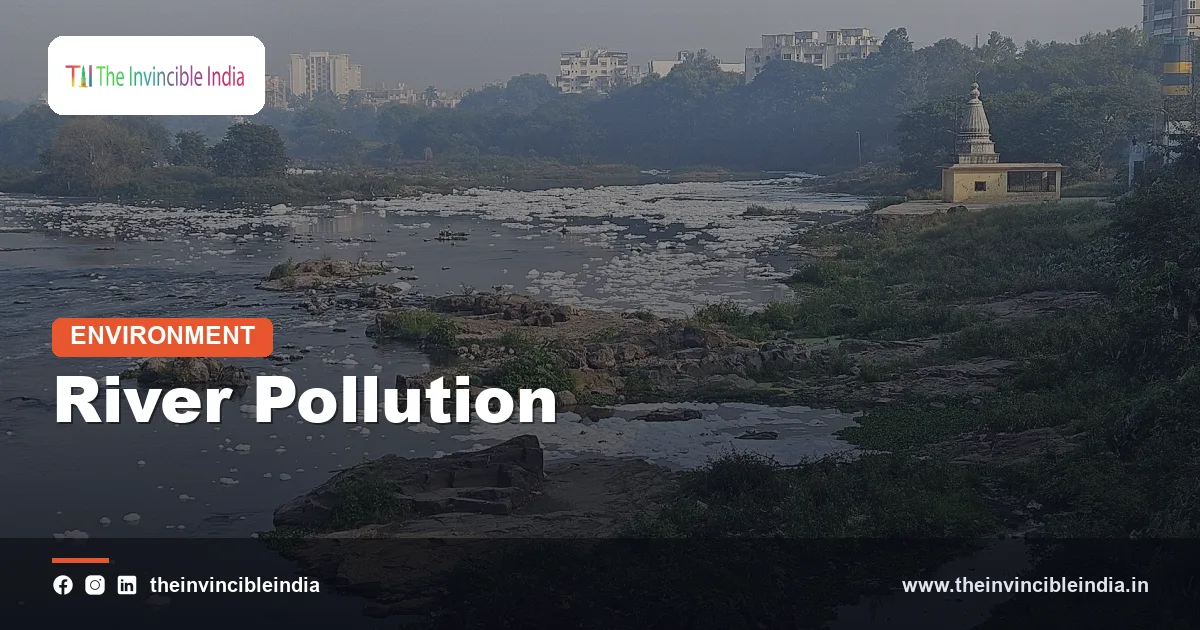
River pollution is the contamination of rivers by untreated sewage, industrial effluent, farm runoff and solid waste, and in India it has left long stretches of rivers such as the Ganga, Yamuna, Sabarmati and Mithi unfit for bathing, let alone drinking. India worships its rivers and depends on them for drinking water, irrigation, fishing and ritual, yet it also uses them as the cheapest drain available for the waste of its towns and factories.
This explainer covers what is polluting India’s rivers, why sewage is the dominant load, how the Central Pollution Control Board (CPCB) measures and ranks river health, what is wrong with the Ganga and the Yamuna, and what Namami Gange and other programmes have achieved so far. It was last reviewed on 2 November 2026.
| Attribute | Detail |
|---|---|
| What it is | Degradation of river water quality by sewage, industrial discharge, agricultural runoff and dumped waste |
| Dominant source | Domestic sewage from towns and cities, a large share of which is untreated |
| Main monitoring body | Central Pollution Control Board (CPCB), with State Pollution Control Boards |
| Key indicators | Biochemical oxygen demand (BOD), dissolved oxygen (DO) and faecal coliform bacteria |
| Polluted stretches | CPCB assessments in recent years have identified over 300 polluted river stretches on nearly 300 rivers |
| Governing law | Water (Prevention and Control of Pollution) Act, 1974 and the Environment (Protection) Act, 1986 |
| Flagship programme | Namami Gange, launched in 2014 for the Ganga and its tributaries |
| Worst-affected areas | Stretches passing through large cities and industrial clusters, especially in Maharashtra, Gujarat, Uttar Pradesh, Delhi and Punjab |
Key Takeaways
- Untreated or partly treated sewage is the single largest source of river pollution in India, because towns and cities generate far more wastewater than they can treat.
- CPCB monitoring has repeatedly found hundreds of polluted river stretches across the country, most of them near big cities and industrial clusters, with Maharashtra among the states with the most.
- Pollution is judged mainly by biochemical oxygen demand (BOD), dissolved oxygen and faecal coliform; a river stretch is classed as polluted when its BOD is above 3 mg/L, the limit for bathing-quality water.
- The Yamuna is most polluted in the short stretch through Delhi, where drains carrying sewage and industrial waste swamp a river that is almost dry upstream.
- Namami Gange and earlier plans have built sewage treatment plants (STPs) and cleaned ghats, but gaps in sewer networks, poor operation of plants and low river flows still limit progress.
- Real recovery depends on treating wastewater at source, leaving enough water in the river, and enforcing effluent norms on industry, not only on building plants.
What Is River Pollution and Why Is It a Problem in India?
River pollution is the addition of harmful substances or heat to a river so that its water can no longer support healthy aquatic life or safe human use. In India it is a particularly serious problem because rivers are the lifeline of the country: they feed irrigation canals, supply drinking water to hundreds of towns, support fisheries and carry deep cultural and religious meaning.
Several features of India’s geography make the problem worse. Most rivers run strongly only during the monsoon, and in the dry months many shrink to a trickle, so there is little water to dilute the waste that enters them. Dams, barrages and canals divert much of the flow for farms and cities, so the river that reaches a large city is often far smaller than the river that left the mountains. A city then returns its wastewater to a diminished stream.
The result is that pollution affects human health, ecosystems and the economy at once. People downstream use polluted water for washing, bathing and sometimes drinking. Fish and river dolphins lose habitat. Farmers who irrigate with contaminated water risk passing pollutants into the food chain, and towns must spend more to treat the water they draw from the river.
What Are the Main Sources of River Pollution in India?
The main sources of river pollution in India are domestic sewage, industrial effluent, agricultural runoff and solid waste, with sewage the largest by volume. These sources are grouped as point sources, which discharge through an identifiable pipe or drain, and non-point sources, which wash in diffusely with rain.
- Domestic sewage: Wastewater from toilets, kitchens and bathrooms enters rivers through open drains, nullahs and sewers. It carries organic matter and disease-causing bacteria.
- Industrial effluent: Tanneries, textile and dyeing units, paper mills, sugar mills, distilleries, chemical plants and electroplating units discharge wastewater that can carry heavy metals, acids, dyes and toxic organic compounds.
- Agricultural runoff: Rain washes fertilisers and pesticides from fields into streams, adding nutrients that trigger algal growth.
- Solid waste: Garbage, plastic, construction debris, animal carcasses and ritual offerings are dumped directly on banks and in the water.
- Religious and cultural activity: Idol immersion, flower offerings, cremation and mass bathing add organic load and, in the case of idols painted with chemical pigments, metals.
- Mining and sand extraction: Riverbed mining muddies the water and destroys habitat, and mine drainage can bring acids and metals.
Which source dominates depends on the river. On the plains of the Ganga and Yamuna, sewage dominates. In industrial belts such as parts of Gujarat, Maharashtra and Punjab, effluent plays a much larger role in the chemical character of the pollution.
Why Is Sewage the Biggest Cause of River Pollution?
Sewage is the biggest cause of river pollution because India’s cities generate vastly more wastewater than they treat, and the rest flows straight into drains that lead to rivers. CPCB surveys of urban sewage have estimated that towns and cities produce on the order of seventy thousand million litres of sewage a day, while installed treatment capacity covers well under half of that, and plants do not always run at their designed standard.
Three gaps explain the shortfall. First, many towns have no sewers at all, so household wastewater flows through open drains or soaks into the ground rather than reaching a treatment plant. Second, where plants exist, they are often under-used because the sewer network that should bring sewage to them is incomplete, or they lose power, or lack trained staff and funds for upkeep. Third, treatment plants that do operate may not meet the discharge standards set for them.
Fast urban growth worsens the gap. Informal settlements, new colonies and peri-urban areas often develop faster than sewers can be laid. Septic tanks, where they exist, are frequently emptied by tankers that dump the sludge into drains or fields. The total organic load entering rivers is therefore far higher than the treatment figures alone suggest.
Sewage matters not only for its volume but for what it contains. It uses up oxygen as bacteria break down organic matter, it carries pathogens that cause diarrhoea, typhoid and hepatitis, and it brings nitrogen and phosphorus that drive algal growth. Even when a river looks clear, high bacterial counts can make it unsafe.
How Is River Water Quality Measured?
River water quality is measured by testing samples for indicators such as biochemical oxygen demand (BOD), dissolved oxygen (DO) and faecal coliform, together with pH, nutrients and toxic substances. The CPCB and State Pollution Control Boards operate a national water quality monitoring network that samples rivers, lakes and groundwater at hundreds of stations.
| Indicator | What it shows | Healthy river | Bathing-water benchmark |
|---|---|---|---|
| Dissolved oxygen (DO) | Oxygen available to fish and other aquatic life | High, usually well above 5 mg/L | 5 mg/L or more |
| Biochemical oxygen demand (BOD) | Oxygen bacteria need to break down organic waste, a measure of organic pollution | Low, around 2 mg/L or less | 3 mg/L or less |
| Faecal coliform | Bacteria from human and animal waste, a signal of sewage contamination | Very low | Desirable 500 MPN per 100 ml; maximum permissible 2,500 MPN per 100 ml |
| pH | Acidity or alkalinity of the water | Near neutral | 6.5 to 8.5 |
BOD is the main yardstick for ranking polluted stretches. Water with a BOD of 3 mg/L or less is regarded as suitable for outdoor bathing, and anything above that marks a stretch as polluted. A higher BOD means more organic waste and less oxygen left for fish. When DO falls near zero, a river becomes effectively dead for most aquatic life and often turns black and foul-smelling.
Faecal coliform counts are measured in most probable number (MPN) per 100 millilitres. They are especially important in India because many people bathe in rivers, and in some pilgrimage towns the count has exceeded the bathing standard by large margins even where BOD looks moderate.
How Many Polluted River Stretches Does India Have?
India has several hundred polluted river stretches, according to CPCB assessments carried out in successive years. A 2018 CPCB report identified 351 polluted stretches on 323 rivers, up from 302 stretches on 275 rivers in an earlier assessment, and a later review reported a somewhat lower number of over 300 stretches as some improved. Exact counts shift from year to year with the data and the methods used.
The CPCB divides polluted stretches into five priority classes according to BOD. Priority I stretches, the worst, have a BOD above 30 mg/L, and each lower priority class has progressively cleaner water, down to Priority V, where BOD is between 3 and 6 mg/L. Rivers in the highest priority classes, such as the Mithi in Mumbai, parts of the Sabarmati in Ahmedabad, the Hindon in western Uttar Pradesh and the Yamuna through Delhi, have been repeatedly reported to have very high BOD.
Maharashtra has consistently had the largest number of polluted stretches of any state, followed by states such as Madhya Pradesh, Bihar, Kerala, Gujarat, Assam, Uttar Pradesh and West Bengal in various reports. The pattern reflects population density and industrial concentration more than anything else. Many stretches lie in the middle and lower reaches, just downstream of large cities, while the Himalayan headwaters are mostly cleaner.
How Polluted Are the Ganga and the Yamuna?
The Ganga is badly polluted in its middle and lower reaches, and the Yamuna is among the most polluted rivers in the country, particularly where it passes through Delhi. Both rivers rise in clean mountain catchments and are degraded mainly by what the plains cities add.
The Ganga
The Ganga is relatively clean in its Himalayan upper course, but the picture changes after it enters the plains. Cities and towns along its banks, including Haridwar, Kanpur, Prayagraj, Varanasi, Patna and Kolkata along the Hooghly, discharge large volumes of sewage, and industrial clusters add effluent. Kanpur’s tanneries, which release chromium-laden wastewater, have long been a focus of concern. Monitoring has found low dissolved oxygen and high faecal coliform at several stations. The Ganga also carries tributaries, such as the Ramganga, Kali and Gomti, that are themselves heavily polluted.
The Yamuna
The Yamuna is distinctive because most of its pollution comes from one short stretch. The river is about 1,370 kilometres long, but the roughly 22 kilometres between Wazirabad and Okhla in Delhi are often said to account for the great majority of its pollution load. Water is diverted at Wazirabad for the city’s supply, leaving very little flow, and then Delhi’s drains, including the Najafgarh drain, pour in sewage and industrial waste. Downstream of Delhi, the river is often largely sewage in the dry season. Toxic foam that periodically covers the surface near Okhla in winter is linked to detergents and phosphates in untreated waste, aggravated by the turbulence at the barrage.
The same story is repeated on smaller rivers. Chennai’s Cooum and Adyar, Hyderabad’s Musi, Pune’s Mula-Mutha and Bengaluru’s Vrishabhavathi are all examples of urban rivers that have become sewage channels.
What Does River Pollution Do to Health and Ecosystems?
River pollution harms health by spreading waterborne disease and exposing people to toxic chemicals, and it harms ecosystems by draining oxygen and poisoning aquatic life. The effects are felt most by people who live beside the river and rely directly on its water.
- Waterborne disease: Contact with or consumption of sewage-contaminated water causes diarrhoea, cholera, typhoid, hepatitis A and other infections, with children most at risk.
- Chemical exposure: Heavy metals such as chromium, lead and mercury, and pesticide residues, can accumulate in fish, sediment and irrigated crops, creating long-term risks.
- Loss of aquatic life: Low oxygen kills fish. Species that need clean, flowing water, such as the Gangetic river dolphin and gharial, lose habitat as pollution and reduced flows combine.
- Eutrophication: Nutrient-rich sewage and runoff fuel algal blooms and invasive water hyacinth, which further drain oxygen.
- Livelihood losses: Fishing communities lose catch, and farmers using polluted irrigation water can see lower crop quality and soil damage.
- Higher water treatment costs: Cities downstream must spend more to make polluted river water fit to drink, and some intakes have to shut down during pollution spikes.
River pollution also interacts with water scarcity. A river with a small flow has less capacity to dilute and break down waste, so the same quantity of sewage does more damage. This is why scientists stress environmental flows, the minimum water a river needs to stay healthy, as part of any cleanup.
What Laws Govern River Pollution in India?
River pollution in India is governed mainly by the Water (Prevention and Control of Pollution) Act, 1974, and the Environment (Protection) Act, 1986. The Water Act created the CPCB and State Pollution Control Boards and made it an offence to discharge polluting matter into streams beyond prescribed standards without consent.
Industries must obtain consent to establish and to operate from the State Pollution Control Board and must treat their wastewater to meet standards. Highly polluting sectors are expected to install effluent treatment plants and, in some cases, to aim for zero liquid discharge. Municipal bodies, too, are bound by norms for treated sewage.
Courts have played a major role. The Supreme Court and the National Green Tribunal (NGT), established in 2010, have issued directions on the Ganga, Yamuna and other rivers, ordered closure of polluting units, imposed environmental compensation and pushed for sewage treatment. The weakness is usually enforcement. Pollution control boards are short of staff and funds, penalties are often small compared with the cost of treatment, and municipalities that are themselves among the biggest polluters are hard to hold to account.
What Has Namami Gange Achieved?
Namami Gange has built and revived a large number of sewage treatment plants, improved ghats and crematoria, and brought a more coordinated approach to the Ganga, but the river is not yet uniformly clean. The programme, launched in 2014 under the National Mission for Clean Ganga (NMCG), has a budget of the order of Rs 20,000 crore and covers sewage infrastructure, industrial pollution, riverfront development, afforestation and public awareness.
It followed earlier efforts, most notably the Ganga Action Plan launched in 1985 and the National Ganga River Basin Authority of 2009. Those earlier plans built treatment plants but suffered from poor maintenance and limited coverage. Namami Gange tried to address this with hybrid annuity and one-city-one-operator models that make private operators responsible for running plants for long periods, along with real-time monitoring of industrial discharges through online sensors.
| Area of work | What is being done | Remaining challenge |
|---|---|---|
| Sewage treatment | New and rehabilitated STPs and sewer networks in Ganga basin towns | Plants under-used where sewers do not connect homes; operation and maintenance |
| Industrial pollution | Inspection of grossly polluting industries, online monitoring, treatment norms | Enforcement, small units outside the net, tanneries |
| Riverfront and ghats | Ghat cleaning, crematoria upgrades, riverfront development | Does not change water quality unless drains are tackled |
| Ecological flow | Notification of minimum flows from barrages and dams | Compliance and monitoring of flows |
| Biodiversity and afforestation | River dolphin conservation, riverside plantation, fish and turtle programmes | Long-term habitat restoration |
Monitoring reports have shown improvement at some locations, especially in the upper stretches, where dissolved oxygen has improved and BOD has fallen. Results are uneven in the plains, where the pollution load is greatest. Independent reviewers have also noted that spending has been faster on construction than on the operation and upkeep that keep plants working.
How Can India Clean Its Rivers?
India can clean its rivers by treating sewage and industrial waste at source, leaving enough water in channels, and making pollution control an enforced local responsibility rather than only a large engineering project. The measures that work best are combined and sustained.
- Close the sewage gap: Build sewers that actually connect to homes, treat all wastewater to prescribed standards, and manage faecal sludge from areas without sewers.
- Reuse treated water: Supply treated wastewater to industry, construction, parks and farms, so that less is dumped in the river and less fresh water is drawn from it.
- Enforce industrial norms: Use continuous online monitoring, heavier penalties and zero liquid discharge in the worst-polluting sectors.
- Protect river flows: Maintain environmental flows so that rivers can dilute and break down what remains.
- Manage solid waste and rituals: Improve garbage collection, ban dumping on banks, and promote eco-friendly idols made of natural clay with non-toxic colours, with immersion in designated artificial tanks.
- Restore floodplains and wetlands: Natural buffers filter runoff and hold water, and protecting them reduces the load reaching the channel.
- Empower local bodies and citizens: Publish real-time water quality data, involve river communities, and hold municipalities accountable.
Experience from rivers abroad, such as the Thames, shows that a polluted river can recover within decades once sewage is treated and industry is regulated. India’s challenge is to do this at a much greater scale and with far less money per person.
Bottom Line
River pollution in India is chiefly a sewage problem, compounded by industrial effluent, reduced flows and solid waste. CPCB data show hundreds of polluted stretches, with the Yamuna through Delhi and several urban rivers among the worst. Namami Gange has added treatment capacity and attention, but the fundamentals of connected sewers, well-run plants, healthy flows and strict enforcement decide whether the rivers truly recover.
Frequently Asked Questions
What is the main cause of river pollution in India?
The main cause of river pollution in India is untreated or inadequately treated domestic sewage from towns and cities. Treatment capacity covers well under half of the wastewater generated, and much of the rest flows into drains that empty into rivers. Industrial effluent, farm runoff and solid waste add to the load.
How does the CPCB decide that a river stretch is polluted?
The CPCB classifies a river stretch as polluted when its biochemical oxygen demand (BOD) is above 3 mg/L, the limit for bathing-quality water. Stretches are then ranked into five priority classes, with Priority I having a BOD above 30 mg/L. Dissolved oxygen and faecal coliform are also checked.
Which part of the Yamuna is the most polluted?
The most polluted part of the Yamuna is the stretch through Delhi, roughly 22 kilometres between Wazirabad and Okhla. This short section is often said to contribute the great majority of the river’s pollution load, because water is diverted for supply and drains then pour sewage and industrial waste into a low flow.
Is the Ganga cleaner after Namami Gange?
The Ganga is cleaner in some locations, particularly in its upper stretches, but it is not uniformly clean. Namami Gange has added sewage treatment capacity, ghat improvements and industrial monitoring. Results in the heavily populated plains are mixed because sewer networks, plant operation and river flows still fall short.
What do BOD and faecal coliform tell us about a river?
BOD measures the oxygen that microbes need to break down organic waste, so a high value signals heavy organic pollution and low oxygen for fish. Faecal coliform counts bacteria from human and animal waste, signalling sewage contamination and disease risk. Bathing-quality water has a BOD of 3 mg/L or less.
Can polluted rivers recover?
Polluted rivers can recover when sewage and industrial waste are treated and enough water is left in the channel. Rivers in other countries, such as the Thames, improved over decades. During the 2020 COVID-19 lockdown, reduced industrial discharge produced clear if temporary improvements in stretches of the Ganga and Yamuna.
{“@context”:”https://schema.org”,”@graph”:[{“@type”:”FAQPage”,”mainEntity”:[{“@type”:”Question”,”name”:”What is the main cause of river pollution in India?”,”acceptedAnswer”:{“@type”:”Answer”,”text”:”The main cause of river pollution in India is untreated or inadequately treated domestic sewage from towns and cities. Treatment capacity covers well under half of the wastewater generated, and much of the rest flows into drains that empty into rivers. Industrial effluent, farm runoff and solid waste add to the load.”}},{“@type”:”Question”,”name”:”How does the CPCB decide that a river stretch is polluted?”,”acceptedAnswer”:{“@type”:”Answer”,”text”:”The CPCB classifies a river stretch as polluted when its biochemical oxygen demand (BOD) is above 3 mg/L, the limit for bathing-quality water. Stretches are then ranked into five priority classes, with Priority I having a BOD above 30 mg/L. Dissolved oxygen and faecal coliform are also checked.”}},{“@type”:”Question”,”name”:”Which part of the Yamuna is the most polluted?”,”acceptedAnswer”:{“@type”:”Answer”,”text”:”The most polluted part of the Yamuna is the stretch through Delhi, roughly 22 kilometres between Wazirabad and Okhla. This short section is often said to contribute the great majority of the river’s pollution load, because water is diverted for supply and drains then pour sewage and industrial waste into a low flow.”}},{“@type”:”Question”,”name”:”Is the Ganga cleaner after Namami Gange?”,”acceptedAnswer”:{“@type”:”Answer”,”text”:”The Ganga is cleaner in some locations, particularly in its upper stretches, but it is not uniformly clean. Namami Gange has added sewage treatment capacity, ghat improvements and industrial monitoring. Results in the heavily populated plains are mixed because sewer networks, plant operation and river flows still fall short.”}},{“@type”:”Question”,”name”:”What do BOD and faecal coliform tell us about a river?”,”acceptedAnswer”:{“@type”:”Answer”,”text”:”BOD measures the oxygen that microbes need to break down organic waste, so a high value signals heavy organic pollution and low oxygen for fish. Faecal coliform counts bacteria from human and animal waste, signalling sewage contamination and disease risk. Bathing-quality water has a BOD of 3 mg/L or less.”}},{“@type”:”Question”,”name”:”Can polluted rivers recover?”,”acceptedAnswer”:{“@type”:”Answer”,”text”:”Polluted rivers can recover when sewage and industrial waste are treated and enough water is left in the channel. Rivers in other countries, such as the Thames, improved over decades. During the 2020 COVID-19 lockdown, reduced industrial discharge produced clear if temporary improvements in stretches of the Ganga and Yamuna.”}}]}]}


