

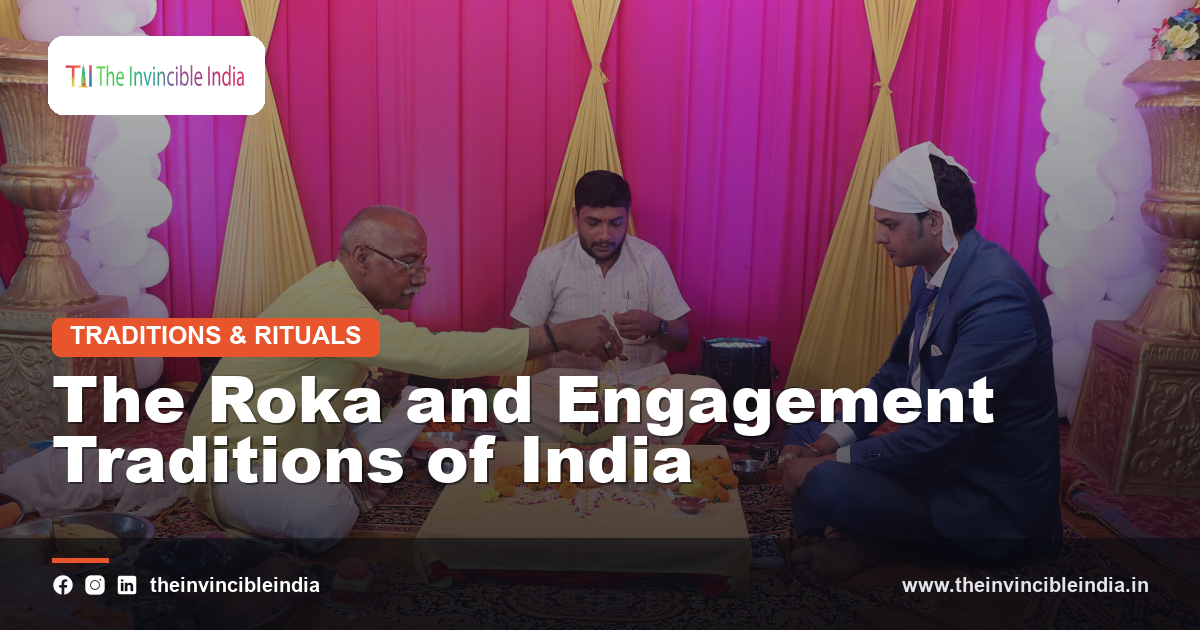
In India, the road to marriage is marked by a series of ceremonies that begin well before the wedding day itself. Among the earliest are the Roka and the engagement, rituals through which two families formally agree to a match and publicly commit to the union. The Roka is often a simple, intimate gathering that signals approval, while the engagement is usually a larger celebration that includes the exchange of rings, gifts and blessings. These traditions form the opening chapters of the wider Indian wedding traditions that unfold across the months that follow. This guide explores their meaning and variety.
Quick Facts
| Detail | Information |
|---|---|
| Roka | A first, informal commitment between two families |
| Engagement | A larger ceremony, often with an exchange of rings |
| Also Known As | Sagai, Mangni, Nischayam and other regional names |
| Common Elements | Blessings, sweets, gifts and family gathering |
| Timing | Usually weeks or months before the wedding |
| Observed By | Communities of many faiths and regions |
Introduction to Pre-Wedding Commitments
Indian marriage customs are known for their richness, and the stages that precede the wedding are an important part of this heritage. Before the main ceremonies begin, families typically hold a gathering at which the match is formally acknowledged. These gatherings vary widely, from small domestic affairs to elaborate celebrations, but they share a common purpose: to mark a decision and to ask for blessings.
The Roka and the engagement represent two stages of this process. The first confirms the families’ consent, and the second publicly celebrates the couple’s commitment. Together they provide a structured and meaningful entry into the marriage journey, and they illustrate the importance that Indian culture attaches to family involvement in the union of two individuals.
What Is the Roka Ceremony
The word Roka means to stop or to hold, and in this context it indicates that the prospective bride and groom are no longer considered available for other proposals. The ceremony is a formal declaration that two families have agreed to proceed with the match, and it usually takes place after the families have met, talked and found common ground.
It is generally a modest event, held at the home of one of the families, with close relatives in attendance. Elders offer blessings, sweets are shared and, in many communities, a small prayer is performed. The Roka thus functions as the first public step in the marriage process, a quiet but significant commitment from both families.
Typical Rituals of the Roka
While practices differ, a typical Roka involves prayers to a family deity, the application of a mark on the forehead of the prospective groom or bride, and the exchange of sweets, dry fruits and gifts. Elders of both families bless the couple, and coconut, fruit and clothing are sometimes presented as part of the exchange.
Often the families of the groom and the bride visit each other’s homes during the ceremony, strengthening the relationship between them. The gifts are modest and symbolic rather than extravagant, and the focus remains on goodwill and acceptance. The Roka’s simplicity is part of its charm, allowing the families to share a warm, informal moment before the more elaborate celebrations begin.
The Engagement Ceremony
The engagement is a more public celebration, usually held a few weeks or months after the Roka and sometimes soon before the wedding. It may be hosted at a home, a hall or a banquet venue, with extended family and friends in attendance. The occasion marks the couple’s formal betrothal.
At its centre is the exchange of rings, a custom that has become widespread across communities, along with gifts and blessings from elders. The engagement offers families an opportunity to introduce relatives to one another and to celebrate the match. It also serves as a social announcement, signalling to the wider community that the couple are preparing for marriage and inviting everyone to share in the joy.
The Exchange of Rings
The exchange of rings is the most recognisable moment of the engagement. The couple place rings on each other’s fingers, often to the sound of applause and the blessings of family members. In India, the ring has been adopted into engagement customs alongside older ritual forms of commitment such as the exchange of gifts and sweets.
The moment has deep personal meaning, as it is often the first public acknowledgement of the couple’s relationship. Photographs, music and celebration usually accompany it, and the ring itself becomes a lasting reminder of the day. Across communities the details may differ, but the gesture has acquired a shared significance as a symbol of commitment.
Names and Customs Across Regions
The pre-wedding commitment ceremony goes by many names across India. In northern regions it is commonly called sagai or Roka, in Gujarat there is a custom involving jaggery and coriander seeds, and in Maharashtra there are ceremonies centred on gifts of sugar. In south Indian traditions, an event of formal agreement is often held with the exchange of betel leaves and fruits.
Bengali families may hold ceremonies of blessing at which the families formally meet, and Punjabi families often exchange gifts and sweets. These diverse names and customs reflect the many cultural strands within India, even as the underlying purpose, a formal and joyful commitment, remains consistent across regions.
Engagement Customs of Different Faiths
Pre-wedding commitments are observed by communities of many faiths in India. Among Sikh families, a ceremony of formal commitment is held, often at the gurdwara or at home, with prayers and the exchange of gifts. Muslim families commonly hold an engagement known as mangni, in which the match is formally announced and gifts are exchanged.
Christian communities mark betrothal in various ways, often with a blessing by a priest or pastor and a gathering of family and friends. These practices differ in rites and language but share a common spirit of seeking blessings and celebrating the couple. The diversity of customs illustrates the pluralism of Indian society, in which every community brings its own character to life’s milestones.
Gifts, Sweets and Symbolic Exchanges
The exchange of gifts is an important feature of many engagement customs. Families may present clothing, jewellery, sweets, dry fruits and decorative items, often wrapped in traditional packaging and arranged on trays. Each item is chosen with care, and the way in which it is presented reflects the respect that one family has for the other.
Sweets, in particular, hold symbolic significance, representing the hope that the relationship will be sweet and auspicious. They are shared among all those present, turning the gift into a communal experience. The exchange is less about material value than about warmth, courtesy and the building of goodwill between two families who are about to become relatives.
Role of Elders and Family Blessings
Family elders occupy an honoured place in the Roka and engagement. Their blessings are regarded as essential, and the couple often touch their feet as a mark of respect. Grandparents, parents and senior relatives offer prayers and good wishes, and their presence gives the ceremony a sense of continuity.
In many families, elders also play a role in the process leading up to the Roka, meeting the other family, discussing the match and building trust. The involvement of the extended family reflects a cultural understanding of marriage as a union of families as well as individuals, and the blessings of elders carry emotional and symbolic weight for the couple.
The Role of Astrology and Auspicious Timing
In many Hindu families, the date and time of the Roka and the engagement are chosen in consultation with a priest or astrologer, who identifies an auspicious moment. Some families also consider the compatibility of the couple’s horoscopes before proceeding with the match.
These practices are not universal and are followed to different degrees by different families. Some adhere to them closely, while others observe them lightly or choose not to follow them at all. The consultation reflects a wish to begin the marriage process in a favourable and harmonious way, and it shows the continuing influence of tradition on the planning of important family events.
Dress, Decoration and Food
The engagement is an occasion for dressing well. Couples and their families often choose traditional clothing, such as sarees, lehengas, sherwanis and kurtas, while some prefer contemporary styles. Venues are decorated with flowers, lights and rangoli patterns, and the stage or seating area is arranged for the ceremony.
Food is an essential part of the celebration, and hosts usually serve a meal or refreshments reflecting their regional cuisine. A well-planned menu is seen as a gesture of hospitality towards guests. The care taken over dress, decoration and food indicates the importance of the occasion as the first major celebration in the marriage journey.
The Couple's Role in Modern Times
In earlier generations, marriages were often arranged largely by families, and the couple had little say in the ceremonies that marked their betrothal. Today, many couples play a leading role in the process, having chosen one another or having had considerable input into the match.
As a result, engagement ceremonies often reflect the couple’s personalities, with personalised themes, music and decor. Many couples combine traditional elements with modern touches, while keeping the core purpose intact. This evolution demonstrates how families and couples negotiate between inherited customs and contemporary values, preserving what remains meaningful while adapting the rest.
From Roka to Wedding Day
The Roka and engagement are the first in a sequence of events that continue until the wedding. After them come the fixing of dates, the sending of invitations, and a range of pre-wedding ceremonies, among them haldi, mehndi and sangeet in many communities. The period between the engagement and the wedding is a time of preparation and anticipation.
During these months, the couple and their families prepare for the main ceremonies, shopping, planning and spending time together. The earlier ceremonies establish the relationship between the families, and this foundation shapes the tone of the later celebrations. The journey from Roka to wedding thus unfolds as a gradual, layered process of commitment and celebration.
Symbolism of Commitment and Community
The Roka and engagement embody several important ideas. They represent commitment, as the families formally pledge to the match, and they represent community, as relatives and friends gather to witness and bless it. The exchange of gifts and sweets symbolises goodwill and the hope for a sweet future.
The public nature of the ceremonies gives the commitment social weight, creating an understanding that the couple have embarked on a shared path. At the same time, the ceremonies are joyful rather than solemn, demonstrating that the beginning of a marriage is a cause for celebration. This combination of seriousness and festivity is characteristic of Indian ritual life.
Roka and Engagement Today
Today, the Roka and engagement remain popular, adapting to modern lifestyles while retaining their essential meaning. Some families combine the two into a single event, while others hold them separately, and the scale of the celebrations ranges from intimate home gatherings to large banquets.
What endures is the sense of family involvement and joyful commitment. Whether simple or elaborate, these ceremonies mark the moment at which two families agree to join together, and they offer a warm, ceremonial beginning to the marriage journey. In their variety and adaptability, the Roka and engagement reveal the lasting vitality of India’s wedding traditions.
Sources & Further Reading
- Ministry of Culture, Government of India (indiaculture.gov.in).
- Anthropological Survey of India (ansi.gov.in).
Frequently Asked Questions
What is a Roka ceremony?
A Roka is a simple ceremony in which two families formally agree to a match. It signals that the prospective bride and groom are committed and is usually held with close relatives, prayers, blessings and sweets.
What is the difference between a Roka and an engagement?
The Roka is typically an early, informal commitment between the families, while the engagement is a larger celebration that often includes an exchange of rings. Some families combine both into one event.
Are engagement customs the same across India?
No, customs vary widely by region, community and faith. Names such as sagai, mangni and nischayam describe similar ceremonies with different rituals, gifts and traditions.
Who attends a Roka?
A Roka is usually attended by immediate family members and close relatives of both sides. The larger group of friends and extended relatives is more often invited to the engagement.
How long before the wedding does the engagement take place?
The timing varies. Some couples hold the engagement a few weeks before the wedding, while others do so months in advance, depending on family preference and auspicious dates.


