

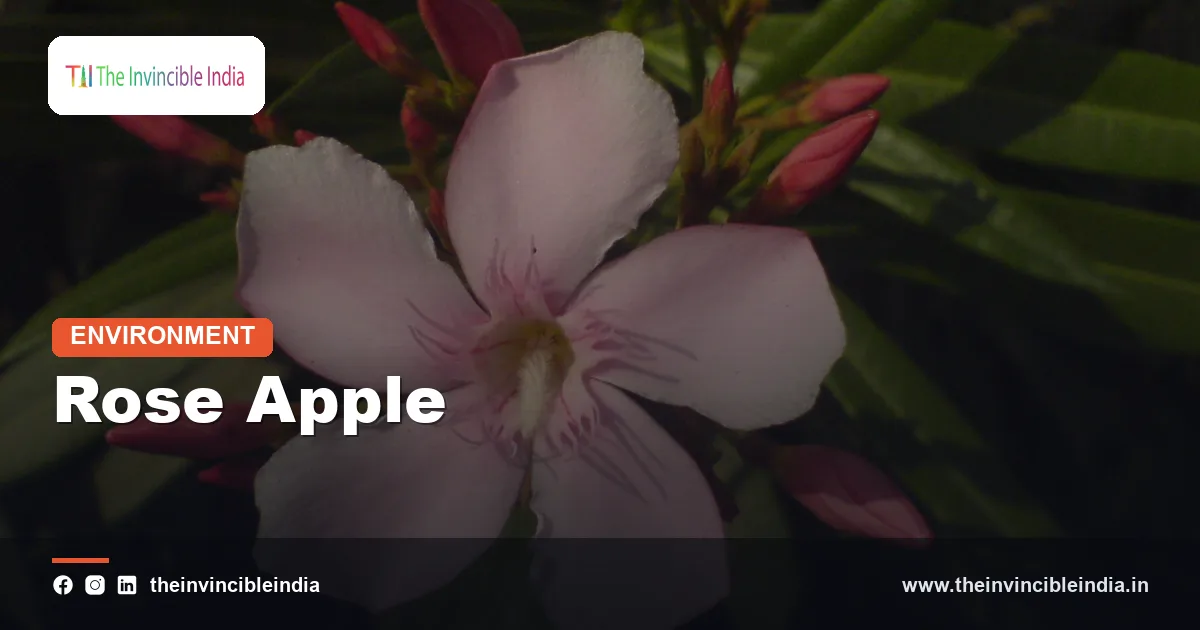
The rose apple (Syzygium jambos) is a bell-shaped, pale yellow-green fruit of an evergreen garden tree in the myrtle family, known for its crisp, watery flesh and a faint scent that resembles rose water. In India the tree is grown mainly as a homestead and roadside fruit tree in humid regions such as Kerala, Karnataka, Bengal, Assam and the north-eastern hills, where it is valued for its shade, its showy flowers and its small seasonal crop.
The rose apple is a minor fruit, which means it is rarely sold in large quantities in city markets, yet it is deeply familiar to people who grow up near old gardens, school compounds and village lanes. This explainer covers what the rose apple is, how it differs from similar-sounding fruits, where it grows, when it ripens, how it is eaten and how the tree is cultivated.
| Quick Fact | Detail |
|---|---|
| Common name | Rose apple, also called jamrul or golap jam in parts of north and east India |
| Scientific name | Syzygium jambos (older name: Eugenia jambos) |
| Plant family | Myrtaceae (the myrtle family, which also includes guava, jamun and clove) |
| Native region | Tropical Southeast Asia and the Malay archipelago, now naturalised across the tropics |
| Where grown in India | Kerala, Karnataka, Tamil Nadu, West Bengal, Assam, other north-eastern states, the Andaman and Nicobar Islands and warm, moist foothills |
| Season | Flowering in the cooler months, with fruit ripening mostly in spring and early summer; timing varies by region |
| Part used | Fresh ripe fruit; flowers, leaves and bark have minor traditional uses |
| Fruit appearance | Round to bell-shaped, 3 to 5 cm long, with a hollow centre holding one to four loose brown seeds |
| Notable fact | The seeds rattle inside the ripe fruit, and the tree bears rounded flowers with long creamy-white stamens |
Key Takeaways
- The rose apple (Syzygium jambos) is a tropical fruit tree of the myrtle family that produces crisp, watery, faintly rose-scented fruit.
- The rose apple fruit has a hollow centre in which one to four brown seeds lie loose and rattle when the ripe fruit is shaken.
- Rose apple trees grow best in warm, humid regions of India such as Kerala, Karnataka, Bengal and the north-east, usually as garden or roadside trees.
- The rose apple is a minor fruit eaten fresh, in fruit salads, stewed or made into preserves, because its flesh is mild, dry-crisp and low in acidity.
- The common name jamrul is applied in some regions to a different tree, the wax apple (Syzygium samarangense), so local names for the rose apple can be confusing.
- The rose apple tree is easy to raise from seed, tolerates wet soils, and also serves as an ornamental and shade tree with showy pompom-like flowers.
What Is the Rose Apple?
The rose apple is the edible fruit of Syzygium jambos, a spreading evergreen tree in the plant family Myrtaceae. The tree is usually between 3 and 10 metres tall, has a dense rounded crown and narrow glossy leaves, and bears fruit that is generally between 3 and 5 centimetres long.
Botanists formerly placed the species in the genus Eugenia, and older books therefore list the rose apple as Eugenia jambos. The modern genus Syzygium is a very large group of tropical trees and shrubs, and includes the Indian blackberry known as jamun (Syzygium cumini), the clove tree (Syzygium aromaticum) and the Malay apple. The rose apple belongs to this wider group, which is why its flowers, with their bunch of long stamens, look similar to those of its relatives.
The name “rose apple” comes from the fragrance. A ripe fruit has a delicate smell that many people compare to rose water, and the flesh carries the same light floral note. The taste is mild and slightly sweet, with very little sourness, which sets the fruit apart from most other Indian garden fruits.
Is the Rose Apple the Same as Jamrul, Water Apple or Wax Apple?
The rose apple is not the same as the wax apple or water apple, although the names overlap in everyday speech. The rose apple is Syzygium jambos, while the wax apple, often called water apple, is Syzygium samarangense, a related tree with pink, red or white bell-shaped fruit that has a waxy skin and no hollow rattling seed cavity.
In several Indian languages the word jamrul, or a similar form, is used for one or both of these fruits. In some places jamrul refers to the wax apple, and the rose apple is described with an extra word such as golap, meaning rose. The word jamun, by contrast, refers to Syzygium cumini, the dark purple fruit of the Indian blackberry tree, which is a different species with an astringent, purple-staining flesh.
A few points help to tell the fruits apart.
- The rose apple has pale cream, greenish-yellow or faintly pink skin, a hollow middle and loose seeds that rattle.
- The wax apple has glossy red, pink or white skin, a spongy juicy flesh and small seeds that are usually embedded, not loose.
- The jamun has small oval fruit that turns deep purple and leaves a stain on the tongue.
- The Malay apple, Syzygium malaccense, has a rounder fruit with deeper pink to crimson skin and a single large seed.
When consulting local fruit sellers or older gardening books, it helps to check the botanical name or look at the seed cavity, because common names in India change from one state to the next.
Where Does the Rose Apple Come From and Where Is It Grown in India?
The rose apple is native to tropical Southeast Asia and the Malay archipelago, and it spread across the tropics through human cultivation. It reached India long ago, was planted in gardens in the humid belts of the south and east, and is now naturalised in many warm and moist areas.
Within India the rose apple is most common in regions with plenty of rainfall and mild winters. Kerala, coastal Karnataka, parts of Tamil Nadu, West Bengal, Assam, Meghalaya and other north-eastern hill districts have well-known rose apple trees, and the tree is also found in the Andaman and Nicobar Islands. In drier states, including Rajasthan and much of the Deccan plateau, the tree needs regular irrigation, so it is seen less often.
The rose apple has no major commercial plantation industry in India. Most trees stand in home gardens, temple grounds, school compounds, old bungalow compounds and along stream banks, and the crop is mostly consumed locally or sold in small lots at village markets. As a result, there are no widely cited national production figures for the fruit, and it is better described as a heritage fruit than a market commodity.
What Does a Rose Apple Tree Look Like?
A rose apple tree is a medium-sized evergreen with a short trunk, spreading branches and long, narrow, lance-shaped leaves that are leathery and glossy. New leaves often appear in pinkish or coppery shades, which makes the tree attractive even without flowers or fruit.
The flowers are the most distinctive part. Each flower is a creamy-white or pale greenish puff, roughly 5 to 10 centimetres across, made mostly of long threadlike stamens, and the flowers appear in small clusters at the tips of branches. They attract bees and other insects, and fallen stamens often carpet the ground below the tree like soft white fluff.
The fruit forms from the flower and ripens over about two months. It is usually rounded or slightly bell-shaped with a small crown of persistent sepals at the top, and its skin changes from green to pale yellow or cream, sometimes with a faint pink blush. When cut, the fruit shows a thin layer of firm flesh around a large hollow chamber, and the seeds inside move freely.
When Is the Rose Apple in Season?
The rose apple fruiting season in India falls mainly in spring and early summer, roughly from March to June depending on region and local climate. Flowering usually happens a couple of months earlier, in the cooler or drier part of the year, and the fruit takes time to mature.
Because India has very different climates, the exact timing is not fixed. Trees in warm southern regions may flower and fruit earlier than those in the foothills, and an occasional tree can produce a smaller second crop. Gardeners therefore watch their own tree rather than depend on a fixed calendar.
The ripe fruit is fragile and does not store long. Once picked it begins to soften and lose its fragrance within a few days, and so it rarely travels beyond local markets. This short shelf life is one reason the fruit has stayed a neighbourhood fruit and has not entered organised retail.
What Does the Rose Apple Taste Like and How Is It Eaten?
The rose apple tastes mildly sweet, watery and crisp, with a floral aroma reminiscent of rose water and almost no sourness. The flesh is thin, firm and slightly dry-crisp, closer to a pear or a crunchy apple than to a juicy mango.
Most people eat the fruit fresh, either whole after discarding the seeds or sliced into pieces. The skin is edible and thin, and the fruit is often washed and eaten straight from the tree. Because the fruit is delicate and bland compared with spicy or tart Indian fruits, it is commonly paired with other flavours.
Common ways to use rose apple
- Eaten fresh as a snack, often with a pinch of salt or chaat masala.
- Sliced into fruit salads and cold desserts, where the crisp texture and rose scent stand out.
- Stewed with sugar to make a light compote or syrup.
- Cooked into jams, jellies and preserves, usually with added lemon juice to supply acidity.
- Candied or used in drinks, where the floral aroma carries into the liquid.
The hollow centre means there is less edible pulp than the size suggests, and a handful of fruit gives only a light snack. The seeds are not eaten.
What Nutrients Does the Rose Apple Contain?
The rose apple is mostly water, with a small amount of carbohydrate, a little dietary fibre and modest quantities of vitamins and minerals. Water makes up the large majority of the fruit’s weight, and the flesh is low in calories compared with sweet tropical fruits such as mango or banana.
Published food composition tables report small amounts of vitamin C, vitamin A precursors, and minerals such as potassium and calcium, but the quantities vary by variety, ripeness and growing conditions. For that reason it is more accurate to describe the rose apple as a light, hydrating fruit than as a rich source of any single nutrient.
The rose apple is not a medicine, and eating it is not a substitute for medical treatment. People who follow a specific diet for diabetes, kidney disease or another condition should treat the fruit like any other fruit and consult a qualified doctor or dietitian about portion sizes.
How Is the Rose Apple Grown?
The rose apple is grown from seed or by vegetative methods such as air layering, and it thrives in warm, humid conditions with deep, moist soil. It tolerates a wide range of soils, including heavy and seasonally wet ones, and it is one of the few fruit trees that can handle waterlogged ground near streams and ponds.
Climate and soil
The rose apple prefers tropical and subtropical conditions with steady warmth and reliable moisture. Cold frost damages young trees, so the species is best suited to areas with mild winters. A site with full sun and room for a broad crown suits it well.
Propagation
The seeds germinate readily when fresh, and a seedling can fruit in about four to six years. Trees raised from seed vary in fruit size and quality, which is why growers who want uniform fruit prefer air layering or grafting from a chosen parent. Seeds lose viability quickly and are best sown soon after extraction.
Care and yield
- Regular watering during dry spells improves fruit set and size.
- Light pruning after harvest keeps the crown open and makes picking easier.
- Mulch around the base helps to hold moisture, and compost improves growth.
- Fruit flies and birds can damage ripening fruit, so some growers bag the fruit or harvest slightly early.
Because the rose apple needs little attention once established, it suits home gardens and community plantings more than intensive orchards.
What Traditional Uses Does the Rose Apple Tree Have?
Beyond its fruit, the rose apple tree has traditional uses as a shade tree, a windbreak, a source of timber and a plant in folk herbal practice. The wood is hard and reddish and has been used for small tools and fuel, while the dense foliage gives good shade.
In several tropical countries, the leaves, bark and seeds of the rose apple have been used in folk remedies, and laboratory studies have examined its extracts. These traditional uses are not established medical treatments, and no claim of cure should be drawn from them. Ayurvedic and local herbal references mention the plant, but modern evidence for specific health effects remains limited.
The tree also has ecological value. Its flowers feed bees and other pollinators, its fruit feeds birds and bats, and its roots help to hold soil along stream banks. In some regions the rose apple has spread so well that it grows wild, and conservation guides in a few countries list it as an invasive species. In India it is generally regarded as a harmless naturalised garden tree.
How Does the Rose Apple Compare With Related Syzygium Fruits?
The rose apple differs from its Syzygium relatives in size, skin colour, seed type and taste. The table below summarises the main differences between four well-known fruits of the genus that are found in India.
| Fruit | Scientific name | Appearance | Taste and texture |
|---|---|---|---|
| Rose apple | Syzygium jambos | Pale yellow-green, bell-shaped, hollow centre with loose seeds | Mild, crisp, watery, rose-scented |
| Wax apple (water apple) | Syzygium samarangense | Glossy pink, red or white, bell-shaped | Juicy, spongy, lightly sweet |
| Jamun (Indian blackberry) | Syzygium cumini | Small oval purple-black berry | Sweet-sour, astringent, stains tongue |
| Malay apple | Syzygium malaccense | Rounded, pink to crimson skin, one large seed | Soft, sweet and mildly aromatic |
All four trees share the Syzygium flower pattern of many long stamens, but only the rose apple has the distinctive rattling seed cavity and rose-water scent.
Why Does the Rose Apple Matter?
The rose apple matters because it preserves agricultural diversity, supports pollinators and gives households a low-maintenance seasonal fruit. Minor fruits such as the rose apple, karonda, bilimbi and chironji reflect the wide range of tree crops that Indian gardens and forests have long supported, even though they receive little attention from large markets.
Keeping such trees in home gardens also carries cultural value. Many people remember the rose apple as a school-time fruit, picked from low branches or collected from the ground after a windy day. As old compounds give way to buildings, planting a few rose apple trees in new gardens and parks is a simple way to keep this fruit available.
Bottom Line
The rose apple is a gentle, fragrant, water-rich fruit from an easy-to-grow tropical tree, best known in the humid south and east of India. It is not a commercial staple, but it remains a pleasant seasonal fruit, a handsome garden tree and a useful food source for birds, bees and people.
Frequently Asked Questions
What is a rose apple?
A rose apple is the bell-shaped, pale yellow-green fruit of the evergreen tree Syzygium jambos, which belongs to the myrtle family. It has crisp, watery flesh with a faint rose-water scent and a hollow centre holding loose seeds.
Is jamrul the same as rose apple?
Not always, because the name jamrul is used differently across India. In some regions jamrul means the rose apple, while in others it means the wax apple (Syzygium samarangense), so the botanical name is the safest way to tell them apart.
When is rose apple in season in India?
Rose apple is mainly in season from spring to early summer, roughly March to June. The exact period depends on local climate, and the fruit is usually available only for a few weeks near the tree.
What does rose apple taste like?
Rose apple tastes mildly sweet and watery, with a crisp texture and a light floral aroma like rose water. The flesh has very little sourness and is thin around a hollow centre.
Can rose apple be grown at home?
Yes, the rose apple can be grown at home in warm, humid regions, either from fresh seed or from an air-layered sapling. The tree needs sun, room to spread and regular watering in dry spells, and it can start fruiting in about four to six years from seed.
Are rose apple seeds edible?
Rose apple seeds are not normally eaten, because they are hard and make up no useful part of the fruit. The seeds are discarded or planted, and they germinate best when sown fresh.
{“@context”:”https://schema.org”,”@graph”:[{“@type”:”FAQPage”,”mainEntity”:[{“@type”:”Question”,”name”:”What is a rose apple?”,”acceptedAnswer”:{“@type”:”Answer”,”text”:”A rose apple is the bell-shaped, pale yellow-green fruit of the evergreen tree Syzygium jambos, which belongs to the myrtle family. It has crisp, watery flesh with a faint rose-water scent and a hollow centre holding loose seeds.”}},{“@type”:”Question”,”name”:”Is jamrul the same as rose apple?”,”acceptedAnswer”:{“@type”:”Answer”,”text”:”Not always, because the name jamrul is used differently across India. In some regions jamrul means the rose apple, while in others it means the wax apple (Syzygium samarangense), so the botanical name is the safest way to tell them apart.”}},{“@type”:”Question”,”name”:”When is rose apple in season in India?”,”acceptedAnswer”:{“@type”:”Answer”,”text”:”Rose apple is mainly in season from spring to early summer, roughly March to June. The exact period depends on local climate, and the fruit is usually available only for a few weeks near the tree.”}},{“@type”:”Question”,”name”:”What does rose apple taste like?”,”acceptedAnswer”:{“@type”:”Answer”,”text”:”Rose apple tastes mildly sweet and watery, with a crisp texture and a light floral aroma like rose water. The flesh has very little sourness and is thin around a hollow centre.”}},{“@type”:”Question”,”name”:”Can rose apple be grown at home?”,”acceptedAnswer”:{“@type”:”Answer”,”text”:”Yes, the rose apple can be grown at home in warm, humid regions, either from fresh seed or from an air-layered sapling. The tree needs sun, room to spread and regular watering in dry spells, and it can start fruiting in about four to six years from seed.”}},{“@type”:”Question”,”name”:”Are rose apple seeds edible?”,”acceptedAnswer”:{“@type”:”Answer”,”text”:”Rose apple seeds are not normally eaten, because they are hard and make up no useful part of the fruit. The seeds are discarded or planted, and they germinate best when sown fresh.”}}]}]}


